AI That Decides Who Waits: Setting the Rules for AI Queue Prioritization

Picture two patients in the same emergency department CT queue on a busy afternoon:
- A young woman with abdominal pain and nausea. She turns out to have a closed-loop small-bowel obstruction, a surgical emergency.
- A young man with neck pain two days after a car accident. He is ordered a CT angiogram to rule out vascular injury, and his scan will come back clean.
In a recent Stanford simulation study, an AI system reordered that queue. Compared with the standard first-come, first-served approach:
- The woman with the bowel obstruction was scanned about an hour sooner.
- The man with the clean scan waited 84 minutes longer.
The researchers described that delay as appropriate deprioritization of a nonurgent study, and on the evidence, it probably was.
But somebody decided it was acceptable. Every time a queue is reordered, someone waits longer so someone else waits less. AI does not remove that decision. It makes the decision faster, more often, and less visible. That is why I think the real question about AI queue prioritization isn’t whether it works, but who sets the rules.
Prioritization is moving before the scan
Most AI triage in radiology acts after images are acquired. Stroke, intracranial hemorrhage, and pulmonary embolism tools analyze a finished study and move suspected critical cases to the top of the radiologist’s reading worklist. We have described this in our guide to how AI triage reorders the reading worklist.
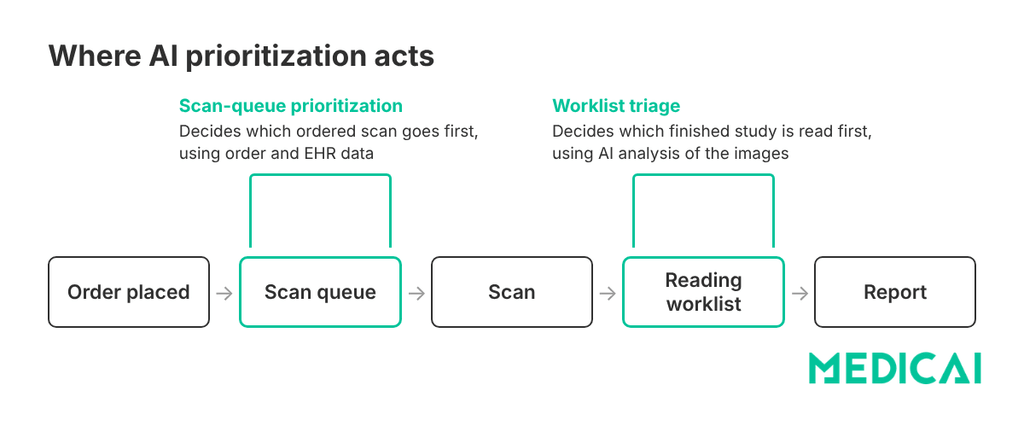
A newer approach moves the decision earlier, to the queue of ordered scans waiting for the scanner. Instead of analyzing images, the model uses information available at the moment the order is placed. In the Stanford study, the most useful signals were:
- Strongest: vital-sign trends, the documented reason for the visit, and the requested study type
- Next: vital signs, demographics, and chief complaint
The model predicts how likely each scan is to show a clinically actionable finding. The system then looks at the next 35 studies in the queue and scans the one most likely to show such a finding first.
This matters because the scanner queue is often the hidden bottleneck in emergency care. The approach requires no new hardware or staff, only data the hospital already collects. A separate two-site simulation, published in Academic Radiology in 2026, reached a similar conclusion: prioritizing CT acquisition with machine learning at triage improved access to the scanner across a range of congestion levels.
What the study found, including who paid for it
The Stanford team, publishing in Radiology: Artificial Intelligence, worked in three steps:
- They trained their model on data from 313,966 emergency department visits at a single academic emergency department and level I trauma center.
- They built a simulation of the department’s CT workflow, calibrated against real operations.
- They compared AI-based ordering with first-in, first-out on more than 20,000 scans.
The gains for urgent studies were real. For scans with actionable findings:
- The median wait fell by about 11 minutes.
- The longest waits (90th percentile) fell by about 43 minutes.
- The share of actionable findings obtained within an hour rose from 48% to 57%.
- The model captured 80% to 87% of the benefit that perfect predictions could have delivered.
The cost was real too, and the authors reported it. For scans without actionable findings, the median wait actually fell slightly, but the longest waits grew by about 14 minutes. That is the arithmetic of any priority queue: the tail of the line gets longer for someone.
The authors concluded that the approach reduces time to diagnosis for critical findings with minimal disruption to lower-acuity patients, and that is a fair reading of their numbers. Two cautions still apply:
- This was a simulation at one academic center, not a live deployment. Simulations rank below prospective studies in the hierarchy of evidence, as we explain in our guide to judging AI vendor evidence.
- “Minimal” and “appropriate” are judgments. They may be the right judgments, but someone has to make them deliberately.
Why this is a governance question, not a technical one
The commentary that accompanied the study made the point directly: because these systems redistribute waiting time among patients, radiologists must actively define their objectives, safeguards, and acceptable trade-offs. I agree, and I would go further. The decision belongs to the department, written down in advance, not to whatever the default settings happen to be.
Three details from the research show why.
First, what counts as urgent was itself an AI judgment. In the Stanford study, the “actionable” labels used to train and evaluate the model came from a previously validated GPT-4-based classifier that read finalized radiology reports. That is a reasonable research method, but it means another model shaped the definition of urgency before the prioritization model ever ran.
Second, misses compound in a priority queue. An earlier simulation study of AI worklist prioritization for chest X-rays found that without a maximum waiting time, the AI’s false negatives could greatly increase how long critical findings waited. A study the AI wrongly scores as low priority does not just wait its normal turn. It keeps getting passed.
Third, the people affected are not in the room. The patient whose scan is deprioritized does not know it happened, and often neither does the ordering clinician. If a delay ever matters clinically, the department will need to explain the rule that caused it.
A queue charter: five rules to set before AI reorders anything
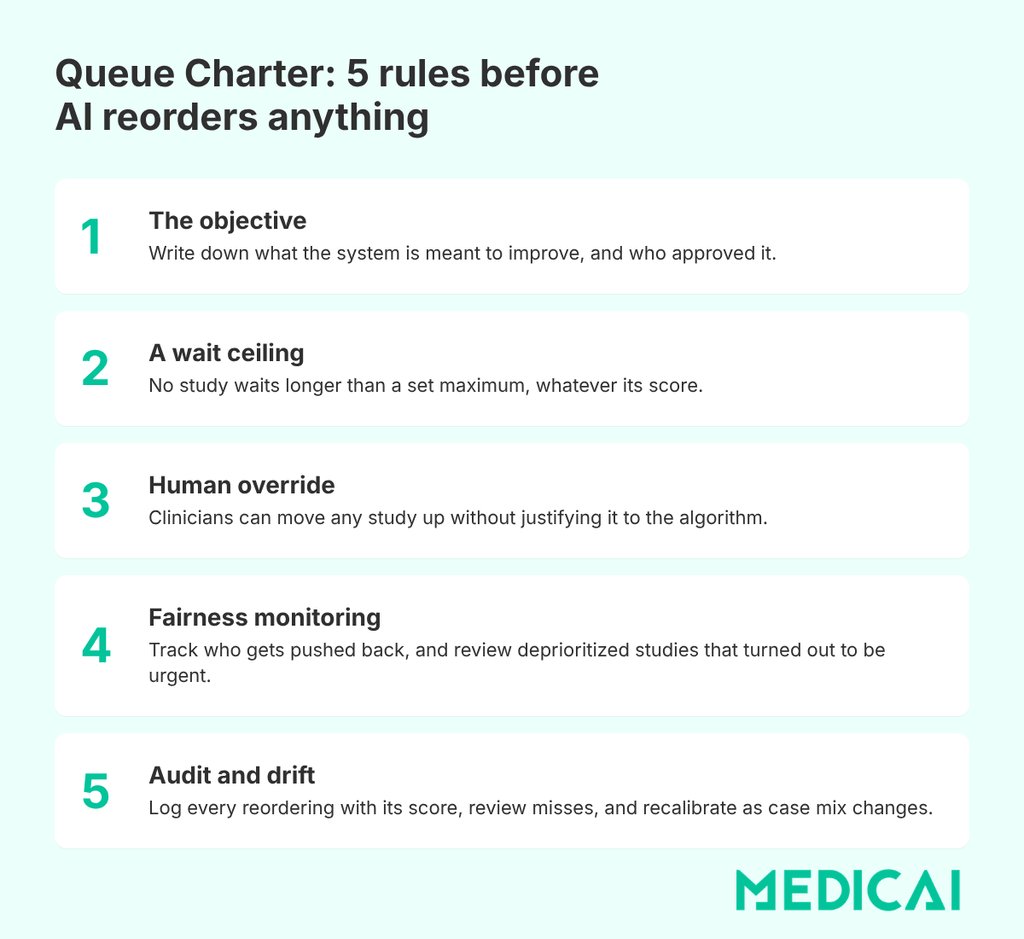
None of this argues against AI prioritization. It argues for writing the rules down first. Before any AI system reorders a scan queue or a reading worklist, a department should agree on a short queue charter covering five points.
1. The objective. State what the system is optimizing, such as time to scan for actionable findings or for specific time-critical pathways, and record who approved that objective. If no one can say what the system is for, no one can say whether it is working.
2. A wait ceiling. Set a maximum wait that no study can exceed, whatever its score. This is the single most important safeguard, because it caps the damage from any study the AI wrongly pushes back.
3. Human override. Keep clinician urgency flags and emergency severity levels in force, and let technologists and radiologists move a study up without justifying it to the algorithm. AI should add information to the queue, not lock it.
4. Fairness monitoring. Track who is being pushed back. Review deprioritized studies that turned out to be actionable, and check whether delays fall unevenly on any patient group. The Stanford study did not analyze subgroups, so every department will need to monitor this for itself.
5. Audit and drift. Log every reordering decision with the score behind it, review misses regularly, and recalibrate as volumes, case mix, and ordering habits change. A model tuned to last year’s emergency department may not fit this year’s.
Download the one-page Queue Charter template (PDF) to fill in with your department before any AI system goes live.
What it takes from the infrastructure
A queue charter is only as good as the systems that enforce it. Each rule depends on the infrastructure underneath:
- Order-time prediction depends on order and clinical data reaching the queue in real time. That usually means HL7 order messages flowing cleanly from the EHR to the RIS, as described in our guide to how PACS and RIS work together.
- A wait ceiling needs a worklist that tracks elapsed time and escalates automatically.
- Audit needs every score and every reordering decision recorded alongside the study, so a department can reconstruct why a scan waited when it did.
This is the layer Medicai works on: where orders, studies, worklists, and AI results meet. Whatever tool makes the prediction, ask three questions of the system underneath it: can the worklist enforce a maximum wait, does it log every reordering with the score behind it, and can you export that log for review?
Where I land
AI should reorder imaging queues. The Stanford results suggest it can get the sickest patients scanned faster using data hospitals already have, and the potential benefit is too large to ignore. But no department should switch it on without a written charter: a clear objective, a ceiling on waiting, human override, monitoring of who is delayed, and a full audit trail.
The question is not whether AI decides who waits. In a busy emergency department, something always decides. The question is whether those decisions follow rules that people chose, can see, and can change.
Frequently asked questions
AI queue prioritization uses a model to reorder imaging work by predicted urgency instead of strictly by arrival time. It can act on the reading worklist after images are acquired, which is common today, or on the queue of ordered scans before acquisition, an approach now being tested in emergency departments.
It can. Moving some studies forward moves others back. In a 2026 Stanford simulation, AI ordering cut the longest waits for actionable CT scans by about 43 minutes, while the longest waits for scans without actionable findings grew by about 14 minutes. That is why departments should set a maximum wait that no study can exceed.
Worklist triage reorders studies after acquisition, using AI analysis of the images so the radiologist reads suspected critical cases first. Scan-queue prioritization happens earlier, deciding which ordered study is scanned first, using information available at the time of the order such as vital signs, reason for visit, and requested study type.
The department that uses it, led by radiologists, together with emergency physicians and operations staff, should set the rules before the system goes live. The rules should define what the system optimizes, maximum wait times, how humans can override it, how delays are monitored across patients, and how decisions are audited.
Sources
- Silva E, Tang K, Chiacchia S, Zhang X, Langlotz C, Kim D. Simulation of AI-driven CT Queue Prioritization in the Emergency Department. Radiol Artif Intell. 2026;8(5):e260110. doi:10.1148/ryai.260110
- Pfeiffer D, Thalhammer JB. Who’s on First? Prioritizing Radiology Examinations in the Emergency Department (Commentary). Radiol Artif Intell. 2026;8(5):e260778. doi:10.1148/ryai.260778
- Triage-Time Machine Learning for Computed Tomography Acquisition Prioritization in the Emergency Department. Acad Radiol. 2026. doi:10.1016/j.acra.2026.08.017
- Baltruschat I, Steinmeister L, Nickisch H, et al. Smart chest X-ray worklist prioritization using artificial intelligence: a clinical workflow simulation. Eur Radiol. 2021;31(6):3837-3845. doi:10.1007/s00330-020-07480-7

Related Articles

Lets get in touch!
Learn more about how Medicai can help you strengthen your practice and improve your patients’ experience. Ready to start your Journey?
Book A Free Demo