How Digital Healthcare Technologies Are Transforming the Patient Experience

Healthcare changes slowly for defensible reasons. Regulatory requirements, patient safety standards, and the complexity of clinical workflows all apply friction. Digital technologies have compressed that timeline, and the effects now show up in patient outcomes.
AI-assisted imaging runs inside major hospital systems today. 82% of healthcare organizations report moderate or high ROI from AI adoption in 2025. Cloud platforms manage imaging data for health systems serving millions of patients.
What follows covers where those tools have changed care delivery, and what separates the deployments that work from the ones sitting idle.
AI in Diagnostics
Radiologists review hundreds of images per shift. At that volume, fatigue becomes a clinical risk.
AI tools flag anomalies, prioritize urgent cases, and handle routine screening at speeds no human matches. Radiologist judgment still governs the read.
A study in The Lancet Digital Health found AI-assisted mammography screening performed comparably to two-radiologist review in detecting breast cancer, with a 44.2% reduction in radiologist workload. Patients get faster results and fewer missed findings.
The same pattern holds outside imaging. Predictive models identify patients heading toward deterioration before symptoms escalate. ICUs running AI-powered monitoring analyze vitals continuously and flag early sepsis indicators, with mortality reductions documented across clinical trials.
Integration decides whether any of this helps. A tool your clinicians reach through a separate login, with manual data entry on both ends, adds work to a shift already short on time. Before you evaluate accuracy claims, ask the vendor how the output lands in your existing worklist.
Telemedicine and Access to Care
Seeing a specialist used to mean weeks of waiting, a day off work, and a drive. Video consultations removed most of that friction.
Adoption held steady well above pre-2020 levels across most specialties, which points to a permanent shift.
The access gains are concrete:
- Mental health services reach patients who had no realistic path to consistent care before
- Dermatology by photo submission cut wait times from months to days in some systems
- Connected glucose meters, cardiac monitors, and pulse oximeters feed data to care teams between visits, which prevents hospitalizations that would otherwise happen
Infrastructure determines whether any of it delivers. Secure video, integrated EHR access, and reliable broadband on the patient side all have to function together. When they do, the clinical evidence supports continued investment.
Medical Imaging Infrastructure
PACS (Picture Archiving and Communication Systems) replaced physical film with digital storage and retrieval. DICOM (Digital Imaging and Communications in Medicine) is the standard format keeping images readable across vendors and systems.
Together they let a radiologist at one facility read a scan taken at another, or a specialist pull a patient’s full imaging history in seconds.
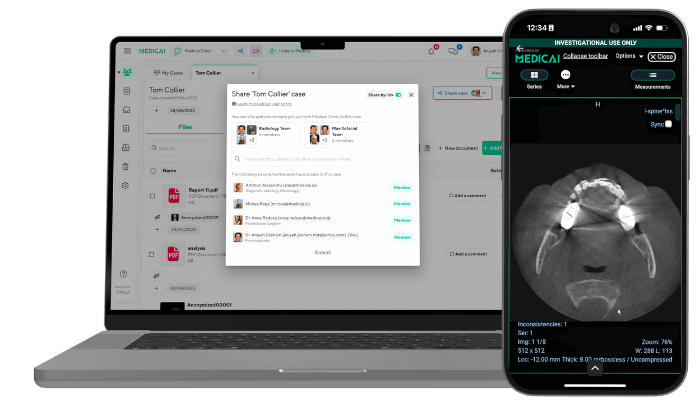
Cloud-based PACS extends the reach. Storage scales on demand. Images open from any authorized endpoint. A trauma surgeon reviewing an incoming transfer pulls imaging taken at the originating hospital without waiting for a disc or a manual upload.
Local storage on workstations and personal devices creates hard limits as study sizes grow. Anyone managing storage on a MacBook or similar hardware in a remote or hybrid clinical setup knows how fast a few multiphase CTs fill a drive. Enterprise cloud imaging moves that burden off individual machines and onto centralized infrastructure, where your IT team controls access, retention, and backup at scale.
Patient Comfort in Imaging
Technical progress in imaging has run alongside progress in what the procedure feels like.
Digital X-rays expose patients to a fraction of the radiation film required. Intraoral scanners replaced physical impressions across many dental applications. For patients with a strong gag reflex, gag-free imaging made oral imaging tolerable for people who had been avoiding it entirely.
Treat compliance as a clinical variable. Discomfort has driven avoidance of necessary diagnostic procedures for decades, which delays diagnosis and worsens outcomes.
CT and MRI protocols evolved on the same logic. Shorter scan times cut how long a patient holds still. Pediatric protocols prioritize lower doses and faster acquisition because children tolerate long scans poorly. Clinical feedback about completion barriers drove those changes.
Interoperability
A digital health system is worth what it can share. Imaging sitting in an isolated PACS with no link to the patient’s primary care EHR produces no clinical benefit.
Health Information Exchange networks connect hospitals, clinics, labs, and pharmacies so data follows the patient. In the United States, the 21st Century Cures Act requires organizations to support data sharing and prohibits information blocking. The European Health Data Space initiative is building parallel standards across the EU.
For patients, that translates into:
- Fewer repeated tests after a provider change
- Faster onboarding with a new specialist
- Care teams working from a full clinical history, not the portion a patient remembers to mention in a fifteen-minute appointment
FHIR (Fast Healthcare Interoperability Resources) is becoming the dominant framework for health data exchange, with commitments from every major EHR vendor. Adoption stays uneven across smaller and rural systems. Regulatory pressure and vendor standardization keep pushing the timeline forward.
Implementation Determines Whether Patients Benefit
Technology is rarely the limiting factor in digital health transformation. Deployment decisions, workforce training, and infrastructure investment decide whether patients see anything change.
A cloud imaging platform bolted onto clinical workflows without integration creates friction your staff routes around. AI trained on non-representative datasets performs worse for specific patient demographics, and you will not catch that without auditing performance by subgroup. Telehealth access depends on broadband, which remains unequal across income levels and geography.
Pick two or three measures before the next purchase and track them after go-live. Turnaround time from scan to signed report. Retrieval time for an outside study. No-show rate by modality. Those numbers tell you within a quarter whether an investment reached patients or stopped at the IT department.

Related Articles



Lets get in touch!
Learn more about how Medicai can help you strengthen your practice and improve your patients’ experience. Ready to start your Journey?
Book A Free Demo