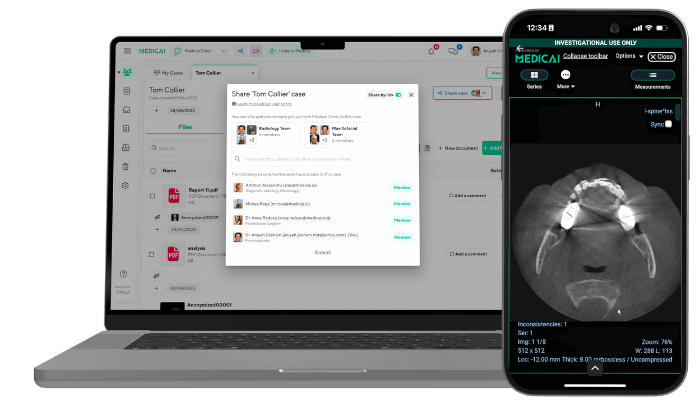
Cómo la IA está dando forma a la próxima era de la imagenología médica
¿Y si una simple exploración pudiera detectar enfermedades antes de que los síntomas aparecieran o guiar las manos de un cirujano con precisión durante un procedimiento que salva vidas?
Esto no es solo un sueño futurista, es el poder y el futuro de la IA en la imagen médica hoy.
La IA en la imagen médica ayuda a los médicos a diagnosticar pacientes, agilizar los flujos de trabajo y apoyar la atención personalizada. Al analizar los datos de imagen, detecta enfermedades de manera temprana y ofrece orientación quirúrgica en tiempo real, lo que mejora los resultados de los pacientes.
Exploremos el papel transformador de la IA en la imagen médica, sus aplicaciones, desafíos y su impacto en la medicina personalizada y la atención de precisión.
Papel actual de la IA en la imagen médica
Las herramientas de IA son ahora esenciales en la imagen médica. Nuestro Copilotos de Radiología con IA ayudan a mejorar la precisión de los diagnósticos, hacen los flujos de trabajo más eficientes y mejoran la calidad de las imágenes.
Exploremos cómo se está utilizando actualmente la IA en la imagen médica.
Precisión Diagnóstica
La IA es increíble porque mejora la capacidad de los médicos para leer imágenes médicas con precisión. Las herramientas de aprendizaje profundo, como Redes Neuronales Convolucionales (CNNs), pueden analizar imágenes con precisión. Estas herramientas a menudo encuentran detalles demasiado pequeños para que el ojo humano los vea.
Por ejemplo, los sistemas de IA ahora son expertos en identificar signos tempranos de enfermedades como el cáncer de pulmón al analizar tomografías computarizadas. Señalan nódulos sospechosos que pueden pasar desapercibidos en un entorno clínico ocupado.
De manera similar, la IA mejora la mamografía al resaltar áreas de preocupación, lo que lleva a menos falsos negativos y a una mejor detección temprana. Es especialmente útil para condiciones complejas como el Alzheimer, donde analiza cambios sutiles en escaneos del cerebro para una intervención temprana.
Al integrar redes neuronales avanzadas, estos sistemas proporcionan a los radiólogos un segundo par de «ojos», asegurando que no se pasan por alto detalles.
Optimización del Flujo de Trabajo
La IA está revolucionando los flujos de trabajo de la imagen médica automatizando tareas rutinarias y que consumen mucho tiempo. Los algoritmos de IA pueden segmentar rápidamente estructuras anatómicas, como resaltar tumores en una imagen de resonancia magnética.
Ayuda a los radiólogos a centrarse en casos complejos que requieren su experiencia y ahorra horas de esfuerzo manual.
Otra contribución significativa es la capacidad de la IA para priorizar casos según su urgencia.
Imagine un departamento de emergencias subiendo docenas de estudios de imagen simultáneamente. Un sistema de IA analiza rápidamente estudios médicos para encontrar casos serios, como hemorrágeas cerebrales o accidentes cerebrovasculares, y los prioriza para el radiólogo.
Plataformas como Medicai integran características de priorización de IA para mejorar la atención de emergencia y salvar vidas.
Mejora de las Técnicas de Imagen
La IA también está avanzando en las técnicas de imagen. Garantiza que las imágenes médicas sean más detalladas y seguras para los pacientes. La reducción de ruido en imágenes de baja dosis es un ejemplo principal.
Reducir la exposición a la radiación en procedimientos como tomografías computarizadas tradicionalmente ha llevado a una menor calidad de imagen. La IA ahora cubre esta brecha utilizando algoritmos avanzados para limpiar imágenes ruidosas, produciendo visuales de alta calidad mientras minimiza el riesgo para el paciente.
La resolución mejorada es otra área donde la IA brilla. La IA aplica técnicas de super-resolución para reconstruir imágenes más nítidas a partir de escaneos de menor calidad, ayudando a los radiólogos a ver detalles más finos.
La mejora es particularmente impactante en áreas como la oncología, donde la imagen precisa es crucial para evaluar los límites del tumor.
Futuro de la IA en la Imagen Médica
Los avances tecnológicos están dando forma al futuro de la IA en la imagen médica. Innovaciones como el aprendizaje profundo y las integraciones en tiempo real hacen que la atención médica sea más precisa y centrada en el paciente.
Conozcamos más sobre cómo la IA puede cambiar la imagen médica.
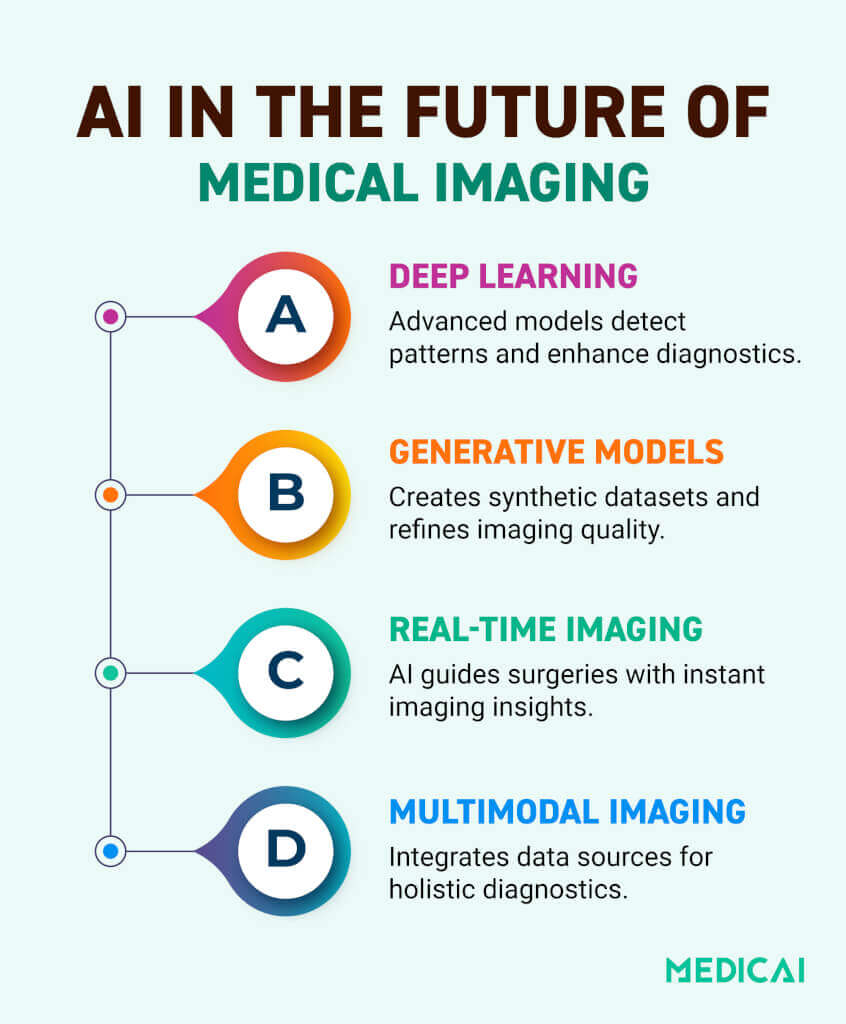
Aprendizaje Profundo y Transformación de la Visión
Los modelos de aprendizaje profundo, especialmente las Redes Neuronales Convolucionales (CNNs), juegan un papel crucial en la IA para la imagen médica. Sin embargo, Transformadores de Visión (ViTs) están trayendo nuevos avances al campo.
A diferencia de las CNNs, que se centran en los patrones locales de imagen, los Transformadores de Visión analizan imágenes completas de manera global. Están mostrando promesas en el análisis de datos de imágenes de alta dimensión, como las resonancias magnéticas 3D, donde identifican detalles intrincados con una precisión sin igual.
Estos modelos son excelentes para encontrar múltiples problemas en un solo escaneo y notar pequeñas diferencias en diferentes conjuntos de datos. Aprenden del contexto, lo que les ayuda a desempeñarse mejor que los métodos tradicionales en la detección de tumores y el seguimiento de la progresión de la enfermedad.
Modelos Generativos (GANs)
Las Redes Generativas Antagónicas (GANs) están cambiando cómo la inteligencia artificial aprende y utiliza la imagen médica. Una forma significativa en que lo hacen es creando conjuntos de datos sintéticos. Estos conjuntos de datos son muy útiles para abordar las limitaciones en los datos disponibles.
Los modelos de IA a menudo requieren vastas cantidades de datos etiquetados, lo cual es difícil de obtener en el cuidado de la salud debido a las restricciones de privacidad y regulación. Las GANs pueden generar imágenes realistas y anonimizadas que imitan datos del mundo real, ofreciendo a los sistemas de IA un entorno seguro y efectivo para el entrenamiento.
Además, las GANs mejoran la calidad de las imágenes al reconstruir imágenes de alta resolución a partir de escaneos de baja calidad. Por ejemplo, pueden «llenar los vacíos» en un conjunto de datos incompleto o mejorar la claridad de una imagen de ultrasonido borrosa, haciendo que los diagnósticos sean más fiables.
Integración Con Imágenes en Tiempo Real
Imagine un cirujano realizando un procedimiento mínimamente invasivo mientras un sistema de IA analiza imágenes de inmediato. La IA puede resaltar áreas vitales y ayudar a guiar las acciones del cirujano.
Medicai proporciona soluciones de imagen en tiempo real para necesidades quirúrgicas y diagnósticas críticas. La integración minimiza riesgos y mejora la precisión quirúrgica.
Las herramientas de IA también están cambiando cómo los médicos diagnostican condiciones médicas. Por ejemplo, los radiólogos pueden usar estas herramientas durante la imagen para obtener información rápida, como detectar áreas sospechosas en una tomografía computarizada de inmediato. Esto es especialmente importante en emergencias, donde cada segundo cuenta.
IA en la Imagen Multimodal
La imagen multimodal combina información de diferentes fuentes, como tomografías computarizadas, resonancias magnéticas e historiales médicos del paciente, para ofrecer una imagen completa de la salud de un paciente. La IA ayuda a unir esta información para un análisis más claro. Ofrece perspectivas que las pruebas individuales por sí solas no pueden proporcionar.
Por ejemplo, la IA puede fusionar datos de imágenes con perfiles genómicos para predecir cómo un paciente podría responder a tratamientos específicos. La combinación permite a los proveedores de atención médica tomar decisiones más informadas y adaptar las intervenciones a las necesidades de los pacientes.
Aplicaciones de la IA en la Imagen Médica
La IA está introduciendo un nuevo futuro para la radiología y aplicaciones de diagnóstico que mejoran los diagnósticos, la personalización del tratamiento y las capacidades de investigación.
Medicina Personalizada
La IA mejora la medicina personalizada al analizar los datos de imágenes médicas con otras métricas del paciente, como perfiles genéticos e historiales médicos. El enfoque holístico ayuda a los proveedores de atención médica a personalizar tratamientos para las necesidades únicas de cada individuo.
Como resultado, mejora los resultados y reduce los riesgos.
Por ejemplo, en oncología, los algoritmos de IA pueden evaluar las características de los tumores a partir de datos de imágenes para predecir cómo un paciente podría responder a terapias específicas. Esto optimiza tratamientos como la quimioterapia o la radiación y minimiza intervenciones innecesarias y efectos secundarios.
De manera similar, en cardiología, la IA analiza bloqueos arteriales utilizando datos de imágenes de tomografías computarizadas o resonancias magnéticas. Ayuda a los cardiólogos a elaborar planes de tratamiento adaptados a la condición del paciente.
Detección Temprana de Enfermedades
La detección temprana es crucial para mejorar los resultados de los pacientes, y la IA sobresale en identificar los primeros signos de enfermedad. El sistema examina los datos de imagen en detalle más allá de lo que los humanos pueden hacer.
Esto ayuda a detectar problemas como pequeños bultos en el cáncer de pulmón o cambios menores en la estructura cerebral que pueden sugerir la enfermedad de Alzheimer. Encontrar estos problemas temprano puede mejorar significativamente las tasas de supervivencia y simplificar tratamientos al prevenir enfermedades antes de que empeoren.
En la mamografía, las herramientas de IA encuentran el cáncer de mama en etapas más tempranas con mayor precisión y menos casos perdidos que los métodos tradicionales. Para los escaneos cerebrales, la IA analiza resonancias magnéticas para detectar micro-hemorragias o placas vinculadas a enfermedades degenerativas.
Cirugía Guiada por Imagen
La IA es crucial en las cirugías guiadas por imagen porque proporciona información en tiempo real durante los procedimientos. La integración mejora la precisión quirúrgica, reduce los riesgos y mejora los resultados de los pacientes.
Por ejemplo, durante cirugías espinales mínimamente invasivas, los sistemas de IA utilizan datos de imagen para identificar puntos anatómicos críticos. Guían a los cirujanos en tiempo real, minimizando el daño a los tejidos circundantes.
En neurocirugía, las herramientas de IA analizan imágenes preoperatorias e intraoperatorias para ayudar a los cirujanos a navegar por estructuras cerebrales complejas. Ayudan a evitar áreas críticas como centros de motor o del habla.
Datos Sintéticos para la Investigación
La IA se utiliza en la imagen médica para crear conjuntos de datos sintéticos con herramientas como las GANs (Redes Generativas Antagónicas). Estos conjuntos de datos se parecen a las imágenes médicas reales y ayudan a los investigadores a entrenar algoritmos de IA. Este enfoque protege la privacidad del paciente y aborda el problema de la falta de datos.
Los datos sintéticos aceleran el diagnóstico por IA al ayudar a los sistemas a aprender de condiciones raras y grupos subrepresentados. También reducen los costos y las dificultades en la recopilación de datos de entrenamiento diversos, facilitando el desarrollo de IA para los investigadores.
Abordando Desafíos en IA para la Imagen Médica
La adopción de la IA en la imagen médica tiene desafíos significativos que requieren una consideración cuidadosa.
Privacidad y Seguridad de los Datos
Entrenar algoritmos de IA requiere grandes conjuntos de datos de imágenes médicas, a menudo conteniendo información sensible del paciente. Esto crea preocupaciones sobre posibles brechas de datos, uso indebido o acceso no autorizado.
Soluciones:
- Plataformas como Medicai implementan cifrado para garantizar que los datos se mantengan seguros durante la transmisión y el almacenamiento.
- Cumplir con HIPAA en EE.UU. y GDPR en Europa asegura el uso legal y ético de los datos del paciente.
- Eliminar la información personal de los conjuntos de datos protege la privacidad al mismo tiempo que permite que los datos sean utilizados para el entrenamiento de IA.
Sesgos y Generalizabilidad
Sobre-representar ciertos grupos, como la edad o el género, puede distorsionar el rendimiento del modelo de IA. Los sesgos históricos en el cuidado de la salud también pueden aparecer en la IA, llevando a un tratamiento injusto.
Soluciones:
- Incluir datos de imagen de diversas poblaciones asegura que los modelos de IA sean representativos y se desempeñen de manera confiable a través de las demografías.
- Incorporar métricas para identificar y medir sesgos dentro de los sistemas de IA ayuda a mitigarlos.
- Actualizar regularmente los modelos de IA con nuevos datos asegura que sigan siendo generalizables y equitativos.
Interpretabilidad y Confianza
Los sistemas de IA a veces actúan como «cajas negras», dando resultados sin explicar cómo llegaron allí. Esta falta de claridad puede hacer difícil para los clínicos confiar y utilizarlos.
Soluciones:
- Herramientas de IA interpretables, como mapas de calor y árboles de decisiones ayudan a los médicos a entender cómo la IA toma sus decisiones.
- Las herramientas de IA necesitan pruebas exhaustivas en entornos clínicos reales para asegurar confiabilidad y confianza.
Consideraciones Regulatorias y Éticas
El rápido crecimiento de la IA en la imagen médica ha superado las reglas para su uso y aprobación, creando confusión sobre su uso ético y aprobación para uso clínico.
Soluciones:
- Se necesitan estándares internacionales para la IA en el cuidado de la salud para asegurar confiabilidad.
- Los comités de ética deberían revisar la IA para sesgos, seguridad e impacto social.
- Los desarrolladores de IA deberían obtener certificaciones de organismos como la FDA en EE.UU. y el marcado CE en Europa.
Conclusión
La IA mejora la imagen médica haciendo diagnósticos más precisos y acelerando los procesos. Ayuda a detectar enfermedades temprano y a guiar las cirugías, mostrando un gran potencial para el futuro.
Plataformas como Medicai están liderando esta transformación al integrar herramientas de IA de vanguardia en soluciones seguras e interoperables. Estamos empoderando a los proveedores de atención médica para ofrecer una atención más inteligente y eficiente.


Artículos relacionados

¡Pongámonos en contacto!
Descubra cómo Medicai puede ayudarle a fortalecer su consulta y mejorar la experiencia de sus pacientes. ¿Listo para comenzar su viaje?
Reserve una demostración gratuita