Buy vs Build vs Customize: How to Choose the Right Healthcare Software Strategy

Choosing the right healthcare software isn’t only about finding the most features or the lowest upfront cost. You need technology that fits your clinical operations, connects with existing systems, protects patient data, and can adapt as your organization grows.
That raises an important question: should you buy an established solution, build software from scratch, or customize what you already have?
In many cases, you don’t need to build every capability yourself. If a proven solution already addresses a specialized need, such as medical image storage, viewing, or exchange, buying and integrating it can save you from recreating complex infrastructure. Custom development makes more sense where your requirements are unique or central to your competitive advantage.
The right strategy comes down to knowing what you can buy, what you should own, and what is worth adapting.
Buy vs Build vs Customize: What’s the Difference?
Custom development makes sense when available healthcare software solutions cannot adequately support your clinical processes, business model, or technical requirements.
| Approach | What it means | Best suited for |
| Buy | Adopt an established healthcare software product or SaaS platform that already delivers most of the functionality your organization needs. | Requirements already addressed well by available solutions |
| Build | Create custom healthcare software or functionality around your specific clinical, operational, and technical requirements | Unique products, specialized workflows, or capabilities that ready-made software cannot support |
| Customize | Adapt an existing software solution to better fit your needs through configuration, extensions, custom modules, or supported integrations | When the existing platform works but needs additional flexibility |
The right approach depends on how closely available software matches your requirements, how much control you need, and where custom functionality creates real value.
When Is Buying Healthcare Software the Better Choice?
Buying deserves particular consideration when a mature solution already solves a complex problem effectively.
Medical imaging is a good example. Building PACS infrastructure from scratch means handling DICOM storage, image retrieval, viewing, permissions, integrations, multi-site access, scalability, and ongoing infrastructure management.
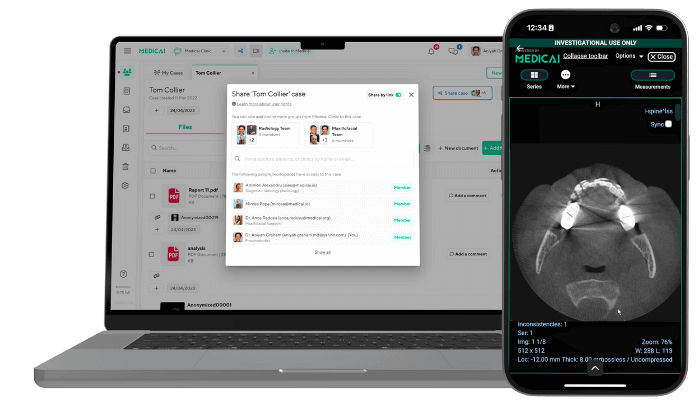
Instead, you can adopt a platform such as Medicai Cloud PACS, which provides cloud-based imaging storage, browser access, DICOM viewing, multi-location connectivity, and integration capabilities within an established imaging infrastructure.
Buying an established SaaS product can make sense when you need:
- Proven functionality for a well-defined requirement
- Faster access to operational capabilities
- Vendor-managed infrastructure and product updates
- Predictable subscription-based costs
- Less internal engineering and maintenance responsibility
But don’t evaluate a product only by its subscription price. Implementation, integration, storage growth, migration, training, and future expansion all contribute to the real investment. Medicai’s analysis of cloud PACS total cost of ownership explains why healthcare buyers should assess the complete cost over time rather than compare monthly fees alone.
The same principle applies beyond imaging: buy when an established product solves the requirement well enough that rebuilding it would add complexity without creating meaningful differentiation.
The same logic holds for the non-clinical work around your software. If your team needs patient education graphics, onboarding visuals, or marketing images for a digital health launch, so your engineers can stay focused on clinical functionality instead of building a design workflow. Tools like this suit communication and marketing content, not diagnostic imaging, which still calls for dedicated medical imaging infrastructure.
When Should You Build Custom Healthcare Software?
Custom development makes sense when you need software or functionality designed around your specific requirements rather than the limitations of an existing product.
You may choose to build a complete healthcare platform, develop a custom application, or create specialized capabilities that ready-made software does not provide. For example, a digital health company may need a remote patient monitoring platform with proprietary algorithms, device integrations, personalized dashboards, and care management functionality tailored to its product model.
Building custom software gives you greater control over functionality, architecture, integrations, and future development. You can shape the software around your clinical processes and business goals instead of adjusting critical requirements to fit a vendor’s product.
For specialized development needs, a Peerbits healthcare software development company can provide the engineering expertise needed to build custom applications and functionality around your users, integrations, and long-term product objectives.
The trade-off is greater responsibility for planning, development, testing, maintenance, security, and continued evolution. Custom development is most valuable when the capabilities you need are important enough to justify that investment.
When Does Customizing Existing Healthcare Software Make Sense?
Customization is useful when your existing software already provides a suitable foundation but does not fully fit your requirements.
For example, you might retain your EHR while adapting dashboards, reporting, interfaces, or connected applications around specific clinical processes.
You can customize through configuration changes, extensions, additional modules, or supported integrations. This lets you preserve technology that already works while addressing specific gaps.
However, customization has boundaries. Vendor restrictions, architecture, APIs, and future upgrades can limit how far you can modify a platform. Extensive customization can also create maintenance complexity.
The key is determining whether adapting the existing system remains simpler and more sustainable than replacing or rebuilding it.
Five Factors That Should Guide Your Healthcare Software Decision
Before choosing whether to buy, build, or customize healthcare software, you need to evaluate how each approach fits your current requirements and long-term goals. Here are five factors to consider:
1. Clinical and Operational Fit
Start with what your users actually need. Standard requirements are often better served by established software, while unique processes or proprietary functionality may justify customization or custom development.
2. Total Cost of Ownership
Compare more than development costs or SaaS fees. Include implementation, infrastructure, integrations, migration, maintenance, training, and future upgrades.
3. Time to Value
If a proven solution already provides the capability you need, buying may get you operational faster than developing the same infrastructure internally.
4. Interoperability
Your software rarely operates alone. Consider how it needs to connect with EHRs, RIS platforms, imaging systems, patient applications, and other clinical technologies.
For imaging use cases, Medicai’s Medical Imaging API allows imaging capabilities to be integrated into EHRs, digital health applications, and custom software without requiring teams to build the imaging layer themselves.
When evaluating imaging infrastructure specifically, it is also worth understanding how deployment models affect integration, operational overhead, and long-term architecture. Medicai’s comparison of cloud versus on-premise PACS explores these trade-offs in greater depth.
5. Security, Compliance, and Scalability
Consider who will be responsible for protecting patient data, maintaining infrastructure, managing access controls, and supporting future growth. These responsibilities can look very different depending on whether you build or rely on an established SaaS provider.
Why a Hybrid Strategy Often Works Best
You don’t have to use one strategy across your entire healthcare technology environment.
Your hospital might buy an established EHR, adopt a cloud PACS for medical imaging, customize selected clinical functionality, and build a proprietary patient application around your specific care model.
That lets you buy proven infrastructure where differentiation is limited, customize where existing systems need adaptation, and build where unique functionality creates real value.
The success of this approach depends on interoperability. Your systems need to exchange data securely and reliably without creating an architecture that becomes difficult to maintain as your requirements evolve.
Conclusion
Buy, build, and customize are not competing answers to the same problem. They are different tools for different technology requirements.
Before deciding, ask where you genuinely need ownership and differentiation. If an established SaaS product already solves a complex requirement effectively, buying may be more practical than rebuilding it.
If your existing platform is close to what you need, customization can fill the gaps. And when your requirements are unique to your organization or product, custom development gives you greater control.
The strongest healthcare technology strategy is often the one that builds only what needs to be unique and uses proven technology for everything that doesn’t.

Related Articles



Lets get in touch!
Learn more about how Medicai can help you strengthen your practice and improve your patients’ experience. Ready to start your Journey?
Book A Free Demo