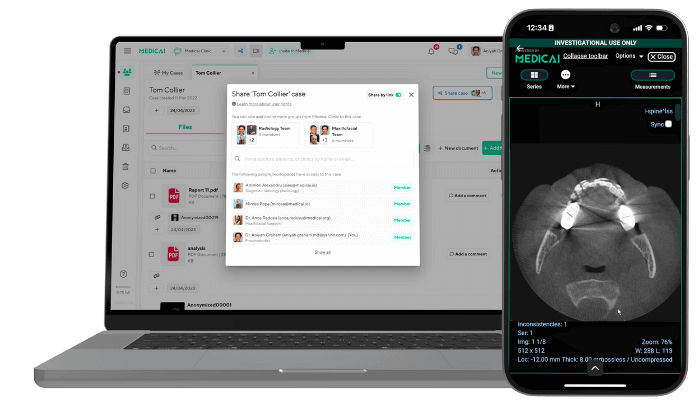
AI in Medical Imaging: Why Workflow Automation Matters

When people talk about AI in medical imaging, the conversation usually goes straight to diagnosis.
Can AI detect a tumor? Can it find an abnormality on a CT scan? Can it interpret an MRI?
Those are important questions, but I think we sometimes start at the wrong end of the problem.
A doctor makes a relatively small number of major clinical decisions. Around those decisions, however, there are hundreds of smaller ones.
Where should this patient go? Which specialist should see the case? Are all the previous studies available? Is some relevant information missing? How should the data be organized? Does this patient actually need another examination?
This is where I think AI can create significant value today.
Not by removing the doctor from the process, but by removing some of the friction around the doctor.
The amount of medical information has changed
There is a simple example I often use.
Thirty years ago, a doctor might have received an X-ray with one image to review.
Today, a CT examination can contain hundreds or even thousands of images.
The doctor hasn’t suddenly acquired hundreds of times more hours in the day.
At the same time, populations are getting older, chronic disease is increasing, and healthcare systems in many countries already have shortages of specialists.
So we have more patients, more complex cases, and much more data for roughly the same amount of clinical time.
The system cannot scale simply by asking doctors to work faster.
We need technology to take on some of the workload around clinical decision-making.
This is one reason I find the evolution of AI workflows in radiology so interesting. The useful applications are increasingly not isolated AI algorithms. They are tools that fit into triage, image review, measurements, reporting, and the broader workflow in which the radiologist already works.
I don’t think AI needs to make the final decision
I want to make an important distinction here.
When I talk about automation, I am not saying that an AI system should necessarily make the final medical decision.
The doctor still needs to say:
“This is the diagnosis.”
“This is the treatment.”
“This is what we should do next.”
But there are many decisions surrounding that moment that technology can help with.
Maybe the system can determine that a case should be routed to a particular specialist.
Maybe it can automatically retrieve the relevant prior examination.
Maybe it can identify that information is missing before the doctor starts reviewing the case.
Maybe it can prepare measurements or organize findings into a structured report.
These are smaller decisions individually, but when you repeat them across thousands of patients, they represent an enormous amount of work.
That is why I think clinical workflow automation may prove just as important as the more visible diagnostic applications of AI.
Good PACS integration and radiology workflow automation already remove many manual steps by keeping orders, patient identities, images, priors, and reports synchronized. AI gives us another layer on top of that infrastructure.
The problem is bigger than the image
Another thing we’ve learned at Medicai is that medical imaging cannot be treated in isolation.
A patient doesn’t arrive as an MRI.
The patient may have an MRI, a prior CT, laboratory results, medical reports, a referral, a pathology result, and information from another hospital.
The doctor needs the relevant pieces of that picture before making a decision.
This may sound obvious, but healthcare systems remain highly fragmented.
Sometimes the previous study is sitting in another PACS.
Sometimes the patient arrives with a CD.
Sometimes the doctor doesn’t even know that another examination exists.
So before we ask AI to reason over medical data, we have to solve a more basic problem:
Can we reliably bring the relevant data together?
This is why interoperability matters so much.
An AI model is only as useful as the information it can access within the clinical workflow. We have written before about why an interoperable imaging infrastructure is important for applying large language models in radiology. The same principle applies to AI more broadly.
If the data remains trapped across disconnected systems, even a very capable model starts with an incomplete picture.
Reporting is a good example of where AI can help
Radiology reporting shows what I mean by supporting the doctor rather than trying to replace the doctor.
The radiologist still interprets the examination and takes responsibility for the report.
But the mechanical work around reporting can be improved considerably.
Measurements can move from the viewer into structured fields. Templates can ensure that important information isn’t forgotten. Dictation can be converted into structured text. Previous information can be surfaced at the appropriate moment.
The doctor remains responsible for the clinical meaning.
The technology reduces the work needed to express and organize it.
This is the direction we are also taking with structured radiology reporting and AI-assisted workflows.
The goal isn’t to generate more text.
The goal is to give the clinician a better workflow.
Better information can also mean fewer unnecessary actions
There is another consequence that I think deserves more attention.
If clinicians have better access to existing information, sometimes the best decision is not to do something.
Maybe the patient doesn’t need another test.
Maybe the CT they had last week already answers the question.
That matters financially, but it also matters clinically.
If you order an unnecessary test, you create an additional cost for the healthcare system. In the case of an examination involving ionizing radiation, such as CT, you may also expose the patient unnecessarily.
So making information available at the right moment isn’t just an IT problem.
It can influence real clinical decisions.
What we’re trying to build at Medicai using AI in medical imaging
This way of thinking has influenced how we approach Medicai.
We started with medical imaging because imaging data is unusually difficult to move, manage, and make accessible. Anyone who has received an MRI on a CD has seen a very simple version of that problem.
But increasingly, I don’t think about Medicai as simply a place to store images.
The bigger opportunity is to create infrastructure through which imaging and relevant clinical information can become available to the people and technologies that need it.
Then you can add automation.
You can add AI.
You can add AI Co-Pilots for radiology workflows.
But the foundation still matters.
You need the right data, available in the right place, inside the right workflow.
AI should give doctors time back
I don’t think the most useful question is:
“When will AI replace the radiologist?”
A much more useful question is:
“Which parts of the radiologist’s work should never have required the radiologist’s time in the first place?”
Finding files.
Moving information between systems.
Re-entering data.
Searching for prior studies.
Formatting repetitive documentation.
Routing cases manually.
Those are the places where technology can give clinicians time back.
The doctor’s attention is one of the most valuable and constrained resources in healthcare.
If AI in medical imaging can protect more of that attention for the decisions that genuinely require clinical judgment, I think that is already a very meaningful transformation.
And we don’t need to replace the doctor to achieve it.

Related Articles
Lets get in touch!
Learn more about how Medicai can help you strengthen your practice and improve your patients’ experience. Ready to start your Journey?
Book A Free Demo