Future of Medical Imaging in 2026: AI-Driven, Cloud-Powered & Patient-Centered

The future of medical imaging is a seismic shift from “better pictures” to an objective science that blends imaging with AI, precision medicine, and mobile access.
The imaging stack now spans the full pipeline: acquisition, reconstruction, triage, reporting, and follow-up. Speed and quality depend on both algorithms and infrastructure.
The next winners build cloud-first access to priors, AI-assisted workflow, and secure sharing across sites.

Future of Medical Imaging
The future of medical imaging is a shift toward context-aware diagnostics, where images, notes, labs, and genomics combine into a single clinical story.
Future of medical imaging treats the scan as a measurable dataset, not a static picture, so value comes from quantification, comparison with priors, and decision support.
The future also depends on longitudinal access to prior studies, because the fastest diagnostic gains come from change detection, not isolated reads.
Medical imaging advancement needs interoperable sharing, because modern care teams rarely sit in one building, one PACS, or one time zone.
Future Trends in Medical Imaging
- Embed AI across the entire imaging pipeline to raise accuracy, reduce turnaround time, and lower clinician workload.
- Generative and multi-modal AI that combines imaging with clinical notes, labs, and genomic signals to reduce “blind” interpretation.
- Workflow automation that addresses the shortage problem by reducing time spent on repetitive steps such as triage and documentation.
- Advanced reconstruction that aims for high-quality imaging at lower dose, using deep-learning reconstruction approaches that have real CT deployments.
Radiologists become proactive care architects, not just report generators.
New Medical Imaging Technology
New medical imaging technology improves image quality, expands access, and reduces dose and installation constraints, thereby changing where imaging occurs.
The technology includes photon-counting CT, intended to deliver higher resolution with lower radiation dose than conventional CT while improving tissue differentiation.
New medical imaging technology also includes deep learning CT reconstruction, with GE HealthCare TrueFidelity positioned as a deep learning-based CT reconstruction approach.
Emerging technologies include helium-free MRI magnets, such as Philips BlueSeal and BlueSeal Mobile concepts, which offer a path toward easier siting and mobile deployment.
Lastly, new medical imaging technology includes handheld point-of-care ultrasound, with bedside acquisition that supports rapid triage in the ICU, emergency, and outpatient care.
Future Possibilities of X-rays
Future possibilities for X-rays center on portability, lower-dose protocols, and AI triage that reduces time-to-action for common high-risk findings.
The possibilities also include portable digital radiography workflows that shift imaging closer to triage and away from bottlenecked departments.
X-ray’s future potentials come with AI worklist prioritization for chest radiographs and emergency pathways, where queue order drives outcomes.
The possibilities include tighter dose governance in digital radiography programs, because digital flexibility needs operational controls to prevent drift.
The Future of Radiology
The future of radiology runs on cloud-native systems that support remote reporting, secure sharing, and multi-site collaboration as normal operations. It depends on fast access to priors and longitudinal timelines, because change detection drives real diagnostic value.
The future of radiology includes cloud PACS platforms and image exchange workflows that remove CDs and reduce cross-site friction, which Sectra positions as a core cloud value proposition. It expands through 5G-class connectivity patterns that support near-real-time remote imaging workflows, including real-time remote ultrasound scenarios described in the healthcare 5G literature.
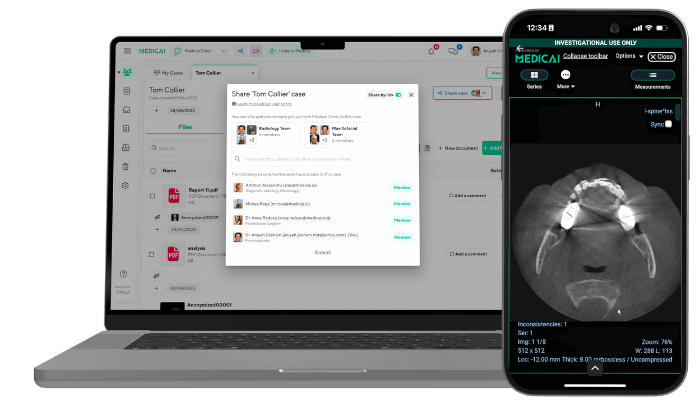
The radiology future fits Medicai’s product direction, unified cloud PACS, zero-footprint DICOM viewing, and collaboration across care teams.

Recent Advances in Radiology
Recent advances in radiology move AI from “reading help” into operational automation that reduces turnaround time and reduces non-interpretive workload. It includes report drafting and documentation support, a pattern that industry coverage frames as productivity support rather than replacement.
The current advances in radiology include lesion segmentation and measurement consistency, which improve follow-up comparisons and oncologic response tracking. It comes with smart worklist prioritization based on urgency and context to address backlog pressure and staffing constraints.
Recent advances in radiology improve safety when systems log model outputs, human edits, and downstream outcomes, because auditability defines clinical deployment credibility.
Imagine a radiology department where AI manages logistics, freeing specialists to focus on interpretation and patient care.
Human-Centered Imaging: Comfort, Access & Transparency
Expect imaging to become more accessible, faster, and less stressful:
- Open MRI and quiet scanners
- Faster sequences and motion-correction AI
- Mobile MR/CT units and home-based diagnostics
- AI-powered patient portals with plain-language explanations
Immersive Diagnostics
Immersive diagnostics bring 3D and 4D visualization into clinical planning, not just education. The diagnostics include cinematic rendering, a 3D visualization technique used for clearer anatomical understanding in CT-based planning.
Immersive diagnostics also include 4D CT and 4D MRI approaches that capture motion and time-resolved anatomy for selected clinical use cases. You will get AR overlays that project 3D CT and MRI information into the surgeon’s field of view during procedures, as shown in real deployments and published discussions.
Imaging becomes a transparent, real-time experience that directly empowers patients.
Digital Twins & Precision Imaging
Medical imaging + AI enables in-silico medicine — computational patient models for predicting outcomes.
Future innovations include:
- Digital twins for surgery planning & oncology
- Imaging + genomics-driven therapy selection
- AI simulation of tumor growth & treatment response
Molecular imaging extends precision imaging beyond anatomy by targeting biological processes and biomarkers, supporting earlier detection and treatment monitoring in oncology.
Radiology becomes core to personalized medicine and precision therapeutics.
Ethics, Safety & Regulation Take Center Stage
Expect global digital health frameworks that ensure:
- Bias-resistant and explainable AI
- Continuous-learning model approval pathways
- Interoperable imaging data exchange standards
- HIPAA/GDPR grade security at scale
AI governance becomes just as critical as AI capability.
Radiologists Are Being Augmented — Not Replaced
From Today to Future Transformation.
| Today | Future |
|---|---|
| Image interpretation | Intelligence orchestration |
| Manual workflow | Autonomous AI-driven operations |
| Productivity focus | Precision & prediction focus |
| Episodic care | Longitudinal patient management |
Radiologists move from image readers to data strategists — central to precision healthcare.
Bottom Line: Future of Medical Imaging
The future of medical imaging is:
- AI-native
- Cloud-integrated
- Context-aware
- Agentic + workflow-automated
- Patient-centric
- Interoperable across systems
- Predictive and preventive
Healthcare organizations adopting this future will lead in:
- Faster diagnosis
- Earlier disease detection
- Better patient outcomes
- Scalable radiology operations
And platforms like Medicai are enabling this shift — merging imaging, documents, data extraction, and AI orchestration into a seamless ecosystem.

Related Articles
Lets get in touch!
Learn more about how Medicai can help you strengthen your practice and improve your patients’ experience. Ready to start your Journey?
Book A Free Demo