Why Imaging and Documentation Need to Talk to Each Other in Rehab Care

A postoperative knee film comes back on Tuesday, and the surgeon changes the patient’s weight-bearing status. The therapist, working in a different system, runs Thursday’s session using instructions written a month earlier. Nothing about the scan was wrong.
Medical imaging in rehabilitation usually fails at the handoff, not at the scanner. The image and the radiologist’s report describe structure and diagnosis. The therapy record describes function: what the patient can do, and how that changes under treatment. When one is missing at the moment, somebody has to decide; Thursday can go sideways.
What medical imaging in rehabilitation changes in the plan
A scan changes the plan when it turns up something the plan didn’t account for. That might be a contraindication that takes a movement off the table or a postoperative restriction that never reached the therapist. Healing status does the same work: a follow-up film showing delayed union at a fracture site can hold a patient at partial weight bearing for another three weeks, which reshapes gait training and moves the discharge date the family was given in week two.
That is how imaging informs rehab treatment plans: it changes load, timing, precautions, or the route back to the referring provider.
The report doesn’t write the plan, though. Therapists read it against what they see in the clinic, including pain behavior and measured tolerance under load. Scope matters too. When a finding or a symptom pattern points to something outside the therapist’s scope, it goes back to the referring provider instead of getting managed through a modified exercise set.
Functional notes give the image its clinical meaning
Radiology records don’t capture how far a patient walked before the limp showed up. They don’t capture how a shoulder behaved under load, or what a caregiver noticed at home. Structural findings and reported symptoms don’t always agree, and when another clinician opens that scan three months later, the functional record is what tells them which one the patient was living with.
Communication gaps carry measurable risk. A systematic review in the International Journal for Quality in Health Care found that communication failures contributed to nearly 25% of the patient-safety incidents examined.
What breaks when the records stay separate
“Connected” doesn’t mean one application
Connected doesn’t mean every professional works inside the same software. It means each authorized clinician can reach the record they need, with reliable patient matching and a visible date on every report. It means one named person owns updates, and there’s a defined route for significant findings.
Timely access to both records lowers the odds that somebody acts on an instruction that changed last week.
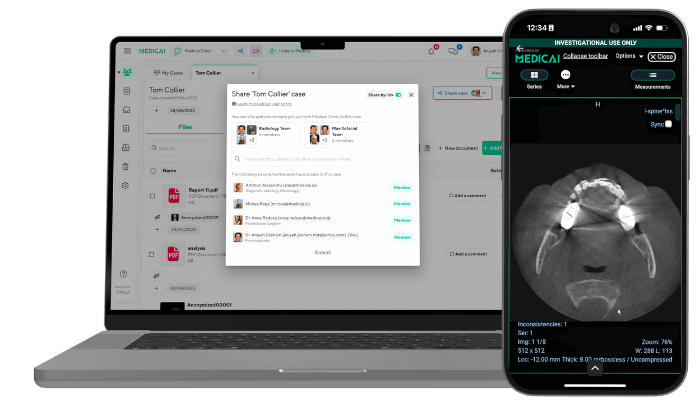
On the therapy side of that split, the record lives in whatever system the practice already documents in—such as specialized care coordination software for rehab therapy EHRs like Fusion by Ensora Health. However, viewing the actual diagnostic scans requires a bridge between these clinical systems. Cloud PACS infrastructure solves this by providing embeddable, zero-footprint web viewers directly within or alongside therapy workflows. When a report arrives midweek and the plan changes, the therapist can instantly review the original images and log the plan revision where whoever treats the patient next will see it, instead of keeping it in private notes.
Where fragmentation shows up in the day
You know the operational symptoms. A patient repeats the same history at a third intake. Precautions in the chart predate the most recent procedure. Staff phone the referring office to confirm a restriction, then upload a document that already sits somewhere else in the record. Three copies of the same report, no clear original.
Some of this is a cost question. The JAMA analysis Waste in the US Health Care System, by Shrank and colleagues, put failure of care coordination at $27.2 billion to $78.2 billion in annual waste. That figure covers the entire US health system rather than rehabilitation specifically, but the mechanism it describes is the one your front desk works around every week.
Build the workflow that carries a finding into the plan
Decide what has to travel
Start with an inventory of what actually has to move between the two records:
- The radiology report, with its examination date and the organization that produced it
- A secure, zero-footprint route (e.g., DICOMweb links or embedded web-viewer access) to the images themselves, enabling therapists to view diagnostic scans directly in a browser without requiring local PACS installations
- Current precautions and contraindications, plus the provider responsible for them
- The therapy side of it: goals, functional findings, how the patient responded, and every revision to the plan
- Access controls and audit history, along with consent status and a procedure for corrections
A report pasted into a progress note isn’t connected access. It strips the source details and goes stale on its own, and nobody reading the paste can tell whether the original has since been amended. Whatever exchange route you build also has to hold up under the HIPAA Security Rule, and the US Department of Health and Human Services publishes Security Rule guidance on safeguarding electronic health information.
Decide who reviews it and who acts
The technology moves the file. The protocol does the harder part: it names who reviews an incoming report and who documents the change it triggers. It sets how the treating clinician gets told. And it says what happens when two sources give conflicting instructions, which is the situation most practices have never written down.
Rehab documentation workflow best practices make that ownership explicit, including who reviews, escalates, records, and acknowledges each update.
An MRI read on Friday adds a lifting restriction. The therapy lead sees it before Monday’s session and revises the plan in the note, and the referring office can see that revision without anyone placing a call.
Evaluate the workflow, not the label
“Imaging integration” covers a wide span of capability in product marketing, so test the workflow you would actually run. Look for role-based access and patient matching reliable enough not to spawn duplicate charts. Time-stamped updates and an audit trail should show who changed what and when.
When vendors describe EHR imaging integration for physical therapy, confirm whether clinicians can open the source record, see amendments, and trace the update into the therapy plan.
Referral management should route an incoming report to a named person rather than a shared inbox, and mobile documentation matters if your therapists treat patients in homes or schools. A therapy EHR may not store or display diagnostic images at all, which is workable as long as authorized clinicians keep a dependable route to them for the times the report isn’t enough.
Make the record usable at the next decision
What connected records buy you is context at the point of decision: the current imaging finding sitting beside the current precautions and last week’s measured response, at the moment a therapist decides whether to add load. Fragmented records rarely produce dramatic failures. They produce small delays that accumulate across a caseload.
The benefits of connected rehab care systems include shared rehab documentation across providers, so a changed restriction and the response to it stay visible to the next clinician.
So set one standard and hold the practice to it. A significant imaging update reaches the responsible therapist and prompts a documented plan revision when one is warranted. The update and the action it triggered stay traceable in the shared record afterward.
Want to bridge the gap between radiology and therapy workflows? Learn how Medicai’s cloud PACS and zero-footprint viewer embed diagnostic imaging directly into your team’s existing EHR software.

Related Articles



Lets get in touch!
Learn more about how Medicai can help you strengthen your practice and improve your patients’ experience. Ready to start your Journey?
Book A Free Demo