Cloud-Based Medical Imaging Collaboration: Better Access, Faster Insights, Stronger Care

Today, collaboration is becoming just as important as interpretation.
Online medical imaging collaboration helps clinicians to review, share, and discuss complete DICOM studies from anywhere. It connects radiologists, specialists, primary care providers, and patients in a unified, cloud-based workspace that speeds up decisions and strengthens care.
Learn how cloud collaboration works, why it matters for clinical practice, and how modern platforms streamline teleradiology, MDT reviews, second opinions, and multi-site workflows.

What Online Medical Imaging Collaboration Means
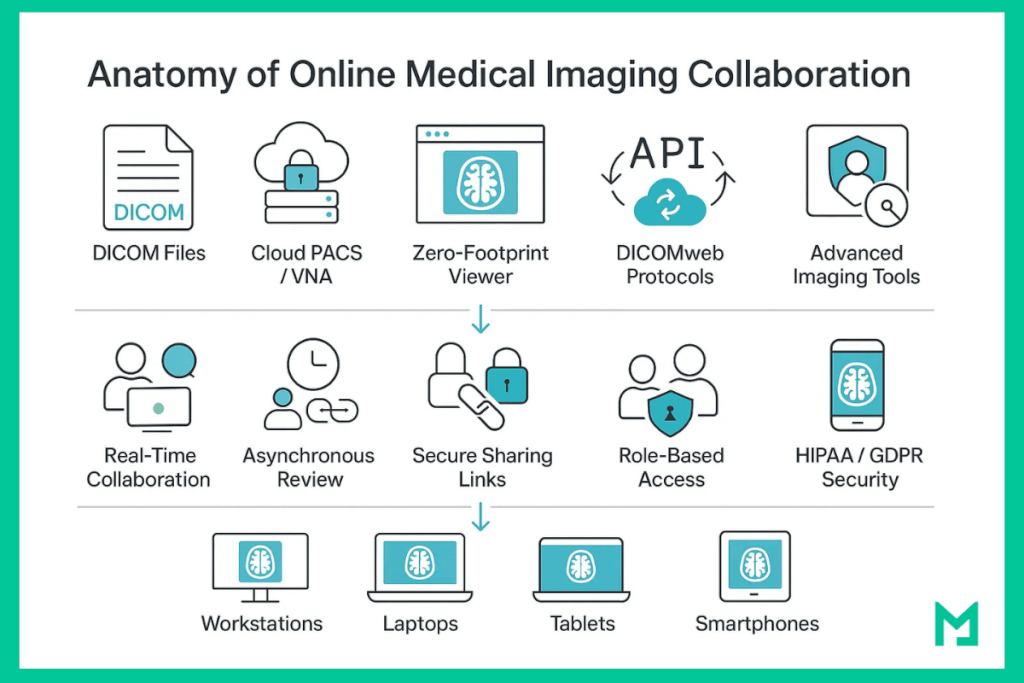
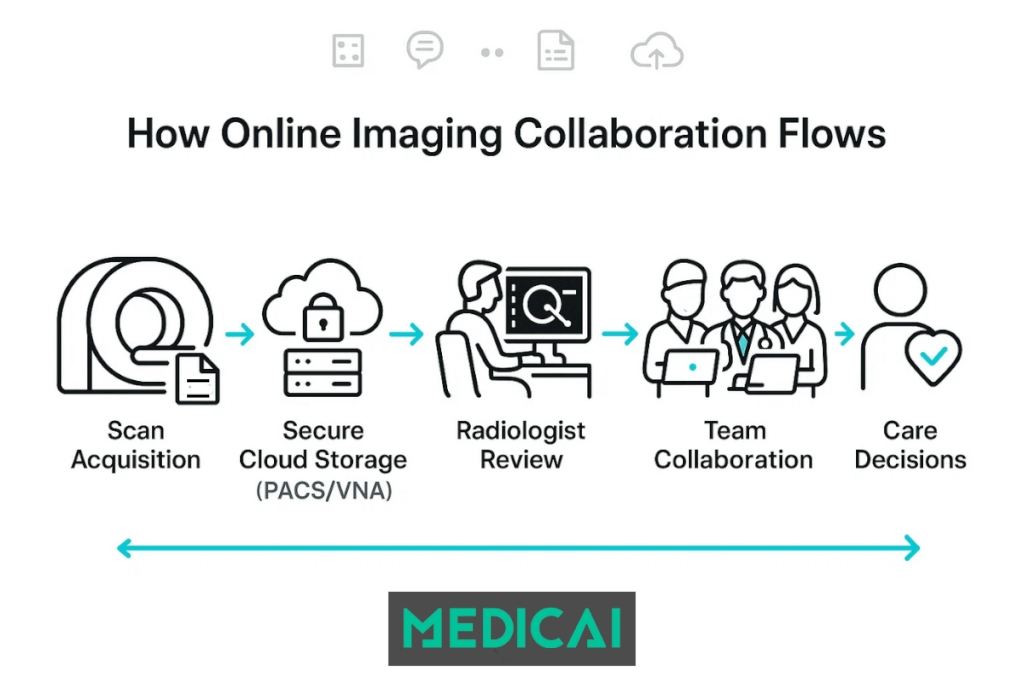
Online medical imaging collaboration has transformed clinician access to imaging studies by moving away from isolated PACS systems and local workstations. Now, unified cloud platforms offer immediate access to full DICOM studies in diagnostic quality.
At its core, collaborative imaging allows clinicians to digitally review and exchange MRI, CT, X-ray, ultrasound, PET, and mammography studies, complete with metadata, series structure, acquisition parameters, and modality-specific tools.
This transforms imaging from a static file into a shared clinical workspace that multiple professionals can access simultaneously.
Full, Instant Access to DICOM Studies
Medical professionals require far more than static JPEG screenshots or compressed files. They need the ability to open the complete DICOM dataset with the correct metadata, windowing, and acquisition details intact.
Cloud-based viewers enable clinicians to access multi-series MRI or CT studies in seconds, overcoming issues such as VPN access and workstation dependency. This ensures quick and reliable study reviews, no matter their location.
Instant access allows imaging to align with clinical needs. Radiologists can read trauma CTs from home, surgeons can view images before surgery, and neurologists can review stroke CTAs shortly after acquisition.
Collaborative imaging bridges the gap between acquisition and interpretation.

Zero-Footprint Viewing
Zero-footprint viewing is central to modern imaging collaboration. With a browser-based viewer, clinicians need no installations, plugins, or dedicated hardware; just a secure login and an internet connection. Even large studies stream smoothly via DICOMweb.
Zero-footprint platforms provide access to advanced tools, including:
- Diagnostic-quality resolution
- Window/level adjustments
- Multi-series navigation
- MPR and thin-slice reconstructions
- Side-by-side comparison
- Real-time annotation
This accessibility supports remote reading, hybrid work, and multi-site coverage, removing reliance on on-prem workstations and reducing friction in clinical workflows. Clinicians can rely on consistent performance when reviewing studies, participating in discussions, or preparing for surgeries.
Secure Sharing Links for Internal and External Collaboration
One of the most transformative capabilities for collaboration is secure, time-limited sharing links. Instead of exporting studies from PACS, burning CDs, or compressing files for email transfer, clinicians can instantly grant controlled access to complete DICOM studies.
These links allow imaging to be shared with:
- Referring physicians
- External specialists
- Multidisciplinary teams
- Primary care providers
- Patients and caregivers
Every access event is authenticated, logged, and audited to comply with HIPAA, GDPR, and SOC 2 standards. Clinicians control who sees information, ensuring privacy while facilitating collaboration.
Secure sharing accelerates consultations, minimizes information loss, and connects imaging to the care pathway, particularly in urgent cases.
On-Image Annotations for Clearer Clinical Discussion
Clinical communication often requires more than words, especially when describing subtle lesions, borderline findings, or postoperative changes. With on-image annotations, clinicians can highlight specific features using arrows, circles, measurements, and comments.
Annotations offer clarity for:
- Staging discussions
- Determining lesion characteristics
- Surgical planning
- Subspecialty consultations
- Longitudinal comparisons
These annotations stay linked to the study, providing a detailed reference for multiple providers.
Real-Time or Asynchronous Review
Collaboration must match the realities of clinical practice. Time zones, shift schedules, and case urgency vary widely. Cloud platforms like Medicai support both synchronous and asynchronous interactions.
- Real-time review: multiple clinicians scroll through slices together, annotate simultaneously, and discuss findings in live sessions.
- Asynchronous review: specialists review studies independently, leave notes or measurements, and contribute when available.
This flexibility ensures that collaboration remains clinician-driven rather than schedule-driven. It also supports teams that work across borders or coordinate care between multiple facilities.
Support for Multidisciplinary Workflows
Effective collaboration in healthcare requires all team members, radiologists, surgeons, oncologists, cardiologists, neurologists, primary physicians, and pathologists, to access the same imaging data.
Cloud collaboration platforms enable multidisciplinary workflows by ensuring:
- A unified view of the study
- Consistent annotations
- Role-based access
- Synchronized navigation
- Cross-platform compatibility
These capabilities benefit tumor boards, cardiac reviews, orthopedic planning, stroke pathways, and complex pediatric cases by enhancing shared situational awareness. It leads to better planning and fewer miscommunications.
Why Collaborative Imaging Matters for Medical Professionals?
Collaborative imaging is the tech upgrade that transforms how clinical teams work and communicate. For medical professionals, it eliminates barriers that slow decision-making and hinder efficiency.
Faster, More Predictable Reporting
When studies are accessible instantly, and specialists can join from anywhere, reporting delays shrink dramatically. Emergency cases get solved faster. Routine cases move through the workflow without unnecessary stoppages.
More Accurate Diagnoses
Collaboration enables clinicians to involve the right subspecialist at the right moment.
A subtle neuro finding, a complex MSK fracture, a borderline liver lesion: these cases benefit from shared review, second opinions, and coordinated interpretation.
Reduced Back-and-Forth
With shared viewing, annotations, and comments, clinicians no longer rely on screenshots, vague descriptions, or fragmented communication channels. Everyone sees the same study, in the same quality, with the same context.
Better Communication With Patients
Patients receive clearer explanations when clinicians can open scans during consultations, onsite or over telehealth. It builds trust, improves adherence, and helps patients understand their diagnosis and next steps.
Improved Care Coordination Across the Patient Journey
Primary care physicians, specialists, and follow-up teams can all access the same imaging without duplication or data loss. It leads to smoother transitions, fewer repeated scans, and stronger continuity of care.
Greater Access to Subspecialists
Hospitals without local neuroradiology, pediatric imaging, or oncology expertise can connect instantly with subspecialists worldwide. It closes the expertise gap and improves outcomes for complex or rare cases.
How PACS-to-Cloud Integration and Secure Sharing Enable Real Collaboration
Collaboration becomes reliable only when imaging moves securely and seamlessly between systems. Modern platforms achieve this through standards-based routing and robust security controls.
PACS-to-Cloud Routing
Hospitals can transmit studies from PACS to the cloud using DICOM C-STORE or C-MOVE. Routing rules allow facilities to automatically send studies to remote radiologists, subspecialty readers, MDT groups, or partner institutions.
It eliminates manual exports and speeds up case movement.
Interoperability Standards
Modern platforms maintain alignment with existing health IT systems through:
- DICOM / DICOMweb for image transfer and query
- HL7 for patient demographics and order synchronization
- FHIR APIs for EHR integration
- IHE profiles for cross-enterprise imaging exchange
These standards preserve compatibility without forcing the hospital to rebuild its infrastructure.
Secure, Controlled Sharing
Encrypted, time-limited sharing links ensure controlled access to imaging studies without exposing patient data to insecure channels. Every access is tracked through audit trails and role-based permissions to maintain full compliance with regulatory requirements.
Teleradiology: Connecting Specialists Across Borders
Teleradiology has become one of the most significant applications of imaging collaboration. It allows clinicians to access subspecialists rapidly, regardless of location.
Faster Access to Expert Opinions
Subspecialists, such as neuroradiologists, MSK experts, pediatric radiologists, and breast imagers, can weigh in immediately. This accelerates diagnoses and prevents delays that could impact outcomes.
24/7 Emergency Coverage
Emergency departments benefit from continuous coverage for stroke, trauma, GI bleeds, and postoperative complications. Radiologists can interpret studies remotely with full PACS-level functionality.
Cross-Border Consultation
Rare or complex findings often require niche expertise. Teleradiology connects clinicians with global experts in congenital anomalies, advanced neuroimaging, and rare tumors.
Better Utilization of Radiology Expertise
Radiologists can support multiple sites, balancing workloads and reducing bottlenecks. High-volume centers can dynamically route cases to subspecialists.
Reduced Reporting Blockages
Dynamic routing enables hospitals to weather surges in imaging volume by distributing studies more efficiently across available radiologists.
Collaboration Use Cases in Everyday Clinical Workflow
Cloud-based collaboration shapes daily clinical operations across disciplines.
- Specialist Consultations Across Borders: Clinicians across countries can review studies together, enabling faster escalations for complex cases and improved accuracy for rare pathologies.
- Multidisciplinary Team (MDT) Reviews: Multiple specialists view the same DICOM study simultaneously, with shared annotations and synchronized navigation. This leads to clearer staging, better planning, and reduced miscommunication.
- Family Members Coordinating Care: Patients and caregivers gain controlled access for follow-ups, second opinions, specialist referrals, and emergency visits.
- Remote Consultations and Telehealth: Clinicians can open scans during telehealth sessions, improving understanding and continuity of care.
- Second Opinions Without Delays: Secure cloud-based sharing replaces CD-based workflows, enabling rapid case review and more confident diagnoses.
How Modern Platforms Bridge Gaps in Imaging Workflow
Many hospitals still rely on outdated tools for imaging exchange, using physical media and insecure channels that hinder diagnoses and collaboration. Modern cloud-based platforms like Medicai address these issues by providing a secure and accessible space for imaging workflows.
Eliminating Delays From Physical Media
CDs and USB drives remain a major bottleneck. Theyâre often:
- corrupted or unreadable
- incompatible with local PACS
- missing essential metadata
- easily lost between appointments
Cloud-native sharing removes physical media entirely. Studies are uploaded once and shared instantly with referring physicians or specialists.
Fixing Viewer Compatibility Problems
Different hospitals rely on different PACS systems, which often causes:
- missing or incomplete series
- incorrect windowing
- failed reconstructions
- inconsistent study quality
A zero-footprint, diagnostic-grade DICOM viewer standardizes access across all devices. It provides consistent, reliable viewing every time, everywhere.
Faster, More Reliable Clinician Communication
Without dedicated collaboration tools, imaging discussions rely on:
- screenshots in messaging apps
- long phone explanations
- multi-step PACS exports
These slow decisions increase miscommunication. Modern platforms offer:
- shared viewer sessions
- real-time annotations
- synchronized scrolling
- time-stamped comments
Reducing Workflow Fragmentation
Clinicians often jump between PACS, email, messaging apps, and EHRs. This causes lost context, inconsistent records, and workflow fatigue.
Cloud platforms unify:
- viewing
- reporting
- annotations
- sharing
- communication
The clinicians can have a streamlined, compliant workflow in one place.
Supporting Remote and Hybrid Reading Models
With more radiologists working off-site, systems must support high-quality remote access. Platforms like Medicai provide:
- high-speed DICOM streaming
- device-agnostic access
- role-based permissions
- complete audit trails
Our scalable, flexible imaging operations enhance care without compromising diagnostic quality.
Conclusion
When imaging becomes collaborative, care becomes smarter.
Cloud platforms remove the delays, barriers, and siloed workflows that once held clinicians back, replacing them with instant access, shared insight, and real-time teamwork. Radiologists, specialists, and care teams can now work as one, no matter where they are.
With solutions like Medicai, imaging finally aligns with the speed and coordination modern medicine demands.


Related Articles
Lets get in touch!
Learn more about how Medicai can help you strengthen your practice and improve your patients’ experience. Ready to start your Journey?
Book A Free Demo