Full-Body MRI Cost Without Insurance: Current Prices and Ways to Save

A full-body MRI without insurance can cost anywhere from about $499 to $3,999 in the United States, depending on the provider, the body areas included, scan duration, location, and whether the price includes clinical review or follow-up support.
However, “full-body MRI” is not a standardized medical service. A preventive whole-body screening package is different from a medically necessary MRI ordered to examine a specific body part, such as the brain, spine, knee, or abdomen. Comparing their prices directly can be misleading.
This guide explains current self-pay full-body MRI prices, how they differ from standard diagnostic MRI costs, what insurance may cover, and how to compare quotes before booking a scan.
How Much Does a Full-Body MRI Cost Without Insurance?
Commercial preventive whole-body MRI providers currently advertise self-pay prices ranging from approximately $499 to $3,999.
The exact amount depends on what the provider calls “whole body,” which may include different combinations of the brain, neck, chest, abdomen, pelvis, spine, and extremities. Some packages also include AI-assisted image analysis, a radiologist report, blood testing, a clinician consultation, or follow-up navigation.
| Provider | Advertised starting price | Notes |
| SimonMed | $499 | Lower-cost whole-body MRI option; higher tiers are also available |
| Prenuvo | $2,499 | Whole Body Scan; approximately a 50-minute scan |
| Ezra | $999 | Entry-level MRI screening price; higher-tier plans are available up to $3,999 |
These prices are for direct-pay preventive screening packages. They should not be treated as a benchmark for every MRI procedure or as a guarantee that a provider’s scan covers every body part.
For example, a lower-cost package may focus on selected areas of the body or provide less extensive imaging than a premium whole-body screening exam. Before scheduling, ask the provider for a written description of the anatomy included in the scan.
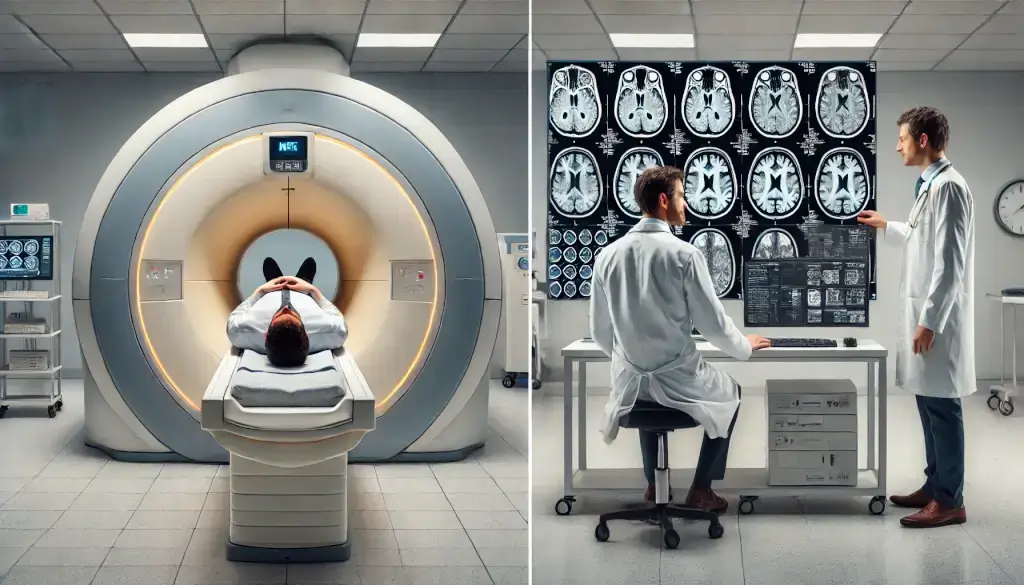
How Much Does a Standard (Diagnostic) MRI Cost Without Insurance?
A diagnostic MRI is ordered by a clinician to investigate a specific symptom, such as a suspected ligament tear, persistent headaches, or back pain, and it scans one body region rather than the whole body. Self-pay prices vary widely by body part, whether contrast is used, region, and whether the scan is performed at a hospital or an independent imaging center.
As a general guide, a self-pay diagnostic MRI of a single region commonly falls somewhere in the mid-hundreds to low-thousands of dollars. Hospital outpatient departments sit at the higher end because they add a facility fee, while independent imaging centers are usually the lower-cost option for the same scan. Contrast, when required, incurs an additional charge on top of the base scan.
Because the range for any specific scan is wide and location-dependent, the most reliable way to price a diagnostic MRI is to request a written self-pay estimate that specifies exactly what is included and to compare it with a consumer cost-transparency lookup for your area. The next section explains what makes the numbers move and how to get an estimate you can trust.
Full-Body MRI vs. Standard Diagnostic MRI
A full-body MRI is often marketed as a proactive or preventive screening service. In contrast, a standard diagnostic MRI is usually ordered by a clinician to investigate a symptom, injury, abnormal test result, or known condition.
A diagnostic MRI may focus on one region, such as the brain, cervical spine, shoulder, knee, abdomen, or pelvis. Its cost is influenced by the specific exam, whether contrast is used, the imaging facility, geographic region, and whether the scan is performed in a hospital outpatient department or an independent imaging center.
| MRI type | Typical purpose | Self-pay price considerations |
| Preventive whole-body MRI | Broad screening for potential abnormalities | Coverage area, scan time, report review, provider package |
| Brain MRI | Neurological symptoms, injury, tumor assessment, stroke evaluation | Contrast, hospital vs. imaging center, urgency |
| Spine MRI | Back pain, nerve symptoms, trauma, degenerative conditions | Cervical, thoracic, or lumbar region; contrast use |
| Joint MRI | Knee, shoulder, hip, ankle, or wrist injury assessment | Body part, orthopedic protocol, facility type |
| Abdominal or pelvic MRI | Evaluation of abdominal or pelvic organs and tissues | Contrast, specialized protocol, hospital facility charges |
| Cardiac MRI | Heart structure and function assessment | Specialized equipment, radiology and cardiology expertise |
As a broad reference, published self-pay estimates for common diagnostic MRIs vary substantially. General MRI estimates may fall around $650–$1,650, while a brain MRI may be approximately $700–$1,800, an abdominal MRI roughly $725–$1,850, and a lower-extremity MRI around $420–$1,100. These are not universal prices; local quotes may be higher or lower depending on the provider and the exam.
Current Full-Body MRI Prices
SimonMed Whole-Body MRI
SimonMed advertises multiple whole-body MRI options. Its listed prices range from $499 to $2,699, depending on the tier selected.
The lower-priced option should not automatically be assumed to provide the same anatomical coverage, scan duration, or included services as the higher-priced tiers. Patients should confirm:
- Which body regions are included
- Whether the brain, neck, chest, abdomen, pelvis, and spine are scanned
- How long the scan lasts
- Whether contrast is used
- Whether a radiologist interpretation is included
- Whether follow-up support is available if an incidental finding appears
Prenuvo Whole Body Scan
Prenuvo lists its Whole Body Scan at $2,499 in the United States. The company describes the scan as taking approximately 50 minutes and providing a detailed, radiation-free MRI examination of multiple body regions.
The final price may vary by location, upgrades, membership offerings, or additional services. Prospective patients should check the provider’s current pricing page before booking.
Ezra MRI Screening
Ezra currently lists MRI screening plans starting at $999, with higher-tier options reaching $3,999. The company previously promoted a 30-minute scan priced at $1,350 and a 60-minute full-body MRI at $1,950, but those figures are historical and should not be used as current baseline pricing.
As with other providers, patients should confirm the scan protocol, organs and body regions included, and whether the price includes clinical review, AI-assisted analysis, radiology interpretation, or a consultation.
Why Full-Body MRI Prices Vary
Price variation does not necessarily mean one scan is better than another. It often reflects differences in coverage, workflow, staffing, and service design.
Key factors include:
- Body areas scanned: A head-to-pelvis scan may not include the same anatomy as a scan marketed as “whole body.”
- Scan duration: Longer protocols can capture more sequences or more detailed images.
- MRI equipment: Scanner field strength, image quality, and available protocols can affect operating costs and diagnostic capabilities.
- Contrast use: Contrast-enhanced MRI may increase the total price and is not included in every screening package.
- Radiologist interpretation: Confirm that the estimate includes the final radiology report, not only the imaging appointment.
- Clinical review and navigation: Some providers include physician consultations, follow-up support, or care navigation.
- Location: Prices often differ by city, local market competition, and whether the imaging is performed in a hospital or independent center.
- Facility setting: Hospital outpatient departments may have higher charges than freestanding imaging centers, although individual quotes vary.
Does Insurance Cover a Full-Body MRI?
Insurance often does not cover elective preventive full-body MRI screening for people without a documented medical indication. Insurers generally assess coverage based on medical necessity, plan benefits, prior authorization requirements, network status, and the specific MRI protocol ordered.
A standard diagnostic MRI is more likely to be covered when a clinician orders it to evaluate a symptom, injury, abnormal result, or suspected condition. Even then, patients may owe a deductible, copayment, or coinsurance amount.
Before scheduling a diagnostic MRI, contact your insurer and ask:
- Is this MRI covered under my plan?
- Does the exam require prior authorization?
- Is the imaging center in network?
- What is my remaining deductible?
- What is my estimated out-of-pocket cost?
- Is the radiologist’s interpretation billed separately?
- Does the quoted amount include contrast and facility fees?
Do not assume an MRI is covered simply because a clinician recommends it. Confirm coverage before the appointment whenever possible.
Medicare Coverage for MRI
Original Medicare Part B may cover medically necessary diagnostic MRI exams when ordered by an appropriate healthcare professional. After meeting the Part B deductible, beneficiaries typically pay 20% of the Medicare-approved amount for covered diagnostic non-laboratory tests performed in a physician office or independent diagnostic testing facility.
Coverage and out-of-pocket costs can differ when imaging occurs in a hospital outpatient department. Medicare Advantage plans may also have network rules, prior-authorization requirements, copayments, and other plan-specific conditions.
Elective full-body MRI screening packages are generally different from medically necessary diagnostic imaging and may not be covered.
How to Find a Lower-Cost MRI Without Insurance
If you need a diagnostic MRI and plan to self-pay, compare providers before booking. The first price you receive is not always the best available price.
Ask for a written cash-pay quote
Request a written estimate for the exact MRI procedure. The estimate should identify the body part, whether contrast is included, and whether the radiologist’s interpretation is included.
For example, “MRI” is not specific enough. Ask whether the quote is for:
- MRI brain with or without contrast
- MRI lumbar spine without contrast
- MRI knee without contrast
- MRI abdomen with and without contrast
- MRI pelvis with and without contrast
Compare hospital and independent imaging centers
Freestanding imaging centers may offer lower self-pay prices than hospital outpatient imaging departments. This is not guaranteed, but comparing both settings can reveal substantial differences.
Ask every facility whether its estimate includes:
- Technical imaging fee
- Radiologist reading and final report
- Contrast material, if needed
- Facility fee
- Sedation, if needed
- Image transfer or CD access
- Follow-up imaging required because of incomplete or unclear results
Look for self-pay or prompt-pay discounts
Many imaging facilities offer discounted rates for uninsured patients or for patients who pay in full before the appointment. Ask directly whether the provider has:
- A self-pay rate
- A cash-pay rate
- A prompt-pay discount
- A payment plan
- Financial-assistance policies
- A lower rate for scheduling during off-peak times
Use an order from a qualified clinician when appropriate
For diagnostic imaging, a clinician’s order can help ensure that the imaging center follows the correct protocol. It can also make the scan more likely to qualify for insurance coverage if you later use insurance.
A clinician can help determine whether an MRI is the right test or whether another exam, such as an ultrasound, X-ray, CT scan, or targeted MRI of one region, may be more appropriate.
Confirm whether a full-body MRI is the right choice
A preventive whole-body MRI may sound comprehensive, but it is not a substitute for routine preventive care, recommended cancer screening, clinical evaluation, or symptom-based diagnostic testing.
It can also identify incidental findings—unexpected abnormalities that may be harmless but can require additional tests, follow-up appointments, expense, and anxiety. Consider discussing the decision with a qualified clinician, particularly if you have symptoms, a known medical condition, a family history of disease, or elevated health risks.
Questions to Ask Before Booking
Whether you are considering a whole-body screening package or a standard MRI, ask these questions before paying:
- What exact body regions and organs are included?
- Is this a preventive screening MRI or a diagnostic MRI for a specific medical concern?
- Is the quoted price a self-pay price, an insurance estimate, or the facility’s billed charge?
- Does the estimate include the radiologist’s final report?
- Is contrast included, and is contrast medically appropriate for this scan?
- Are there separate charges for facility, interpretation, consultation, or follow-up?
- What happens if the scan identifies an incidental finding?
- Can I receive my images and report electronically?
- How long will it take to receive the radiology report?
- Does the provider offer payment plans, cash discounts, or financial assistance?
Frequently Asked Questions
Commercial direct-pay full-body MRI screening packages currently range from approximately $499 to $3,999. The price depends on the provider, body coverage, scan duration, included services, location, and whether the package contains additional testing or clinical support.
Elective preventive full-body MRI screening is often not covered by insurance. A diagnostic MRI ordered for a medical reason may be covered, subject to your plan’s deductible, coinsurance, network rules, and prior-authorization requirements.
A self-pay brain MRI can vary widely by location, use of contrast, and facility type. Published estimates commonly place brain MRI pricing in the range of roughly $700 to $1,800, although local quotes may be lower or higher.
Independent imaging centers can sometimes offer lower self-pay prices than hospital outpatient departments. However, the best option depends on the needed MRI protocol, whether contrast or specialized expertise is required, your clinical circumstances, and the facility’s total quoted price.
Yes. Many imaging providers accept self-pay patients and may offer cash-pay or prompt-payment discounts. Always request a written estimate for the exact exam and confirm whether the price includes both the scan and the radiologist’s interpretation.
The answer depends on your health context, risk factors, budget, and goals. Whole-body MRI is not a replacement for routine care or evidence-based screening programs. It may also lead to incidental findings that require additional testing. Discuss the potential benefits, limits, and downstream costs with a healthcare professional before scheduling.
Final Thoughts
A full-body MRI without insurance can cost anywhere from less than $1,000 to several thousand dollars, depending on the commercial provider’s scan protocols and service packages. The most useful comparison is not simply the advertised price—it is the exact anatomy covered, scan length, MRI protocol, radiologist interpretation, included follow-up, and potential extra costs.
For a medically necessary MRI, request written self-pay estimates from both hospitals and independent imaging centers. For preventive whole-body screening, compare providers carefully and confirm what “full body” means before booking.


Related Articles



Lets get in touch!
Learn more about how Medicai can help you strengthen your practice and improve your patients’ experience. Ready to start your Journey?
Book A Free Demo