Functional Interoperability in Healthcare: Levels, Types, Benefits, and Challenges Explained

Healthcare interoperability is the ability of different health information systems, medical devices, and software applications to connect, exchange, and use patient data securely across organizational boundaries. The Healthcare Information and Management Systems Society (HIMSS) defines four levels of interoperability that healthcare leaders should understand: foundational interoperability (basic data exchange), structural interoperability (defined data format), semantic interoperability (shared clinical meaning), and organizational interoperability (governance and workflows).
Each level builds on the previous one, and most real-world healthcare interoperability implementations operate across all four simultaneously. The benefits of effective interoperability include better-coordinated patient care, reduced medical errors, lower operational costs, and improved population health management. The challenges include technical incompatibility between systems, inconsistent data standardization, security and privacy risks, and the cost of upgrading legacy infrastructure.
This guide explains the four levels in detail, the standards that enable interoperability at each level, and the practical considerations for healthcare organizations evaluating their own interoperability maturity. For deeper coverage of specific interoperability standards, see the What Is HL7 guide.

What Is Interoperability in Healthcare?
Interoperability in healthcare refers to the ability of different health information systems, devices, and applications to connect and communicate with each other securely and seamlessly. This allows for the efficient and accurate exchange of electronic health information (EHI) among various stakeholders, including:
- Healthcare providers: Hospitals, clinics, pharmacies, laboratories
- Patients: Individuals accessing their own health records through portals and apps
- Payers: Insurance companies and government agencies
- Researchers: Analyzing data to improve treatments and outcomes
- Public health organizations: Monitoring disease outbreaks and trends
Examples of interoperability in healthcare
Five concrete examples illustrate how interoperability operates in practice across the healthcare ecosystem.
- Sharing patient records between hospitals and clinics allows providers to access a patient’s complete medical history, including allergies, medications, and test results, during care transitions.
- Connecting pharmacies with prescribers enables electronic prescribing and reduces medication errors through automated drug-interaction checks and dosing verification.
- Integrating patient portals with EHRs empowers patients to access their health information, schedule appointments, view lab results, and communicate with providers through standardized FHIR-based APIs.
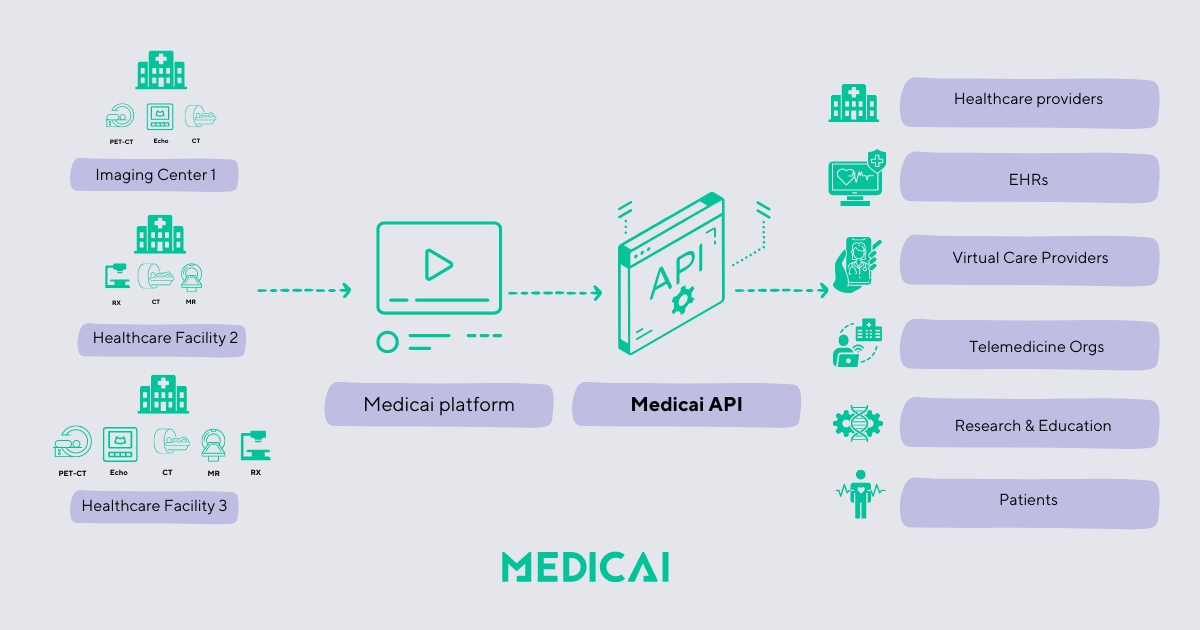
- Connecting imaging facilities with referring physicians enables radiologists to deliver reports back to the ordering EHR, while patients access their imaging studies through patient portals using HL7 messaging and DICOMweb in combination.
- Public health reporting facilitates the electronic reporting of infectious diseases, immunizations, and population health data to public health agencies for surveillance and intervention planning.
Why interoperability matters in modern healthcare
Healthcare interoperability has shifted from optional to mandatory across the US healthcare system. The 21st Century Cures Act and its information blocking provisions require certified EHRs to support data exchange. The Trusted Exchange Framework and Common Agreement (TEFCA) creates a national infrastructure for cross-organizational data flow. Value-based care programs depend on interoperability for quality reporting and care coordination. Patient empowerment use cases, such as patient portals and personal health apps, require API-based data access.
The benefits across healthcare delivery include better-informed clinical decision-making through comprehensive patient context, reduced duplicate testing across provider transitions, faster care coordination during referrals and admissions, automated workflows that reduce administrative burden, improved population health management at scale, and a data foundation for AI clinical decision support tools.
For detailed coverage of the benefits and the obstacles healthcare organizations encounter when implementing interoperability, see Benefits and Challenges of Interoperability in Healthcare.

The four levels of interoperability in healthcare
Interoperability in healthcare is not a single capability. The Healthcare Information and Management Systems Society (HIMSS) defines four levels of interoperability, each building on the previous one. Healthcare organizations operate at different levels depending on the systems they connect, the standards they support, and the governance frameworks they have established. Understanding the four levels helps healthcare leaders assess their current interoperability maturity and plan investments to advance to higher levels.
| Level | What it ensures | Standards involved | Healthcare example |
|---|---|---|---|
| Foundational | Basic data exchange between two systems with no specific structure required for receiving system to interpret | TCP/IP, HTTPS, basic file transfer protocols | Hospital sends a fax or unstructured PDF of a patient record to a primary care physician’s office |
| Structural | Defined format and structure so receiving systems can parse incoming data reliably | HL7 V2 messages, HL7 FHIR resources, DICOM, CDA documents | EHR sends HL7 ORM order to RIS using consistent segment structure both systems can parse |
| Semantic | Shared clinical meaning so both systems interpret data consistently | SNOMED CT, LOINC, ICD-10, RxNorm, USCDI | Lab result coded with LOINC means the same clinical concept whether viewed in the originating system or the receiving EHR |
| Organizational | Governance, policies, and workflows that allow data to flow across organizational boundaries with appropriate consent | TEFCA Common Agreement, HIPAA business associate agreements, regional HIE governance frameworks | Multi-state QHIN participation under TEFCA with formal data-sharing agreements and consent management |
Foundational interoperability
Foundational interoperability is the most basic level, ensuring that systems can simply connect and exchange data. The receiving system gets the data, but may not be able to interpret it without manual processing. This is similar to two people who speak different languages exchanging written notes — the notes arrive successfully, but understanding requires translation.
In healthcare, foundational interoperability means systems can send and receive information, but the format or meaning might not be standardized. A hospital sending a fax of a patient record to a primary care physician’s office achieves foundational interoperability. The data transfer happens, but the receiving office must manually process the content.
Structural interoperability
Structural interoperability builds on foundational principles by standardizing the format of data exchange, ensuring that the receiving system can parse and process the information correctly. The language analogy now includes a shared grammar book, making sentences clearly structured even when individual word meanings still need clarification.
In healthcare, structural interoperability is provided by HL7 V2, HL7 FHIR, DICOM, and CDA standards. An EHR sending an HL7 ORM order to a RIS achieves structural interoperability because both systems agree on the segment structure, field positions, and data types. The receiving system can parse the message into its component fields without manual intervention.
Semantic interoperability
Semantic interoperability ensures that all systems understand the meaning of the data, not just its structure. The language analogy now includes a shared dictionary, ensuring everyone interprets words the same way. This level requires standardized terminologies and clinical coding systems applied consistently across organizations.
In healthcare, semantic interoperability depends on standardized terminologies like SNOMED CT for clinical concepts, LOINC for laboratory observations, ICD-10 for diagnoses, RxNorm for medications, and USCDI for the minimum data set required by US certification programs. When a lab result is coded with LOINC, it means the same clinical concept whether viewed in the originating laboratory information system or the receiving EHR. Without semantic interoperability, “diabetes” in one system might map to different clinical concepts than “diabetes” in another, leading to misinterpretation during data exchange.
Organizational interoperability
Organizational interoperability addresses the human factors involved in data exchange beyond pure technology. It focuses on policies, workflows, consent management, and governance frameworks that enable data to flow effectively across organizational boundaries while maintaining appropriate controls. The language analogy now includes shared cultural norms and etiquette governing when and how communication happens.
In healthcare, organizational interoperability is what TEFCA’s Common Agreement provides for national health information exchange. Healthcare organizations participating in TEFCA-connected Qualified Health Information Networks (QHINs) operate under formal data-sharing agreements, consent management frameworks, and governance structures that enable cross-organizational data flow at a national scale. Regional Health Information Exchanges (HIEs) operate similar governance frameworks on a smaller scale.
Barriers to Interoperability in Healthcare: The Interoperability Challenges
The challenges of interoperability operate at each of the four levels, with different obstacles dominant at each.
At the foundational level, the primary barriers are infrastructure limitations — legacy systems lacking modern network connectivity, organizations running outdated software, and basic security gaps that prevent secure data transmission. At the structural level, the dominant barriers are inconsistent implementation of HL7 V2, HL7 FHIR, DICOM, and CDA standards across vendors, leaving theoretical interoperability that fails in practice when systems try to connect. At the semantic level, the barriers are terminology mismatches between coding systems, mapping errors during data exchange, and the substantial work required to harmonize clinical concepts across organizations. At the organizational level, the barriers are governance complexity, consent management challenges, business associate agreement administration, and the cultural resistance that healthcare organizations face when expanding cross-organizational data sharing.
For a comprehensive treatment of the benefits and challenges of healthcare interoperability, including the seven primary obstacles healthcare organizations encounter, see Benefits and Challenges of Interoperability in Healthcare.
How healthcare organizations advance interoperability maturity
Improving interoperability requires deliberate work at each of the four levels, often in sequence. Healthcare organizations that have successfully advanced their interoperability maturity share recognizable patterns.
Adopt standardized data formats and protocols. FHIR is the modern standard for new integrations and is mandated by the 21st Century Cures Act for certified EHR API access. HL7 V2 remains operationally important for real-time clinical messaging, including orders and results. DICOM handles medical imaging data exchange. For the architectural comparison between HL7 V2 and FHIR, see HL7 FHIR vs HL7 V2.
Prioritize data security and privacy. HIPAA compliance applies across all four levels of interoperability. The Privacy Rule limits data sharing and requires patient consent for specific use cases. The Security Rule mandates encryption, access controls, and audit logs. The Breach Notification Rule requires reporting of data breaches. Cross-organizational interoperability adds complexity to business associate agreements that healthcare organizations must manage carefully.
Foster collaboration and information sharing. Cross-organizational partnerships are essential for advancing from structural to semantic and organizational interoperability. Regional HIEs and TEFCA-participating QHINs provide governance frameworks for cross-organizational data sharing. Industry consortia working on shared terminologies advance semantic interoperability.
Invest in modern technology and infrastructure. Cloud-based imaging platforms, modern EHR systems with native FHIR APIs, and middleware integration platforms (interface engines, integration platforms-as-a-service) provide the technical foundation for interoperability. Legacy system modernization is often necessary before higher levels of interoperability become achievable. For a cloud-native imaging architecture that handles HL7 V2, FHIR, and DICOMweb in a unified platform, see Medicai’s imaging-EHR integration patterns.
Empower patients and providers. Patient portals, third-party health apps, and personal health records all depend on access to FHIR APIs. Provider training on interoperable workflows is essential to the organizational interoperability enabled by the technical layers. Digital health literacy programs help patients use interoperable tools effectively.
Support ongoing innovation. Interoperability is operational capability, not project work. Healthcare organizations that treat interoperability as a sustained investment achieve and maintain a higher level of maturity than those that treat it as a one-time project.
Frequently asked questions about healthcare interoperability
Interoperability in healthcare is the ability of different health information systems, medical devices, and software applications to connect, exchange, and use patient data securely across organizational boundaries. HIMSS defines four levels: foundational (basic data exchange), structural (defined format), semantic (shared meaning), and organizational (governance and workflows). Healthcare interoperability is built on standards including HL7 V2, HL7 FHIR, DICOM, USCDI, and the TEFCA national framework.
The four levels of healthcare interoperability defined by HIMSS are foundational interoperability (basic data exchange without specific structure), structural interoperability (defined data format using standards like HL7 V2 and FHIR), semantic interoperability (shared clinical meaning through SNOMED CT, LOINC, and other terminologies), and organizational interoperability (governance and workflows enabling cross-organizational data flow through frameworks like TEFCA). Each level builds on the previous one.
Foundational interoperability is the most basic level of healthcare interoperability, ensuring that two systems can simply connect and exchange data. The receiving system gets the data but may not be able to interpret it without manual processing. Foundational interoperability is what basic network protocols like TCP/IP and HTTPS provide. It enables data transfer but not automated processing of clinical information.
Structural interoperability builds on foundational by standardizing the format of data exchange so receiving systems can parse and process the information correctly. In healthcare, structural interoperability is what HL7 V2 messages, HL7 FHIR resources, DICOM, and CDA documents provide. Both sending and receiving systems agree on the segment structure, field positions, and data types, enabling automated processing of clinical messages between systems.
Semantic interoperability ensures that all systems understand the meaning of healthcare data, not just its structure. It requires standardized terminologies applied consistently across organizations. In healthcare, semantic interoperability depends on SNOMED CT for clinical concepts, LOINC for laboratory observations, ICD-10 for diagnoses, RxNorm for medications, and USCDI for the minimum data set required by ONC certification. Without semantic interoperability, the same clinical concept might mean different things in different systems.
Organizational interoperability addresses the human and governance factors involved in healthcare data exchange beyond technology. It includes policies, workflows, consent management, business associate agreements, and governance frameworks enabling data flow across organizational boundaries. Organizational interoperability is what TEFCA’s Common Agreement provides for national health information exchange and what regional HIEs provide for local data sharing. It is often the level where technical capability either succeeds or fails in practice.
The main standards enabling healthcare interoperability include HL7 V2 for real-time clinical messaging, HL7 FHIR for modern API-based exchange (mandated by the 21st Century Cures Act), DICOM for medical imaging, SNOMED CT for clinical terminology, LOINC for laboratory observations, ICD-10 for diagnoses, RxNorm for medications, USCDI for the minimum data set, and TEFCA for the national health information exchange framework. Different standards address different interoperability levels.
Interoperability is important because patient care increasingly happens across multiple providers, settings, and time periods, and clinical decisions improve when clinicians have complete patient information rather than fragmented records. The 21st Century Cures Act mandates interoperability through information blocking provisions and certified FHIR APIs. TEFCA establishes national infrastructure for cross-organizational data exchange. Value-based care programs depend on interoperability for quality reporting and care coordination across providers.
Conclusion
Functional interoperability in healthcare is no longer a futuristic concept but a present-day necessity.
By embracing standardized data formats, prioritizing security, and fostering collaboration, healthcare organizations can unlock the true potential of interconnected systems. This translates to better care coordination, reduced medical errors, empowered patients, and a more efficient and effective healthcare ecosystem.
While challenges remain, the benefits of functional interoperability far outweigh the costs, paving the way for a brighter future for both patients and providers. Now is the time to invest in the solutions that will transform your organization and contribute to a more connected and collaborative healthcare landscape.

Related Articles

Lets get in touch!
Learn more about how Medicai can help you strengthen your practice and improve your patients’ experience. Ready to start your Journey?
Book A Free Demo