Bringing Order to Chaos: The Role of AI in Medical Document Processing
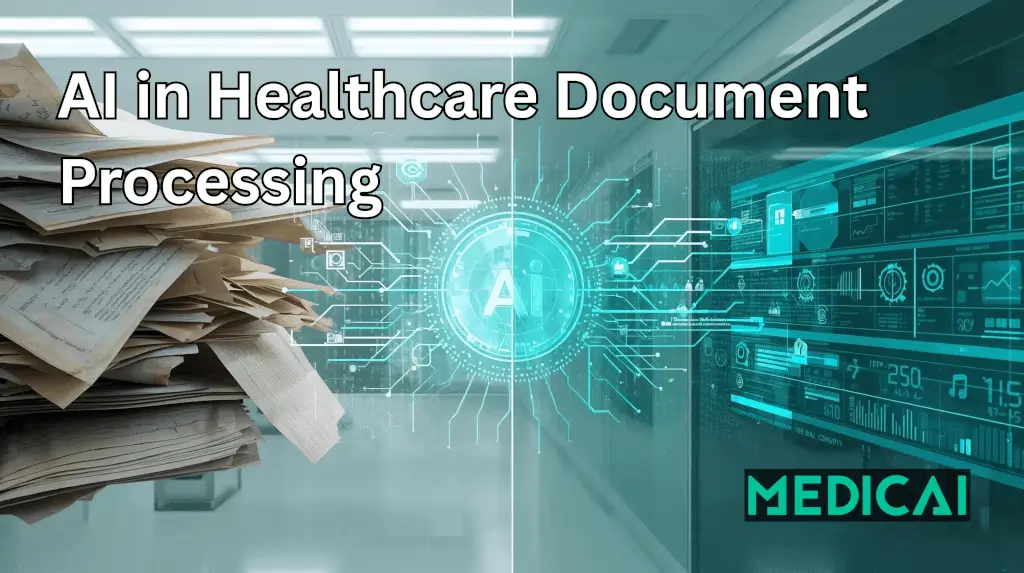
Healthcare runs on information — but much of that information is locked inside unstructured documents: handwritten notes, scanned lab reports, discharge summaries, and referral letters.
Every hospital, clinic, and imaging center generates thousands of such documents daily, each essential for patient care but difficult to manage efficiently.
This growing administrative complexity has turned document processing into one of the healthcare industry’s biggest pain points. Fortunately, artificial intelligence (AI) in document processing is changing that, introducing automation, structure, and insight into workflows that once relied entirely on manual effort.
The Complexity of Healthcare Paperwork
The average healthcare provider interacts with dozens of document types daily, each with a different format, structure, and language. Radiologists receive imaging referrals via fax, oncologists interpret discharge summaries, and billing teams handle insurance forms and authorizations.
A 2024 Linnaeus University thesis on AI-based medical administration found that nearly 60% of clinical staff time is spent processing or searching for information buried in unstructured documents. This administrative burden slows down diagnosis, increases costs, and contributes to physician burnout.
Key sources of document chaos include:
- Lab reports: Often unstandardized, with varying terminology and handwritten notes.
- Prescriptions: Scanned or faxed with inconsistent formats.
- Referrals: Frequently incomplete or lacking structured patient identifiers.
- Discharge summaries: Dense and narrative, making it hard to extract key insights.
Even in modern digital hospitals, PDFs and scanned images dominate the workflow — meaning the promise of electronic health records (EHRs) remains only partially fulfilled. As the European Commission’s Digital Health Strategy highlights, the future of healthcare data depends not only on collection but also on contextual understanding — something that AI is uniquely positioned to deliver.
What AI Brings: Understanding Unstructured Healthcare Data
Traditional document management systems could only store and search files. AI automation in healthcare, however, does something entirely different: it understands the content of those documents.
By combining machine learning (ML), natural language processing (NLP), and optical character recognition (OCR), AI systems can interpret unstructured medical text the same way humans do — but faster, and at scale.
According to Tateeda’s analysis of medical document automation, AI models trained on clinical datasets can now classify documents by type, extract key fields (like diagnosis or test values), and flag missing or inconsistent information in seconds.
Key capabilities include:
- Entity recognition: Identifying patient names, ID numbers, medications, and lab metrics.
- Contextual understanding: Distinguishing between “family history of diabetes” and “diagnosed diabetes.”
- Relationship mapping: Linking imaging results with referrals and treatment notes.
- Language translation: Processing multilingual clinical documents across international workflows with online translation.
AI doesn’t just read — it comprehends. This ability to process unstructured data and convert it into structured, interoperable formats is at the heart of modern EHR document management and interoperability efforts worldwide.
From Scanned PDFs to Structured Data — How AI Processing Works
AI-based document processing can be visualized as a three-step workflow:
Optical Character Recognition (OCR)
OCR transforms printed or handwritten text into digital text. In healthcare, this means scanning a paper referral or lab report and converting it into readable data. Advanced OCR tools — such as those used in WinWire’s Microsoft Azure-based medical document processing system — can even handle poor image quality and handwritten annotations.
Natural Language Processing (NLP)
Once text is digitized, NLP models interpret the meaning. They identify clinical terms, medical codes (ICD-10, SNOMED), and context such as “recommended test” vs. “performed test.” NLP transforms narrative text into structured fields ready for database entry or EHR synchronization.
Large Language Models (LLMs) and Reasoning
LLMs take automation further by reasoning across documents. For instance, an AI can cross-check a patient’s discharge summary against prior lab results and imaging reports to detect inconsistencies or missed follow-ups.
Integrating LLMs into medical documentation systems leads to smarter data classification and predictive insights — allowing hospitals to forecast patient readmissions or treatment adherence.
By merging OCR, NLP, and LLM reasoning, AI turns static PDFs into actionable medical intelligence.
Medicai’s Approach: Connecting Imaging + Medical Documents
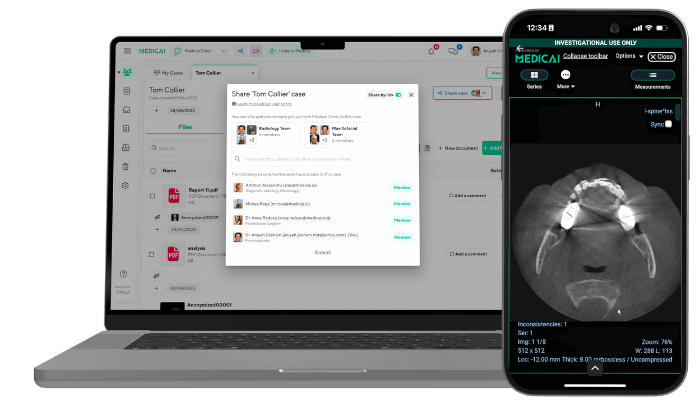
Medicai’s cloud-based infrastructure already helps healthcare organizations centralize DICOM images, reports, and patient data. Now, with AI-powered document processing, Medicai extends that intelligence to the non-imaging layer — enabling hospitals to unify medical documents and imaging in a single digital ecosystem.
Here’s how the workflow operates within Medicai:
- Document ingestion: Referrals, reports, and notes (from fax, email, or upload) are captured by Medicai’s secure cloud gateway.
- AI processing: OCR and NLP modules extract patient identifiers, imaging requests, and diagnostic terms.
- Automated linkage: Each document is automatically attached to the correct patient case and imaging series in the Medicai PACS environment.
- Structured output: The data can be pushed to EHRs or shared with specialists via secure cloud access.
By integrating document automation with imaging workflows, Medicai removes the disconnect between what clinicians see (imaging data) and what they read (medical text). This holistic approach supports faster diagnoses, reduces redundant scans, and strengthens collaboration among radiologists, oncologists, and referring physicians.
Use Cases: AI in Healthcare Document Processing
Referral to Imaging Workflow
Referrals often arrive as unstructured PDFs or faxes. AI document processing extracts details such as patient ID, modality requested, and clinical reason for imaging. Medicai automatically attaches this information to the patient’s case, ensuring radiologists have all context upfront.
As noted in Onymos’s use case library on AI in healthcare, automated referral intake can reduce scheduling time by up to 70% and eliminate errors caused by manual data entry.
Lab Report Extraction
Lab results typically contain valuable diagnostic insights but are often stored as flat PDFs. Medicai’s AI system identifies key lab values (e.g., creatinine, glucose, hemoglobin) and integrates them into the patient timeline. Organizations like Meditice help in this identification and integration.
By aligning lab data with imaging and clinical reports, physicians gain a complete, chronological view of patient health — supporting precision medicine initiatives.
Discharge Summary Archiving
Discharge summaries contain essential details: diagnosis, procedures, prescribed medications, and follow-up instructions. Medicai’s document processor categorizes and indexes these summaries, enabling fast retrieval and cross-referencing with imaging or prior admissions.
As Topflight Apps explains, automating discharge documentation improves care continuity and simplifies quality-assurance audits across departments.
Across all use cases, AI’s role is not simply to store data but to create intelligent, interoperable connections between documents and patient outcomes.
Future Trends in Medical Document Intelligence
The next wave of medical document intelligence will focus on autonomy, interoperability, and context-aware reasoning.
Emerging trends include:
- Agentic AI Systems: Self-coordinating agents capable of triaging, categorizing, and routing documents without human intervention.
- Multimodal Integration: Combining text, imaging, and sensor data for comprehensive patient modeling.
- Predictive Analytics: Using document trends (e.g., frequency of tests or diagnoses) to anticipate patient needs or hospital resource allocation.
- Federated Learning: Training document AI models across multiple hospitals without sharing sensitive data, preserving privacy while expanding knowledge.
The European Commission identifies trustworthy, transparent AI as a cornerstone of the future European Health Data Space — a vision perfectly aligned with Medicai’s privacy-first, interoperable architecture.
As healthcare moves toward a data-driven ecosystem, the ability to extract, structure, and reason over documents will define the leaders in digital transformation.
Conclusion: From Data Disorder to Digital Clarity
AI has become the quiet force behind healthcare modernization — not replacing clinicians, but empowering them by eliminating inefficiency and information overload.
From scanned lab reports to complex oncology case histories, AI-powered medical document processing turns chaos into clarity. By converting unstructured data into structured intelligence, platforms like Medicai are closing the gap between administrative burden and clinical value.
The result? Faster workflows, more accurate records, and a healthcare system where information flows as seamlessly as care itself.


Related Articles
Lets get in touch!
Learn more about how Medicai can help you strengthen your practice and improve your patients’ experience. Ready to start your Journey?
Book A Free Demo