Hospital Information System (HIS): Why It Is the Centre of Every PACS Workflow

Every radiology order that reaches your PACS starts in your Hospital Information System. Every patient identity mismatch that breaks your PACS workflow traces back to a data problem in your HIS. Understanding HIS is not optional knowledge for imaging informatics teams — it is the prerequisite for understanding why the PACS workflow behaves the way it does.
What is a Hospital Information System?
A Hospital Information System is a comprehensive, integrated hospital management software platform that manages all aspects of hospital operations — clinical, administrative, financial, and legal — with the patient as the central data object. Where a departmental system like a Radiology Information System (RIS) or a Laboratory Information System (LIS) manages a single department’s data and workflow, an HIS manages the full lifecycle of a patient’s interaction with the institution: from the first registration through discharge, billing, and audit. In a broader hospital operations context, teams may also use workplace safety software to manage facility hazards, incident reporting, and compliance protocols that sit outside the core HIS workflow.
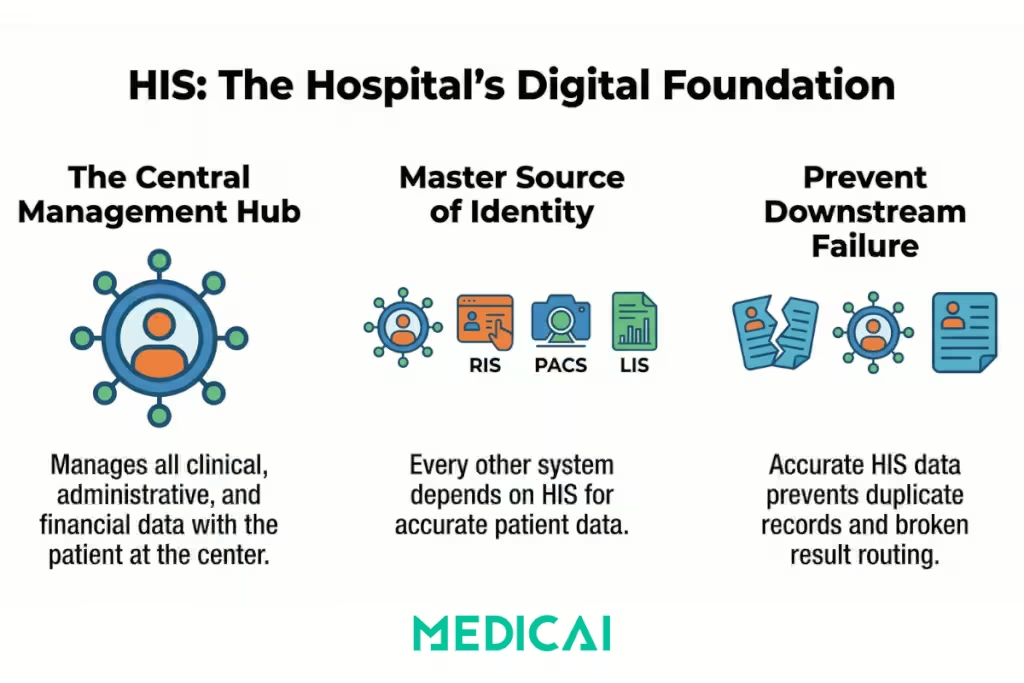
The working definition matters for imaging teams because HIS sits at a specific position in the hospital architecture: it is the system of record for patient identity. Every other system in the hospital — RIS, PACS, LIS, pharmacy, and the EHR — depends on the patient identity data that HIS establishes and maintains. When that data is correct and consistently synchronized, the imaging workflow runs without friction. When it is inconsistent, every downstream system exhibits symptoms: duplicate patient records, unmatched studies in the PACS archive, broken result routing, and failed prior retrieval.
HIS is also frequently called HMS (Hospital Management System), and many vendors use the term Hospital Management Software to describe the same category of solutions. The distinction is largely cosmetic: all three terms refer to the same class of enterprise hospital platform.
| Term | Relationship to HIS |
| HMS (Hospital Management System) | Synonym — same category, different marketing label |
| EHR (Electronic Health Record) | Sub-system within HIS, or a separate system that HIS integrates with. EHR focuses on the patient clinical record; HIS covers the full operational scope, including billing, supply chain, and staffing |
| EMR (Electronic Medical Record) | Narrower than EHR; covers the digital patient chart within a single practice or department |
| RIS (Radiology Information System) | Departmental sub-system that manages imaging orders, scheduling, and reporting. Receives identity and order data from HIS |
| PACS (Picture Archiving and Communication System) | Imaging archive and viewing layer. Does not typically connect directly to HIS; the vector runs HIS → RIS → PACS |
| LIS (Laboratory Information System) | Departmental sub-system for laboratory operations; same integration pattern as RIS |
What is the information system of a hospital, and what does it cover?
A hospital’s information system covers every data domain it must manage to operate legally, clinically, and financially. In modern implementations, these domains are managed through a combination of a central HIS platform and integrated departmental systems, all connected by standardized messaging protocols.
Patient administration domain
The patient administration domain covers registration, identification, and movement through the institution. Admission, Discharge, and Transfer (ADT) events are the most significant data outputs of this domain. Every ADT event — an admission, a transfer between wards, a discharge — triggers an HL7 message that other systems depend on to update their own records. For imaging teams, ADT messages are the mechanism by which PACS learns that a patient’s room has changed, that an encounter has closed, or that a patient previously registered under one record has been merged with another. ADT messaging failures are among the most common causes of patient identity mismatches in PACS archives.
Order management domain
The order management domain covers the lifecycle of clinical orders: physician-initiated requests for imaging, laboratory tests, medications, and procedures. In the imaging chain, the relevant event is the radiology order: a physician creates an order in HIS, which transmits it via an HL7 ORM message to the RIS. RIS converts the order into a scheduled examination, which becomes the worklist entry that the modality sees and the radiologist reads. A hospital that creates imaging orders in HIS but does not transmit them reliably to RIS forces manual worklist entry at the modality — one of the primary sources of transcription errors in the PACS workflow.
Clinical documentation domain
The clinical documentation domain covers the patient chart: diagnoses, history, medication lists, allergies, procedure notes, and discharge summaries. This is where the EHR component of HIS operates. For imaging teams, this domain is relevant at the result delivery end of the workflow: when the RIS transmits a completed radiology report back to HIS via an HL7 ORU message, HIS stores the result in the patient’s chart and makes it available to the ordering clinician.
Financial and revenue cycle domain
The financial domain covers charge capture, billing, claims submission, insurance verification, and revenue cycle management. Imaging departments interact with this domain when procedure codes, modality charges, and radiologist professional fees are submitted from RIS to HIS for billing. Integration failures at the billing interface can cause underbilling, duplicate charges, or claim denials that are invisible to the clinical team but financially significant.
Departmental integration domain
This domain covers all connections between HIS and departmental systems, including RIS, LIS, pharmacy, nursing, and operating room management. The integration architecture typically uses an interface engine at the centre — a middleware layer that routes HL7 messages between the HIS and each departmental system, translates formats as needed, and monitors message delivery for failures. The interface engine is the component that imaging informatics teams interact with most frequently when troubleshooting PACS workflow failures that originate upstream in HIS.
What are the components of a Hospital Information System?
The components of an HIS are typically described in two complementary frameworks: the five technical components that define any information system, and the specific software modules that make up a healthcare HIS implementation.
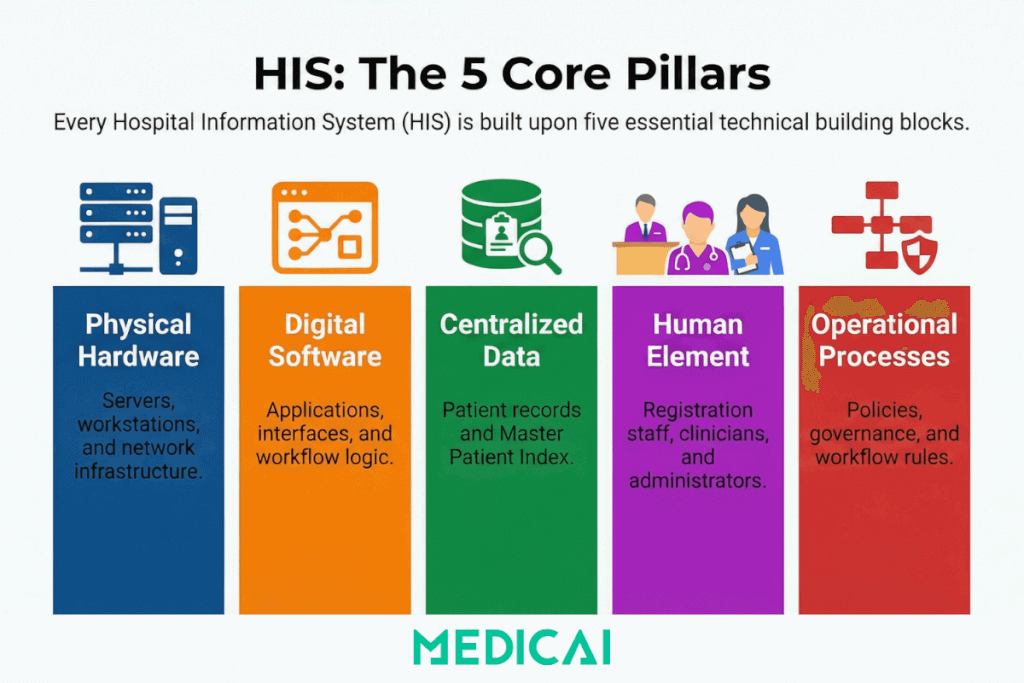
The five technical components of an information system
| Component | What is in HIS | Where imaging teams encounter it |
| Hardware | Servers, workstations, storage arrays, and network infrastructure that host and run the HIS | Network latency is affecting HL7 message delivery to RIS; server performance is affecting ADT event propagation speed |
| Software | The HIS application itself — modules, user interface, workflow logic, and message handling | The ADT module, order entry module, and HL7 interface engine that generate the messages the PACS workflow depends on |
| Data | Patient records, order history, clinical documentation, billing data, and the Master Patient Index | The MPI is the data component that imaging teams must understand most thoroughly — every patient identity mismatch in PACS is a data quality problem that originates here |
| People | Registration staff, clinical users, HIS administrators, interface engine operators, and vendor support | Registration staff whose data entry quality directly determines whether accession numbers match between HIS, RIS, and PACS |
| Processes | Policies, workflows, and governance structures that define how the system is used and how errors are escalated | ADT event governance directly determines PACS workflow stability downstream |
The HIS software modules
| Module | Function |
| Patient Registration / ADT | Entry point for every patient encounter. Captures demographic data, establishes the patient identity record in the MPI, and generates ADT events that propagate to all integrated systems |
| Master Patient Index (MPI) | Enterprise patient identity registry. Resolves duplicate records, links encounters across visits and facilities, and maintains the single authoritative patient identifier that all other systems reference |
| Order Management / CPOE | Computerized Physician Order Entry. Where clinicians create orders for imaging, laboratory, and pharmacy. Generates the HL7 ORM messages that reach RIS |
| Electronic Health Record (EHR/EMR) | Clinical documentation module. Receives results (HL7 ORU messages) from departmental systems, including RIS, and stores them in the patient chart |
| Laboratory Information System (LIS) | Manages laboratory orders, specimen tracking, result reporting, and quality control |
| Radiology Information System (RIS) | Manages imaging orders, modality scheduling, exam status tracking, report management, and billing for the radiology department |
| Pharmacy Information System (PIS) | Manages medication dispensing, drug interaction checking, formulary management, and medication administration recording |
| Nursing Information System (NIS) | Ward-level nursing documentation: care plans, nursing assessments, medication administration records, and patient monitoring data |
| Billing / Revenue Cycle Management (RCM) | Charge capture, claims generation, insurance eligibility verification, denial management, and payment posting |
| Clinical Decision Support (CDSS) | Alert generation, evidence-based guideline surfacing, drug interaction warnings, and clinical protocol enforcement at the point of care |
| Analytics / Business Intelligence | Operational and clinical reporting, performance dashboards, and population health data aggregation |
What is the difference between HIS, EHR, and EMR?
The most common confusion in clinical IT procurement concerns the relationships among HIS, EHR, and EMR. These are not synonyms, but they overlap in scope, and the boundary is not always clear in vendor marketing.
The simplest frame: HIS is the full hospital operating system. EHR is the clinical record within that operating system. EMR is the digital version of the paper chart within a single practice or department.
| Hospital Information System (HIS) | EHR / EMR | |
| Scope | Enterprise-wide: clinical, administrative, financial, and operational domains across the hospital or health system | Clinical record focus: patient medical history, diagnoses, medications, allergies, care plans, and results |
| Users | Clinicians, nursing, registration, billing, department administrators, IT teams, and executives | Primarily clinical users: physicians, nurses, and allied health professionals |
| Integration | Contains or connects to all departmental systems: RIS, LIS, PACS, pharmacy, OR management, billing, and more | Receives results from departmental systems and presents them in the patient’s chart |
| Patient identity | Maintains the Master Patient Index — the authoritative patient identity registry for the institution | References patient identity from the MPI; does not manage it |
| Imaging context | HIS generates an ADT event on admission; HIS creates an imaging order; HIS receives a radiology report and stores it in the chart | The EHR is where the referring clinician sees the completed radiology report within the patient’s chart |
For imaging teams, the practical implication is this: the integration points that matter are between HIS and RIS (order transmission, ADT messaging, result return), not between EHR and PACS. PACS does not typically integrate with the EHR. The integration architecture runs HIS → RIS → PACS, with results returning on the reverse path.
How HIS sits at the origin of every PACS workflow event
The PACS workflow — the lifecycle that moves an imaging order into an acquired study, then into a searchable archive, and finally into clinical access points with correct patient and encounter context — does not begin at the modality or the PACS. It begins at the Hospital Information System.
Every meaningful event in the PACS workflow has a corresponding upstream event in HIS. Understanding the mapping between HIS events and PACS workflow events is the single most useful framework for diagnosing why a PACS workflow breaks.
The HIS to RIS to PACS event chain
| HIS event | Downstream effect in RIS and PACS |
| Patient registration (ADT A01 — Admit) | RIS receives the A01 message and creates the patient record with demographic data. PACS receives patient identity from RIS. MRN mismatches at this step cause duplicate patient records across all systems. |
| Patient transfer (ADT A02 — Transfer) | RIS updates the patient’s location. Workflow managers who route studies to reading queues by location depend on this event being accurate and timely. |
| Patient merge (ADT A40 — Merge) | The most operationally significant ADT event for imaging. An A40 message instructs downstream systems to merge two patient records identified as duplicates. PACS merge processing failures leave split patient records where a radiologist may not see studies acquired under the legacy MRN. |
| Imaging order created (ORM O01) | RIS creates a scheduled examination. Assigns an accession number. Makes the examination visible on the modality worklist. If the ORM message arrives late, the modality technologist examines without a worklist entry and must manually enter patient and order data, increasing the risk of transcription errors. |
| Radiology report completed (ORU R01 — return) | RIS transmits the signed radiology report back to HIS. HIS stores the result in the patient’s EHR and may trigger alerts to the ordering physician. ORU transmission failure means the referring clinician does not receive the result in the EHR. |
| Patient discharge (ADT A03 — Discharge) | RIS closes open encounters. Billing interfaces trigger charge submission. Imaging orders placed after discharge may need manual encounter reconciliation in RIS. |
The Master Patient Index is the identity foundation
The Master Patient Index is the HIS component that imaging teams most frequently underestimate until something goes wrong. The MPI is the enterprise patient identity registry: a deduplicated, authoritative list of every patient the institution has encountered, with each patient assigned a unique enterprise identifier.
Every patient record in RIS and in PACS ultimately references an identity that originated in the HIS MPI. When HIS maintains a clean, deduplicated MPI — with consistent MRNs, correct names, and no duplicate registrations — the downstream systems operate correctly. When the MPI contains duplicates, the imaging systems exhibit four characteristic failure modes: two patient records in RIS for the same person, studies in PACS under the wrong patient, priors unretrievable because stored under a legacy identifier, and worklist entries that do not match acquired studies at the modality.
IHE (Integrating the Healthcare Enterprise) defines the Patient Administration Management (PAM) profile to govern how ADT events from HIS are propagated to downstream systems. The PIR (Patient Information Reconciliation) profile defines how to handle unmatched studies — acquisitions that arrived in PACS without a matched worklist entry. Both profiles describe problems that originate in the HIS-to-RIS data layer, not in PACS itself.
How does HIS communicate with RIS, PACS, and other systems?
HIS communicates with departmental systems primarily through HL7 version 2 messaging. HL7 v2 defines the structure of messages that HIS sends to RIS, LIS, and pharmacy, as well as the structure of the result messages those systems send back. For modern interoperability requirements, FHIR is emerging as the API layer that complements or replaces HL7 v2 for specific integration patterns.
HL7 v2 — the messaging backbone
| HL7 message type | What it carries and why it matters |
| ADT A01 — Patient Admit | Patient registration data: MRN, name, date of birth, sex, address, insurance, attending physician, and encounter identifiers. Establishes the patient context that RIS and PACS will use for all subsequent events in the encounter. |
| ADT A08 — Patient Update | Corrects demographic data without a location change event. Name corrections, MRN corrections, and insurance updates come through A08. Late-arriving A08 messages can cause discrepancies between the patient name in PACS and the current registered name in HIS. |
| ADT A40 — Patient Merge | Merges two patient records identified as duplicates. The most operationally complex ADT event is because it requires every downstream system to reconcile all historical data for the merged records. PACS implementations that do not fully process A40 messages leave split imaging histories. |
| ORM O01 — Order Message | The imaging order: procedure code, ordering physician, clinical indication, priority, patient identity, and requested time. Creates the scheduled examination in RIS and the worklist entry that the modality will receive. |
| ORU R01 — Observation Result | The completed radiology report was transmitted from RIS back to HIS for storage in the EHR and notification to the ordering clinician. Closes the imaging order loop. |
FHIR — the modern interoperability layer
FHIR (Fast Healthcare Interoperability Resources) is the HL7-published standard for API-based interoperability. Where HL7 v2 uses message-based push delivery, FHIR uses RESTful APIs that allow systems to request data on demand, expose resources in standardized formats, and integrate with modern applications, including analytics platforms and AI tools.
The FHIR ImagingStudy resource is the specific integration point that connects the FHIR layer to the PACS layer. An ImagingStudy resource provides the WADO-RS endpoint that a FHIR-enabled application — such as an EHR with an integrated DICOMweb viewer — can use to retrieve imaging objects from PACS. This architecture enables radiology report links to open directly in an image viewer within the EHR context, and it depends on both the HIS and PACS correctly implementing FHIR. The 21st Century Cures Act’s information-blocking provisions and ONC’s API certification requirements have accelerated FHIR adoption across HIS platforms.
How does HIS relate to PACS interoperability?
PACS interoperability — the ability of a PACS to exchange imaging data and clinical context with other systems across institutional boundaries — depends directly on HIS quality, a factor rarely discussed in PACS-centric content. The four levels of interoperability (foundational, structural, semantic, and organizational) each have an HIS component.
Foundational interoperability
At the foundational level, HIS must be able to transmit HL7 messages, and PACS must be able to receive DICOM objects. The failure mode at this level is typically network or interface engine configuration: messages are generated in HIS but not received in RIS because of firewall rules, incorrect IP routing, or interface engine downtime.
Structural interoperability
At the structural level, the data fields in HIS messages must be populated in the correct format and mapped to the correct fields in RIS and PACS. A HIS that populates the patient identifier in the wrong HL7 field, uses a non-standard date format, or generates ORM messages with procedure codes that RIS does not recognise will produce PACS workflow failures that appear as imaging data problems but are actually HIS data quality issues. This is where most chronic PACS workflow problems originate.
Semantic interoperability
At the semantic level, HIS and RIS must share a common understanding of what the data means. Clinical indication codes in HIS must map to procedure codes in RIS that the modality and PACS understand. SNOMED CT and LOINC coding in HIS order data must translate meaningfully into DICOM metadata fields in the modality worklist. When a referring physician enters a clinical indication in HIS that RIS cannot translate into a recognised procedure code, the result is an examination acquired with incorrect or missing DICOM metadata, which degrades report searchability and downstream AI algorithm performance.
Organizational interoperability
At the organizational level, HIS governance determines whether PACS interoperability across institutions is achievable. A health system that has not established consistent patient identity management across its HIS instances — different MRN formats at different sites, or no enterprise MPI linking records across facilities — cannot achieve reliable cross-site priors retrieval in PACS regardless of the technical standards implemented. The organizational decisions made in HIS governance set the ceiling for what PACS interoperability can achieve.
What HIS problems cause PACS workflow failures?
When a PACS workflow breaks — a study appears in the wrong patient, an accession number does not match, a prior is unretrievable, a worklist entry is missing — the diagnostic instinct is to look at PACS or RIS first. In most cases, the root cause is upstream in HIS.
| HIS problem | Symptom visible in the PACS workflow |
| Duplicate patient registration in the MPI | Two patient records in PACS. Studies from different visits appear under different names or MRNs. A radiologist cannot retrieve the complete prior history. Must be resolved by an A40 merge in HIS propagated to RIS and PACS. |
| ADT message transmission delay (A01 not received in RIS before imaging order placed) | The modality worklist entry exists in RIS, but patient demographics are incomplete or absent. The technologist performs an exam with a partial worklist entry, thereby increasing the risk of transcription errors. |
| ORM message failure (imaging order created in HIS but not transmitted to RIS) | No worklist entry in RIS. The technologist performs the exam without a worklist entry and manually enters patient and order data. Manually entered data may not exactly match the HIS record, causing an unmatched study in PACS. |
| A08 demographic update not propagated | PACS retains the original (incorrect) name. Radiology reports are filed under the corrected name in HIS, but imaging studies display the old name, creating compliance discrepancies. |
| A40 merge is not fully processed by PACS | Split imaging history: studies from the merged record remain under the old identifier. A radiologist reading priors for a follow-up encounter cannot see historical studies without manually searching by legacy MRN. |
| Accession number format mismatch | ORM messages arrive in RIS but cannot be parsed correctly. The order is created with an incorrect or truncated accession number. Modality acquires the study with a mismatched accession, creating an unmatched study in PACS requiring manual reconciliation. |
| ORU result return failure | The referring clinician does not receive the result notification in the EHR. Clinicians must access RIS or PACS directly to see the completed report, bypassing the standard result review workflow and potentially delaying clinical action. |
Which standards govern HIS interoperability?
| Standard | Role in HIS interoperability |
| HL7 version 2 (v2.3 through v2.8) | The primary messaging standard for HIS-to-RIS and HIS-to-LIS integration. Defines the structure of ADT, ORM, and ORU messages. Dominant in existing HIS implementations globally. |
| HL7 FHIR (R4 and R4B) | The API standard for modern HIS interoperability. Mandated for US provider data sharing under the 21st Century Cures Act. FHIR R4 is the current stable version and the certification target for ONC compliance. |
| IHE PAM (Patient Administration Management) | The IHE integration profile governing the propagation of ADT events from HIS to departmental systems. Defines the specific ADT message triggers, required data fields, and acknowledgement patterns that ensure reliable patient identity propagation from HIS to RIS and PACS. |
| IHE PIR (Patient Information Reconciliation) | The IHE profile defining how unmatched imaging studies — acquisitions that arrived in PACS without a matched worklist entry — are linked retrospectively to the correct patient and encounter. |
| IHE Scheduled Workflow (SWF) | The IHE profile governing the full order-to-archive workflow chain from HIS through RIS to PACS. SWF defines the complete sequence of HL7 and DICOM transactions expected when a patient is registered, an order is placed, a study is acquired, and the study is archived. |
| SNOMED CT / LOINC / ICD | Terminology standards used within HIS for clinical coding. Consistent terminology in HIS order data is the prerequisite for semantic interoperability between HIS, RIS, and PACS. |
How do you measure HIS performance in the context of imaging integration?
| Metric | What it measures and why it matters for imaging |
| ADT message latency (A01 to RIS receipt) | Time between a patient registration event in HIS and the corresponding patient record appearing in RIS. Target: under 60 seconds for elective admissions, under 10 seconds for emergency registrations. Latency above this threshold increases the risk that an imaging order will be placed in the RIS before the patient record exists. |
| ORM message success rate | Percentage of imaging orders placed in HIS that successfully create a scheduled examination in RIS. Target: 99.5% or higher. Failures require manual order entry in RIS and introduce transcription error risk. |
| A40 merge processing rate | Percentage of HIS patient merge events successfully processed by RIS and PACS to consolidate imaging histories. Target: 100% within 4 hours of the merge event. Unprocessed merges leave split imaging records. |
| Unmatched study rate in PACS | Percentage of imaging studies that arrive in PACS without a matched worklist entry and must be manually reconciled. The downstream measure of HIS data quality: high unmatched rates consistently trace to ORM message failures, ADT latency, or CPOE workflow problems in HIS. |
| ORU result return success rate | Percentage of completed radiology reports successfully transmitted from RIS to HIS and stored in the EHR. Target: 99.9% or higher. Failures require manual report delivery and can delay clinical decision-making. |
| MPI duplicate rate | Percentage of active patient records in the HIS MPI identified as duplicates during ongoing data quality monitoring. Target: below 1%. Above this threshold, duplicate-driven PACS workflow failures become frequent enough to require dedicated remediation resources. |
What are the main challenges of implementing and operating a Hospital Information System?
- Implementation cost and complexity: Enterprise HIS implementations are among the most complex and expensive IT projects hospitals undertake. For imaging teams, the HIS go-live is a high-risk event: if the ADT and ORM interfaces are not configured correctly before go-live, the PACS workflow will fail from the first hour of production.
- User adoption and clinical workflow change: HIS implementations change how every clinical and administrative user in the hospital works. Incomplete adoption of CPOE and workarounds that bypass the intended system design degrade the quality of imaging order data flowing from HIS to RIS.
- Data quality and MPI integrity: Legacy data migrated from old systems carries issues: duplicate MRNs, inconsistent name formats, and missing demographic fields. These problems propagate to RIS and PACS through the ADT and ORM interfaces and require a sustained data governance programme to resolve.
- Interoperability gaps between HIS and departmental systems from different vendors: Most hospitals use HIS and RIS from different vendors, each with its own HL7 implementation. The interface engine bridges the gap but requires careful configuration and ongoing maintenance. When either HIS or RIS is upgraded, the interface configuration must be re-validated.
- Cybersecurity and HIPAA compliance across an expanded attack surface: HIS stores the hospital’s most sensitive ePHI. An HIS outage cascades across all integrated systems: if HIS goes down, the ADT feed to RIS stops, imaging orders cannot be transmitted, and result returns to the EHR fail.
How is the Hospital Information System evolving?
Cloud-native HIS platforms
The shift from on-premise HIS to cloud-hosted architectures is accelerating. For imaging integration, cloud HIS changes the network path between HIS and RIS, introducing new latency considerations for high-frequency ADT messaging in busy emergency departments.
FHIR as the primary interoperability layer
US regulatory requirements under the 21st Century Cures Act are driving HIS vendors to implement FHIR R4 APIs as a condition of ONC certification. For imaging integration, FHIR introduces the ImagingStudy resource as a standardized mechanism for sharing imaging metadata and study access endpoints, enabling EHR-integrated viewers to access PACS studies via FHIR rather than proprietary interfaces.
AI integration at the HIS layer
Clinical decision support is becoming AI-driven within HIS: algorithms that review order appropriateness, predict admission needs, and flag deteriorating patients. For imaging, the relevant development is AI-driven order appropriateness checking integrated into CPOE, where HIS evaluates whether an imaging order is clinically appropriate before transmitting the ORM to RIS. This capability changes the HIS-to-RIS message flow by modifying orders based on algorithmic evaluation.
Enterprise imaging governance through HIS
As PACS evolves toward enterprise imaging platforms with VNA-based archives and cloud delivery, HIS is increasingly being used as the governance layer for enterprise imaging access control. Patient consent preferences managed in HIS determine which studies can be shared across institutional boundaries. Enterprise imaging governance frameworks that are not anchored in HIS identity and consent data will fail to achieve organizational interoperability regardless of the imaging technical stack.
Interoperability mandates and information blocking rules
The ONC’s information blocking provisions, effective since April 2021, prohibit practices that unreasonably restrict access to electronic health information. Radiology results stored in HIS are subject to these provisions, which affect how quickly reports must be released and how access to patient-facing applications is granted.
What are examples of Hospital Information Systems?
| Platform | Context |
| Epic (US) | The largest HIS platform by market share in US academic medical centres and large health systems. Functions as an integrated HIS + EHR + revenue cycle platform. Epic’s integration with third-party PACS is one of the most commonly discussed HIS-to-PACS integration scenarios in US radiology informatics. |
| MEDITECH (US and international) | A major HIS platform serving community hospitals in the US and internationally. MEDITECH Expanse is the current cloud-native version. |
| Oracle Health / Cerner (US and international) | Formerly Cerner, acquired by Oracle in 2022. One of the two largest HIS platforms in the US, alongside Epic. Strong presence in the US government and VA healthcare, and significant international deployments in the UK NHS, the Middle East, and Australia. |
| SAP for Healthcare (international) | Widely deployed in European and Middle Eastern hospital networks. SAP HIS capabilities are often paired with departmental systems from other vendors through HL7 interfaces. |
| IQVIA HIS (international) | Widely deployed in Europe and the Asia-Pacific markets. The platform is relevant in contexts where international HIS-to-PACS integration patterns differ from US market conventions. |
| OpenMRS (global low-resource settings) | Open-source HIS platform widely deployed in low- and middle-income countries. Limited PACS integration capability relative to commercial platforms, but widely used in global health contexts where commercial licensing is not feasible. |
Frequently asked questions
Is HIS the same as an EHR?
No. HIS is the broader enterprise hospital platform that covers clinical, administrative, financial, and operational functions. EHR is typically a single module within HIS, focused on the patient’s clinical record. For imaging integration, the integration points that matter are between HIS and RIS, not between EHR and PACS.
What is the relationship between HIS, RIS, and PACS?
HIS, RIS, and PACS form a three-system chain in the imaging workflow. HIS is the system of record for patient identity and clinical orders. RIS is the radiology department’s operational system, receiving identity and orders from HIS and managing imaging scheduling, worklist generation, and report management. PACS is the imaging archive and viewing layer. The data direction is HIS → RIS → PACS for identity and orders; PACS → RIS → HIS for results. PACS does not typically connect directly to HIS.
Why does the PACS workflow break when something changes in HIS?
Because the PACS workflow is downstream of HIS in the data chain, every patient registration in PACS is created first by an ADT message from HIS. Every imaging order in the PACS archive was first created by an ORM message from HIS. When HIS changes — an upgrade, a configuration change, an ADT message format update — the downstream effects propagate to RIS and PACS. Changes to HIS that are not coordinated with the interface engine and downstream system administrators are the most common cause of sudden PACS workflow failures in stable environments.
What does HIS stand for?
HIS stands for Hospital Information System. It is also referred to as the Health Information System in some contexts. In search contexts, Hospital Management System (HMS) is the highest-volume synonym and refers to the same system category.


Related Articles


Lets get in touch!
Learn more about how Medicai can help you strengthen your practice and improve your patients’ experience. Ready to start your Journey?
Book A Free Demo