Agentic Document Processing: The Future of Intelligent Healthcare Workflows

For years, healthcare automation relied on rules—if-then systems that could only handle predictable inputs. If a referral form matched a known template, it was processed; if not, it was flagged for human review. But the reality of healthcare data is messy: handwritten notes, scanned PDFs, multilingual reports, and incomplete records.
Traditional automation could digitize these documents, but not understand them. That’s where the next evolution—Agentic AI—emerges. Instead of being programmed to follow fixed logic, it learns, reasons, and adapts dynamically to each document and workflow.
This shift is transforming medical document management from static automation to autonomous coordination, mirroring how clinical teams collaborate. As noted in a ScienceDirect study on autonomous document intelligence, healthcare is among the industries most likely to benefit from systems that combine perception, understanding, and decision-making in real time.
What Is Agentic AI (Explained Simply)?
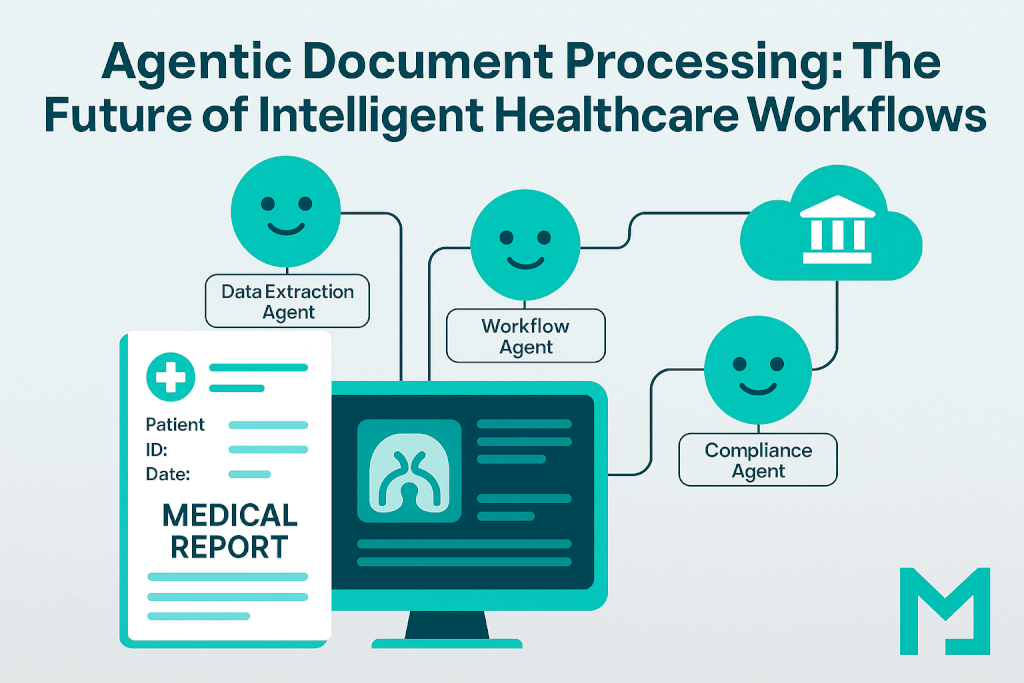
Agentic AI represents a paradigm shift from passive machine learning to proactive, goal-driven intelligence. Instead of a single model performing one task—like OCR or classification—agentic systems deploy multiple specialized agents that work together, much like a digital team.
Each agent has a clear role:
- OCR Agent reads and digitizes medical text.
- NLP Agent extracts key fields and identifies relationships between entities.
- Compliance Agent ensures that disclosures follow HIPAA or GDPR standards.
- Workflow Agent routes documents to the correct department or system.
These agents communicate and collaborate, adapting their responses based on the task and context. AWS describes this shift as “workflow automation powered by reasoning-capable multi-agent ecosystems”, where AI doesn’t just automate a step—it manages an entire process.
How Agentic Systems Learn, Decide, and Collaborate
In traditional AI document processing, models work in isolation: OCR → NLP → Classification → Output. Agentic systems, however, use a loop of perception, reasoning, and coordination.
Here’s how it works in medical document workflows:
- Perception — The system detects the type of document (e.g., lab report, referral, consent form).
- Reasoning — LLMs interpret context: a mention of “contrast-enhanced CT” means it belongs to a radiology case.
- Decision-making — The routing agent decides whether to forward it to imaging, oncology, or billing.
- Collaboration — Agents validate each other’s outputs, ensuring accuracy before data syncs with the PACS or EHR.
According to XenonStack’s exploration of AI-powered healthcare documentation, generative and agentic systems can manage end-to-end document lifecycles—from intake to audit trails—without human intervention.
Medicai’s Approach: Agentic AI Meets Document Workflows
Medicai is advancing from AI-based automation to agentic intelligence—integrating multi-agent systems within its PACS and document ecosystem. The goal is to make every document, whether a referral or ROI authorization, self-routing and self-validating.

In a typical scenario:
- The Document Intake Agent captures uploads from patients, clinicians, or external systems.
- The Data Extraction Agent identifies key metadata (e.g., patient ID, modality, referring physician).
- The Routing Agent associates the data with the relevant imaging case.
- The Audit Agent logs all actions for compliance and traceability.
This setup mirrors the collaborative behavior described in Microsoft Azure Marketplace’s healthcare automation showcase, where multi-agent AI dynamically manages document flow, ensuring accuracy and compliance without manual intervention.
Medicai’s architecture extends this concept by embedding these AI agents directly within its imaging network—bridging documents, diagnostics, and patient communication into one unified workflow.
Real-World Impact: Triage, ROI, and Referrals
Agentic AI isn’t theoretical—it’s already redefining daily workflows in medical settings.
Referral Triage
When a new referral is uploaded, the system identifies modality type, urgency, and referring department. It then automatically routes it to the right radiologist or specialty queue—saving administrative staff hours of manual sorting. This echoes Medicai’s own AI advancements outlined in its blog on AI document processing.
ROI (Release of Information) Automation
The agentic system reads ROI forms, verifies patient identity, checks authorization fields, and sends data to the proper compliance queue.
This process aligns with how Medicai already handles digital ROI workflows described in its healthcare document automation blog.
Referral-to-Imaging Synchronization
When a referring provider sends a document and images are later uploaded, the AI cross-links them by metadata. The radiologist instantly sees both, ensuring faster case interpretation.
Similar workflows are detailed in Medicai’s post on AI in patient document processing, showcasing seamless integration between uploads, extraction, and routing.
The outcome: fewer delays, higher throughput, and better continuity of care.
The Path to Full Autonomy in Medical Administration
Agentic AI doesn’t just execute commands—it plans and learns. According to LinkedIn’s analysis of agentic document processing, these systems can autonomously decide how to handle new or complex document types, refine workflows based on past performance, and even suggest improvements in document design for better readability.
The implications for healthcare are profound:
- Dynamic Adaptation: When hospitals update referral templates, agents learn the new layout without retraining.
- Collaborative Agents: One agent might handle referral data extraction while another validates insurance authorization.
- Self-Monitoring Compliance: Built-in logs and feedback loops ensure HIPAA/GDPR alignment without extra configuration.
This evolution points to a future where healthcare systems manage themselves—intelligently, securely, and in real time.
As described in ScienceDirect’s 2025 research on autonomous healthcare AI, “the transition from rule-based automation to agentic collaboration is the defining leap toward self-managing healthcare ecosystems.”
Conclusion: Agentic AI in Medical Document Processing
From OCR to NLP to large language models, the evolution of healthcare AI has been rapid—but agentic AI is the next frontier. It takes automation beyond efficiency into autonomy—where intelligent agents collaborate to ensure that every referral, consent, or discharge document is processed, routed, and validated in seconds.
Medicai’s move toward Agentic Document Processing represents a pivotal step in building self-orchestrating healthcare ecosystems—where imaging, documentation, and administration operate as one unified, intelligent system.
As generative AI continues to mature, the question is no longer whether automation can handle healthcare paperwork—it’s how far we’ll let AI take us toward a truly autonomous hospital.


Related Articles
Lets get in touch!
Learn more about how Medicai can help you strengthen your practice and improve your patients’ experience. Ready to start your Journey?
Book A Free Demo