How AI Document Extraction Accelerates Clinical Workflows

Healthcare runs on documents — referrals, reports, authorizations, discharge summaries, and imaging requests. Each plays a critical role in diagnosis and care coordination, yet most are still processed manually.
This administrative bottleneck delays treatment, increases clinician burnout, and slows down operational throughput.
Today, AI document extraction and automated routing are transforming how hospitals handle the flood of unstructured medical paperwork — turning chaos into actionable data within seconds.
From Document Chaos to Intelligent Categorization: AI Document Extraction in Healthcare
Every healthcare organization struggles with document overload. PDFs, faxes, and handwritten notes arrive from multiple sources daily — outpatient clinics, labs, insurance companies, and referring physicians.
Traditionally, staff had to open each file, interpret its content, and manually assign it to the right department or patient folder.
A 2025 study published in Artificial Intelligence in Medicine found that over 65% of administrative time in radiology still goes into manually identifying, sorting, and routing documents — a process highly prone to delays and errors.
AI eliminates this friction through intelligent categorization. By analyzing document content rather than relying solely on filenames or metadata, it automatically determines the document type (e.g., referral, consent, lab report) and routes it to the correct destination.
This shift from static storage to dynamic categorization enables seamless, near-real-time document management across the clinical workflow.

How AI Understands Context — Not Just Text
The true value of AI in document management lies not just in reading words, but in understanding clinical context.
Unlike traditional OCR tools that merely digitize text, modern AI systems combine Optical Character Recognition (OCR), Natural Language Processing (NLP), and Large Language Models (LLMs) to extract structured meaning from unstructured data.
As the Radiological Society of North America (RSNA) notes, AI systems can now “interpret unstructured narratives and infer relationships between diagnosis, modality, and procedure type.”
For example:
- When a referral states, “CT Brain for post-trauma evaluation,” AI identifies the modality (CT), anatomical region (brain), and clinical purpose (post-trauma).
- When processing a lab report, it distinguishes test results from interpretations and comments.
- It can even infer priority levels from contextual language — recognizing urgency phrases like “rule out stroke” or “urgent oncology referral.”
This kind of semantic understanding enables accurate routing and prioritization, a critical feature for radiology and multidisciplinary workflows.
Medicai’s Smart Routing: From Upload to Radiologist
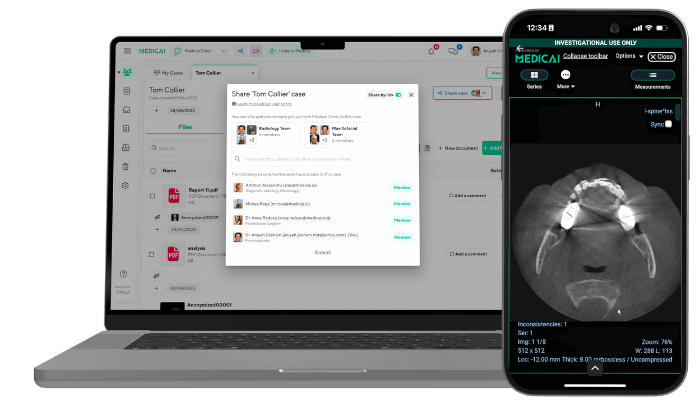
Medicai takes this one step further by embedding AI document processing directly within its cloud PACS and collaboration platform.
In traditional workflows, when a radiologist receives a faxed referral, administrative staff must:
- Upload the document.
- Match it manually with a patient record.
- Tag it with the imaging modality.
- Forward it for interpretation.
With Medicai, the process is automated end-to-end:
- Upload – The referring physician or patient uploads a document via Medicai’s portal.
- Extract – AI identifies relevant details (patient name, ID, modality, referring doctor, indication).
- Route – The system automatically associates the document with the correct patient case and forwards it to the assigned radiologist.
This workflow mirrors advanced AI-powered referral processing systems, where uploaded documents are analyzed and routed based on content and urgency, as described in Medicai’s overview of AI in healthcare document processing.
The result: zero manual triage, faster assignment of imaging, and greater consistency across departments.
AI-Powered Referral Matching and Prioritization
Routing isn’t just about sending documents — it’s about sending the right document to the right specialist at the right time.
A recent study in Computers in Biology and Medicine found that AI-based document triage can increase referral accuracy by over 40%, particularly in radiology and oncology workflows where case context is essential.
Medicai’s referral intelligence model performs three core tasks:
- Automatic Matching: AI extracts patient identifiers and matches them with existing imaging studies or EHR data.
- Smart Prioritization: Urgent or high-risk referrals are flagged for priority review, based on content and clinical keywords.
- Cross-Linking: AI connects relevant documents (e.g., prior imaging reports, lab results, or discharge summaries) to give radiologists full context before reading new scans.
This ensures that each imaging case reaches the correct radiologist, equipped with the full patient narrative.
Landing AI’s healthcare division highlights a similar framework in their analysis of AI-driven healthcare routing, noting that contextual classification enables both speed and safety in document processing pipelines (source).
Integrating with EHRs, PACS, and Patient Portals
For AI document extraction to deliver real operational value, it must integrate seamlessly across healthcare IT systems.
Modern platforms like Medicai achieve this through API-driven interoperability — enabling bi-directional data flow between EHRs, PACS, and patient portals.
For instance:
- Extracted data from referral PDFs syncs directly into patient profiles within EHRs.
- Imaging metadata from PACS is automatically updated with relevant documentation.
- Patients uploading reports through portals see their files processed and attached to their digital record in seconds.
This kind of integration is the foundation of AI-enhanced interoperability, ensuring data accuracy, continuity of care, and compliance with HIPAA and GDPR standards — all while reducing redundant manual entry.
As described in Medicai’s AI-in-healthcare document automation insights, these connections not only speed up workflows but also create the foundation for future agentic systems capable of coordinating across multiple departments autonomously.
Future: Agentic Routing for Multi-Department Coordination
The next evolution of AI in medical document processing is agentic intelligence — systems capable of understanding institutional workflows and making autonomous routing decisions.
In simple terms, instead of merely classifying and forwarding documents, agentic AI can:
- Detect a new patient intake referral.
- Notify scheduling to book imaging.
- Forward findings to oncology and billing simultaneously.
- Create task assignments for radiologists based on availability and specialization.
As explained in this analysis on how agentic AI revolutionizes intelligent document processing, such models will handle entire workflow loops — from recognition to routing to resolution — with minimal human intervention.
This approach aligns with Medicai’s vision of connecting imaging, documentation, and communication into one continuous digital ecosystem, enabling hospitals to evolve from reactive data handling to proactive decision orchestration.
Conclusion: From Data to Delivery
AI document extraction and routing are redefining how healthcare organizations manage information.
By merging OCR, NLP, and contextual reasoning, AI doesn’t just digitize — it interprets, categorizes, and routes data with near-human intelligence.
Platforms like Medicai demonstrate how integrating document automation within PACS workflows can cut administrative time, reduce manual errors, and deliver faster, context-rich insights to clinicians.
As AI evolves toward agentic orchestration, hospitals can look forward to an era where every referral, lab report, and imaging request flows seamlessly — connecting patient data, providers, and care outcomes like never before.


Related Articles
Lets get in touch!
Learn more about how Medicai can help you strengthen your practice and improve your patients’ experience. Ready to start your Journey?
Book A Free Demo