Why Cloud Dental PACS is Critical for Multi-Site Centralization: The DSO Tech Stack
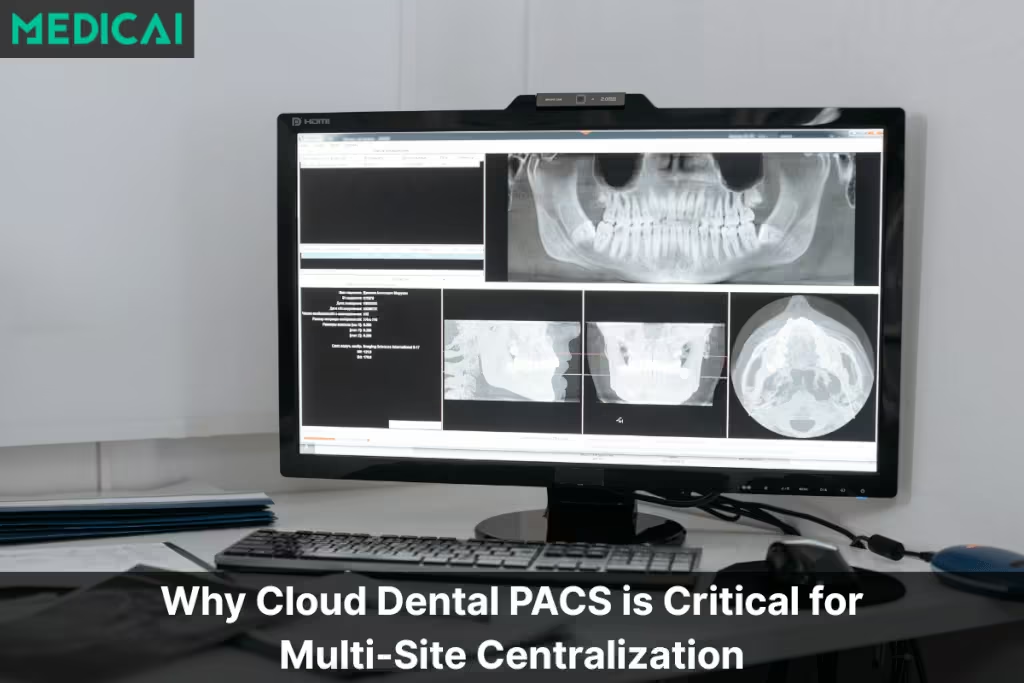
Dental Service Organizations (DSOs) often hit a technological wall in the race to scale.
It happens somewhere between the 5th and the 50th location. You acquire a new practice, and along with the patient list, you inherit a server closet full of aging hardware, a different Practice Management Software (PMS), and a proprietary imaging system that doesn’t talk to your headquarters.
Multiply this by 20 locations, and you don’t have a “network”—you have Data Fragmentation.
For the modern DSO CIO or Operations Director, the challenge isn’t just buying clinics; it’s integrating them. This guide explores why shifting to a Cloud-Based Dental PACS is the foundational step in building a scalable, profitable DSO Tech Stack.

The Hidden Cost of Decentralized Data
When every clinic operates as an island, your operational overhead explodes.
In a traditional decentralized model, each location relies on a local server to store X-rays and CBCT scans. This architecture creates three massive liabilities for a growing DSO:
- IT Maintenance Debt: You are managing 50 separate backups, 50 separate firewalls, and 50 potential hardware failure points.
- Staff Inflexibility: A hygienist or associate dentist cannot easily float between locations because they can’t access their patients’ imaging history at another clinic.
- Invisibility: Clinical Directors cannot audit quality of care or perform Remote Second Opinions without physically driving to the location or dealing with clunky VPNs.
To solve this, you need to stop thinking about “Storage” and start thinking about “Multi-site data management.”
The Cloud-Native Shift: Centralizing the Archive
The solution is to decouple the imaging data from the local hardware.
By implementing a Cloud PACS with a Centralized Archive, you create a “Hub and Spoke” model. The local clinics (Spokes) capture the images, and the data is immediately synced to a secure, central cloud repository (Hub).
Why This Matters for Scaling:
- Standardizing Dental Workflows: Whether a clinic uses Dexis, Schick, or Carestream sensors, the data is normalized into a single standard viewer. Your staff learns one interface, not five.
- Instant Onboarding: When you acquire a new practice, you simply install a lightweight gateway. Their legacy data is ingested into your central cloud, and they are part of your network on Day 1.
Unlocking New Revenue Streams: Teledentistry & Specialist Sharing
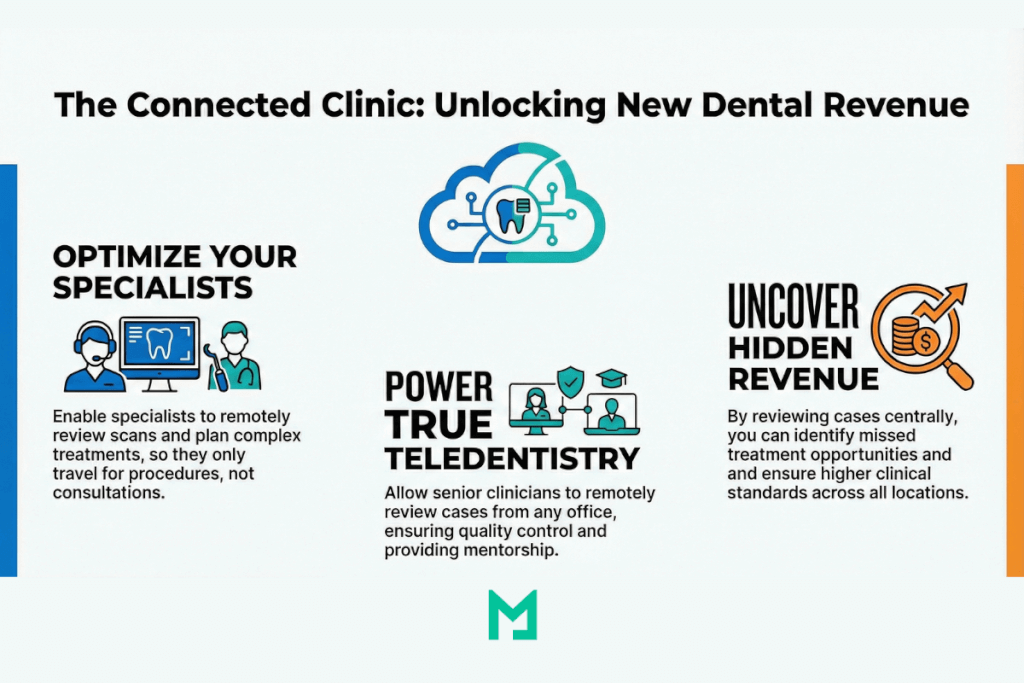
A centralized Cloud-native dental imaging stack doesn’t just save money on servers; it makes money by optimizing clinical utilization.
The Virtual Specialist
Many DSOs struggle to keep their in-house specialists (Oral Surgeons, Orthodontists) busy. With a Cloud PACS, a specialist can instantly review CBCT scans from any clinic in the network. They can plan implants or aligners remotely, ensuring that when they travel to the clinic, they are there to operate, not just to consult.
Teledentistry and Remote Grading
For hygiene checks or emergency triage, a centralized viewer enables true Teledentistry. A senior Clinical Director can review questionable cases from junior associates across the country, ensuring clinical standards are met and uncovering missed treatment opportunities (e.g., missed canals or periodontal disease).
Medicai: The Enterprise Layer for DSOs
Most dental software is built for a single practice. Medicai is built for the Enterprise.
We understand that DSOs rarely have a homogeneous environment. You likely have a mix of Dentrix, Eaglesoft, and Open Dental. You have a mix of sensor brands.
- The VNA Advantage: Medicai acts as a Vendor Neutral Archive (VNA). We sit above the PMS layer, ingesting imaging data from any source and presenting it in a unified web viewer.
- Elastic Scalability: Whether you have 10 locations or 1,000, our cloud-native architecture scales automatically. You never have to buy another hard drive.
- HIPAA & GDPR Compliance: We handle complex security, encryption, and redundancy, offloading that liability from your local IT team.
Build a Foundation for Growth
You cannot build a scalable business on an unscalable infrastructure.
If your growth strategy involves acquiring more locations, you must have a data strategy that supports them. By moving to a centralized Cloud PACS, you turn your imaging data from a fragmented liability into a unified asset.


Related Articles
Lets get in touch!
Learn more about how Medicai can help you strengthen your practice and improve your patients’ experience. Ready to start your Journey?
Book A Free Demo