How VNA Technology Unifies Dexis, Schick, and Carestream

For many dental practice owners and IT managers, buying a new digital sensor is not just a hardware purchase—it’s a software sentence.
If you buy a dental digital imaging system like Schick sensor, you are often forced to use Schick’s imaging software. If you acquire a practice that uses Dexis, you are suddenly managing two separate databases.
Over time, a growing dental group becomes a graveyard of incompatible legacy systems, where patient X-rays are trapped in proprietary silos that refuse to communicate with one another.
This is Sensor Lock-In, and it is the single biggest barrier to scaling a modern dental network.
The good news? You don’t need to replace your expensive sensors to fix your workflow. You just need to change how you archive the data. This guide explains how Dental PACS and Vendor Neutral Archive (VNA) technology can unify your fragmented hardware into a single, cloud-native viewer.

The Problem: Why Dental Sensors Don’t Play Nice
In the broader medical world (Radiology), almost every machine speaks a universal language called DICOM. An MRI from GE opens perfectly in a viewer from Siemens.
Dentistry is different.
Historically, dental imaging systems manufacturers treated their software as a “walled garden.” They encoded images in proprietary formats or wrapped standard DICOM files in restrictive encryption. To view the image, you needed their specific driver and their specific software license.
This creates a massive headache for DSOs (Dental Service Organizations) and multi-site practices:
- Data Fragmentation: You cannot easily view a patient’s history if their 2022 X-rays are in Eaglesoft and their 2024 X-rays are in Dentrix.
- Licensing Bloat: You end up paying annual maintenance fees for three different software suites just to keep legacy data accessible.
- Hardware Handcuffs: You want to switch to a cheaper, better sensor, but you can’t because it isn’t compatible with your current practice management software.
The Solution: The Vendor Neutral Archive (VNA) for Dental Digital Imaging
The solution to integrating legacy sensors is not more hardware—it’s an intelligent middle layer.
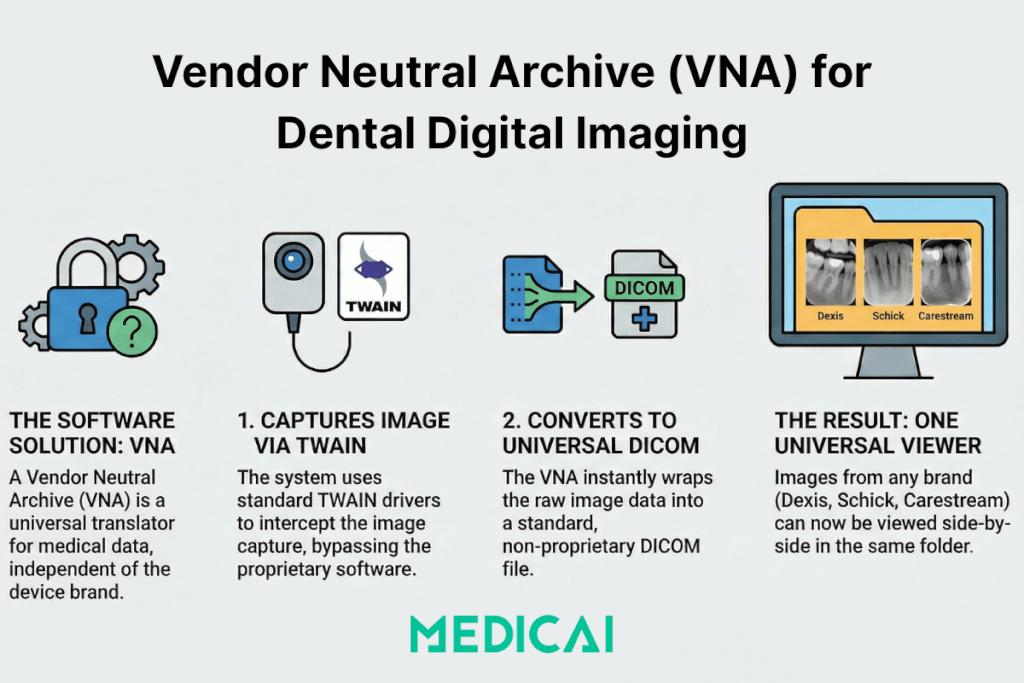
A Vendor Neutral Archive (VNA) is a medical data storage platform that operates independently of the device that captures the data. Unlike proprietary software that only “speaks” one language, a VNA is a universal translator.
How It Works: TWAIN Drivers and DICOM Conversion
To break the lock-in, modern cloud platforms utilize two key technologies:
- TWAIN Integration: Most sensors (even proprietary ones) offer a “TWAIN driver”—a standard communication protocol used by scanners. A VNA-enabled system can intercept the image via TWAIN at the moment of capture, bypassing the proprietary software entirely.
- On-the-Fly DICOM Conversion: Once the image is captured, the VNA wraps the raw pixel data into a standard, non-proprietary DICOM file.
The Result: A Dexis image, a Schick image, and a Carestream CBCT all live side-by-side in the same cloud folder, viewable in the same Universal DICOM Viewer for dental radiology imaging.
Why Migrating Away from Proprietary Software Pays Off
Moving to a VNA-first strategy isn’t just a technical fix; it’s a financial strategy.
Freedom of Hardware Choice
When your imaging software is neutral, you can buy whatever sensor offers the best price-to-performance ratio. You are no longer forced to purchase expensive sensors just because “that’s what our software supports.”
Centralized Cloud Access
For DSOs, a VNA allows for true centralization. A dentist in Location A can instantly pull up full-resolution bitewings taken at Location B, even if the clinics use different sensor brands. This is critical for remote second opinions and teledentistry workflows.
Future-Proofing Your Data
Proprietary formats die when the vendor stops supporting them. Standardized DICOM data lives forever. By converting your archive to standard formats, you ensure that you—not the sensor manufacturer—own your patient data.
Medicai: The “Universal Key” for Dental Imaging
At Medicai, we believe your data belongs to you, not your hardware vendor.
Our platform is built on a cloud-native Hybrid VNA architecture that ingests data from any source. Whether you are dealing with intraoral sensors, panoramic X-rays, or massive CBCT files, Medicai normalizes the stream into a single, accessible web viewer.
- No VPNs required.
- No proprietary drivers required for viewing.
- Just instant, secure access to your clinical reality.
Take Back Control of Your Imaging
Don’t let your hardware dictate your workflow. If you are tired of juggling multiple viewers, paying redundant licensing fees, and feeling “held hostage” by your sensor company, it is time to decouple your data.


Related Articles

Lets get in touch!
Learn more about how Medicai can help you strengthen your practice and improve your patients’ experience. Ready to start your Journey?
Book A Free Demo