

What if a single image could reveal the root of an animal’s illness, without a single word spoken?
In holistic veterinary care, that’s the quiet power of digital imaging.
DICOM (Digital Imaging and Communications in Medicine) enables veterinarians to capture, store, and share precise medical images that aid in accurate diagnosis and personalized treatments. This supports the whole-animal approach at the heart of holistic care.
Let’s explore how DICOM enhances holistic veterinary medicine and why it’s changing the way animal care is delivered.

Why DICOM and Vet Treatment Matter?
Digital Imaging and Communications in Medicine (DICOM) is a globally accepted standard for handling, storing, printing, and transmitting medical imaging information. It establishes a common language for medical imaging devices, such as X-rays, ultrasounds, MRIs, and CT scanners, ensuring seamless communication among manufacturers.
The DICOM format standardizes medical images and patient data storage, enabling clear communication among veterinary professionals. The files not only contain visual images but also include essential data such as
- Patient details
- Date and time stamps
- Technical parameters of the imaging device
- Diagnostic reports.
Originally developed for human medicine, DICOM now plays an important role in veterinary care. In 2006, the DICOM Standards Committee adjusted veterinary use, allowing data entries specific to animals, like species, breed, and unique anatomical structures.
Thus, DICOM has evolved from being merely a human-centric imaging protocol into a sophisticated veterinary tool that accommodates the diverse and specialized needs of animal healthcare.
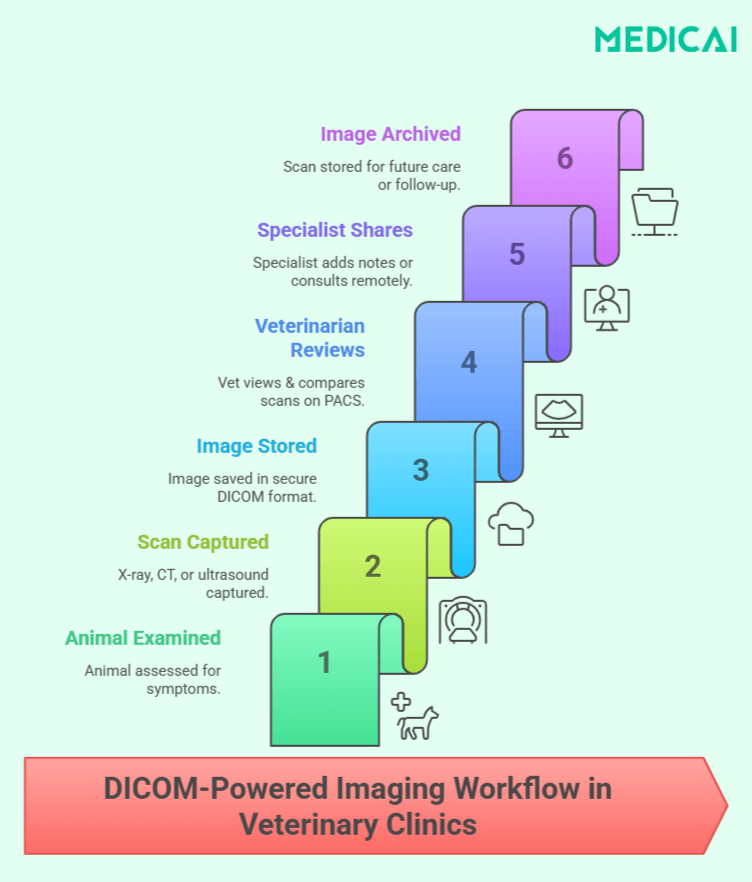
How DICOM Benefits Veterinary Treatment
DICOM technology enhances diagnostics and streamlines communication in veterinary practices.
Improved Diagnostic Accuracy and Reliability
DICOM technology improves diagnostic accuracy by providing high-quality digital images that veterinarians can manipulate—zooming, enhancing contrast, or adjusting brightness—without losing clarity. Unlike traditional film, digital images remain clear, easy to interpret, and less prone to degradation over time.
Veterinarians can reliably detect subtle abnormalities, enabling accurate diagnoses of fractures, joint disorders, tumors, and internal injuries.
Enhanced Collaboration Between Veterinary Professionals and Specialists
A key advantage of DICOM in veterinary medicine is its ability to facilitate collaboration among veterinarians and specialists. With DICOM-compatible software, images and patient data can be shared securely in real-time, enabling quick consultations with various specialists.
This instant collaboration enhances care planning, speeds up second opinions, and improves treatment strategies for animals with complex medical needs.
Efficient Image Storage, Management, and Retrieval Capabilities
Traditional veterinary practices struggled with managing physical image files, which required large storage space and were prone to damage. DICOM’s digital approach offers efficient data management, allowing instant retrieval, secure backups, and easy long-term management.
It helps veterinarians access an animal’s imaging history, compare past and current scans, track treatment progress, and make informed decisions about the animal’s health.
Universal Standardization Across Devices and Manufacturers
DICOM’s strength is its universal acceptance and standardization, ensuring compatibility and interoperability between imaging equipment from various manufacturers. This allows veterinary practices to select equipment based on their needs, promoting high-quality care through standardized communication protocols.
Simplified Workflow and Increased Efficiency
Traditional veterinary practices used manual filing for medical images and records, which was a labor-intensive process. DICOM digitizes these images, allowing quick retrieval and remote access, streamlining workflows.
It helps staff to focus on patient care while reducing administrative tasks and speeding up decision-making.
Improved Image Quality through Advanced Algorithms
DICOM uses advanced technology to improve medical images, especially MRI scans. Its deep learning denoise algorithms make images clearer and sharper. This allows veterinarians to spot small problems more easily, leading to earlier diagnoses and better treatment plans.
As a result, veterinary care outcomes improve.

Core Imaging Modalities Enhanced by DICOM
DICOM supports various imaging modalities, providing holistic veterinarians with the tools to make informed, precise decisions that align with the whole-animal care philosophy.
Digital Radiography
Digital radiography, when supported by DICOM, produces high-quality X-ray images with significantly less radiation than traditional film. These images are immediately viewable, can be enhanced for clarity, and are easily shared or compared over time.
Digital radiographs are essential in holistic veterinary care for detecting issues like arthritis, spinal misalignments, and fractures. This information guides treatments like chiropractic adjustments, acupuncture, and natural anti-inflammatory support, enabling precise, non-invasive care based on visible imbalances.
Ultrasound Imaging
Ultrasound imaging is a key tool for evaluating soft tissue structures, including the liver, kidney, bladder, and heart. DICOM integration allows for clear image capture, digital archiving, and collaboration with specialists when needed.
Holistic vets often use ultrasound with PACS to uncover internal causes of symptoms such as digestive upset or hormonal imbalances. These insights inform targeted treatment approaches, such as herbal detoxification, dietary adjustments, or reproductive support, aligning with the whole-animal care philosophy.
Advanced Imaging Techniques: CT and MRI
CT (Computed Tomography) and MRI (Magnetic Resonance Imaging) are advanced imaging techniques for complex cases. CT visualizes bone, sinus, and lung structures, while MRI evaluates the brain, spinal cord, and soft tissues.
With DICOM, these scans are easily stored and shared among care teams. Holistic veterinarians use them to identify deep-seated issues, enabling tailored care plans that merge technology and natural healing methods.
Implementing DICOM in Holistic Veterinary Practice
Successfully integrating DICOM into a holistic veterinary practice starts with assembling the right equipment and digital infrastructure.
Necessary Equipment and Infrastructure
Setting up DICOM in a holistic veterinary clinic requires a few essential components to create a streamlined, digital imaging workflow. These tools support advanced diagnostics and ensure compatibility across devices and systems.
Core equipment:
- Digital Radiography Systems (DR): These systems produce instant, high-resolution X-rays with reduced radiation exposure, which is ideal for detecting structural issues that may guide chiropractic or acupuncture treatment.
- Ultrasound Machines: They are crucial for non-invasive, real-time imaging of soft tissues and organs, often used in digestive or reproductive health assessments.
- Workstations and Monitors: Equipped with veterinary DICOM viewer software, these can view and manipulate DICOM files.
Storage and connectivity tools:
- DICOM Server or PACS (Picture Archiving and Communication System): Acts as a secure, centralized hub for storing and managing image data.
- Network Infrastructure: Ensures all imaging devices, storage systems, and workstations are connected for seamless data flow.
Recommended software:
- Veterinary-friendly DICOM viewer platforms offer intuitive tools for image comparison, measurement, and annotation.
- Practice management integration allows DICOM imaging to sync with patient records, enabling clinicians to access all relevant data from one place.
Many clinics benefit from a phased approach—starting with digital radiography and gradually expanding to ultrasound or other advanced imaging techniques. This helps manage costs while laying a strong foundation for diagnostic excellence.
Staff Training and Workflow Integration
Technology alone doesn’t improve patient care; your team’s ability to use it effectively does. Proper training and thoughtful integration into daily operations ensure that DICOM enhances diagnostics and holistic treatment planning.
Key training areas for staff include:
Veterinary technicians: They should learn-
- Safe and efficient use of imaging equipment.
- Accurate labeling of images with species-specific data.
- Basic troubleshooting of devices and software.
Front office staff: They should understand-
- How to schedule imaging procedures efficiently.
- How to communicate the purpose and value of imaging to pet owners, especially within a holistic care framework.
To integrate DICOM into your workflow, use imaging findings to guide natural treatment approaches, such as acupuncture, nutrition therapy, or herbal protocols.
Also, develop Standard Operating Procedures (SOPs) that define:
- When imaging is recommended.
- How results inform holistic care plans.
- How to securely share images with external specialists when necessary.
With DICOM seamlessly integrated into both diagnostics and everyday workflows, holistic veterinary practices can deliver scientifically informed and deeply personalized care.

Customizing DICOM Standards for Veterinary Medicine
Veterinary medicine presents unique challenges that human healthcare standards can’t always address. Animals vary significantly in size, anatomy, and species-specific conditions, so imaging data must be flexible and detailed.
Customizing DICOM standards allows practices to record information such as species, breed, body part, or even specialized parameters for exotic and large animals. This ensures each image is properly labeled and interpreted, supporting more accurate diagnostics and tailored care.
Without such adaptations, there is a risk of mislabeling, lost data context, or inaccurate interpretations, especially in clinics that treat a variety of patients. Customization helps bridge this gap, empowering veterinarians to deliver more precise and individualized treatment.
How Veterinary Practices Are Adapting DICOM
Many leading veterinary clinics and hospitals have successfully adapted DICOM systems to meet their unique needs. For example:
- Species-Specific Data Fields: Some practices use DICOM-compatible software that prompts users to input species, breed, and weight, ensuring images are always matched to the correct patient profile.
- Custom Imaging Protocols: Large animal clinics may adjust scanning parameters and labeling for horses, cattle, or exotic animals, allowing images to be archived and compared over time.
- Integrated Practice Management: DICOM systems are now integrated with veterinary EMR software, automatically linking diagnostic images and reports to the correct animal’s record and streamlining care from diagnosis to treatment and follow-up.

Challenges and Considerations in Using DICOM in Veterinary Practice
While DICOM technology brings undeniable value to modern veterinary care, its successful adoption comes with practical and logistical challenges.
Initial Investment and Equipment Costs
Transitioning to DICOM-compatible imaging requires costly equipment upgrades, which can be challenging for small practices.
Many practices opt for a phased approach to manage costs, starting with core tools like digital X-rays and expanding over time. Leasing options, cloud-based PACS solutions, and open-source DICOM viewers can reduce financial pressure.
Training Requirements
New systems require staff to learn to capture, store, and manage digital images effectively. To minimize the learning curve, offer role-specific training and choose software that is intuitive and has vendor support.
Workflow Adjustments
Shifting from manual to digital systems can temporarily disrupt clinic flow. Implement DICOM during quieter periods and create clear protocols for integrating imaging into holistic assessments.
Compatibility Issues
Not all devices or platforms fully support DICOM, especially older models. Ensure any new or existing systems are fully DICOM-compliant and compatible with your practice software.
Data Storage and Security
To protect patient data, high-resolution images need significant storage and secure handling. Use encrypted, regularly backed-up storage, and consider cloud solutions for scalability and remote access.
Species-Specific Customization
Veterinary medicine involves diverse species and body types, which standard DICOM fields may not fully support. To ensure accurate records, use software that allows flexible metadata for species, breed, and anatomy.
Conclusion
Integrating DICOM into veterinary care combines advanced diagnostics with compassionate treatment. With tools like Medicai, veterinarians access AI-powered imaging, secure cloud storage, and easy collaboration, without complex infrastructure. We empower clinics to diagnose confidently and treat intentionally.
So, why wait? Let’s unlock a future where technology and treatment work paw in paw.


