VNA in Radiology: How Vendor-Neutral Archives Fit Into the Radiology Workflow

A vendor-neutral archive (VNA) in radiology is the long-term storage layer that sits beneath the PACS, storing radiology imaging studies in vendor-independent DICOM format so the images outlive any single PACS contract. In a radiology department, the VNA solves three problems the PACS alone cannot: consolidating imaging archives across multiple PACS systems (radiology, cardiology, ophthalmology), enabling prior-study comparison across years and across sites, and preparing the imaging archive for AI workflows that need standardized data access independent of the originating PACS vendor.
Why radiology specifically needs a VNA
Radiology generates more imaging data than any other clinical specialty — a single CT or MRI study can run 1–2 GB, and a busy hospital radiology department produces terabytes of imaging data per year. The PACS handles active reading workflow, but it isn’t designed to handle the 7-to-10-year retention requirements, cross-departmental access patterns, and AI-readiness demands that modern radiology operations face. That’s the gap the VNA fills.
Three radiology-specific operational realities make the VNA structurally necessary rather than optional.
Long retention horizons
HIPAA and equivalent regulations require imaging studies to be retained for years after acquisition — typically 7 years for adult patients, longer for pediatric studies (often until the patient reaches 21+ years of age). The active PACS is not designed for decade-long storage tiering. The VNA handles intelligent data lifecycle management: hot storage for recent studies the radiologist needs immediately, warm storage for studies likely to be referenced as priors, cold storage for compliance-only retention.
Multi-PACS reality in larger health systems
Large radiology departments often run multiple PACS systems — one for radiology proper, one for cardiology, one for women’s imaging, and one for the surgical specialties. Each PACS stores its own studies in its own proprietary database. Without a VNA, a radiologist reviewing a chest CT cannot pull the patient’s prior echocardiogram from cardiology’s PACS for comparison. The VNA consolidates these archives into a single accessible imaging layer.
AI-readiness for radiology workflows
Radiology AI tools — for triage, detection, segmentation, and reporting — need access to standardized DICOM data, often with longitudinal patient history. AI models trained on a specific PACS vendor’s data format don’t generalize cleanly across multi-PACS environments. The VNA provides the vendor-neutral DICOM layer that AI tools can call without per-PACS integration work, which is why AI-readiness is now a top-three procurement criterion in radiology VNA evaluations.
VNA vs PACS in radiology: what each does

In a radiology department, the PACS and the VNA serve different operational layers. The PACS handles the active reading workflow — worklist management, the diagnostic viewer, and dictation integration. The VNA handles the storage layer — long-term archive, cross-departmental access, vendor-neutral DICOM consolidation. Most modern radiology departments operate both.
| Dimension | PACS | VNA |
|---|---|---|
| Primary purpose | Active reading workflow | Long-term imaging archive |
| Time horizon | Recent studies, active worklist | Years to decades of retained history |
| Data format | Vendor-proprietary database | Standards-based DICOM, vendor-independent |
| Scope | Typically single-department | Cross-departmental and cross-site |
| Vendor lock-in | Switching PACS requires data migration | Data outlives any single PACS contract |
| AI integration | Per-PACS, vendor-specific tools | Open data layer, multi-vendor AI access |
| Radiologist visibility | Daily diagnostic workstation | Invisible — operates beneath the viewer |
The practical takeaway for radiology buyers: PACS and VNA are complementary, not alternatives. A radiology department choosing between them is making a category mistake. The right question is which PACS for active reading and which VNA for long-term archive — typically two separate procurement decisions.
For a deeper comparison, including buyer evaluation criteria, see [vendor-neutral archive vs PACS]. For the broader VNA entity definition across all clinical specialties, see [the vendor-neutral archive guide].
How VNA fits into the radiology workflow
The VNA touches the radiology workflow at four operational points: at acquisition (studies route from modality through PACS to VNA), at reading (the viewer pulls priors from the VNA for comparison), at reporting (reports route through PACS but reference imaging stored in VNA), and at long-term access (referring physicians, subspecialists, and AI tools pull from the VNA across years).
Stage 1 — Acquisition routing
A patient is scanned. The modality sends the DICOM study to the radiology PACS for active reading. In parallel — or shortly after — the PACS forwards the study to the VNA for long-term storage. The radiologist reading the study doesn’t see this routing; the study appears in the worklist as normal. Behind the scenes, the imaging archive is being built.
Stage 2 — Prior-study comparison during reading
When the radiologist opens a current study for interpretation, the viewer queries the VNA for prior imaging on the same patient. If the patient had a chest CT 18 months ago at a different facility (whose PACS has since been replaced), the VNA still holds that prior study. The radiologist can see the prior alongside the current study without manual lookup or an external request. This is where the VNA’s clinical value becomes visible to the radiologist day to day.
Stage 3 — Reporting and structured findings
The radiologist dictates or types the diagnostic report. The report routes through the PACS to the RIS and EHR. The structured findings — measurements, classifications, AI-detected lesions — can be stored alongside the imaging in the VNA as DICOM Structured Report (SR) objects, making the findings retrievable across systems years later.
Stage 4 — Long-term access and AI integration
Months or years later, referring physicians pull imaging from the VNA through the EHR. Subspecialists at remote sites access the VNA for second opinions. AI tools — for population health analytics, longitudinal disease tracking, research cohort identification — query the VNA directly. The PACS may have been replaced one or two contract cycles ago; the imaging data lives on in the VNA.
Radiology-specific clinical use cases for a VNA
Beyond the mechanics of the storage layer, the VNA enables four clinical use cases that pure-PACS architectures cannot deliver: multi-site reading, subspecialty access, longitudinal disease tracking, and AI workflow consolidation.
Multi-site reading
A radiology group reading for five hospitals needs access to imaging from each site without having to log in to five separate PACS systems. The VNA aggregates studies from each site into a unified archive. The radiologist’s viewer queries the VNA; the originating site’s PACS is invisible to the reading workflow. For nighthawk and teleradiology arrangements, this is the architectural backbone.
Subspecialty access
A neuroradiologist at an academic center reads brain MRI cases routed in from community hospitals. The VNA gives the neuroradiologist access to the patient’s full prior imaging history — MRIs from the originating hospital, CTs from the emergency department visit two years ago, and ultrasounds from the obstetric workup before that. Pure-PACS architectures can’t deliver this because each PACS holds only its own department’s or site’s studies.
Longitudinal disease tracking
Oncology imaging, MS imaging follow-up, and post-surgical surveillance all depend on comparing current imaging against years of prior studies. The VNA holds the longitudinal record — every CT, MRI, PET, and ultrasound the patient has had at any connected facility. The radiologist tracking treatment response or disease progression has the full clinical picture, not just the studies that happen to live in the current PACS.
AI workflow consolidation
Radiology AI tools — for stroke triage, lung nodule detection, breast cancer screening, and brain volumetrics — require standardized access to DICOM data. Each AI tool typically integrates with the VNA once rather than integrating separately with every PACS in the health system. For radiology departments deploying multiple AI vendors, the VNA is the integration anchor.
Evaluating a VNA for a radiology department
Five criteria matter most when a radiology department evaluates VNA platforms: DICOMweb support depth, PACS integration patterns, AI-readiness, subspecialty workflow fit, and deployment model (cloud-native vs hybrid vs on-premise).
DICOMweb support depth
DICOMweb (WADO-RS, QIDO-RS, STOW-RS) is the modern RESTful protocol that enables browser-based viewers, cross-site image sharing, and cloud-native deployment. Every modern VNA claims DICOMweb support, but the depth varies — some implementations support full DICOMweb across all operations, others retrofit partial DICOMweb on top of legacy DIMSE architecture. Cloud-native VNAs (Medicai, AGFA’s recent platform, the cloud variants of Hyland and Sectra) implement DICOMweb more comprehensively than legacy platforms.
PACS integration patterns
If the radiology department already runs a specific PACS, the VNA’s native integration with that PACS matters. Some VNAs (Hyland Acuo with Epic-integrated PACS, GE Datalogue with GE PACS, Philips Vue Archive with IntelliSpace) ship deep native integration with specific PACS ecosystems. Others (Medicai, AGFA, Mach7) operate as PACS-agnostic platforms designed to consolidate multiple PACS systems.
AI-readiness
Modern VNA evaluation increasingly emphasizes native AI orchestration — the VNA’s ability to route studies to AI tools, accept AI-generated outputs, and store AI annotations alongside the source imaging. AGFA’s RUBEE AI, the AI orchestration in Sectra and Hyland, and Medicai’s open API approach all address this; partner-based AI models in Fujifilm, Philips, and GE address it through external integrations.
Subspecialty workflow fit
Academic medical centers running multiple radiology subspecialties (neuro, MSK, breast, cardiac, IR) need VNA platforms that support subspecialty-specific data formats and workflows. Enterprise VNAs from Hyland, Sectra, AGFA, and Mach7 typically address this. Mid-tier VNAs serve general radiology well but may require additional integration to meet subspecialty-specific requirements.
Deployment model
Cloud-native (Medicai, AGFA, modern Hyland, and Sectra deployments) eliminates on-premise hardware refresh cycles. On-premise (Visage, legacy Philips, legacy Merge deployments) maintains data residency control but carries ongoing infrastructure costs. Hybrid balances both. Match the deployment model to the radiology department’s existing IT operating model.
For the full vendor comparison across these criteria, see [the best vendor-neutral archives listicle].
How Medicai’s VNA serves radiology
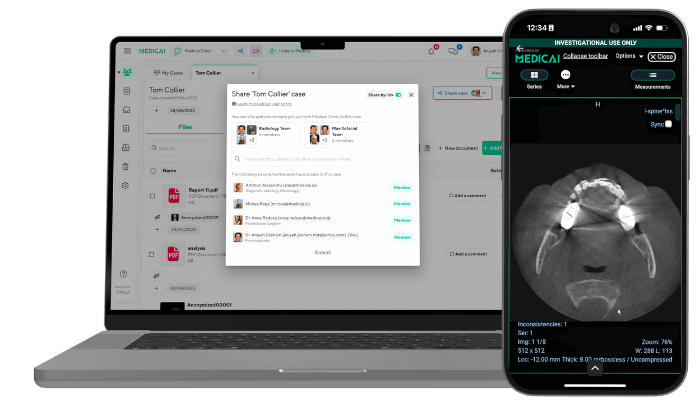
Medicai’s cloud-native VNA is built for imaging centers, specialty radiology practices, and growing radiology groups that need enterprise-grade vendor-neutral archive capability without the deployment complexity and pricing of legacy enterprise platforms.
Three architectural mechanisms make the platform radiology-specific: full DICOMweb support (WADO-RS, QIDO-RS, STOW-RS) for browser-based reading and cross-site access, an open API and FHIR integration for connecting to multiple PACS systems and AI tools, and a zero-footprint web viewer that automatically pulls priors from the VNA without manual lookup. The platform was built cloud-native rather than retrofitted from on-premise software, which means cross-site image sharing, automatic priors prefetching, and zero-footprint reading are core architecture rather than bolt-on features.
For multi-site radiology coverage, the cloud-native unified worklist eliminates the swivel-chair problem that older VPN-based setups created. For the full Medicai cloud PACS and VNA architecture, see [the Medicai cloud PACS platform].

Frequently asked questions about VNA in radiology
These eight questions cover the queries radiologists, IT directors, and procurement teams most often search when evaluating VNA for a radiology department. The first four address the SERP’s recurring People Also Ask box for ‘vna radiology.’
What is a VNA in radiology?
A VNA in radiology is the long-term storage layer beneath the PACS that stores radiology imaging studies in vendor-independent DICOM format. The VNA enables prior-study comparison across years and across sites, consolidates imaging archives from multiple PACS systems, and provides the standardized data layer that radiology AI tools need.
What is the difference between DICOM and VNA?
DICOM is the imaging data format and network protocol — the standard that defines how medical images are structured, stored, and transmitted. A VNA is a software platform that stores DICOM imaging data in a vendor-independent way. DICOM is the format; the VNA is the archive. Every VNA stores DICOM data; not every DICOM-compliant system is a VNA.
What is the difference between a VNA and a PACS system?
A PACS is the active reading system radiologists use for day-to-day work: a worklist, viewer, and dictation integration. A VNA is the long-term archive layer beneath the PACS — vendor-independent storage designed to outlive any single PACS contract. Most radiology departments operate both PACS for active reading workflow and VNA for long-term archive and cross-departmental access.
What does VNA stand for?
VNA stands for Vendor-Neutral Archive. The ‘vendor-neutral’ part is the key feature: the archive stores imaging data in standards-based DICOM format independent of any single PACS vendor, so the imaging data can be accessed by any standards-compliant system and outlives any single PACS contract.
Why does radiology need a VNA?
Radiology needs a VNA for three reasons: long-term storage that the active PACS isn’t designed to handle (7-to-10-year retention horizons), cross-PACS consolidation in health systems running multiple PACS platforms, and AI-readiness for radiology AI tools that need standardized DICOM data access independent of the originating PACS vendor.
How does a VNA help radiologists day-to-day?
The VNA makes prior studies available for comparison without manual lookup. A radiologist opening a current chest CT sees prior chest imaging in the viewer automatically, even if the prior was acquired at a different site or stored in a PACS that has since been replaced. The radiologist doesn’t query the VNA directly — the viewer does it on their behalf.
Can a VNA store non-radiology imaging?
Yes. Enterprise VNAs typically consolidate imaging across multiple specialties — radiology, cardiology, pathology, ophthalmology, dermatology, dental — into a single archive. The ‘vendor-neutral’ design extends to specialty-neutral: any DICOM-compliant imaging from any clinical specialty can be stored alongside radiology imaging in the same archive.
Is a VNA required for radiology AI deployment?
Not strictly required, but increasingly expected. Radiology AI tools deployed without a VNA must integrate with each PACS separately, which adds integration overhead and limits longitudinal data access. With a VNA, AI tools integrate once and access the consolidated archive. For radiology departments deploying multiple AI vendors, the VNA is the practical integration anchor.
Where VNA in radiology is heading
Three trends are reshaping VNA in radiology through 2027 and beyond. Cloud-native deployment is moving from a differentiator to a baseline expectation — even legacy on-premise VNA leaders are migrating toward cloud-extension architectures. AI orchestration is becoming a native VNA capability rather than a partnership extension, with platforms like AGFA’s RUBEE AI signaling where the market is heading. And the boundary between cloud PACS and VNA is dissolving as cloud-native platforms increasingly deliver both archive and active-workflow capability through a single architecture.
For radiology departments evaluating VNA in 2026 and 2027, the practical implication is that today’s VNA selection constrains the next 7-to-10 years of imaging architecture. The questions worth asking aren’t just ‘which VNA has the highest KLAS ranking’ — they’re ‘which VNA fits where this radiology department will be three contract cycles from now.’
For broader context, see the vendor-neutral archive guide, vendor-neutral archive vs PACS, and the best vendor-neutral archives comparison.


Related Articles


Lets get in touch!
Learn more about how Medicai can help you strengthen your practice and improve your patients’ experience. Ready to start your Journey?
Book A Free Demo