EMR vs EHR: Differences, Benefits, Costs, and How to Choose (2026 Guide)

The main difference between an EHR (Electronic Health Record) and an EMR (Electronic Medical Record) is scope. An EMR is a digital patient chart confined to a single practice or organization. An EHR is a comprehensive longitudinal record designed to be shared across multiple providers, laboratories, pharmacies, and care settings through interoperability standards like HL7 v2 and FHIR. Both store patient information electronically, both must comply with HIPAA, and both serve as the foundation for modern healthcare workflow automation.
The practical difference shows up in care coordination: EHRs enable seamless data sharing across organizations, whereas EMRs operate as efficient internal systems within a single practice but face challenges when patient information needs to move between providers. This guide compares EMR vs EHR across the dimensions healthcare leaders use to choose between them: interoperability, scope, benefits and challenges of each, cost, HIPAA compliance, integration with imaging and practice management systems, and the decision framework for selecting the right system for your organization.
What is the difference between EMR vs EHR?
| Dimension | EHR (Electronic Health Records) | EMR (Electronic Medical Records) |
|---|---|---|
| Primary scope | Comprehensive longitudinal record shareable across providers and care settings | Digital patient chart confined to a single practice or organization |
| Interoperability | Built for cross-organizational data exchange via HL7 v2, FHIR, and direct integrations | Limited external sharing, primarily designed for use within one organization |
| Data sources | Multiple providers, laboratories, pharmacies, imaging centers, patient-reported data | Clinical data generated within the single practice or organization |
| Patient access | Patient portals provide longitudinal view across care settings | Patient access usually limited to data from the single practice |
| Cost and complexity | Higher initial investment, more complex implementation, ongoing interoperability maintenance | Lower cost, simpler implementation, fewer external integration requirements |
| Best fit | Health systems, hospital networks, multi-site practices, organizations participating in HIE | Small to medium standalone practices, specialty clinics with self-contained workflows |
| Care coordination | Supports care transitions between providers and specialty referrals naturally | Care coordination across organizations requires manual data export and external sharing |
| Regulatory framework | HIPAA compliance plus ONC certification and interoperability requirements (TEFCA, USCDI) | HIPAA compliance with fewer interoperability mandates |
The Electronic Medical Record (EMR) was the original term for digitized patient charts that replaced paper records inside individual healthcare practices. An EMR contains the clinical data generated and maintained by one healthcare organization, including patient demographics, medical history, treatment plans, lab results, medications, and clinical notes. The system is optimized for the workflow within that practice, with the goal of efficiently replacing paper charts and improving internal record-keeping.
The Electronic Health Record (EHR) emerged later as a broader concept. An EHR is a longitudinal digital representation of a patient’s health that spans across multiple healthcare settings. EHRs aggregate information from primary care, specialty providers, hospitals, laboratories, pharmacies, imaging centers, and patient-reported data into a unified record that follows the patient across care transitions. The system is built on the assumption that patient care spans multiple organizations, and the record needs to move with the patient rather than remain within a single practice.
The two terms are sometimes used interchangeably in casual conversation, but the formal distinction matters for healthcare IT planning. An EMR is sufficient when a practice operates as a self-contained clinical workflow. An EHR is necessary when patient data needs to flow across organizational boundaries, when the practice participates in health information exchange (HIE), or when interoperability with hospitals, specialists, and other care providers is a strategic requirement.
The evolution from EMR to EHR also reflects how the healthcare industry’s understanding of patient data has matured. Early electronic records focused on replacing paper within a single office. Modern records focus on continuity of care across the patient’s entire health journey.
Key differences in interoperability and data exchange
Interoperability is the central technical distinction between EHR and EMR systems. The capabilities differ across three layers.
The first layer is data exchange standards. EHRs are built to communicate with other systems through industry-standard interfaces. HL7 v2 messages carry orders, results, admission and discharge data, and other clinical events between systems. FHIR (Fast Healthcare Interoperability Resources) provides modern REST-based APIs for granular data exchange. EHR vendors invest substantially in supporting these standards because their value proposition depends on connecting to other systems. EMR systems may support basic data export, but typically don’t include the comprehensive interoperability layer that EHRs provide.
The second layer is governance and certification. EHRs participating in federal programs in the United States must meet ONC (Office of the National Coordinator for Health Information Technology) certification requirements, which mandate specific interoperability capabilities, security controls, and data exchange formats. The 21st Century Cures Act and its information blocking provisions add legal requirements around making patient data available through standardized APIs. The Trusted Exchange Framework and Common Agreement (TEFCA) creates a national framework for health information exchange. The United States Core Data for Interoperability (USCDI) defines the minimum data set that must flow between systems. EMRs face fewer interoperability mandates because their use case doesn’t require the same cross-organizational data flows.
The third layer is the actual integration ecosystem. EHR vendors maintain extensive integration directories with hospital systems, laboratory networks, pharmacy systems, imaging platforms, and clinical decision support tools. EMR systems typically have narrower integration ecosystems focused on the practice management, billing, and clinical workflow tools needed within a single organization.
For healthcare leaders evaluating systems, the interoperability layer is often the deciding factor. Organizations that need to participate in HIE, coordinate care across multiple providers, or integrate with hospital systems need EHR capabilities. Organizations operating as self-contained practices may find EMR systems fully sufficient.
Benefits and challenges of EHR systems
EHR systems deliver value across multiple dimensions of healthcare operations, but entail higher complexity and cost than simpler EMR alternatives.
The clinical care benefits include real-time access to comprehensive patient data at the point of care. Physicians see lab results from external laboratories, prescription histories from external pharmacies, imaging studies from external imaging centers, and notes from prior specialty visits, all in a single interface. Clinical decision support tools integrated into EHR systems flag potential medication interactions, surface clinical guidelines relevant to specific patients, and reduce diagnostic errors through structured data presentation. The longitudinal record supports informed decision-making across care transitions in ways that paper records or single-practice EMRs cannot match.
The operational benefits include streamlined documentation, reduced duplicate testing, faster care coordination, and improved billing accuracy. EHR-integrated tools handle charting, e-prescribing, lab ordering, and coding in unified workflows that reduce administrative burden on clinicians. Population health management capabilities let organizations aggregate data across patient panels to identify trends, target preventive interventions, and meet quality reporting requirements.
The financial benefits include qualifying for value-based care programs, meeting Quality Payment Program (QPP) reporting requirements, and participating in Accountable Care Organizations (ACOs), in which shared savings depend on coordinated care across providers.
The challenges are real and substantial. Initial implementation costs for EHR systems can reach hundreds of thousands of dollars for small practices and tens of millions for large health systems, including software licensing, hardware infrastructure, implementation services, staff training, and workflow redesign. Implementation timelines range from six months to several years, depending on the organization’s size. Workflow disruption during the transition period affects clinician productivity and patient satisfaction. Ongoing maintenance includes software updates, interoperability connection management, security monitoring, and continued training as features evolve.
Technical issues, including system downtime, data migration challenges, and integration failures, can affect clinical operations. Privacy and security demands include implementing robust safeguards against unauthorized access and cyber threats, since EHR systems become high-value targets for ransomware and data breaches.
Benefits and challenges of EMR systems
EMR systems offer practical advantages for healthcare organizations that don’t need the broader interoperability layer EHRs provide.
The benefits of accessibility and organization are foundational. EMR systems centralize patient charts, clinical notes, test results, medication histories, and treatment plans in a single digital location, eliminating the inefficiencies of paper-based records. Information retrieval during clinical encounters takes seconds rather than the minutes required to locate paper charts. Documentation legibility improves because handwriting variability is eliminated. Multiple staff members can access the same patient record simultaneously, supporting team-based care within the practice.
The workflow benefits include integration with practice management systems for appointment scheduling, billing, and revenue cycle management. Clinical decision support tools embedded in EMRs provide alerts, reminders, and evidence-based guidelines at the point of care. Remote access capabilities support telemedicine workflows, enabling clinicians to access patient records and conduct virtual consultations from any location with an internet connection.
The cost and implementation benefits are particularly meaningful for smaller practices. EMR systems typically have lower upfront costs than EHR systems, simpler implementation timelines, and reduced ongoing infrastructure requirements. Cloud-based EMR options have further reduced the cost barrier, making robust digital record-keeping accessible to practices that couldn’t justify the EHR investment.
The scalability and customization options let organizations adapt EMR systems to specialty-specific workflows. Specialty EMRs for dermatology, ophthalmology, dental, behavioral health, and other practice types include workflow templates and documentation patterns optimized for those clinical contexts.
The challenges of EMR systems become apparent as soon as patient data needs to move outside the organization. Care coordination across providers requires manual data export, faxing, or secure messaging, whereas EHRs handle these natively. Patients receiving care across multiple providers may face fragmented records, with each practice maintaining its own siloed EMR. Reporting for value-based care programs becomes more difficult without the comprehensive longitudinal data EHRs provide. Practice growth that involves multiple sites or a merger with other practices often triggers a transition from EMR to EHR architecture.
For specialty practices and standalone clinics with self-contained workflows, EMRs deliver substantial value at lower cost. For organizations needing care coordination across boundaries, the interoperability gap becomes a constraint that justifies the EHR investment.
Impact on patient care, workflow efficiency, and population health
The adoption of EHR and EMR systems has reshaped healthcare delivery across three dimensions that matter to clinical leadership, operations, and population health professionals.
Patient care and safety have improved measurably through structured electronic records. Decision support tools embedded in both EHR and EMR systems reduce medication errors by flagging dangerous interactions, allergies, and dosing concerns at the point of prescribing. Structured data presentation supports faster diagnosis by surfacing relevant patient history during clinical encounters. Real-time access to lab results, imaging studies, and prior notes reduces the diagnostic delays caused by paper-based systems. The most consequential improvements come from EHR systems, in which information from multiple care settings reaches the treating clinician without manual coordination.
Workflow efficiency improvements include automated documentation, integrated billing and coding, electronic prescribing, and streamlined patient scheduling. Administrative tasks that previously required paper handling, manual data entry, and physical record retrieval now happen through software workflows that complete in seconds. Practice management integrations handle insurance verification, claim submission, and revenue cycle automation. The efficiency gains free clinician time for direct patient care while reducing the operational costs of healthcare delivery.
Population health management has become possible at scale because EHR systems aggregate data across patient panels. Healthcare organizations can identify diabetic patients overdue for HbA1c monitoring, hypertensive patients whose blood pressure isn’t controlled, or cancer survivors due for follow-up screening. Public health monitoring of disease outbreaks, vaccination rates, and chronic disease trends draws on EHR data aggregated across networks. Quality reporting for federal programs such as the Quality Payment Program and the Medicare Shared Savings Program depends on structured data from EHRs. EMR systems support narrower population health applications within single practices but cannot match the scale of connected EHR networks.
The combined impact has shifted healthcare from paper-based, reactive care to data-driven, proactive care, with EHR-enabled care coordination representing the most significant change.
HIPAA compliance for EHR and EMR systems
Both EHR and EMR systems must comply with HIPAA (Health Insurance Portability and Accountability Act) regulations that protect patient health information. The compliance requirements span three rules, all applicable equally to both system types.
The HIPAA Privacy Rule limits access to Protected Health Information (PHI) and requires patient consent for data sharing outside of specified treatment, payment, and health care operations purposes. Both EHR and EMR systems must implement role-based access controls that limit which staff members can view which patient data, audit logs that track who accessed what records when, and consent management capabilities that respect patient preferences for data sharing.
The HIPAA Security Rule requires three categories of safeguards. Technical safeguards include encryption of data at rest and in transit, secure authentication, access controls, and audit logging. Administrative safeguards include security policies, staff training, business associate agreements with vendors handling PHI, and incident response procedures. Physical safeguards include workstation security, device controls, and restrictions on physical access to systems containing PHI. Both EHR and EMR systems must implement all three categories, though the specific implementations vary by deployment architecture (cloud vs on-premise, hosted vs self-managed).
The HIPAA Breach Notification Rule mandates that healthcare organizations report data breaches affecting more than 500 patients to the Department of Health and Human Services, affected individuals, and, in some cases, the media. Smaller breaches must be logged and reported annually. Both EHR and EMR systems need breach-detection capabilities and incident-response procedures aligned with these reporting requirements.
The practical compliance differences between EHR and EMR systems lie in scope. EHR systems that handle data flows across multiple organizations face additional compliance considerations, including business associate agreements with each participating organization, secure data-exchange protocols, and patient-consent management across care boundaries. EMR systems operating within a single organization face a simpler compliance scope but the same fundamental requirements.
Healthcare organizations selecting between EHR and EMR systems should evaluate vendor HIPAA compliance attestations, audit reports (typically SOC 2 Type II), and breach history, alongside each system’s functional capabilities.
EHR and EMR integration with medical imaging
Medical imaging integration is one of the most operationally significant interoperability challenges for healthcare organizations using EHR or EMR systems. The technical pattern differs from how clinical documents or lab results flow into clinical records, and it has direct implications for clinical workflow efficiency.
The fundamental architectural pattern is that imaging operates as a separate domain (PACS, vendor-neutral archive, or cloud imaging platform) that integrates with the clinical record via industry standards rather than being stored inside the EHR or EMR. This separation reflects three structural realities. First, imaging studies are 100 times to 1,000 times larger than typical clinical records, making direct storage inside the EHR or EMR impractical at scale. Second, radiologists need specialized viewing tools (diagnostic-grade DICOM viewers with window/level controls, multi-planar reconstruction, 3D rendering, comparison workflows) that go beyond what general-purpose EHR or EMR interfaces provide. Third, diagnostic imaging viewers are subject to FDA medical device regulations that don’t apply to general clinical record systems, thereby requiring distinct product certification pathways.
The integration interfaces that connect imaging to EHR and EMR systems include three standards-based pathways. DICOMweb (specifically WADO-RS for image retrieval, QIDO-RS for study queries, and STOW-RS for image storage) handles imaging study access from within EHR and EMR interfaces, allowing clinicians to view imaging directly in the clinical record. HL7 v2 ORU messages and FHIR DiagnosticReport resources carry imaging results into the clinical record, so reports appear alongside other clinical documentation. FHIR ImagingStudy resources reference imaging metadata for EHR-side clinical decision support tools.
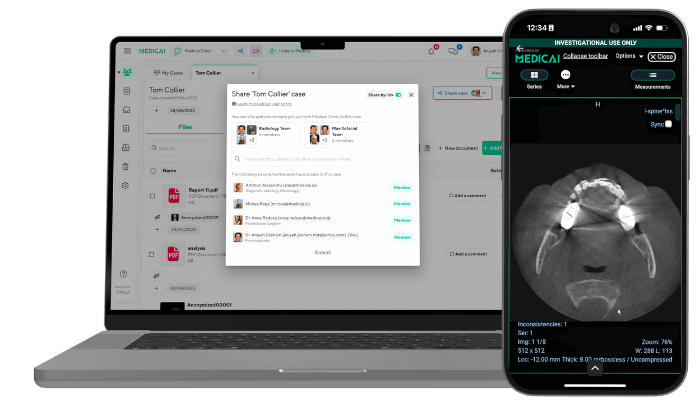
Medicai’s cloud imaging platform implements all three integration pathways, connecting imaging archives to major EHR and EMR systems through these standards rather than custom point-to-point connections. The integration pattern supports radiologists working in specialized diagnostic viewers, referring physicians accessing imaging within their EHR or EMR clinical workflow, and patients viewing their imaging studies through patient portals.
For healthcare organizations evaluating EHR-imaging or EMR-imaging integration patterns, see Medical Imaging EHR Systems Integrations with Medicai for specific integration capabilities across major EHR and EMR vendors.
How to choose between EHR and EMR for your healthcare organization
The choice between EHR and EMR depends on five factors that healthcare leaders should evaluate in sequence.
Start with interoperability needs. If your organization needs to share patient data across multiple providers, exchange information with hospitals or specialists, or participate in health information exchange, an EHR is required. If your practice operates with a self-contained clinical workflow and has minimal external data exchange needs, an EMR can be sufficient and more cost-effective. This is typically the deciding factor.
Consider organization size and growth plans. Health systems, hospital networks, and multi-site practices generally need EHR capabilities. Standalone single-location practices may operate effectively on EMR systems. Practices planning expansion to multiple sites should consider EHR systems, even when current operations could run on an EMR, because migrating from an EMR to an EHR mid-growth creates substantial costs and workflow disruption.
Evaluate participation in value-based care programs. Organizations participating in Accountable Care Organizations, bundled payment programs, or other value-based arrangements typically need EHR systems to meet quality reporting requirements and support the care coordination these programs reward. Pure fee-for-service practices have greater flexibility in operating within EMR systems.
Assess integration requirements with other healthcare technologies. Practices integrating with hospital systems, laboratory networks, imaging platforms, or specialty referral networks generally benefit from EHR systems with robust integration ecosystems. Practices with minimal external integration needs face less pressure on this dimension.
Factor in budget and resources for implementation and ongoing operations. EHR implementations typically require 6 to 18 months of project work and ongoing investment in interoperability connection maintenance. EMR implementations typically take 3 to 6 months and have lower ongoing complexity. Organizations with limited IT resources may find EMR systems more operationally manageable. Organizations with dedicated healthcare IT capabilities can absorb EHR complexity in exchange for broader functionality.
The decision is rarely binary in practice. Many healthcare organizations operate hybrid environments, with practice-level EMRs feeding into system-level EHRs, or with EMR systems that offer selective interoperability for specific use cases, such as e-prescribing and lab orders. For specialty practices with extensive imaging workflows, the advantages and disadvantages of EHR systems breakdown covers the specific considerations that should drive the decision.
Frequently asked questions about EHR vs EMR
The main difference is scope and interoperability. An EMR (Electronic Medical Record) is a digital patient chart confined to a single practice or organization. An EHR (Electronic Health Record) is a comprehensive longitudinal record designed to be shared across multiple providers, laboratories, pharmacies, and care settings. EMRs improve internal record-keeping; EHRs enable care coordination across organizations through standards like HL7 v2 and FHIR.
EHR and EMR are related but not interchangeable. The terms are sometimes used loosely as synonyms, but they describe systems with different scope. EMR refers to a digital chart within one practice. EHR refers to a comprehensive shareable record across providers. As interoperability has become essential in healthcare, the industry has increasingly favored EHR terminology to reflect the broader patient-centered approach.
Neither is universally better. The right choice depends on your organization’s size, care coordination needs, and interoperability requirements. EHRs are better for health systems, multi-site practices, and organizations participating in health information exchange. EMRs are better for small to medium standalone practices with self-contained workflows where the higher cost and complexity of an EHR isn’t justified. Many specialty clinics start with EMRs and migrate to EHRs as they scale.
Generally yes. EHRs require higher initial investment, more complex implementation, and ongoing maintenance of interoperability connections to external systems. EMRs typically have lower upfront cost, simpler deployment, and reduced ongoing infrastructure requirements. The total cost difference depends on the specific vendors, the size of the organization, and the integration scope. Cloud-based EHR and EMR options have reduced the cost gap compared to traditional on-premise deployments.
The term EMR predates EHR in widespread industry use. Early digital patient charts were called EMRs because they operated within single organizations. As healthcare interoperability became essential, the term EHR emerged to describe the broader shareable system that the industry was moving toward. Many vendors and clinicians still use the terms interchangeably, but the formal distinction reflects different system architectures.
HIPAA applies equally to both EHR and EMR systems through three rules. The Privacy Rule limits access to Protected Health Information (PHI) and requires patient consent for data sharing. The Security Rule requires technical, administrative, and physical safeguards including encryption, access controls, and audit logs. The Breach Notification Rule mandates reporting of data breaches to affected individuals and authorities. Both EHRs and EMRs must implement HIPAA-compliant security architecture, with EHRs facing additional interoperability-specific requirements.
Yes. Modern EHR and EMR systems integrate with medical imaging through several pathways. DICOMweb provides web-based imaging access from within the clinical record interface. HL7 and FHIR messaging carries imaging study metadata and results into the patient record. Cloud imaging platforms like Medicai connect imaging archives to EHR and EMR systems through these standards, allowing radiologists, referring physicians, and patients to access imaging studies alongside the broader clinical record.
Start with your interoperability needs. If your organization needs to share patient data across multiple providers, exchange information with hospitals or specialists, or participate in health information exchange, an EHR is required. If your practice operates as a self-contained clinical workflow without significant external data exchange needs, an EMR can be sufficient and more cost-effective. Other factors include organization size, growth plans, integration with billing and practice management systems, and regulatory reporting requirements. See EHR advantages and disadvantages for a deeper look at the considerations.
The future of EHR and EMR systems
The direction of EHR and EMR systems through the next several years is shaped by three structural forces.
Interoperability is moving from optional to mandatory through regulatory pressure. The 21st Century Cures Act information blocking provisions, TEFCA’s national framework for health information exchange, and the ongoing expansion of USCDI requirements are forcing both EHR and EMR vendors to support broader data exchange capabilities. The functional gap between EHR and EMR systems is narrowing as EMR vendors add interoperability layers to meet regulatory requirements and customer expectations.
AI integration is moving from experimental to operational across both system categories. Clinical decision support powered by machine learning, ambient documentation tools that generate clinical notes from clinician-patient conversations, predictive analytics for patient risk stratification, and automated coding suggestions are entering both EHR and EMR products. The pace of AI integration varies significantly across vendors, but the direction is consistent.
Cloud architecture is replacing on-premise deployments as the default for new implementations. Cloud-based EHR and EMR systems reduce upfront infrastructure costs, simplify ongoing maintenance, improve scalability, and support remote work patterns that became standard during and after the COVID-19 pandemic. Legacy on-premises EHR and EMR systems remain operational at many large health systems but increasingly face pressure to migrate as vendor investment concentrates on cloud platforms.
For healthcare organizations planning EHR or EMR investments through 2026 and beyond, the practical implication is that interoperability capabilities, AI feature roadmaps, and cloud architecture should carry more weight in vendor evaluation than in earlier procurement cycles. The systems that thrive will be those that integrate cleanly with the broader healthcare technology ecosystem rather than those that operate as closed silos.
Choosing the right system for your organization
The EHR vs EMR comparison ultimately comes down to one question: does your organization need patient data to move across boundaries, or does it operate as a self-contained clinical workflow? Organizations that need cross-organizational data sharing benefit from EHR systems despite the higher cost and complexity. Organizations operating within single locations with limited external data exchange needs can deliver effective patient care on EMR systems at a meaningfully lower total cost of ownership.
The decision rarely happens in isolation. EHR and EMR investments connect to broader healthcare technology decisions, including practice management systems, billing platforms, telemedicine tools, and medical imaging infrastructure. Healthcare organizations achieving the best results approach these decisions as an integrated architecture rather than independent procurements, with interoperability standards (HL7 v2, FHIR, DICOMweb) connecting the components into a coherent clinical and operational workflow. For deeper coverage of the considerations that should drive the choice, see EHR advantages and disadvantages. For imaging integration patterns specifically, see Medical Imaging EHR Systems Integrations with Medicai.
Related Articles


Lets get in touch!
Learn more about how Medicai can help you strengthen your practice and improve your patients’ experience. Ready to start your Journey?
Book A Free Demo