How 3D Imaging Is Changing Breast Augmentation Planning and Recovery

According to the International Society of Aesthetic Plastic Surgery, more than 3.9 million breast augmentation surgeries are performed globally every year. Thailand has become one of the leading destinations for this procedure, attracting international patients who seek experienced surgeons, modern hospital infrastructure, and competitive pricing. Resources focused on understanding Breast Augmentation In Thailand Cost procedures allow prospective patients to review verified clinics, implant options, and estimated treatment costs while learning about the technologies used during surgical planning.
One of the most important innovations shaping cosmetic surgery today is 3D imaging technology. It enables surgeons to simulate breast augmentation outcomes before the operation. Thai clinics use these systems to improve surgical planning and help patients visualize results during consultations.

Why Surgical Planning Matters in Breast Augmentation
Breast augmentation outcomes depend on several anatomical factors, including:
- Chest wall structure — affects how implants sit on the chest.
- Breast tissue thickness — influences how natural the implants look and feel.
- Skin elasticity — determines how well skin adapts to implants.
- Body proportions — helps choose an implant size that looks balanced with the body.
Traditionally, surgeons relied on manual measurements and implant samples during consultations. While this method helped estimate implant size, it often made it difficult for patients to clearly understand how the final result would appear.
Modern cosmetic surgery clinics increasingly rely on digital imaging systems to analyze a patient’s anatomy and test different implant sizes and shapes before surgery.
What 3D Imaging Technology Does
3D imaging systems capture a detailed digital scan of the patient’s chest using specialized cameras and software.
The process typically involves three stages.
- First, the patient undergoes a 3D surface scan that records the contours of the chest and breast area.
- Next, imaging software reconstructs the scan into a digital anatomical model.
- Finally, surgeons simulate implant placement to show how different implant sizes and shapes will affect the final appearance.
Some cosmetic surgery clinics use systems such as Vectra 3D imaging, which allow surgeons to compare different implant types and placement techniques directly during the consultation.
This approach helps patients make more informed decisions about implant selection.
The underlying principles behind medical imaging, digital modelling, and simulation tools are also explored in modern learning platforms such as sparx science, where students study how technology visualizes complex biological structures.
Types of Breast Implants Used in Thailand
Surgeons who perform breast augmentation in Thailand typically use implants produced by internationally recognized manufacturers such as Mentor Worldwide and Motiva. These implants comply with international regulatory standards, including U.S. Food and Drug Administration approval.
The most common implant types include:
| Implant type | Description |
| Saline implants | Filled with sterile saltwater; often chosen for moderate augmentation. |
| Silicone implants | Very common; provide a more natural feel and appearance. |
| Teardrop (anatomical) implants | Shaped to mimic the natural slope of the breast. |
| Gummy bear implants | Cohesive silicone gel implants that keep their shape and offer greater stability. |
| Fat transfer augmentation | Fat taken from another area of the patient’s body is used to increase breast volume. |
Some clinics also offer breast augmentation with fat transfer, where fat is taken from another area of the patient’s body and used to enhance breast volume. With 3D imaging simulations, patients can visualize how these options will affect their body proportions before surgery.
Implant Placement Techniques
Another key decision during surgical planning is implant placement.
The most common approaches include:
| Implant placement technique | Description |
| Subglandular placement | The implant is placed above the chest muscle but beneath the breast tissue. |
| Submuscular placement | The implant is positioned under the pectoral muscle, giving additional tissue coverage. |
| Dual-plane placement | A combination technique where the implant is partly under the muscle to improve contour and support. |
3D imaging tools help surgeons predict how each technique will influence breast shape and symmetry.
Breast Augmentation Costs in Thailand Compared to Western Countries
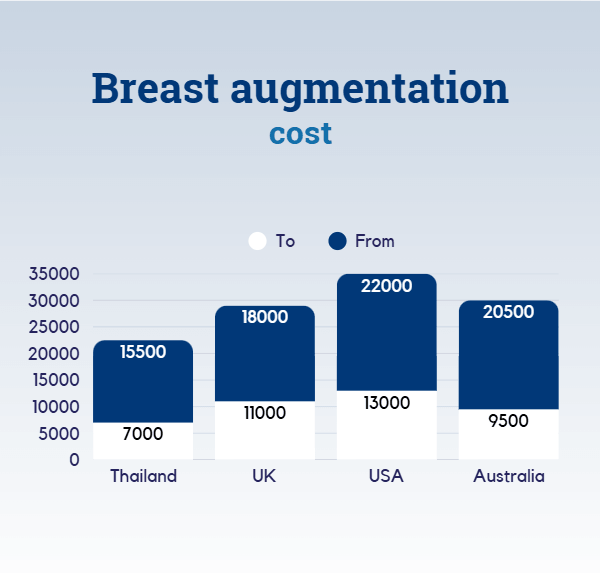
One reason Thailand attracts international patients is the cost difference compared to Western countries, while still maintaining high medical standards.
| Procedure & type | Thailand (AUD) | Australia (AUD) | UK (AUD) | USA (AUD) |
| Teardrop implants | $12,000 – $15,500 | $8,000 – $12,000 | $16,000 – $19,500 | $13,000 – $18,000 |
| Silicone implants | $11,000 – $15,500 | $8,000 – $11,000 | $16,000 – $19,500 | $13,000 – $18,000 |
| Saline implants | $8,500 – $12,500 | $7,000 – $10,000 | $13,000 – $15,500 | $9,500 – $14,500 |
| Gummy bear implants | $14,000 – $17,000 | $10,000 – $15,500 | $17,000 – $22,000 | $14,500 – $20,500 |
| Breast augmentation with fat transfer | $8,000 – $13,000 | $8,000 – $13,200 | $11,000 – $18,000 | $13,000+ |
Even with lower pricing, many hospitals in Thailand performing cosmetic procedures meet international standards and are accredited by the Joint Commission International (JCI).
Why Thailand Has Become a Global Hub
Thailand performs thousands of cosmetic procedures each year and has developed a strong reputation in aesthetic medicine. ISAPS lists Thailand among the top 30 countries for total aesthetic procedures, with many patients traveling from Australia, Europe, and the Middle East.
Several factors explain Thailand’s position as a cosmetic surgery hub:
- Board-certified plastic surgeons trained internationally. Thai surgeons complete fellowships in countries such as the United States, South Korea, and Australia and maintain memberships in organizations such as ISAPS and the Royal College of Surgeons of Thailand.
- Hospitals accredited to international safety standards. Surgical centers operate in facilities accredited by JCI, which evaluates hospitals based on surgical safety, infection control, and patient care protocols.
- Advanced planning technologies are used during consultations. Leading clinics use advanced planning tools such as Vectra 3D imaging, ultrasound scanners, and digital implant libraries to simulate outcomes and guide implant size and placement. Vectra 3D predicts postoperative breast volumes with 90–92% accuracy.
- Transparent treatment packages designed for international patients. Clinics provide bundled pricing that includes surgeon fees, implants, anesthesia, operating room costs, and several days of hospital monitoring.
Cities such as Bangkok and Phuket host many internationally recognized cosmetic surgery clinics that specialize in treating international patients.
How 3D Imaging Improves the Patient Experience
3D imaging tools make consultations easier to understand. Instead of relying on implant samples or example photos, patients can view a digital simulation based on their own body measurements and anatomy.
| 3D Imaging Type | Purpose |
| 3D surface imaging | Creates a digital chest model to simulate implant size and shape. |
| 3D simulation software | Adjusts implant size, shape, and placement for realistic previews. |
| 3D body scanning | Measures body and chest proportions to match implant choice. |
| Augmented reality (AR) | Projects simulated results onto the patient’s body during consultation. |
This allows patients to:
- Compare different implant sizes and see how volume changes affect overall breast proportions.
- Evaluate implant shapes to understand how round and anatomical implants influence breast contour.
- Review placement options to see how implant position may change projection and upper-pole fullness.
- Visualize projected results on their own body rather than relying on generalized examples.
Seeing realistic simulations helps patients make more informed decisions and develop clearer expectations before surgery.
Recovery Benefits of Technology-Driven Planning
Digital imaging tools also support more precise surgical planning. When surgeons enter the operating room with a detailed visual plan, they can perform the procedure with greater consistency and fewer intraoperative adjustments.
Technology-assisted planning can:
- Reduce surgical time. Accurate implant selection and placement planning minimize the need for adjustments during surgery, which can shorten the procedure and reduce anesthesia exposure.
- Limit tissue trauma. When implant pockets and incision points are planned in advance, surgeons can work more precisely, which may reduce swelling and bruising after surgery.
- Improve implant positioning. Proper implant placement reduces the likelihood of complications such as asymmetry or implant displacement that may require corrective procedures.
- Optimize incision placement. Pre-operative visualization helps surgeons choose incision locations that balance surgical access with minimal visible scarring.
Although recovery time varies between individuals, careful planning can reduce the likelihood of complications or the need for corrective procedures.
The Future of Imaging in Cosmetic Surgery
Medical imaging technologies continue to evolve. Researchers are now exploring how artificial intelligence and advanced imaging analytics can further improve surgical planning.
Future systems may:
- Combine detailed anatomical scans with large clinical datasets to refine surgical predictions.
- Analyze patterns from previous procedures to improve accuracy when selecting implants and placement methods.
- Generate highly personalized simulations based on body proportions, tissue characteristics, and surgical goals.
These developments may help surgeons create more individualized treatment plans and more precise outcome predictions for cosmetic procedures.
Final Thoughts
Thailand has established itself as one of the world’s leading destinations for breast augmentation, offering experienced surgeons, internationally accredited hospitals, and advanced surgical planning technologies.
The integration of 3D imaging systems enables surgeons to simulate outcomes, refine implant selection, and improve communication with patients before surgery.
For patients considering breast augmentation in Thailand, understanding implant types, surgical techniques, treatment costs, and planning technologies can help ensure a safe procedure and a predictable outcome.

Related Articles

Lets get in touch!
Learn more about how Medicai can help you strengthen your practice and improve your patients’ experience. Ready to start your Journey?
Book A Free Demo