What Are RADS? BI-RADS, TI-RADS, PI-RADS Explained

Reporting and Data Systems (RADS) are standardized frameworks, created by the American College of Radiology (ACR), that give radiologists a consistent way to describe imaging findings, assign a risk category, and recommend the next management step for a specific organ or disease. Instead of every radiologist describing a thyroid nodule or a liver lesion in their own words, a RADS framework defines a fixed vocabulary and a numbered risk scale, so that a score communicates the same meaning to every clinician who reads the report. The best-known are BI-RADS for breast imaging, TI-RADS for thyroid, and PI-RADS for prostate, but the ACR maintains a whole family of them.
Each RADS framework is owned, published, and updated by the ACR (the names are ACR trademarks), making the ACR the authoritative source for the exact categories and criteria of each system. This guide is a plain-language overview of what the RADS systems are, how they work as a group, and how the most widely used ones compare. For the precise, current definitions and management tables for any single system, this guide links directly to the ACR’s page for that standard, since the ACR maintains the authoritative version.
This overview is written for radiologists, referring physicians, and healthcare teams who want to understand the RADS family as a whole and see how the major systems line up side by side. For how standardized scores like these fit into the broader move toward structured radiology reporting, see the Medicai guide to structured radiology reporting.
What Is a Reporting and Data System (RADS)?
A Reporting and Data System is a standardized classification framework that turns a radiologist’s subjective impression into a structured, numbered assessment. Every RADS framework shares the same underlying design: a defined lexicon (the specific terms used to describe imaging features), a set of assessment categories (usually numbered, reflecting increasing suspicion of malignancy or disease), and a management recommendation tied to each category (what should happen next, such as routine follow-up, short-interval imaging, or biopsy).
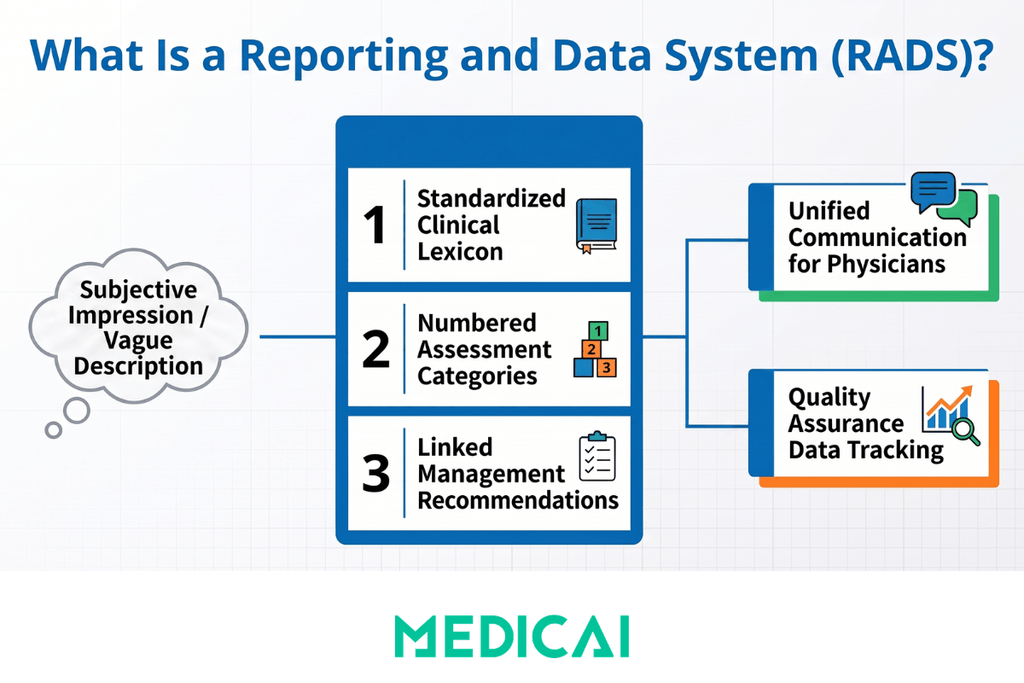
The purpose is to solve a communication problem. Before standardized reporting, two radiologists could describe the same finding differently, and a referring physician could not reliably compare reports or know what action a description implied. A RADS category collapses that ambiguity into a single, shared signal: a BI-RADS 4 or a PI-RADS 5 means the same thing and implies the same next step, regardless of who read the study. This standardization also makes imaging data usable for audit, research, and quality assurance, because findings recorded as structured categories can be tracked and compared at scale.
The ACR describes each RADS framework as a quality assurance tool. The systems are developed by ACR committees of subspecialty radiologists, published as manuals or white papers, and revised over time as evidence accumulates, which is why most have version numbers (for example, the BI-RADS Atlas is in its fifth edition with a v2025 manual, and PI-RADS and TI-RADS have their own version histories).
The RADS Family: How Many Are There?
The ACR maintains a growing family of Reporting and Data Systems, each covering a specific organ, disease, or imaging context. As of recent counts, the ACR has validated roughly a dozen, with more in development. The established systems include BI-RADS (breast), TI-RADS (thyroid), PI-RADS (prostate), LI-RADS (liver), Lung-RADS (lung cancer screening), O-RADS (ovarian and adnexal), NI-RADS (head and neck), C-RADS (CT colonography), CAD-RADS (coronary artery disease, developed with cardiology societies), Bone-RADS, and MSK-RADS (musculoskeletal), among others. Newer frameworks continue to be added as subspecialties adopt the standardized approach.
What unites them is the shared ACR design pattern (lexicon, numbered categories, management recommendations) applied to different clinical questions. What differs is the organ, the imaging modality, the risk being assessed, and the specific category definitions. The three most widely used in day-to-day radiology and most often searched are BI-RADS, TI-RADS, and PI-RADS, compared below.
BI-RADS, TI-RADS, and PI-RADS Compared
The table below compares the three most common RADS frameworks at a high level. The category scales, criteria, and management recommendations summarized here are defined in full and kept current by the ACR, so each system links to its authoritative ACR page for the exact, up-to-date definitions.
| System | Organ / purpose | Primary modality | Category scale | Authoritative source |
|---|---|---|---|---|
| BI-RADS | Breast cancer risk assessment and reporting | Mammography, ultrasound, breast MRI | 0 to 6 | ACR BI-RADS |
| TI-RADS | Thyroid nodule risk stratification | Ultrasound | TR1 to TR5 (points-based) | ACR TI-RADS |
| PI-RADS | Prostate cancer detection and reporting | Multiparametric MRI | 1 to 5 | ACR PI-RADS |
BI-RADS: Breast Imaging Reporting and Data System
BI-RADS (the Breast Imaging Reporting and Data System) is the oldest and most established RADS framework, published and trademarked by the ACR and used to standardize breast imaging reports across mammography, ultrasound, and breast MRI. It assigns a final assessment category from 0 to 6, where 0 means incomplete (additional imaging needed), 1 is negative, 2 is benign, 3 is probably benign (short-interval follow-up), 4 is suspicious (biopsy should be considered), 5 is highly suggestive of malignancy, and 6 is known biopsy-proven malignancy. Each category includes a specific management recommendation, which makes the score actionable for the referring physician.
BI-RADS also standardizes breast density reporting and supports medical audits and outcome monitoring, providing practices with a mechanism for peer review and quality assurance. The current definitions, lexicon, and category criteria are maintained by the ACR in the BI-RADS Atlas and manual. For the authoritative and current version, see the ACR BI-RADS page.
TI-RADS: Thyroid Imaging Reporting and Data System
TI-RADS (the Thyroid Imaging Reporting and Data System) is the ACR framework for stratifying the malignancy risk of thyroid nodules found on ultrasound. Unlike the simpler numbered scales, ACR TI-RADS is points-based: the radiologist scores a nodule across five ultrasound feature categories (composition, echogenicity, shape, margin, and echogenic foci), sums the points, and arrives at a TI-RADS level from TR1 (benign) to TR5 (high suspicion of malignancy). The resulting level, combined with the nodule’s size, determines whether fine-needle aspiration biopsy or follow-up ultrasound is recommended.
ACR TI-RADS was introduced in a 2017 white paper by the ACR TI-RADS Committee and is designed to reduce unnecessary thyroid biopsies by linking biopsy recommendations to a structured risk score rather than to size alone. For the authoritative scoring criteria and management thresholds, see the ACR TI-RADS page.
PI-RADS: Prostate Imaging Reporting and Data System
PI-RADS (the Prostate Imaging Reporting and Data System) standardizes the acquisition, interpretation, and reporting of multiparametric prostate MRI for detecting clinically significant prostate cancer. It assigns an overall assessment category from 1 to 5, where 1 indicates that clinically significant cancer is highly unlikely and 5 indicates that it is highly likely, based on findings across MRI sequences (T2-weighted imaging, diffusion-weighted imaging, and dynamic contrast enhancement). The score guides whether targeted biopsy is warranted.
PI-RADS has evolved through versions since its introduction, refining how the sequences are weighted and how lesions are scored, which is why citing the current version matters in clinical practice. For the authoritative and current PI-RADS criteria, see the ACR PI-RADS page.
How RADS Frameworks Fit Into Structured Reporting and Modern Imaging
RADS frameworks are a specific, organ-focused form of structured radiology reporting: they replace free-text description with a defined lexicon and a categorical score. As radiology moves toward structured, machine-readable reports, RADS scores are increasingly captured as discrete data elements rather than being buried in narrative text, making them usable for downstream analytics, quality tracking, and AI-assisted workflows. A RADS score recorded as structured data can be tracked over time, audited across a practice, and surfaced to referring clinicians through the imaging platform.
For imaging platforms, the relevance is in how these structured scores are captured, stored, and communicated. When a radiologist assigns a BI-RADS, TI-RADS, or PI-RADS category, that assessment travels with the study and the report through the imaging infrastructure to the referring physician and the patient record. For how standardized, structured reporting works in practice and why it matters for imaging workflows, see the Medicai guide to structured radiology reporting. For the broader family of ACR Reporting and Data Systems and the authoritative version of any single standard, the ACR maintains the full list on its Reporting and Data Systems page.
Frequently Asked Questions
RADS stands for Reporting and Data System. A Reporting and Data System is a standardized framework, created by the American College of Radiology (ACR), that gives radiologists a consistent lexicon, a numbered risk-assessment scale, and management recommendations for a specific organ or disease. The best-known examples are BI-RADS (breast), TI-RADS (thyroid), and PI-RADS (prostate). Each RADS is an ACR-owned and trademarked standard, and the ACR is the authoritative source for the exact current criteria of any individual system.
The ACR maintains roughly a dozen validated Reporting and Data Systems, with more in development. Established ones include BI-RADS (breast), TI-RADS (thyroid), PI-RADS (prostate), LI-RADS (liver), Lung-RADS (lung cancer screening), O-RADS (ovarian and adnexal), NI-RADS (head and neck), C-RADS (CT colonography), CAD-RADS (coronary artery disease), Bone-RADS, and MSK-RADS (musculoskeletal). All share the same ACR design of a defined lexicon, numbered assessment categories, and management recommendations, applied to different organs and clinical questions.
They are the same type of ACR framework applied to different organs. BI-RADS standardizes breast imaging (mammography, ultrasound, breast MRI) with categories 0 to 6. TI-RADS stratifies thyroid nodule risk on ultrasound using a points-based system that produces a level from TR1 to TR5. PI-RADS scores multiparametric prostate MRI from 1 to 5 for the likelihood of clinically significant prostate cancer. Each links a category to a management recommendation, such as follow-up or biopsy, and each is defined and updated by the ACR.
The RADS frameworks are created, published, trademarked, and maintained by the American College of Radiology (ACR), developed by committees of subspecialty radiologists. The names (BI-RADS, TI-RADS, PI-RADS, and the others) are ACR trademarks. Because the ACR owns and periodically updates each standard, the ACR’s own pages are the authoritative source for the current categories, criteria, and management recommendations of any individual RADS.
Yes. RADS scores are a focused form of structured reporting: they replace free-text impressions with a defined lexicon and a categorical score. As radiology adopts structured, machine-readable reporting, RADS categories are increasingly captured as discrete data elements, making them usable for audit, quality assurance, research, and AI-assisted workflows, and allowing the score to travel with the study and report through the imaging platform to the referring clinician.


Related Articles



Lets get in touch!
Learn more about how Medicai can help you strengthen your practice and improve your patients’ experience. Ready to start your Journey?
Book A Free Demo