Cloud PACS vs On-Premise PACS: Architecture, Cost, and Performance Compared

Cloud PACS is a medical imaging platform that stores, retrieves, and distributes DICOM studies on remote cloud infrastructure; on-premises PACS performs the same functions on servers physically located within the healthcare facility — the choice between them determines the cost structure, access model, disaster recovery capability, and long-term operational overhead.
For decades, the standard for medical imaging was simple: buy a server, put it in the basement, and run the PACS locally. But as imaging volumes explode and Teleradiology becomes the norm, that model is breaking down.
Healthcare leaders are now enhancing their infrastructure strategies, moving from a binary choice (Cloud vs. On-Premise) to a nuanced decision about workflow, latency, and Total Cost of Ownership (TCO).
If you are evaluating a PACS replacement, you aren’t just buying storage; you are choosing an architecture. This guide compares the three deployment models—On-Premise, Cloud-Native, and Hybrid—to help you make the right choice for your facility.

Types of PACS Systems: An Architectural Overview
Before comparing features and costs, it is critical to understand the three distinct PACS deployment architectures available in the market. A PACS system is defined not just by its software, but by where the data “lives” and how it moves.
On-Premise PACS (The “Legacy” Model)
In this traditional setup, the entire infrastructure—servers, storage arrays, and backup tapes—is physically located within the hospital’s data center.
- The Architecture: The software is installed locally on a Local Area Network (LAN).
- The Financial Model: Heavy Capital Expenditure (CapEx). You purchase the hardware upfront and depreciate it over 5–7 years.
- Best For: Facilities with poor internet connectivity or strict data sovereignty laws requiring physical custody of data.
Cloud-Based PACS (The “SaaS” Model)
Also known as Web-Based PACS, this model moves the entire infrastructure off-site. The vendor hosts the data in a public or private cloud (e.g., AWS, Azure).
- The Architecture: Users access images via a Zero-Footprint Viewer (browser-based) over the internet. There is no local hardware to manage.
- The Financial Model: Predictable Operating Expense (OpEx). You pay a monthly subscription based on usage (per study or per user).
- Best For: Teleradiology groups, small clinics, and distributed networks that need instant scalability without IT overhead.
Hybrid PACS (The “Strategic Bridge”)
The Hybrid PACS is the modern standard for high-volume enterprise imaging. It solves the “physics” problem of pure cloud latency by combining the speed of local servers with the scalability of the cloud.
The Architecture: A small local Edge Server acts as a cache, storing the last 30–60 days of “hot” (active) data for instant LAN-speed viewing. Meanwhile, all data is asynchronously synced to the Cloud Archive for long-term storage and disaster recovery.
What is Hybrid PACS?
Hybrid PACS is a medical imaging deployment architecture that combines a local edge server, physically located at the healthcare facility, with a cloud archive hosted on remote, managed infrastructure. The edge server functions as a high-speed cache, storing recent studies for immediate LAN-speed retrieval by on-site radiologists. The cloud archive runs in parallel, receiving an asynchronous copy of every study for long-term storage, disaster recovery, and remote access by off-site readers.
The core design principle of hybrid PACS is latency separation: studies that clinicians need immediately — today’s worklist, recent priors, active emergency cases — are served from local storage at gigabit LAN speeds regardless of internet connectivity. Studies that are needed rarely or for archival purposes are served from the cloud at acceptable retrieval latency because the urgency is lower. This separation means hybrid PACS does not force a choice between speed and scalability — it delivers both simultaneously by routing each access type to the infrastructure optimised for it.
Hybrid PACS differs from cloud-enabled PACS — legacy on-premise systems migrated to a cloud host — in one critical way: in a true hybrid architecture, the edge server is a lightweight, vendor-managed cache node with no local database, no local backup obligation, and no hardware refresh cycle. In a cloud-enabled deployment, the primary application and database still run on a server that happens to sit in AWS or Azure rather than in the hospital basement — the operational overhead of managing that server does not disappear just because it moved to a data centre.
Three conditions indicate hybrid PACS is the correct architecture for a facility:
- High imaging volume with large file sizes — cardiac CINE loops, breast tomosynthesis, and PET-CT studies exceed 500MB per study; pure cloud retrieval of these over a standard internet connection introduces read latency that disrupts radiologist workflow
- Multi-site network with a mix of connectivity quality — sites with reliable high-bandwidth internet can operate as pure cloud nodes; sites with constrained or unreliable internet need a local cache, and a hybrid architecture accommodates both site types under a single platform
- Existing on-premise PACS being phased out — hybrid architecture allows a staged transition, with the edge server bridging legacy on-premise infrastructure and the cloud archive growing as the PACS migration progresses, rather than requiring a hard cutover
Best For: Hospitals and Imaging Centers that demand the speed of on-premise reading but want the remote access and backup security of the cloud.
The Financial Model: A blend of low CapEx (small edge server) and flexible OpEx (cloud storage tiers).
Comparison Matrix: Cloud vs On Premise PACS vs Hybrid PACS
| Feature | On-Premise PACS (Legacy) | Cloud-Based PACS (SaaS) | Hybrid PACS (Modern Standard) |
|---|---|---|---|
| Primary Architecture | Local Hardware: Servers physically located in the hospital data center. | 100% Web-Based: Data hosted in public/private cloud (AWS/Azure). | Edge + Cloud: Local “Smart Cache” server synced to a Cloud Archive. |
| Financial Model | High CapEx: Large upfront investment for hardware, cooling, and software licenses. | 100% OpEx: Predictable monthly subscription fee (Pay-as-you-go). | Mixed: Low CapEx (Small Edge Server) + Flexible OpEx (Cloud Storage). |
| Speed & Latency | Fastest: Runs on local LAN (Gigabit speed). Zero internet dependency. | Variable: Speed depends entirely on your internet bandwidth. High risk of “buffering.” | Optimized: “Hot” (recent) images load instantly from local cache; “Cold” priors stream from cloud. |
| IT Maintenance | High: Requires dedicated internal IT staff for updates, backups, and hardware fixes. | Zero: Vendor manages all updates, security patches, and uptime remotely. | Low: Vendor remotely manages the Edge server and Cloud backend. |
| Scalability | Difficult: “Storage Cliff.” You must buy new hard drives when space runs out. | Elastic: Infinite scalability. Add Petabytes of storage instantly without downtime. | Elastic: The local cache rotates data automatically; the cloud archive scales infinitely. |
| Disaster Recovery | Manual: You are responsible for off-site backups (tapes/drives). High risk of data loss. | Built-In: Data is automatically replicated across multiple geo-redundant data centers. | Built-In: Geo-redundant cloud backup + Local server allows reading even if the internet goes down. |
| Best For… | Facilities with unreliable internet or strict data residency laws preventing cloud use. | Teleradiology groups, small clinics, and mobile ultrasound services. | Hospitals & Imaging Centers dealing with heavy data (3D Tomo/Cardiac) who need speed and scale. |
The Financial Factor: CapEx vs. OpEx
The most immediate difference between the two models is how they hit your budget.
On-Premise: The “Iceberg” Cost (CapEx)
In the traditional model, you purchase the hardware and software licenses up front. This is a Capital Expenditure (CapEx).
Industry estimates place total on-premise PACS implementation costs for a mid-size hospital at $300,000–$800,000 in year one, with annual ongoing costs of $50,000–$150,000 for maintenance, licensing, and IT staffing. Cloud PACS subscription costs typically run $0.50–$2.00 per study, depending on storage and feature tier, translating to $30,000–$120,000 per year for a department processing 60,000 studies annually, with no hardware refresh obligation after years 5–7.
- Visible Costs: Servers, storage arrays, software licenses.
- Hidden Costs: As noted in our previous analysis, on-premise systems carry significant ongoing overhead: electricity, cooling, server room real estate, and the specialized IT staff required to maintain them.
- The Risk: You must predict your storage needs 3-5 years in advance. If you grow faster than expected, you face an expensive “forklift upgrade” to add more drive bays.
Cloud PACS: The “Utility” Model (OpEx)
Cloud systems operate on a subscription basis—Operational Expenditure (OpEx).
- Predictability: You pay for what you use (per study or per Terabyte).
- Value: The vendor handles the hardware refresh cycles. You never have to buy a server again.
- TCO Reality: While the monthly fee continues forever, the Total Cost of Ownership is often lower because you eliminate the hidden costs of hardware maintenance and emergency IT repairs.
Cloud PACS vs On Premise Cost
| Cost item | On-premise PACS | Cloud PACS |
|---|---|---|
| Initial hardware | $200,000 – $500,000 | $0 — no hardware required |
| Software licensing | $50,000 – $150,000 upfront | Included in subscription |
| Annual maintenance | $30,000 – $80,000 | Included in subscription |
| IT staffing | 0.5 – 1.0 FTE dedicated to PACS infrastructure | Minimal — vendor-managed infrastructure |
| Storage expansion | Hardware forklift upgrade — planned capital expenditure every 3 – 5 years | Automatic elastic scaling — no procurement cycle |
| Disaster recovery infrastructure | $50,000 – $200,000 for secondary off-site backup site | Included — geo-redundant replication across availability zones |
| Hardware refresh (year 5 – 7) | $200,000 – $500,000 | $0 — vendor manages all infrastructure upgrades |
| Typical 7-year TCO | $1.2M – $3M+ | $210,000 – $840,000 |
The Performance Factor: Latency & The Physics of Imaging
Money matters, but speed saves lives. This is where the “Cloud vs. On-Premise” debate gets technical.
On-Premise: The Speed King
- The Pro: Because the server is down the hall, images travel over your local LAN (Local Area Network) at gigabit speeds. Large files—like Breast Tomosynthesis or Cardiology CINE loops—open instantly.
- The Con: That speed vanishes the moment you leave the building. Setting up remote access for radiologists usually requires complex VPNs that degrade performance.
Cloud PACS: The Accessibility Champion
- The Pro: True Zero-Footprint viewing. Radiologists can log in from home, a coffee shop, or a satellite clinic using just a browser. This PACS server configuration is essential for modern Teleradiology workflows.
- The Con: Pure cloud systems are bound by the laws of physics. If your facility has poor internet bandwidth, downloading a 500MB study can result in buffering/latency, leading to physician frustration.
The Security Attribute: Control vs. Expertise
A common myth is that “On-Premise is safer because I can see the server.” In the era of ransomware, the opposite is often true.
The “Castle” Myth (On-Premise)
On-premise servers are vulnerable to physical theft, fire, and local network intrusions. If your hospital network is breached by ransomware, your local PACS server—and its local backups—are often the first targets to be encrypted.
The “Bank” Model (Cloud)
Cloud providers (like AWS, Azure, or Google Cloud) invest billions in security—far more than any single hospital can afford.
Enterprise cloud PACS platforms operating on Azure or AWS implement AES-256 encryption at rest and TLS 1.2+ in transit, a write-once object lock that prevents ransomware from encrypting backup copies, automated geo-redundant replication across a minimum of three availability zones, and SOC 2 Type II compliance, audited annually. On-premise PACS security depends entirely on the hospital’s internal IT security posture — the same network that is vulnerable to phishing, lateral movement, and ransomware propagation across all connected systems.
- Immutable Backups: Modern cloud PACS utilize “object lock” technology. Even if a hacker deletes your live data, the immutable backup cannot be altered or deleted, ensuring rapid Disaster Recovery (DR).
- Compliance: Reputable cloud vendors carry SOC 2 Type II certification, HIPAA business associate agreements, and AES-256 encryption at rest with TLS 1.2+ in transit. Understanding the legal distinctions in these agreements is vital, particularly when defining the responsibilities of a HIPAA covered entity vs business associate to ensure data privacy. The correct question is not whether cloud is secure, but whether the specific vendor’s security posture, compliance certifications, and data residency terms meet the facility’s requirements.
The Winner: Why “Hybrid” Architecture is the Future
Smart healthcare organizations are realizing they don’t have to choose. The industry is converging on Hybrid Architecture (sometimes called “Edge Computing”).
How Hybrid PACS Works
- The Edge Server (Local): A small, inexpensive server sits in your facility. It caches the last 30–60 days of active studies.
- Benefit: You get LAN speeds for recent patients (just like On-Premise).
- The Cloud Archive (Remote): Every image is instantly synced to the cloud for long-term storage and backup.
- Benefit: You get infinite Scalability and Disaster Recovery (just like the Cloud).
This model solves the “physics” problem: Your radiologists get instant image loading for today’s patients, but your IT team gets the simplicity of cloud management.
Decision Matrix: Which PACS Architecture Fits You?
Not every facility needs the same setup. Use this matrix to guide your decision:
| Facility Profile | Recommended Architecture | Why? |
| Small Clinic / Private Practice | 100% Cloud | Zero IT maintenance required; lower startup costs; internet speed usually sufficient for X-Ray/Ultrasound volume. |
| Large Hospital / Trauma Center | Hybrid | Critical need for speed in the ER (local cache) combined with massive data archiving needs (cloud). |
| Imaging Center / Teleradiology | Hybrid or Cloud | Need to distribute images to referring physicians easily; “Zero-footprint” viewing is a priority. |
| Rural Health (Unstable Internet) | On-Premise / Hybrid | Cannot rely on 100% cloud if the internet connection drops frequently. Local caching is mandatory. |
Discover the Future of Medical Imaging with Medicai Cloud PACS!
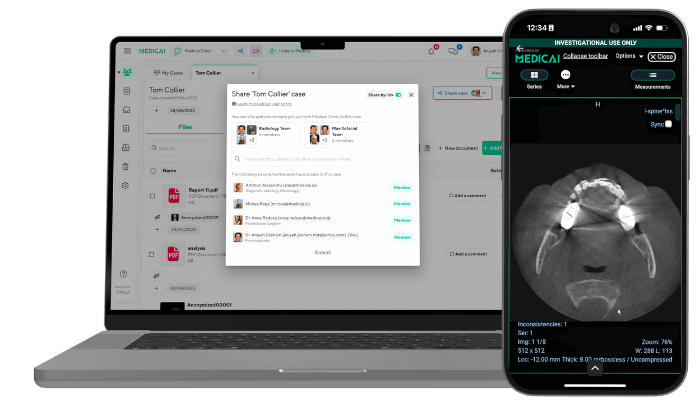
Unlock the power of advanced medical imaging with Medicai Cloud PACS, the cloud-native PACS solution. Seamlessly access, share, and manage your medical imaging data and clinical documents anywhere, anytime. Our cloud-based Picture Archiving and Communication System (PACS) is designed to enhance diagnostic accuracy, streamline workflows, and improve patient care.
Why Choose Medicai Cloud PACS?
- Secure & HIPAA Compliant: Fully compliant with HIPAA and other industry standards, ensuring your patient data is safe and secure.
- Scalable & Flexible: Tailored to meet the needs of healthcare providers of all sizes, from individual physicians to large hospitals.
- User-Friendly Interface: Intuitive design for effortless navigation and easy access.
- 24/7 Support: Dedicated customer support to assist you at every step.
Experience the Benefits for Yourself
- Enhance Collaboration: Easily share images and reports with colleagues and specialists, improving coordination among physicians.
- Improve Diagnostic Efficiency: Access and share images and imaging information instantly, facilitating quicker decision-making.
- Reduce Costs: Eliminate the need for on-premises storage with our secure cloud storage solutions.
FAQ
What is the difference between cloud PACS and on-premise PACS?
The fundamental difference is where the data lives and who manages the infrastructure. In an on-premise PACS, servers, storage arrays, and backup systems are physically installed in the hospital’s data centre — the facility owns the hardware, pays for its maintenance, and is responsible for disaster recovery. In a cloud PACS, all of these functions are handled by the vendor on remote infrastructure, and the facility pays a subscription fee based on usage. The operational consequences of this difference are significant: on-premise systems require dedicated IT staff and capital investment every 5–7 years for hardware refresh; cloud systems scale automatically, update without downtime, and carry no hardware refresh obligation. The performance tradeoff is latency — on-premise systems deliver gigabit LAN speeds for large imaging files, while pure cloud systems depend on internet bandwidth, which is why hybrid architecture has become the standard for high-volume facilities that need both speed and scalability.
What are the advantages of cloud-based PACS?
Cloud-based PACS delivers six measurable advantages over traditional on-premise systems. First, zero hardware investment — no servers, storage arrays, or cooling infrastructure to purchase or replace. Second, elastic scalability — storage expands automatically as imaging volume grows, with no procurement cycle and no storage cliff. Third, built-in disaster recovery — data is automatically replicated across geo-redundant data centres, eliminating the cost and complexity of a secondary off-site backup site. Fourth, vendor-managed maintenance — security patches, software updates, and infrastructure upgrades are handled by the vendor with no downtime, removing the IT overhead that on-premise systems require. Fifth, true remote access — radiologists can read studies from any location using a browser, which is the enabling infrastructure for teleradiology and multi-site reading workflows. Sixth, lower total cost of ownership over a 7-year contract cycle — the elimination of hardware refresh costs typically produces a TCO 60–70% lower than an equivalent on-premise deployment when all costs are accounted for.
Is cloud PACS secure?
Cloud PACS deployed on enterprise infrastructure is demonstrably more secure than most on-premise PACS environments, for two reasons. First, cloud providers such as Microsoft Azure and AWS invest at a scale no single hospital can match — billions of dollars annually in physical security, network security, threat detection, and compliance infrastructure. Second, cloud architecture separates backup data from live data in a way that on-premise systems cannot: immutable object storage with write-once object lock means that even if a ransomware attack encrypts or deletes live imaging data, the backup copy cannot be altered or destroyed. On-premise PACS systems are particularly vulnerable to ransomware because local backups typically sit on the same network as the live system — when the network is breached, both are encrypted simultaneously. Reputable cloud PACS vendors carry SOC 2 Type II certification, HIPAA business associate agreements, and AES-256 encryption at rest with TLS 1.2+ in transit. The correct question is not whether cloud is secure, but whether the specific vendor’s security posture, compliance certifications, and data residency terms meet the facility’s requirements.
Which PACS deployment model is best for a hospital?
For most hospitals in 2026, hybrid PACS is the correct architecture. Pure on-premise systems carry unsustainable infrastructure costs and cannot support the remote access requirements of modern radiology workflows. Pure cloud systems introduce read latency that disrupts workflow for large imaging files — cardiac CINE loops, breast tomosynthesis, and PET-CT studies — in environments without consistently high-bandwidth internet. Hybrid architecture resolves this by caching recent high-priority studies on a local edge server for LAN-speed access while routing long-term storage, disaster recovery, and remote access to the cloud archive. The on-premise model remains appropriate only for facilities with persistent internet connectivity issues or data residency regulations that legally prohibit cloud storage. Small clinics and teleradiology groups processing predominantly X-ray and standard CT volumes can operate effectively on a pure cloud model, where the cost savings outweigh the marginal latency risk. The decision framework is straightforward: if your highest-priority constraint is speed for large files at a single site, lean toward hybrid; if your highest-priority constraint is cost and remote access with no complex files, lean toward pure cloud.
Take Away: Future-Proofing Your Imaging Strategy
For most new deployments in 2026, cloud-native or hybrid PACS offers lower total cost of ownership, better disaster recovery, and easier scalability than on-premise systems — the only scenarios where on-premise remains the right choice are facilities with persistent internet connectivity issues or data residency requirements that prohibit cloud storage.
The transition from on-premise to cloud is not just a trend; it is a necessity driven by data growth and the need for remote access. However, the path there isn’t always a straight line.
For many facilities, the Hybrid PACS offers the perfect bridge—delivering the speed doctors demand with the security and scale administrators need.
Is your infrastructure ready for the transition?
Don’t let hardware limitations dictate your patient care. Evaluate your internet bandwidth, calculate your TCO, and choose the architecture that supports your clinical workflow—not just your storage needs.

Related Articles
Lets get in touch!
Learn more about how Medicai can help you strengthen your practice and improve your patients’ experience. Ready to start your Journey?
Book A Free Demo