DICOM Viewer for Mac: Free Browser-Based Options (No Install Needed)

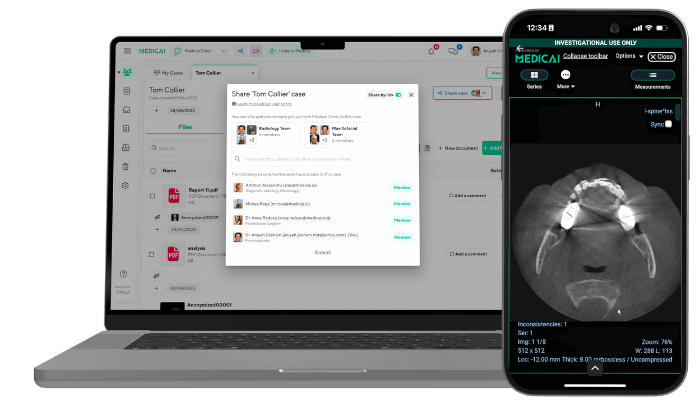
A DICOM viewer for Mac is software that opens and displays medical imaging files (the .dcm files produced by CT, MRI, X-ray, ultrasound, and other imaging modalities) on macOS. Mac users have historically had fewer options than Windows users because many DICOM viewers were built Windows-first, and the two most popular Mac-native options (Horos and OsiriX) are desktop applications that require installation and carry specific limitations. The alternative that has become the practical answer for most Mac users is the browser-based DICOM viewer, which opens DICOM files directly in Safari, Chrome, Firefox, or Edge with no installation required, no macOS version dependency, and no compatibility concerns on Apple Silicon Macs.
This guide covers the Mac DICOM viewer landscape honestly: what Horos and OsiriX do and where their limitations sit, why the browser-based route has become the practical default for opening DICOM files on a Mac, how the options compare, and how to open a DICOM file on your Mac in the browser right now without installing anything. It is written for clinicians, medical students, researchers, and patients who have received imaging on a CD or download and need to view it on a Mac. For the broader cross-platform viewer landscape, see the Medicai online DICOM viewer guide.
Horos: The Popular Free Mac DICOM Viewer, and Its Limitations
Horos is a free, open-source DICOM viewer built specifically for macOS. It was derived from OsiriX and became the most widely used free Mac DICOM viewer, particularly popular in academic, research, and educational settings. Horos provides 2D, 3D, and 4D image navigation, multiplanar reconstruction, measurement and annotation tools, plugin support, and integration with Radiopaedia for educational case uploads. For a Mac user who wants a full-featured desktop viewer at no cost, Horos was for years the default recommendation.
There are two limitations a Mac user should understand before choosing Horos. The first is that Horos is a desktop application that must be downloaded and installed on the Mac, which means it requires a compatible macOS version, consumes local disk space, and needs manual updates. The second and more significant limitation is that active development of Horos has effectively wound down. The project has not seen sustained active maintenance, which matters on modern Macs: as Apple has transitioned to Apple Silicon (M1, M2, M3, and later chips) and continued to update macOS, an application that is no longer actively maintained carries growing compatibility risk. Mac users on recent macOS versions increasingly report installation and stability friction with Horos, and the lack of ongoing development means those issues are unlikely to be resolved.
Horos remains a capable viewer for users on compatible macOS versions who are comfortable with a desktop install, and it is genuinely useful for education and research. But the combination of the install requirement and the wound-down development is the specific reason many Mac users now look for an alternative that does not depend on a maintained desktop application.
OsiriX: The Original Mac DICOM Viewer, Free and Paid Tiers
OsiriX is the original macOS DICOM viewer and the software Horos was built from. It exists in two versions with an important distinction. OsiriX Lite is the free version, suitable for viewing and basic image manipulation, but it is explicitly not FDA-cleared for diagnostic use and displays a non-diagnostic watermark. OsiriX MD is the paid, FDA-cleared and CE-marked version approved for clinical diagnostic use, sold on a license basis.
OsiriX is a powerful and mature viewer, offering 2D, 3D, and 4D visualization, multithreaded performance for smooth navigation of large datasets, PACS connectivity via the DICOM standard, and an extensive feature set that has made it popular among radiologists, oncologists, and other specialists on Mac. For clinical Mac users who need FDA-cleared diagnostic viewing on the desktop and are prepared to pay the OsiriX MD license, it is a serious option.
The limitations mirror Horos in one respect and differ in another. Like Horos, OsiriX is a macOS desktop application that requires installation, a compatible macOS version, local resources, and manual updates. Unlike Horos, OsiriX MD is actively maintained and FDA-cleared, but that clinical-grade version is paid rather than free. The free OsiriX Lite carries the non-diagnostic limitation that makes it unsuitable for clinical use. So the Mac user choosing OsiriX faces a fork: free but non-diagnostic and install-dependent (OsiriX Lite), or diagnostic-grade but paid and install-dependent (OsiriX MD).
The Browser-Based Route: Why It Has Become the Practical Answer
The browser-based DICOM viewer removes the friction associated with both Horos and OsiriX as desktop applications. Instead of downloading and installing software, the user opens a web page in Safari, Chrome, Firefox, or Edge, and the DICOM viewer runs in the browser. For the specific question of opening a DICOM file on a Mac, this approach solves the problems the desktop viewers create.
No installation and no macOS version dependency. The browser-based viewer runs in the browser the Mac already has. There is no application to download, no macOS minimum version requirement, and no manual updating. A Mac user on the latest macOS with an Apple Silicon chip opens the same web page as a Mac user on an older Intel Mac, and both experience the same behavior. This eliminates the compatibility risk that a wound-down application like Horos increasingly carries on modern Macs.
Works on Apple Silicon without concern. Because the viewer runs in the browser rather than as a native application, the Apple Silicon transition that creates compatibility risk for unmaintained desktop applications is a non-issue. The browser handles rendering, and it is maintained by Apple (Safari) or the browser vendor (Chrome, Firefox, Edge), with full Apple Silicon support.
Local processing preserves privacy. A well-designed browser-based DICOM viewer processes the files locally in the browser rather than uploading them to a server. The DICOM files never leave the Mac, preserving patient privacy and supporting HIPAA-compliant handling for a single-study view. This is the model the Medicai Free Online DICOM Viewer uses: files are processed locally in the browser and are not uploaded for basic viewing.
Instant access with no account. For the common situation of a Mac user who has received a CD or download of imaging and needs to view it once, the browser-based route requires no sign-up, no account creation, and no software commitment. The user opens the viewer, drags the DICOM files in, and views them immediately.
The SERP for Mac DICOM viewers reflects this shift: among the highest-traffic results for Mac DICOM viewer searches are browser-based viewers that answer the intent without an install, precisely because they match what most Mac users searching for a DICOM viewer actually want, which is to open a file, not to commit to and maintain a desktop application.
Mac DICOM Viewer Options Compared at a Glance
| Viewer | Cost | Install required | Key consideration | Best fit for |
|---|---|---|---|---|
| Browser-based viewer (Medicai free online viewer) | Free | No (runs in Safari, Chrome, Firefox, Edge) | No install, no macOS version dependency, works on Apple Silicon, local processing for privacy | Anyone who needs to open DICOM files on a Mac quickly without installing software |
| Horos | Free (open source) | Yes (macOS desktop app) | Full-featured but active development has wound down; growing compatibility risk on recent macOS and Apple Silicon | Education and research users on compatible macOS versions comfortable with a desktop install |
| OsiriX Lite | Free | Yes (macOS desktop app) | Not FDA-cleared, displays non-diagnostic watermark, not suitable for clinical use | Non-clinical viewing, education, and research on Mac desktop |
| OsiriX MD | Paid (licence) | Yes (macOS desktop app) | FDA-cleared and CE-marked for diagnostic use, actively maintained, licence cost | Clinical Mac users needing FDA-cleared desktop diagnostic viewing |
How to Open a DICOM File on Your Mac in the Browser
Opening a DICOM file on a Mac through a browser-based viewer takes a few seconds and requires no installation. The steps below use the Medicai free online DICOM viewer as the example, but the general approach applies to browser-based viewers.
Step 1: Locate your DICOM files. DICOM files usually arrive on a CD, a USB drive, or as a download from a patient portal or imaging facility. On a CD or USB drive, the files are typically in a folder named DICOM or IMAGES, and individual files may have a .dcm extension or no extension at all. If you received a ZIP download, unzip it first. Note that if the imaging came on a CD, many modern Macs lack an optical drive, so you may need an external USB CD drive to read the disc, or request a download or USB copy from the imaging facility instead.
Step 2: Open the browser-based viewer. Open Safari or your preferred browser and navigate to the Medicai free online DICOM viewer. The viewer loads in the browser with no sign-up, no account, and no installation required.
Step 3: Drag and drop your DICOM files. Drag the DICOM files or the folder containing them directly into the viewer window, or use the upload control to select them. The files are processed locally in your browser, so they are not uploaded to a server, and your patient data stays on your Mac.
Step 4: View and navigate. Once loaded, the study opens in the viewer. Use the standard tools to zoom, pan, adjust window and level (brightness and contrast), scroll through image slices, and measure. The viewer works identically on any Mac, Intel or Apple Silicon, in any modern browser.
For clinical teams that need more than single-study viewing, including secure storage, worklists, access to prior studies, and PACS integration, the browser-based approach extends into the full Medicai DICOM viewer product, which runs in the same browser without installation but adds the cloud PACS capabilities that clinical workflows require.
Frequently Asked Questions
The best free DICOM viewer for Mac depends on the use case. For simply opening and viewing DICOM files without installing software, a browser-based viewer such as the Medicai free online DICOM viewer is the most practical option: it runs in Safari, Chrome, Firefox, or Edge with no installation, no macOS version dependency, and no compatibility concern on Apple Silicon Macs, and it processes files locally for privacy. For a full-featured free desktop application, Horos has historically been the most popular Mac option, though its active development has wound down, which creates growing compatibility risk on recent macOS versions. OsiriX Lite is another free desktop option but is not FDA-cleared and displays a non-diagnostic watermark. For most Mac users who simply need to open and view a DICOM study, the browser-based route avoids the installation requirement and maintenance concerns associated with desktop applications.
Horos remains a capable, full-featured free DICOM viewer for Mac users on compatible macOS versions who are comfortable with a desktop installation, and it is genuinely useful for education and research. However, active development of Horos has effectively wound down, which matters on modern Macs. As Apple has transitioned to Apple Silicon and continued to update macOS, an application that is no longer actively maintained carries growing compatibility and stability risks, and those issues are unlikely to be resolved given the lack of ongoing development. Mac users on recent macOS versions increasingly encounter installation and stability friction with Horos. For users who want to avoid this risk, a browser-based DICOM viewer runs in the browser without depending on a maintained desktop application.
OsiriX Lite is the free version of OsiriX, suitable for viewing and basic image manipulation but explicitly not FDA-cleared for diagnostic use; it displays a non-diagnostic watermark and is intended for education, research, and non-clinical viewing. OsiriX MD is the paid, FDA-cleared and CE-marked version approved for clinical diagnostic use, actively maintained and sold on a license basis. The practical distinction for a Mac user is that OsiriX Lite is free but cannot be used for clinical diagnosis, whereas OsiriX MD is diagnostic-grade and requires a license. Both are macOS desktop applications that require installation. A Mac user who needs FDA-cleared diagnostic viewing must either purchase OsiriX MD or use another FDA-cleared viewer; a Mac user who only needs to view images for reference or education can use OsiriX Lite, Horos, or a browser-based viewer.
To open a DICOM file on a Mac without installing software, use a browser-based DICOM viewer. Open Safari or another browser, then navigate to a browser-based viewer such as the Medicai Free Online DICOM Viewer, and drag your DICOM files into the viewer window. The files open directly in the browser with no installation required, and a well-designed browser viewer processes them locally, so your patient data stays on your Mac. This approach works on any Mac regardless of macOS version or chip (Intel or Apple Silicon), because it runs in the browser rather than as a native application. If your imaging is on a CD and your Mac lacks an optical drive, you may need an external USB CD drive, or you can request a download or USB copy from the imaging facility.
Yes. A browser-based DICOM viewer runs in Safari on macOS just as it does in Chrome, Firefox, or Edge. The Medicai free online DICOM viewer is compatible with Safari on macOS, so a Mac user can open DICOM files in the Safari browser they already have without installing any additional software. The viewer processes the files locally in the browser, which preserves privacy because the DICOM files are not uploaded to a server for basic viewing. This makes Safari a fully capable way to view DICOM files on a Mac without the desktop applications that Mac DICOM viewing traditionally required.
You do not need a special desktop app to view CT or MRI scans on a Mac. While dedicated Mac applications like Horos and OsiriX exist, a browser-based DICOM viewer opens CT, MRI, X-ray, ultrasound, and other DICOM studies directly in the browser without installation. CT and MRI scans are multi-slice studies, and browser-based viewers support scrolling through the image slices, adjusting window and level, and other tools needed to review these studies. For a single study received on CD or downloaded, the browser-based route is typically the fastest way to view CT or MRI scans on a Mac. For clinical teams that need diagnostic-grade viewing with cloud storage and PACS integration, a browser-based clinical viewer such as the Medicai DICOM viewer provides these capabilities, running in the browser with no installation required.


Related Articles


Lets get in touch!
Learn more about how Medicai can help you strengthen your practice and improve your patients’ experience. Ready to start your Journey?
Book A Free Demo