The Future of DICOM Viewers: How Advanced Technologies Are Transforming Healthcare
Imagine a future where diagnosing a life-threatening disease happens in minutes, not hours. Or picture a surgeon viewing a patient’s anatomy in 3D before making a single incision.
The future of medical imaging is here, and it begins with the evolution of DICOM viewers.
DICOM viewers integrate transformative technologies like Artificial Intelligence (AI), Virtual Reality (VR), and the Internet of Things(IoT). These improvements offer unmatched diagnostic precision, quicker workflows, and smooth collaboration, significantly elevating healthcare efficiency and patient outcomes.
Discover the future of DICOM viewers, the role of emerging technologies, and how they are transforming the healthcare ecosystem.

Evolution of DICOM Viewers
The DICOM viewer is a magical tool in medical imaging.
It displays, analyzes, and shares diagnostic images such as X-rays, CT scans, MRIs, and ultrasounds. It ensures consistent access and interpretation of imaging data across healthcare systems.
The Digital Imaging and Communications in Medicine (DICOM) standard began in the 1980s to solve problems with medical imaging systems.
At that time, healthcare providers faced issues with different file formats and separate systems, which made it hard to share and analyze imaging data.
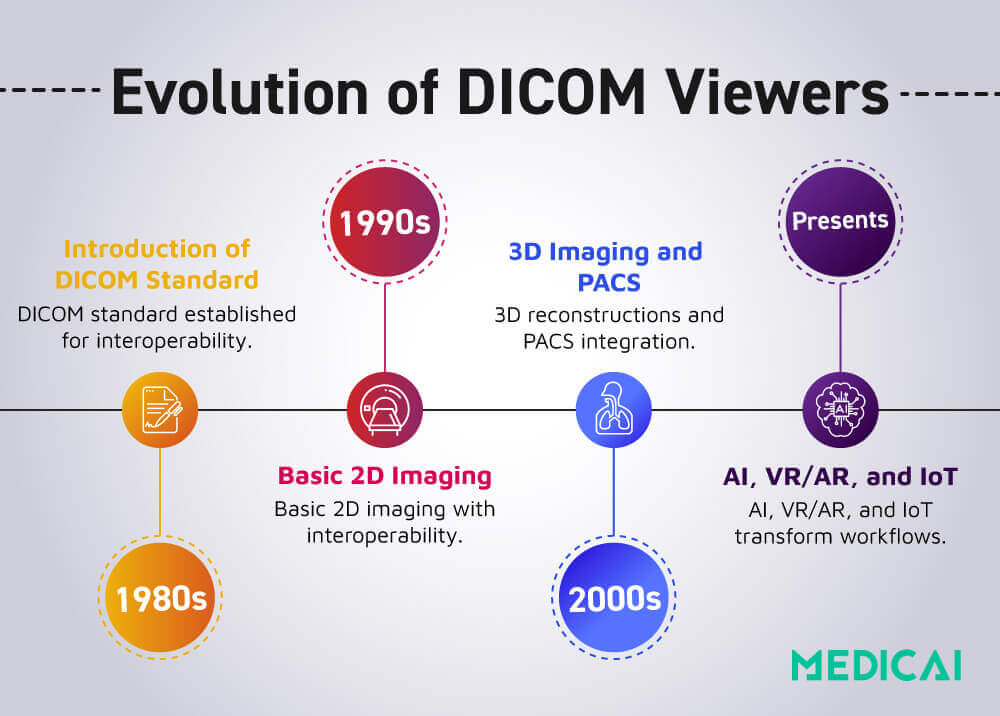
Early DICOM viewers had several key functionalities that included-
- Interoperability: Seamless communication between imaging devices from different manufacturers.
- 2D and 3D Visualization: Started with 2D imaging slices and later progressed to include 3D reconstructions for better anatomical understanding.
- Annotations and Measurements: Tools for making abnormalities and measuring structures for precise diagnostics.
- Integration with PACS: Connected with Picture Archiving and Communication Systems (PACS) to efficiently store, retrieve, and share images.
Limitations of Traditional DICOM Viewers
Despite their innovations, early DICOM viewers had significant limitations.
- Limited support for handling large datasets.
- Minimal interactivity and real-time processing capabilities.
- Lack of integration with broader healthcare IT systems like EHRs.
- Difficulty adapting to emerging technologies such as AI and IoT.
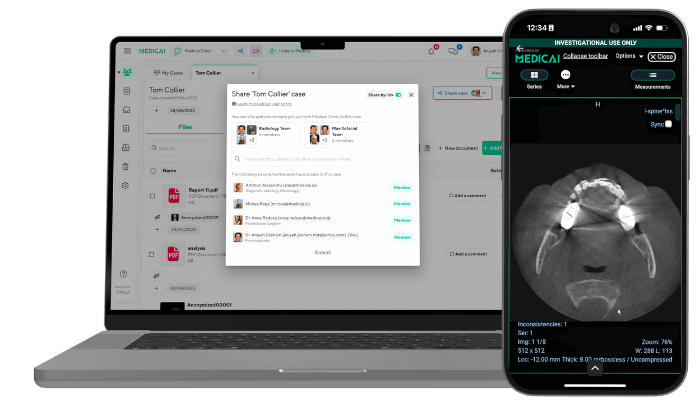
Medicai addresses these limitations by offering a modern, cloud-based DICOM viewer platform. It integrates with legacy systems while providing real-time data sharing, AI analytics, and secure storage.
Future Of DICOM Viewer: The Role of AI, AR, VR, and IoT
Advances in technology drive the evolution of DICOM viewers. They aim to make medical imaging more efficient, accurate, and accessible.
Among these innovations, Artificial Intelligence (AI), Virtual Reality (VR), Augmented Reality (AR), and the Internet of Things (IoT) stand out as transformative forces.
AI Integration: Smarter Diagnostics with DICOM Viewers
Artificial Intelligence (AI) has become a driving force in modern medical imaging. AI automates complicated tasks and gives radiologists and doctors valuable insights, making it easier for them to do their jobs better and faster.
This boosts their efficiency and helps them make more accurate diagnoses.
AI-driven algorithms can analyze imaging data faster and more precisely than manual processes. These algorithms include-
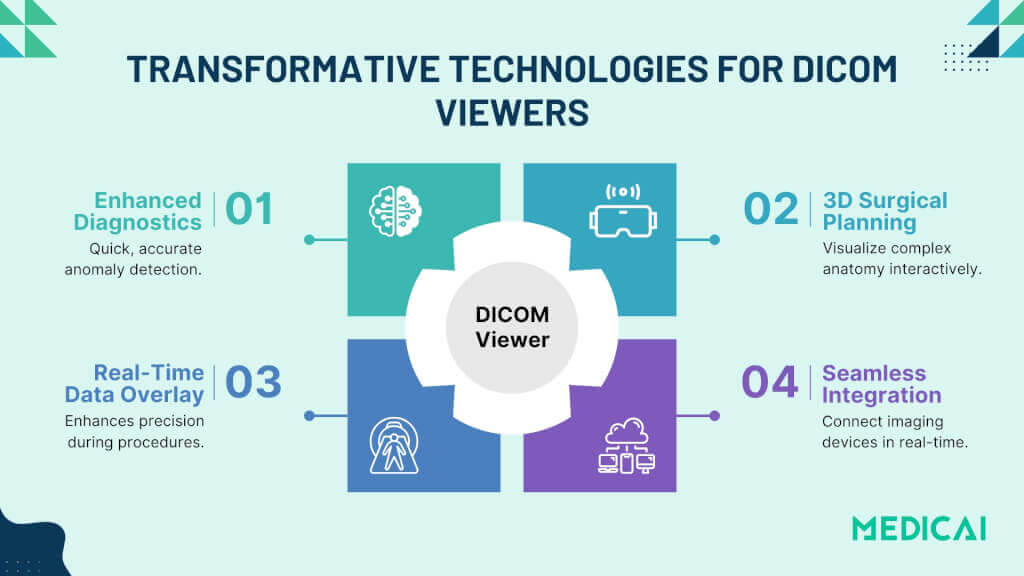
- Detect Anomalies: Automatically identify abnormalities such as tumors, fractures, or lesions, decreasing human error.
- Segment Images: Segment images separate anatomical structures like organs, tissues, and blood vessels, making it easier to focus on specific areas.
- Prioritize Cases: Flag urgent cases based on predefined criteria, helping critical patients to get prompt care.
- Predict Outcomes: Leverage historical data to predict disease progression or treatment response.
Application in Clinical Practice
AI-powered DICOM viewers are widely used in several clinical sectors, including-
- Oncology: Identify tumor growth and monitor treatment progress.
- Cardiology: Detect heart abnormalities through advanced imaging analysis
- Neurology: Identify early signs of conditions like Alzheimer’s or strokes.
- Orthopedics: Detect fractures and joint abnormalities
Medicai’s DICOM viewer leverages AI to give clinicians valuable insights, helping them make smart, data-driven choices. With features for spotting anomalies and streamlining workflows, Medicai helps ensure patients get accurate diagnoses quicker than ever.
VR and AR: Immersive Medical Imaging
Virtual Reality (VR) and Augmented Reality (AR) transform how clinicians visualize and interact with medical imaging data.
VR in Medical Imaging
- 3D Visualization: VR helps clinicians view imaging data in three dimensions, allowing them to understand complex anatomical structures better.
- Surgical Simulation: Surgeons can rehearse procedures in a virtual environment using patient-specific imaging data, reducing the risk during actual surgery.
AR in Healthcare
- Real-Time Data Overlays: AR shows imaging data on a patient’s body during surgeries or procedures, providing real-time guidance to clinicians.
- Patient Education: AR helps patients visualize their conditions and treatment plans, improving communication and engagement.
Medical students and professionals use VR and AR for hands-on training. This technology helps them practice real-world situations without putting patients at risk.
IoT Connectivity: A Networked Future for DICOM Viewers
The Internet of Things (IoT) constructs a fully connected healthcare ecosystem where devices, systems, and data interact smoothly. It ensures that imaging workflows are more efficient and data is always accessible.
Importance of IoT in Medical Imaging
- Real-Time Data Integration: IoT devices, such as wearable health monitors or smart imaging equipment, feed live data into DICOM viewers for continuous monitoring.
- Remote Monitoring: Clinicians can access imaging data and patient metrics from anywhere, making telemedicine and remote consultations more effective.
- Automated Workflows: IoT reduces manual tasks by syncing devices, updating imaging records, and streamlining data transfers.
Applications of IoT in Imaging Workflows
- A wearable heart monitor transmits real-time ECG data to a clinician’s DICOM viewer for immediate analysis.
- Imaging devices connected via IoT automatically upload scans to a centralized platform, minimizing delays and the risk of errors.
- IoT-enabled alerts notify radiologists of new imaging studies requiring urgent review.
Medicai connects IoT devices to share data easily and improve compatibility. This connectivity makes imaging data available when needed, which helps maintain continuous care.
Benefits Of Integrating Technologies In DICOM Viewers
Fusing AI, VR, AR, and IoT with DICOM viewers offers immense benefits.
- Enhanced Diagnostic Accuracy: AI ensures no critical detail is missing, improving diagnostic results.
- Faster Turnaround Times: Automation reduces delays in image processing and report generation.
- Improved Collaboration: Cloud-enabled DICOM viewers allow real-time sharing of images, facilitating collaboration among healthcare teams.
- Patient-Centric Care: Immersive technologies such as virtual reality (VR) and augmented reality (AR) actively involve patients, enabling them to understand their diagnoses and treatment plans better.
Challenges in Adopting New Technologies
While the future of DICOM viewers is promising, integrating these technologies comes with challenges.
- Data Security and Privacy: AI and IoT may increase the risk of data breaches. Strict encryption protocols and compliance with regulations like HIPAA for ROI are crucial.
- System Integration: Adjusting legacy systems to work with advanced technologies can be complex and costly.
- Training and Adaptation: Healthcare professionals may need comprehensive training to use these technologies effectively.
Medicai tackles these challenges head-on by providing innovative solutions that are secure, scalable, and incredibly user-friendly. Our offerings seamlessly integrate with your existing systems, ensuring a smooth transition and enhanced functionality.
Future Outlook For DICOM Viewers
In the next decade, DICOM viewers will become more powerful by combining different technologies for better functionality.
- AI and Deep Learning: Improvements in AI will make image analysis and prediction models more accurate.
- Expanded Use of AR and VR: These technologies will become standard surgical planning, diagnostics, and education tools.
- IoT Integration: A fully connected healthcare ecosystem will provide real-time data insights, improving preventive care.
- Cloud-based Solution: Cloud-enabled DICOM viewers will provide seamless access to imaging data across geographic locations.
Conclusion
The future of DICOM viewers involves integrating AI, VR, AR, and IoT, which will enhance medical image analysis, sharing, and use. These technologies aim to improve diagnostic accuracy, boost patient engagement, and streamline healthcare workflows for better patient outcomes.
Medicai is at the forefront of healthcare transformation, providing providers with the tools to adopt new advancements securely and efficiently. It’s time to stay ahead in medical imaging,


Related Articles
Lets get in touch!
Learn more about how Medicai can help you strengthen your practice and improve your patients’ experience. Ready to start your Journey?
Book A Free Demo