Handling Long-Tail Imaging Requests: A PACS and VNA Workflow for Retrieving Years-Old Studies

Radiology operations are designed around current examinations: acquire the images, route them to a worklist, complete the interpretation, and make the report available to the clinical team. Historical requests expose a different set of weaknesses.
An outside physician, patient, researcher, insurer, or authorized reviewer may request imaging completed years earlier. The organization then has to locate the complete study, confirm the patient’s identity, connect the images with the correct report, and provide controlled access without relying on an improvised CD export or consumer file-sharing service.
Long-tail retrieval is therefore an information-integrity problem rather than a storage problem. Success depends on preserving the relationship between the patient, order, accession number, study, series, report, authorization, recipient, and audit record.
Why Historical Image Retrieval Becomes Difficult
Older studies may sit across several generations of infrastructure. A health system could have one archive for current radiology work, a read-only legacy system from an earlier PACS migration, and separate repositories inherited through acquisitions.
Common complications include:
- Duplicate medical record numbers
- Previous patient names or demographic changes
- Different accession-number formats across facilities
- Imported outside studies with incomplete metadata
- Studies retained on nearline or offline storage
- Reports held in the RIS or EHR while images remain elsewhere
- Missing series after an incomplete migration
- Legacy private DICOM tags that newer systems interpret differently
A study can technically exist while remaining difficult to retrieve safely. The archive may hold the image objects, but staff may lack a reliable route from the request to the correct patient identity, encounter, report, and disclosure authorization.
A Long-Tail Request Use Case
First let’s understand the usage. Imaging teams do not need to determine the clinical, legal, or administrative reason behind an authorized request. They need enough information to identify its scope and complete it accurately.
Historical requests can arise for many reasons. For example, a patient researching lower back pain from epidural years later may seek an older lumbar MRI, anesthesia-related records, or subsequent spine imaging for review by qualified professionals.
For the imaging organization, the operational priorities remain accurate patient matching, complete study retrieval, metadata integrity, authorization validation, and controlled external access.
PACS and VNA Serve Different Operational Roles
Digital Imaging and Communications in Medicine, or DICOM, is the standard used to represent and exchange medical images and related information. A picture archiving and communication system, or PACS, supports daily departmental work such as viewing, worklists, interpretation, and access to active studies.
A radiology information system, or RIS, commonly manages scheduling, orders, procedure status, reporting, and related administrative data. The electronic health record may hold the broader clinical encounter and provide users with links to the report or viewer.
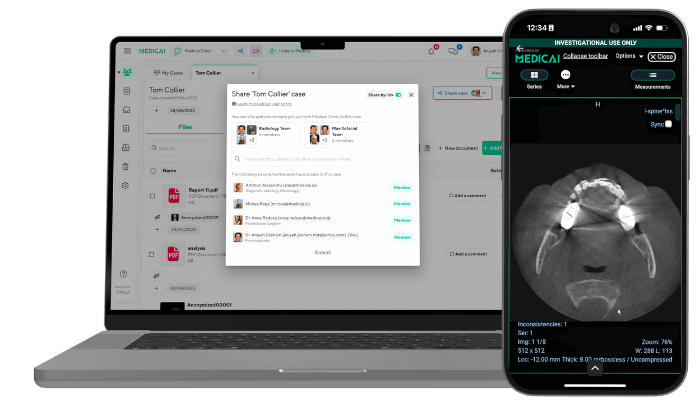
A vendor-neutral archive, or VNA, serves a different purpose. It provides a longer-term, standards-oriented repository that can preserve imaging data independently of a single PACS vendor. Medicai describes the VNA as the long-term imaging layer that helps keep prior studies available across sites and PACS replacements.
A well-designed VNA may:
- Consolidate studies from multiple departmental PACS platforms
- Preserve original DICOM objects and metadata
- Support prior-study discovery across facilities
- Reduce dependence on a retired PACS
- Maintain archive continuity during migrations
- Supply approved viewers and external exchange workflows
The architecture does not remove the need for governance. Migration rules, lifecycle policies, metadata normalization, report associations, and identity updates still determine whether an old study remains clinically meaningful.
Patient Identity Must Be Reconciled Before Release
Historical retrieval should begin with identity validation, not a broad archive export. Staff may compare the patient’s full name, previous names, date of birth, medical record number, facility identifiers, study date, modality, ordering clinician, encounter information, accession number, and Study Instance UID.
The Study Instance UID is a globally unique DICOM identifier assigned to an imaging study. It is useful for confirming the technical object, but it does not replace demographic and encounter reconciliation.
A duplicate chart or incorrect merge can expose another patient’s protected information or place the wrong study into the requesting clinician’s workflow. Imported examinations introduce further risk because external facilities may use different identifiers.
IHE’s radiology framework recognizes that patient information may change after an examination has been scheduled or even after images have been acquired. Its reconciliation workflow places continuing responsibility on image-management systems to handle those updates appropriately.
Organizations need a defined exception path for unresolved conflicts. Staff should not force a match merely to close the request.
Standards-Based Queries Reduce Manual Archive Searches
Traditional DICOM query and retrieve commonly relies on services such as C-FIND to locate objects and C-MOVE to transfer them between DICOM systems. These services remain widely used inside imaging environments.
DICOMweb provides web-based, RESTful services for querying, retrieving, and storing DICOM objects through modern application interfaces. The DICOM Standard defines three core services:
- QIDO-RS queries studies, series, and instances.
- WADO-RS retrieves complete studies, individual series, instances, rendered images, or metadata.
- STOW-RS stores transferred DICOM instances.
The official DICOM resources describe QIDO-RS as the search service, WADO-RS as the retrieval service, and STOW-RS as the storage service.
A modern retrieval workflow might use patient and encounter information from the EHR or RIS, query the VNA through QIDO-RS, retrieve the authorized study through WADO-RS, and present it through an enterprise or external browser viewer.
Standards support interoperability, but implementation details still matter. Teams should review DICOM conformance statements, identifier handling, authentication, supported transfer syntaxes, and behavior with large or unusual studies.
Connect Retrieval to the Release-of-Information Process
Release of information, or ROI, should govern the request from intake through final access. Image retrieval conducted outside the ROI process can produce inconsistent study selections, missing documentation, and unclear authorization.
A practical workflow follows a controlled sequence:
- Receive the request through an approved channel.
- Verify the requester’s identity.
- Confirm the patient’s authorization or the requester’s legal authority.
- Define the facilities, modalities, and date range covered.
- Reconcile the patient across source systems.
- Query the PACS, VNA, and approved legacy archives.
- Validate study and report completeness.
- Select the approved delivery method.
- Authenticate the recipient.
- Apply expiration, download, and resharing controls.
- Record access and completion in the audit trail.
Centralization gives staff one request record, one study list, and one accountable owner. It also reduces the chance that separate departments will send different versions of the same imaging history.
Keep Images, Reports, and Addenda Together
Images and reports frequently travel through different systems. A study may remain in the VNA while the original report is stored in the RIS, EHR, or document repository.
Validation should confirm that the accession number, study date, patient identifiers, procedure description, and system relationships correspond. Filenames are not reliable identifiers.
Staff should also check for amended reports and addenda. An export containing the original report but omitting a later correction may present an incomplete clinical record. Outside interpretations should remain distinguishable from the report created by the original organization.
ASTP and ONC interoperability resources describe imaging references that can connect diagnostic reports with images held in a PACS or VNA.
Secure Electronic Access Offers Better Control Than CDs
Physical media remains part of some workflows, but it creates operational limits.
| CD or Physical Media | Secure Electronic Exchange |
| Requires manual export and handling | Can retrieve directly from PACS or VNA |
| May be delayed, damaged, or unreadable | Supports faster authorized delivery |
| Often depends on bundled viewer software | Can provide browser-based viewing |
| Cannot easily be revoked after delivery | May support expiration and revocation |
| Offers little visibility after release | Can record recipient access |
| May require local hardware | Can work across approved devices |
| Creates duplicate physical copies | Can retain access within a governed portal |
Electronic exchange is not automatically secure or compliant. The platform, configuration, contracts, authentication, policies, and user behavior all affect the result.
Security Controls Must Follow the Data
DICOM studies and related reports can contain electronic protected health information. HHS states that regulated organizations must apply appropriate administrative, physical, and technical safeguards to protect the confidentiality, integrity, and availability of that information.
A governed external-access service may include:
- Encryption in transit and at rest
- Unique recipient identities
- Multi-factor authentication
- Role-based and least-privilege access
- Expiring links and session controls
- Download and resharing restrictions
- Access revocation
- Detailed audit logs
- Monitoring for unusual activity
- Business associate agreements where applicable
- Incident-response procedures
- Documented retention and deletion rules
Risk analysis should cover every location where the organization creates, receives, maintains, or transmits electronic protected health information, including legacy archives and external viewers. HHS identifies risk analysis as the first step in selecting reasonable and appropriate safeguards.
External Viewers Need More Than a Share Button
A recipient may need to inspect multiple series, compare priors, or review a large CT or MRI study. Hospital IT teams should assess whether the external viewer can support the expected clinical use.
Relevant questions include:
- Is access zero-footprint and browser based?
- Is the viewer intended for diagnostic or non-diagnostic use?
- Does it support multi-frame and multi-series studies?
- Are windowing, leveling, zoom, and measurement tools available?
- Can users compare current and prior studies side by side?
- Are reports and addenda visible with the images?
- How does it perform with large datasets?
- What mobile limitations apply?
- Can administrators restrict downloads?
- Are sessions and links time limited?
- Can access be revoked immediately?
- Does the audit log show viewing and downloading activity?
- Does the viewer support DICOMweb or the existing PACS interface?
A technically successful transfer still fails operationally when the recipient cannot open the study, find the report, or determine whether the dataset is complete.
Test Exceptions, Not Only the Ideal Workflow
Long-tail systems should be tested against the cases most likely to expose hidden dependencies.
Useful scenarios include a patient with two medical record numbers, a study stored only in a legacy PACS, a missing series, an amended report, a duplicate study with different identifiers, and an external examination imported into the local archive.
Teams should also test:
- A request covering several facilities and date ranges
- A study too large for the normal delivery path
- An expired access link
- A recipient whose access must be revoked
- A migration in which some objects failed validation
- Incorrect demographic metadata
- A report available without the source images
Testing should confirm both the system response and the operational escalation route. Staff need to know who owns identity exceptions, missing objects, failed links, and recipient-support issues.
Measure the Workflow as a Service
Storage capacity reveals little about request performance. Imaging and IT leaders need measures tied to fulfillment, exceptions, and staff effort.
A useful scorecard may include:
- Average fulfillment time
- Percentage completed electronically
- Manual archive searches per request
- Identity exceptions
- Incomplete study deliveries
- Requests requiring legacy-system access
- Staff time per request
- CD export volume
- Failed recipient-access attempts
- Access revocations
- Viewer-related support tickets
Trends can expose where archive design, identity reconciliation, viewer usability, or ROI staffing is creating delay.
Historical Access Depends on Preserved Context
Long-term retention succeeds only when an organization can recover the correct study with its identifiers, metadata, report, amendments, and authorization history intact.
A reliable long-tail workflow connects PACS and VNA architecture with patient identity management, DICOM retrieval, ROI procedures, secure viewing, and auditability. Clear operational ownership matters at every handoff.
The goal is precise: make the complete imaging record available to the correct authorized recipient without weakening clinical context, security, metadata integrity, or traceability.

Related Articles

Lets get in touch!
Learn more about how Medicai can help you strengthen your practice and improve your patients’ experience. Ready to start your Journey?
Book A Free Demo