How PACS and RIS Systems Improve Imaging Workflows in Healthcare
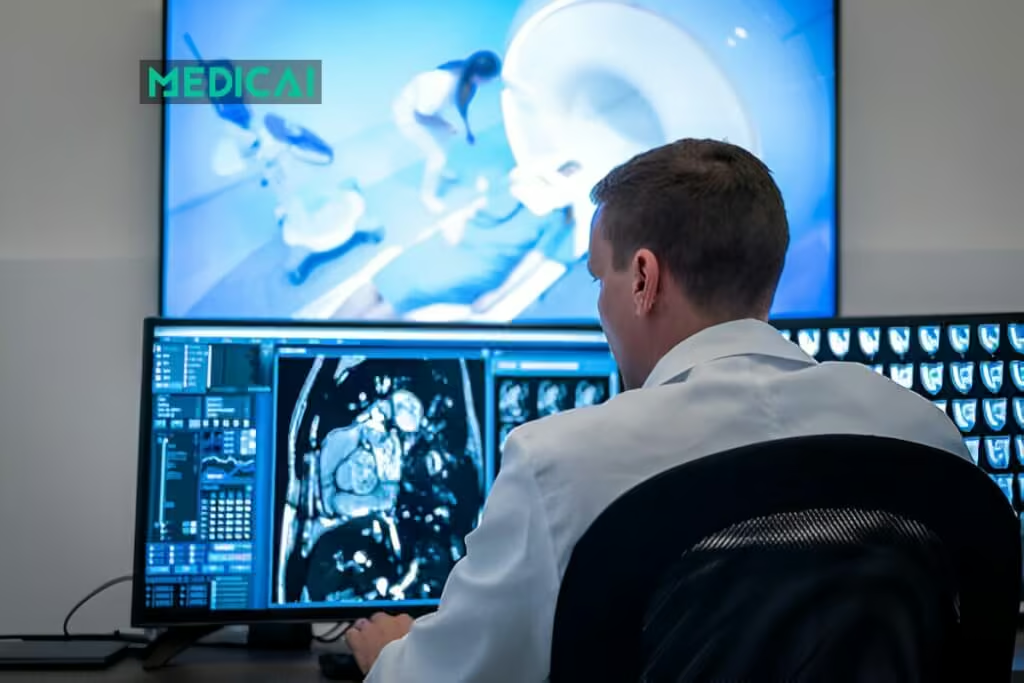
Imagine a radiologist receiving an urgent case at 3 AM. Instead of wrestling with slow servers and missing files, she instantly accesses high-resolution brain scans on her tablet, collaborates with specialists across the hospital, and delivers a life-saving diagnosis in minutes.
This isn’t science fiction—it’s the reality that modern PACS and RIS systems integration makes possible.
PACS is your digital imaging backbone, storing and delivering crystal-clear medical images on demand. RIS orchestrates your entire workflow, from scheduling to reporting. PACS and RIS transform radiology departments from siloed operations into seamless, efficient care delivery centers.
Let me show you how PACS and RIS work together, their benefits, implementation challenges, and best practices for seamless RIS PACS integration.

How Do PACS and RIS Systems Complement Each Other?
PACS and RIS serve distinct roles in radiology but work best when integrated.
End-to-End Workflow Efficiency
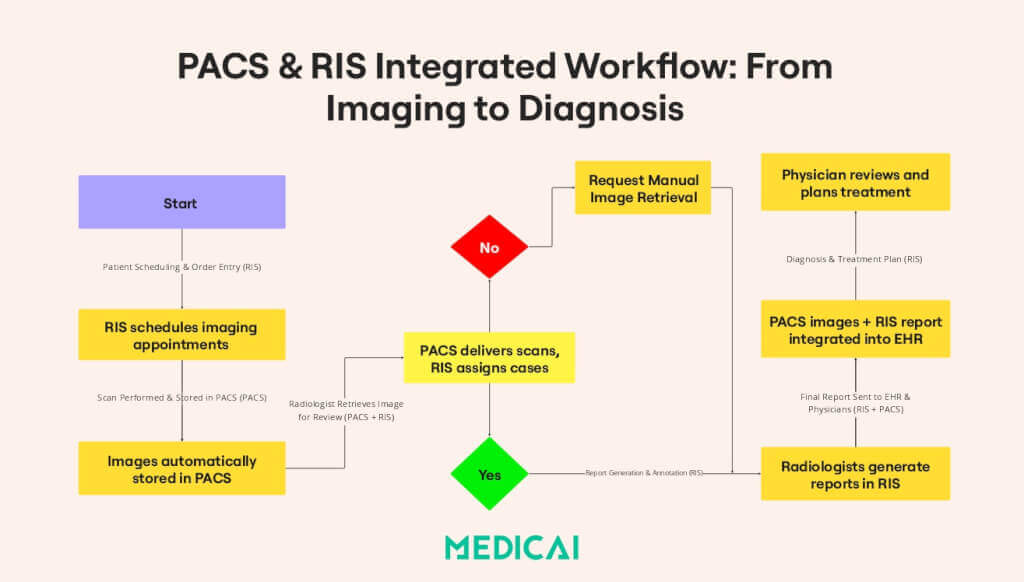
A fully optimized radiology workflow begins when a physician orders an imaging test and continues until the final diagnostic report is reviewed. PACS and RIS complement each other at every stage, ensuring a smooth transition between processes.
PACS and RIS integrated workflow includes-
- Patient Scheduling (RIS): Physicians order imaging tests, and RIS automatically schedules appointments.
- Image Acquisition & Storage (PACS): Imaging devices send scans to PACS for immediate access.
- Diagnosis & Reporting (RIS + PACS): Radiologists review images from PACS and generate reports via RIS.
- Report Distribution (RIS): Finalized reports are sent to referring physicians, ensuring timely patient care.
- Billing & Compliance (RIS): Automates insurance claims and ensures error-free financial transactions.
Faster Image Access & Remote Collaboration
One of the most significant advantages of PACS and RIS integration is the ability to access images instantly.
In traditional systems, radiologists searched for physical films or waited for manual image transfers. PACS stores imaging data digitally, enabling quicker diagnoses. Cloud-based PACS allows remote collaboration among radiologists and physicians, which is crucial for telemedicine.
RIS links patient records and imaging studies, giving healthcare teams a complete view of a patient’s condition.
Improved Accuracy & Fewer Errors
Manual record-keeping often leads to misfiled reports, incorrect patient details, and delays in diagnosis. With PACS and RIS integration, every imaging study is automatically linked to the correct patient record, reducing the chances of administrative errors.
Some key benefits include:
- Automated Patient Tracking: RIS tracks all imaging requests and results, reducing the risk of lost or duplicated records.
- Error-Free Data Entry: With RIS, patient details are entered once and used throughout the radiology process, preventing mistakes.
- Centralized Access to Patient History: PACS and RIS integration enables radiologists to quickly access previous scans and reports to compare findings.
By reducing manual errors, radiology departments can ensure greater diagnosis accuracy and improved patient safety.
Better Data Security & Long-Term Storage
Healthcare data security is increasingly important, especially in radiology departments. Compliance with regulations like HIPAA and GDPR is essential. PACS and RIS aid hospitals in protecting patient records through encryption and restricted access for authorized personnel.
Besides, radiology images often need to be stored for years or even decades.
PACS provides a structured way to archive medical images, ensuring that historical scans can be retrieved whenever necessary. RIS organizes imaging records so that past reports can be easily accessed, eliminating the need to search through paperwork.
PACS and RIS systems ensure data security, regulatory compliance, and long-term access to critical medical records.
Cost Savings & Increased Revenue
Switching to digital imaging enhances efficiency and reduces costs. Traditional film-based radiology incurs high expenses for printing, storage, and processing. Hospitals can eliminate physical films by using PACS, lowering material costs and saving space.
RIS further helps financial efficiency by automating billing and insurance claims, ensuring accurate payments, and reducing claim denials. Hospitals and imaging centers benefit from the following:
- Faster insurance reimbursements due to automated billing processes.
- Higher patient throughput since reduced wait times allow more scans to be performed daily.
- Lower administrative costs by minimizing paperwork and manual data entry.
Common Challenges in Implementing PACS & RIS
Implementing PACS and RIS comes with several challenges.
High Initial Cost of Implementation
Setting up PACS and RIS requires a significant investment in hardware, software, and integration tools. Licensing, cloud storage, and IT infrastructure add to the cost.
Solution:
- Opt for cloud-based PACS/RIS to lower hardware expenses.
- Choose vendor-neutral solutions to prevent costly lock-ins.
- Leverage government or private grants for healthcare IT upgrades.
Data Migration & Compatibility Issues
Hospitals moving from legacy systems face challenges in transferring thousands of imaging files and ensuring vendor compatibility.
Solution:
- Use Vendor-Neutral Archives (VNA) for standardized data storage.
- Migrate data in phases to minimize disruptions.
- Ensure DICOM & HL7 compliance for smooth integration with EHRs.
User Training & Adoption Challenges
Staff accustomed to older systems may struggle with the transition. It can lead to resistance, errors, and slower adoption.
Solution:
- Provide hands-on training and step-by-step onboarding for radiologists and admin staff.
- Designate superusers to support team members.
- Roll out the system gradually to allow time for adaptation.
Security & Compliance Risks
Medical imaging data is highly sensitive, requiring strict security measures to prevent unauthorized access and regulatory violations (HIPAA, GDPR).
Solution:
- Ensure vendors provide HIPAA/GDPR-compliant solutions.
- Implement data encryption, multi-factor authentication, and access controls.
- Conduct regular security audits to identify vulnerabilities.
RIS vs. PACS: Key Differences
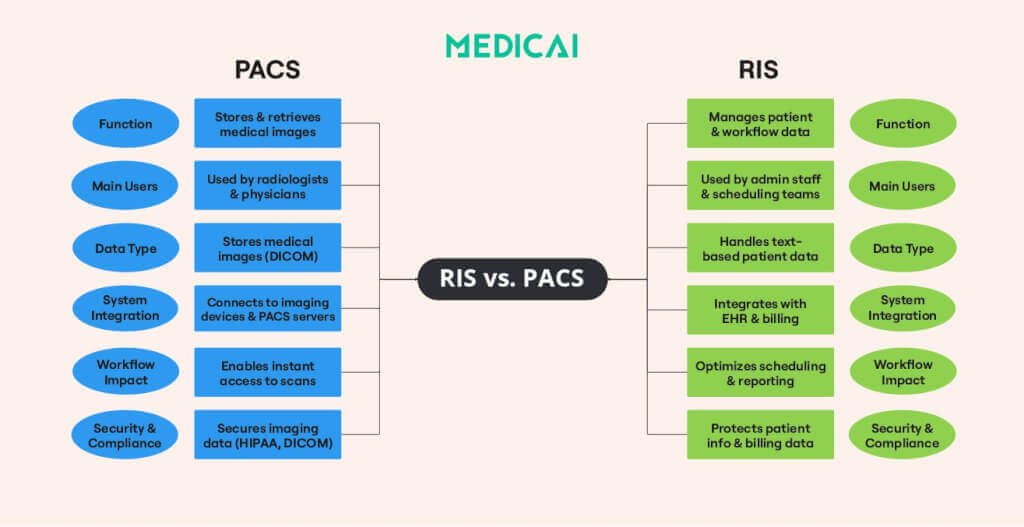
PACS and RIS systems are essential in modern radiology departments but serve different roles. PACS primarily stores and retrieves medical images, while RIS manages administrative and operational radiology-related tasks.
Primary Function
PACS is focused on images, while RIS is focused on workflow and patient data.
PACS is designed to store, retrieve, and distribute medical images such as X-rays, CT scans, MRIs, and ultrasounds. It eliminates the need for physical film, making imaging data instantly available for analysis.
On the other hand, RIS is a workflow management tool for radiology that aids in scheduling, patient tracking, report generation, and billing. It ensures efficient processing of imaging orders and timely delivery of reports.
Main Users and Departments
PACS is primarily for image interpretation, while RIS is used for patient management and administration.
PACS is mainly used by radiologists, imaging technologists, and referring physicians who need to view, compare, and analyze diagnostic images.
Radiologists, administrative staff, scheduling personnel, and billing departments use RIS to manage the entire patient journey, from scheduling to diagnosis and billing.
Data Focus and Storage
PACS handles visual data (DICOM images), while RIS manages text-based patient and administrative records.
PACS stores imaging data, including high-resolution medical images, 3D scans, and diagnostic visuals. It uses DICOM standards to ensure compatibility with different imaging devices and software.
RIS stores textual and administrative data, such as patient demographics, physician orders, imaging schedules, radiology reports, and billing records. It follows HL7 (Health Level Seven) standards for data exchange with hospital information systems.
System Integration and Communication Standards
PACS ensures that images are accessible, while RIS ensures that radiology services are well-coordinated within the hospital system.
PACS integrates with imaging devices, Picture Archiving Systems, and Electronic Health Records (EHRs) to provide physicians with direct access to patient imaging data.
RIS integrates with PACS, EHRs, billing, and hospital management systems, ensuring that radiology services are fully connected to the hospital’s workflow.
Workflow & Process Optimization
PACS speeds up image handling and access, while RIS improves workflow efficiency and patient management.
PACS enhances image storage and retrieval, enabling radiologists to access and compare scans quickly. It eliminates physical films and lowers storage costs with instant image retrieval.
RIS improves the radiology workflow by automating patient scheduling, managing imaging orders, reducing manual errors, and streamlining report delivery.
Impact on Patient Care
PACS improves diagnostic accuracy, while RIS improves operational efficiency and patient care.
PACS enhances diagnostic speed and accuracy by allowing radiologists to retrieve and analyze images quickly, resulting in faster diagnosis and treatment planning.
RIS ensures a smooth patient experience by automating appointments, reducing waiting times, and delivering timely reports to referring physicians.
What is PACS (Picture Archiving and Communication System)?
A Picture Archiving and Communication System (PACS) is a digital technology that enables healthcare providers to store, manage, and share radiological images. It eliminates physical film storage, making diagnostic imaging faster and more accessible.
PACS is commonly used in radiology, cardiology, oncology, and orthopedics. It digitizes medical images to support diagnosis and treatment planning. By archiving scans, PACS enables hospitals and clinics to provide physicians with quick access to these images on computers and mobile devices.
How Does PACS Function?
PACS is designed to streamline the entire medical imaging workflow, from the time an image is captured to the time a specialist reviews it.
- Image Acquisition: Medical imaging devices such as X-rays, CT scans, MRIs, and ultrasounds generate digital images.
- Storage: PACS securely stores images in a digital database, organized by patient name, date, and scan type for easy access.
- Retrieval & Viewing: Radiologists and physicians can quickly access images from the PACS system, compare past and present scans, and make accurate diagnoses.
- Distribution & Sharing: PACS enables easy image sharing between departments, hospitals, and clinics for quicker specialist consultations.
This digital ecosystem removes delays, reduces errors, and enhances collaboration, ultimately leading to better patient outcomes.
Advantages of PACS
- Eliminates Physical Films: Traditional film radiology needed physical storage and manual retrieval, while PACS digitized images, lowering costs and enabling instant access.
- Faster Diagnoses & Improved Patient Care: Doctors can access imaging data in real-time, enabling faster diagnoses and treatment for emergencies like stroke or trauma.
- Cost Savings and Workflow Efficiency: It removes film and storage needs, automates imaging tasks, and enables remote access in healthcare.
What is RIS (Radiology Information System)?
A Radiology Information System (RIS) is a specialized healthcare software designed to track, manage, and streamline radiology workflows. It is a central hub for handling patient data, scheduling imaging appointments, generating reports, and integrating radiology records with other hospital systems.
While PACS focuses on storing and retrieving medical images, RIS manages the administrative and operational aspects of the radiology department. They enhance efficiency, reduce manual errors, and improve patient care.
Hospitals use RIS to streamline tasks and reduce paperwork, allowing radiologists and technicians to focus on accurate diagnoses.
How Does RIS Function?
RIS keeps track of every stage of a patient’s journey from referral to diagnosis. Here’s how it works:
- Patient Registration & Scheduling: RIS manages patient demographics and medical history, schedules radiology appointments, and reduces wait times.
- Tracking & Workflow Management: It tracks a patient’s radiology progress, assigns imaging orders to radiologists, and monitors status: ordered, in progress, completed, and reported.
- Image & Report Management: RIS stores radiology reports, connects them with PACS images, and enables radiologists to generate and share diagnostic reports electronically.
- Billing & Compliance: It automates insurance verification and billing processes and ensures medical coding standards (e.g., CPT, ICD-10) compliance.
- Data Analysis & Reporting: Custom reports for hospital admins to track radiology efficiency, revenue, and patient outcomes.
Why RIS is Essential for Radiology Departments?
Here’s why every radiology department needs RIS:
- Faster Turnaround Times: Automates key processes, reducing manual workload.
- Better Patient Experience: Ensures timely appointments and efficient imaging workflows.
- Seamless Integration with PACS & EHRs: Provides a unified radiology management system.
- Data Security & Compliance: Protects patient records with HIPAA-compliant security protocols.
- Improved Financial Performance: Reduces billing errors, improves claim acceptance rates, and speeds up reimbursement processing.
Conclusion
Implementing PACS and RIS systems is more than a technical upgrade—it’s a step toward a more efficient, patient-centered healthcare system. While challenges like cost, data migration, and security exist, choosing the right partner makes all the difference. With
With Medicai’s advanced, cloud-based PACS-RIS solutions, healthcare providers can effortlessly streamline workflows, enhance collaboration, and ensure compliance. Our seamless integration ensures faster diagnoses and improved efficiency, allowing you to focus on what matters most—patient care.


Related Articles

Lets get in touch!
Learn more about how Medicai can help you strengthen your practice and improve your patients’ experience. Ready to start your Journey?
Book A Free Demo