The Economics of Speed: How Server-Side Rendering Reduces TAT and Boosts Revenue

In the business of radiology, Time is Inventory.
Every minute a radiologist spends waiting for a scan to load, toggling between windows, or struggling with a slow VPN connection is a minute of lost inventory. It is billable time that has evaporated—never to be recovered.
For decades, Radiology Practice Managers and CFOs have focused their efficiency audits on human factors: “Can the radiologist dictate faster?” “Can we optimize the staffing schedule?”
But in 2026, the bottleneck is no longer human. It is architectural.
As imaging datasets explode in size—with 3D Breast Tomosynthesis, Cardiac CT, and Multiparametric MRI becoming the norm—legacy software architectures are collapsing under the weight. The “Spinning Wheel of Death” (loading lag) has gone from a minor nuisance to a massive financial leak.
This guide explores the Economics of Speed. We will analyze how shifting from legacy “Download” architectures to modern Server Side Rendering (SSR) directly impacts your Turnaround Time (TAT), reduces IT overhead, and ultimately drives higher revenue per shift.

The “Hidden Tax” of Legacy Downloading
To understand the financial leak, you must understand the technical flaw in most legacy PACS.
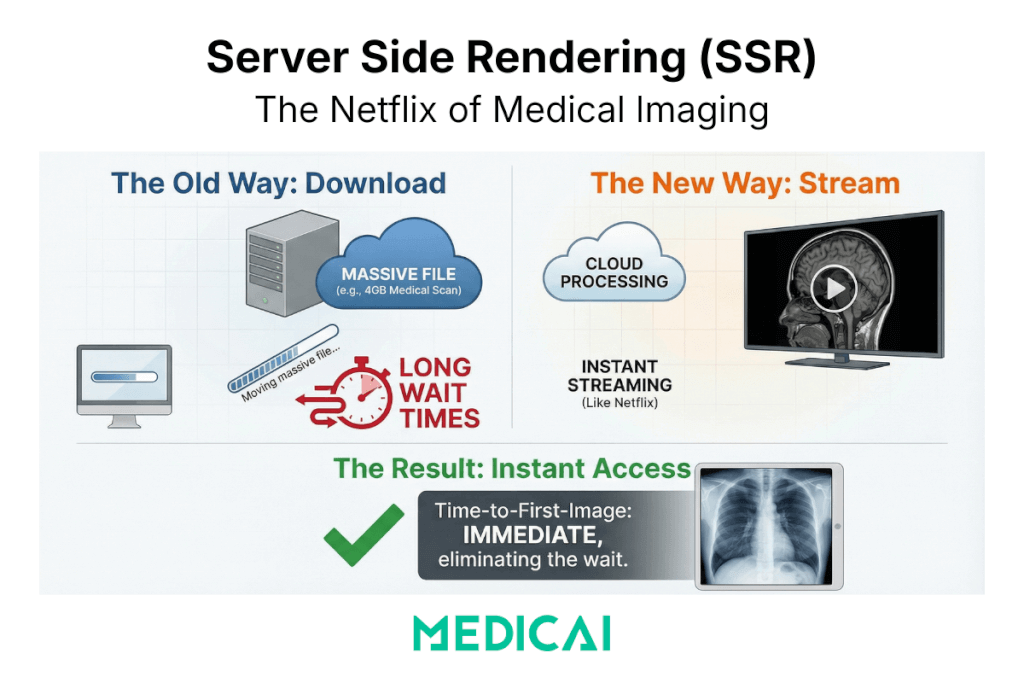
Traditional systems use a “Client-Side Rendering” (Store-and-Forward) architecture. When a doctor opens a study, the server sends the raw DICOM files to the doctor’s workstation. The local computer then has to download, unpack, and render the images.
The Math of Latency
Let’s look at the numbers for a typical remote reading scenario:
- The File: A standard Breast Tomosynthesis study is roughly 4 GB.
- The Connection: A typical home internet connection (VPN overhead included) might sustain 50 Mbps.
- The Wait: 4,000 MB / 6.25 MB/s = ~640 seconds.
That is over 10 minutes of waiting for one patient’s chart to open.
If a radiologist reads 10 of these studies a day, that is 100 minutes of lost productivity per shift. That is 1.5 hours of salary paid for staring at a loading bar. In financial terms, this is a “Latency Tax” of nearly 20% on your most expensive resource (the physician).
The Solution: Server Side Rendering (SSR)
The solution is not “faster internet.” The solution is to stop moving the files altogether.
Modern Cloud-Native PACS platforms like Medicai utilize Server-Side Rendering (SSR).
How It Works: The “Netflix” Model
When you watch a 4K movie on Netflix, you don’t download the entire 50GB file before pressing play. The massive servers at Netflix process the file and stream a high-definition video feed to your TV.
SSR applies this logic to radiology.
- Processing: The heavy 4GB Tomosynthesis file stays in the cloud. Powerful cloud GPUs render the 3D volume instantly.
- Streaming: The system streams an interactive video feed of the image to the radiologist’s web browser.
- The Result: The image opens in seconds, regardless of file size.
The New Metric: Time-to-First-Image (TTFI)
In the SSR model, Time-to-First-Image (TTFI) becomes virtually instantaneous. The radiologist clicks “Open,” and the image is there. The “Latency Tax” is eliminated.
The Direct Financial Impact on Turnaround Time (TAT)
Why does this speed matter to the CFO? Because in radiology, speed is the currency of trust.
Turnaround Time (TAT)—the time from “Order” to “Report Signed”—is the primary KPI by which hospitals judge radiology groups.
Saving the Contract (SLA Penalties)
Most hospital service contracts include strict Service Level Agreements (SLAs). (e.g., “All Stroke Codes must be read within 20 minutes.”).
- Legacy Risk: If the study takes 8 minutes to download over a VPN, you have burned nearly 50% of your SLA window on file transfer alone. This leads to missed SLAs, financial penalties, and eventually, contract termination.
- SSR Advantage: With instant opening, the radiologist has the full 20 minutes to focus on diagnosis. You hit your metrics, you keep the contract.
Increasing Volume (RVU Throughput)
For fee-for-service groups, revenue is a function of volume. If you eliminate the 10-minute wait time on heavy studies, a radiologist can comfortably add 3–5 more complex cases per shift without staying late.
- The ROI: 5 extra RVUs per day x 250 working days = 1,250 additional RVUs per radiologist per year.
- Across a 10-person group, this is a massive injection of “found revenue” achieved simply by removing software friction.
Infrastructure ROI: Killing the CapEx Beast
The ROI of Server-Side Rendering isn’t just about making money; it’s about saving it.
Legacy “Client-Side” systems require expensive hardware to function. Because the rendering happens on the doctor’s computer, you are forced to buy high-end workstations.
The “Hardware Refresh” Cliff
- Legacy Cost: A diagnostic workstation with dual Barco monitors, a high-end NVIDIA Quadro card, and massive RAM costs $15,000–$20,000. You have to replace them every 3–5 years.
- SSR Savings: Because the heavy lifting is done by the cloud server, the local computer can be a lightweight laptop or a standard desktop. The “Client” is just a web browser (Chrome/Edge).
- Result: You slash your hardware CapEx budget by 60–70%.
Killing the VPN Maintenance Cost
Legacy remote reading requires maintaining complex Site-to-Site VPNs for every radiologist’s home. This incurs:
- Firewall licensing fees.
- IT staff hours for troubleshooting connection drops.
- Security audit costs.
Medicai’s SSR architecture runs over standard, encrypted HTTPS (TLS 1.3). No VPNs. No IT overhead. The Total Cost of Ownership (TCO) drops significantly.
Recruitment and Retention (The Human ROI)
There is a “Soft ROI” that is harder to measure but equally critical: Burnout.
Radiologists are in short supply. Recruitment fees are skyrocketing (often $30k–$50k per head). Radiologists hate slow software. It frustrates them. It makes them feel like they are wasting their lives watching loading bars.
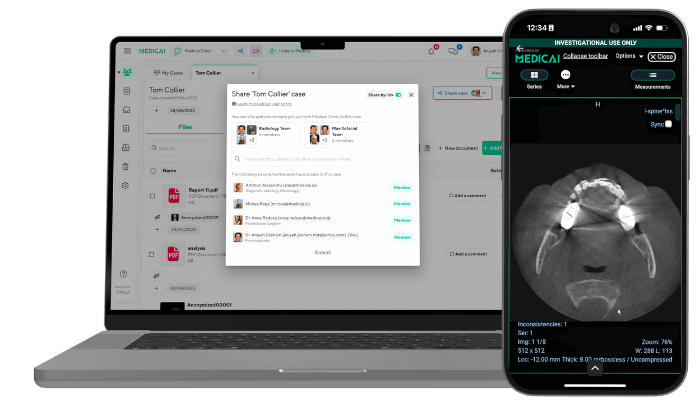
- The Recruitment Tool: When you interview a candidate, show them your Medicai viewer. Let them open a 3,000-slice study on an iPad in 2 seconds.
- The Pitch: “We value your time. We don’t make you fight the software. You just read.”
Investing in high-speed architecture is a retention strategy. Keeping one productive radiologist from quitting saves you hundreds of thousands in lost revenue and recruitment costs.

The Medicai Advantage: Hybrid Architecture
The objection we often hear from technical teams is: “What if the internet goes down?”
This is where Medicai’s Hybrid Architecture protects your ROI. While we leverage Cloud SSR for speed and remote access, we utilize a Local Edge Gateway for on-premise redundancy.
- Inside the Hospital: Images route over the LAN (Local Area Network) for blazing speed, even if the internet is cut.
- Outside the Hospital: Images stream via Cloud SSR using adaptive bitrate streaming (like Netflix adjusting quality if your Wi-Fi drops) to ensure the radiologist can always work.
We optimize for business continuity.
Conclusion: The Cost of Waiting
In 2026, lag is not a technical glitch. It is a business failure.
If your radiology group is still relying on “Download and Wait” architecture, you are paying a hidden tax on every single study. You are paying for it in lost RVUs, missed SLAs, inflated hardware costs, and radiologist burnout.
The shift to Server-Side Rendering is one of the few investments that offers immediate, tangible ROI. It aligns your clinical goals (fast diagnosis) with your financial goals (fast billing).


Related Articles

Lets get in touch!
Learn more about how Medicai can help you strengthen your practice and improve your patients’ experience. Ready to start your Journey?
Book A Free Demo