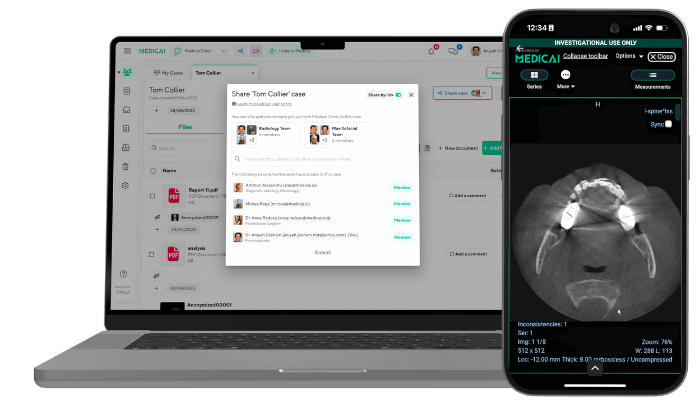
AI-Powered Radiology: Smarter Structured Reporting

What if radiology reports could deliver not just results but faster decisions and better outcomes? Well, AI-driven structured radiology reporting (SRR) indeed promises to fulfill this goal, where advanced technology meets precision care.
In 2022, structured reporting (SR) was used by 77% of radiologists and referring doctors. Now, AI is being applied to structured radiology reporting.
AI-driven SRR uses intelligent automation to create standardized, error-free radiology reports. Incorporating structured templates with AI insights streamlines workflows, enhances diagnostic accuracy, and fosters seamless collaboration in healthcare.
Take the next step in radiology innovation and discover how AI-powered SRR can revolutionize your reporting process and elevate patient care.

What is Structured Radiology Reporting (SRR)?
Structured Radiology Reporting (SRR) systematically creates radiology reports using predefined templates and structured formats. It replaces free-form, narrative-style reporting with a more organized method that ensures consistency, clarity, and standardization across reports.
In fact, radiologists and referring physicians are more satisfied with SRR than free-text reporting (FTR), especially for trauma CT, focussed assessment with ultrasound for trauma (FAST), and prostate MRI.
Every feature documented in the radiology report, e.g., the reason for the test, patient history, procedure, technique, findings, impression (the radiologist’s summary of the findings, including possible causes), and recommendations, is in any SRR. However, the data are integrated into a standardized pattern for better clarity and medical communication.
SRR aims to improve radiology reports’ quality and utility, benefiting radiologists and the broader healthcare ecosystem.
The key features of SRR include-
- Standardization: Predefined templates ensure consistent report structures among radiologists, improving the inclusion of critical information and enhancing integration with EMRs and RIS.
- Clarity: SRR presents findings and recommendations clearly and concisely, minimizing misinterpretation by referring physicians and ensuring a quick understanding of key insights.
- Improved Communication: The structured format of SRR improves communication among radiologists and healthcare providers by using standardized language, making reports more readable and actionable in interdisciplinary settings.
- Data Integration: SRR integrates with healthcare systems like PACS and EMRs, simplifying data sharing and retrieval for more effective access to radiology data.
Besides, SRR enhances interoperability between various platforms by producing structured data, enabling advanced analytics and research.
Structured reports also serve immediate clinical needs and enhance long-term healthcare delivery by supporting population health studies and AI training.
Structured Reporting: A Key to Reducing Burnout and Enhancing Patient Care
Radiologists in North America are grappling with an ever-increasing workload. Their roles have expanded significantly from interpreting complex imaging studies to managing administrative tasks.
This multifaceted demand, compounded by staffing shortages and a growing volume of advanced imaging studies, contributes to around 49% burnout in the profession.
Burnout, characterized by emotional exhaustion and reduced efficiency, impacts radiologists’ well-being and can compromise patient care quality.
Impacts of Structured Reporting on Radiologists
Structured reporting enhances efficiency and reduces radiologists’ cognitive load by standardizing how diagnostic information is documented and shared.
Unlike traditional free-text reports, structured reports use pre-defined templates that ensure consistency, accuracy, and clarity.
For radiologists, this means faster report generation, fewer ambiguities, and reduced time spent on repetitive tasks.
Studies have shown that structured reporting can significantly improve turnaround times for imaging studies, allowing radiologists to focus more on critical diagnostic tasks and patient interactions.
Enhancing Patient Care
Structured reporting also benefits healthcare facilities by improving communication among care teams. Clear, standardized reports reduce the risk of misinterpretation, facilitating timely and accurate treatment decisions. In turn, this enhances patient outcomes and boosts the reputation of healthcare facilities.
Adopting structured reporting aligns with broader operational efficiency and quality improvement goals for healthcare executives. With streamlined workflows and better resource utilization, it becomes possible to address staff burnout while ensuring high-quality care delivery.
How AI Enhances Structured Radiology Reporting?
Artificial Intelligence (AI) transforms structured radiology reporting (SRR) by automating workflows, reducing errors, and enhancing efficiency.
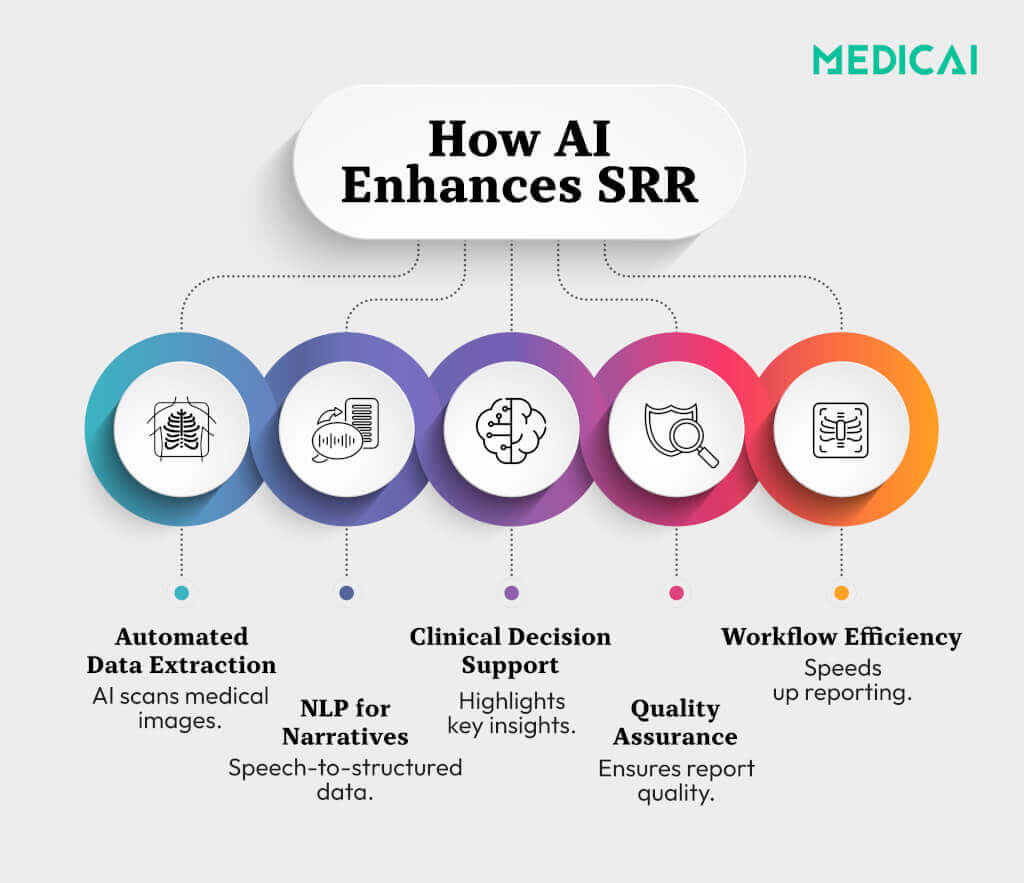
Automated Data Extraction
AI simplifies data extraction by analyzing imaging data, such as MRIs and X-rays, and populating structured templates. Thus, manual input is unnecessary, time-consuming, and prone to errors.
For example, in mammography, AI can detect calcifications or masses and automatically populate report templates with precise measurements. The process saves time and provides consistency and accuracy.
Automating data extraction also helps radiologists focus on interpretation rather than administrative tasks. It leads to faster report generation and reduces the chances of missing critical information.
Medicai automates tasks for radiologists, letting them focus on interpreting images. This speeds up report creation and reduces the risk of missing essential findings.
Natural Language Processing (NLP) in SRR
Natural Language Processing (NLP) links free-text reporting and structured radiology formats. Radiologists can dictate their findings in a conversational tone, and NLP tools convert these narratives into structured templates.
The process ensures that key insights are captured in a consistent format.
With NLP tools, emergency radiology can process dictated trauma scan reports, identifying terms like “fracture” or “internal bleeding” and structuring them into predefined fields.
It can also be used to retrospectively structure legacy reports and make unstructured data usable for analytics and research.
Clinical Decision Support
AI functions as a diagnostic assistant by analyzing imaging data like X-ray or CT scan in real time and suggesting potential findings. It highlights abnormalities that might go unnoticed, such as subtle fractures or early-stage diseases.
For instance, AI in oncology can identify small lung nodules that may indicate early cancer. Such AI-powered diagnostics prompt further investigation.
This additional support layer benefits radiologists, especially in high-volume or high-pressure settings. It reduces diagnostic errors and ensures that critical findings are flagged promptly.
The collaborative approach helps radiologists to make more informed decisions while maintaining their role as the ultimate decision-makers.
Quality Assurance and Error Reduction
AI enhances quality control in SRR by ensuring that reports meet predefined standards. It cross-references the content of reports with established guidelines and identifies any missing or inconsistent information.
For example, if a report fails to document critical tumor dimensions, AI in Medicai can flag the omission for the radiologist to address.
Real-time error detection reduces variability between radiologists, leading to more reliable and standardized reports. By minimizing errors, AI also supports compliance with regulatory and accreditation standards.
Enhanced Workflow Efficiency
AI optimizes radiology workflows by automating repetitive tasks and streamlining report generation. By analyzing imaging data and pre-filling structured templates, AI significantly reduces the time it takes to create reports.
Besides, at Medicai, AI improves collaboration between radiologists and referring physicians.
Structured reports generated with AI help physicians understand key findings and recommendations more easily. Seamless integration with PACS and EMRs further enhances data sharing and interoperability.
Faster reporting, combined with improved communication, ensures that patients receive timely diagnoses and treatment plans. Platforms like Medicai support radiology teams in high-volume settings in maintaining quality while handling increased workloads.
Benefits of AI-Driven Structured Radiology Reporting
AI-driven structured radiology reporting (SRR) transforms the radiology ecosystem, offering unparalleled benefits to radiologists, healthcare providers, and patients.
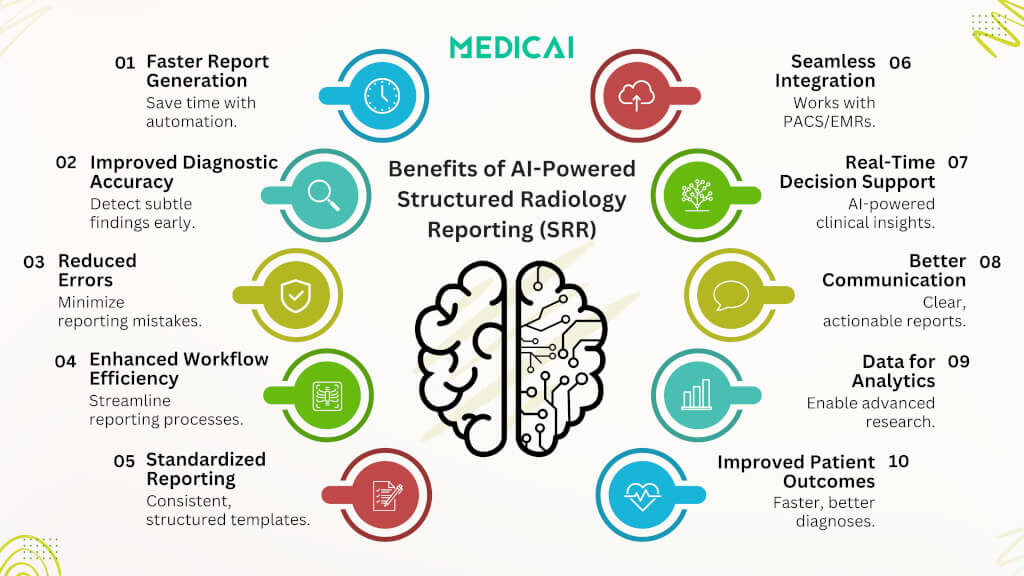
Benefits For Radiologists
Radiologists play a central role in interpreting medical images and ensuring that findings are accurately communicated. AI in SRR is a powerful ally, helping radiologists manage their increasing workloads while improving the quality of their work.
- Reduced Workload and Focus on Complex Cases: AI automates routine tasks such as image analysis, measurement calculations, and report template population, helping radiologists concentrate on interpreting complex cases.
- Enhanced Report Standardization and Quality: AI standardizes reports by ensuring they follow consistent structures and templates. This reduces variability among radiologists and improves the quality and clarity of the information captured.
- Improved Accuracy with AI Support: AI highlights subtle findings that reduce diagnostic errors and help radiologists maintain high accuracy, even under demanding conditions.
Benefits For Healthcare Providers
Healthcare providers, including referring physicians, rely on radiology reports for critical decision-making. So, AI-supported SRR benefits them immensely, including-
- Improved Communication with Clear, Actionable Reports: It presents concise and organized findings, making them easier for referring physicians to interpret without needing to sift through lengthy narratives.
- Seamless Integration with EMR/PACS Systems: It seamlessly integrates with EMRs and PACS, allowing providers to access radiology data within patient records, enhancing workflow and team coordination.
- Faster Turnaround Times for Critical Cases: AI flags critical findings and speeds up report generation, ensuring prompt treatment in emergencies and improving patient outcomes.
Benefits For Patients
Patients stand to gain the most from AI-driven SRR, as it directly impacts the speed, accuracy, and effectiveness of their diagnosis and treatment.
- Faster Diagnosis and Treatment Plans: Automating report generation accelerates the radiology workflow, enabling faster communication of findings to treating physicians.
- Reduced Errors and Improved Outcomes: AI’s ability to highlight abnormalities, cross-check data, and ensure report completeness significantly reduces the risk of misdiagnosis or overlooked findings.
- Enhanced Understanding and Trust: Structured AI-enhanced reports are easily understandable for patients, allowing them to comprehend their diagnosis and treatment options thoroughly.
SRR vs. Traditional Reporting Methods
How is the traditional reporting method different than AI-powered Structured Radiology Reporting? Well, let’s find out.
| Feature | Traditional Reporting | Structured Radiology Reporting |
| Format | Narrative, free-text style | Predefined templates with structured fields |
| Consistency | Highly variable; depends on the radiologist | Standardized across all users |
| Clarity | May include ambiguous or overly detailed text | Clear, concise, and focused |
| Time Efficiency | It may take longer to review and interpret | Quick and easy to understand |
| Integration with Systems | Limited integration with healthcare IT | Seamlessly integrates with PACS, EMRs, etc. |
| Data Analytics | Difficult to analyze due to unstructured data | Structured data enables advanced analytics |
| Error Minimization | Prone to omissions or errors | Reduces errors with checklist-style templates |
Challenges of AI-Driven Structured Radiology Reporting
AI-driven structured radiology reporting (SRR) implementation has challenges you should address to reach its full potential.
Interoperability Issues
A key challenge in implementing AI in SRR is integrating it with existing healthcare systems. Radiology departments use various platforms, such as PACS, RIS, and EMRs. These systems are not always designed to communicate effectively with AI tools, leading to compatibility issues.
This lack of interoperability can result in fragmented workflows, inefficiencies, and delays in patient care.
Vendors and healthcare organizations need to prioritize open standards for data sharing.
AI platforms like Medicai offer seamless integration with existing systems, ensuring data flows smoothly across platforms without disrupting workflows.
Bias in AI Algorithms
The AI models may produce biased or inaccurate results if the training datasets lack diversity. For instance, an AI model trained mainly on imaging data from a specific population may underperform with patients from different demographics, like age, gender, or ethnicity.
Bias can have serious consequences in radiology, leading to misdiagnosis or inequitable care.
So, AI models must be trained on large, diverse datasets that represent a wide range of populations, imaging modalities, and conditions. Continuous monitoring and validation are needed to understand and mitigate AI-powered medical image analysis bias.
Data Security
Healthcare data is a prime target for cyberattacks, and any breach can have severe consequences, including legal liabilities and loss of trust.
Implementing advanced encryption techniques to secure data at rest and in transit is crucial.
Also, regular audits and compliance checks can ensure adherence to legal and regulatory standards.
Medicai ensures data security with advanced encryption, secure cloud infrastructure, and strict compliance protocols to protect patient information.
Adoption Barriers
Using AI tools in radiology requires changes in work processes, which can be challenging for radiologists and healthcare providers. Many radiologists rely on traditional reporting methods, so they may resist AI due to fears of job loss, reduced salary from the standard radiologist pay scale, or unfamiliarity with the technology.
Training is another significant barrier. Radiologists and staff must effectively use AI, interpret its insights, and integrate it into daily practice. Without proper training, the benefits of AI may be underutilized or misused.
Tailored training programs for radiologists, including hands-on workshops and ongoing support, can be beneficial. Also, foster a collaborative culture where radiologists feel empowered to work with AI rather than view it as a threat.
Conclusion
Structured radiology reporting (SRR), powered by AI, is changing how radiologists deliver accurate, efficient, and standardized care. By automating workflows, reducing errors, and enhancing communication, AI-driven SRR empowers radiologists, improves collaboration among healthcare providers, and ensures better patient outcomes.
Platforms like Medicai are at the forefront of this transformation, offering seamless integration, advanced tools, and secure systems to redefine modern radiology.
Embrace the future of radiology with Medicai—where innovation meets exceptional patient care.



Related Articles

Lets get in touch!
Learn more about how Medicai can help you strengthen your practice and improve your patients’ experience. Ready to start your Journey?
Book A Free Demo