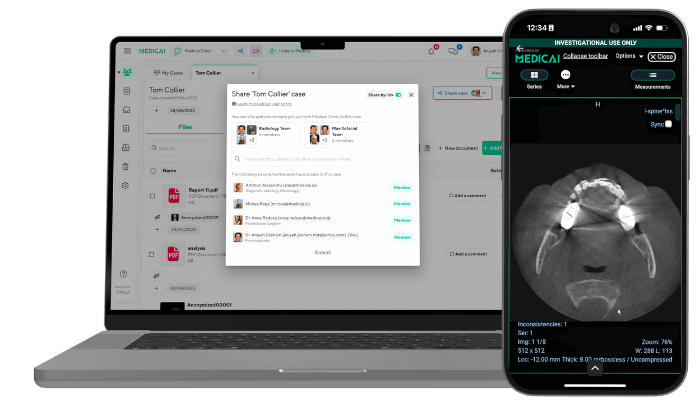
Tumor boards - overview and future developments

Tumor boards are an essential component of cancer treatment since they bring together a varied group of medical professionals to evaluate patient situations and develop specialized treatment plans.
Medical imaging is essential to the tumor board process because it enables the team to visually assess a tumor’s position, size, and relationship to the surrounding organs and tissue. It can be difficult to coordinate the use of medical imaging in a tumor board context, but with the right planning and communication, the procedure can be simplified to guarantee the greatest outcomes for patients.
Coordinating medical imaging within a tumor board
To begin coordinating medical imaging within a tumor board, it is important to create precise procedures for collecting and exchanging pictures. This may include recommendations for the kinds of imaging tests that should be run, as well as when and how frequently they should be done. For instance, it might be advised that all patients with cancer, whether suspected or proven, get a baseline CT scan as well as routine follow-up scans to track the disease’s development.
Making sure that all members of the tumor board team have access to the most recent imaging studies is just as crucial as developing methods for collecting and disseminating images. This can entail the use of digital image management tools like Picture Archiving and Communication Systems (PACS), which make it simple for team members to share and retrieve photographs. A dedicated radiologist or other imaging professional may also be beneficial to the tumor board team in order to offer knowledge regarding the interpretation of pictures and to help direct the discussion of patient cases.
Making sure that every team member has the required education and training to efficiently use and interpret imaging findings is another crucial component of managing medical imaging within a tumor board. This can entail instructing team members on how to use imaging technology and explaining the various imaging modalities that are available and how they are used specifically in tumor board settings. Regular imaging-focused tumor board meetings where the team may evaluate cases and thoroughly discuss the imaging results may also be beneficial.
Incorporating the patient’s overall treatment plan with the findings of medical imaging is crucial. When deciding on the patient’s course of treatment, the tumor board should take the imaging results into account.
The future of tumor boards
The future of tumor boards is rapidly evolving, with the incorporation of molecular information, such as genetic and genomic data, becoming increasingly important.
Traditionally, tumor boards have been made up of a variety of medical professionals that get together to discuss and create treatment options for cancer patients. However, the importance of molecular tumor boards (MTBs) is growing as a result of technological breakthroughs and a better understanding of the genetic and genomic causes of cancer.
Molecular tumor boards (MTBs), which combine molecular information like as genetic and genomic data into the decision-making process, are thought to be the tumor boards of the future. This enables a more individualized and focused method of treating cancer. The following are some justifications for why molecular tumor boards are viewed as the tumor boards of the future:
Personalized medicine
MTBs give doctors the ability to use genetic and genomic data to create treatment programs that are specific to each patient’s tumor, potentially improving outcomes and reducing adverse effects.
Technology development
Thanks to technological improvements, it is now possible to sequence the full genome of a cancer cell, enabling the detection of genetic alterations that might be fueling the disease’s expansion. The medicines that target those particular mutations can then be selected using this knowledge.
Finding novel therapeutic targets
By locating the genetic alterations that are fueling the cancer’s growth, MTBs can assist in finding new therapeutic targets. New medications and therapies can be created using this information.
Patient outcomes may be improved as a result of MTBs since they can result in more efficient treatment strategies.
Cost-effectiveness
By determining the best course of treatment for each patient, MTBs can result in a more effective utilization of resources.
A more accurate diagnosis can be made using MTBs, which can also assist identify patients who are more likely to respond to specific treatments by identifying genetic changes that may be fueling the cancer’s growth.

Related Articles
Lets get in touch!
Learn more about how Medicai can help you strengthen your practice and improve your patients’ experience. Ready to start your Journey?
Book A Free Demo