Half of Europe's MRI Units Now Sit Outside Hospitals

Half of Europe’s MRI units now operate outside hospitals. In 2023, providers of ambulatory health care held these shares across the European countries that report the split to Eurostat:
- MRI units: 50%, across 23 countries
- CT scanners: 33%
- Mammographs: 49%
That changes where medical images are created. In Europe, outpatient imaging increasingly means a scan is acquired in a standalone imaging center or clinic, then needed by a hospital clinician elsewhere. The infrastructure question is no longer only how a hospital stores its own images. It is how a study moves between organizations.
The numbers at a glance
| Equipment | Share held by outpatient providers, 2023 | Countries reporting |
|---|---|---|
| MRI units | 50% | 23 |
| Mammographs | 49% | 21 |
| CT scanners | 33% | 26 |
| PET scanners | 22% | 24 |
“Outpatient providers” here means Eurostat’s category “providers of ambulatory health care.” For imaging equipment, Eurostat counts clinics and physician practices together with diagnostic imaging services, the category where standalone imaging centers belong. Figures count installed machines, not exams performed.
How the outpatient share changed over the decade
Both shares rose between 2013 and 2023, measured across the countries that reported the split to Eurostat every year:
- MRI units: the outpatient share rose from 43% to 50% across 22 countries.
- CT scanners: the outpatient share rose from 29% to 33% across 24 countries.
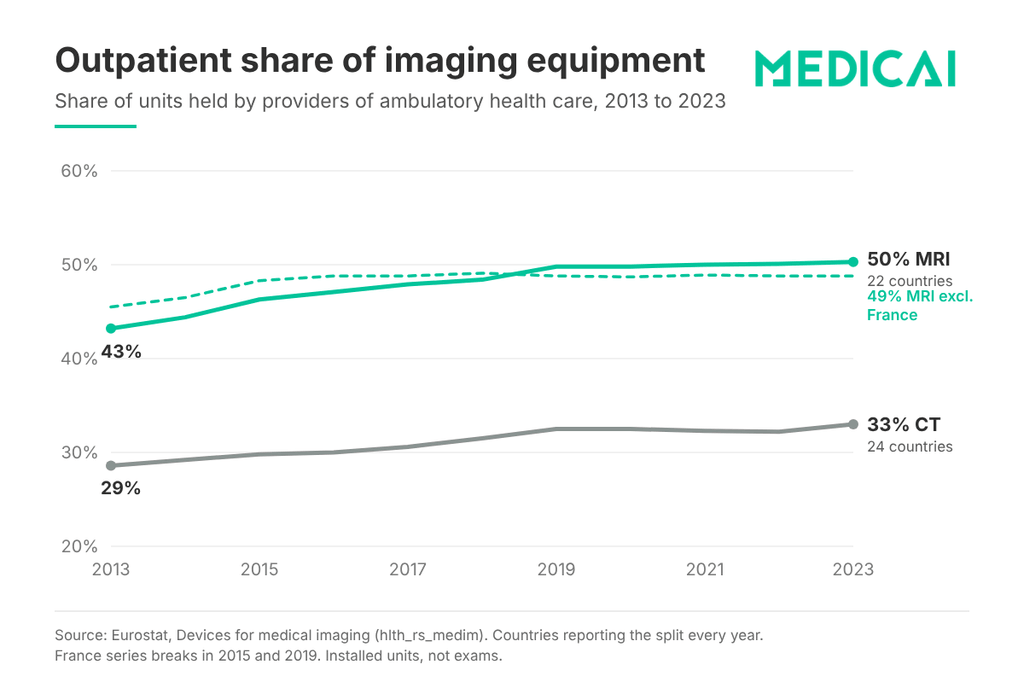
Two things sit behind that line.
Outpatient capacity grew faster in absolute terms. In the 22-country group, outpatient providers added more MRI units than hospitals did, though both sectors grew:
- Outpatient MRI units: up 75%, from 2,840 to 4,962
- Hospital MRI units: up 32%, from 3,730 to 4,912
France accounts for much of the change in share. French outpatient MRI units went from 133 to 785. Eurostat flags breaks in the French series in 2015 and 2019, so part of that jump may be reclassification. Excluding France, the outpatient share rose from 46% to 49%, and it has been stable since 2016.
The accurate reading is that outpatient providers have held about half of Europe’s MRI capacity for most of a decade. This is an established structure, not a recent swing.
Where outpatient imaging dominates
The European average hides two different models. In seven countries, outpatient providers hold most MRI units. In others, hospitals still provide MRI services.
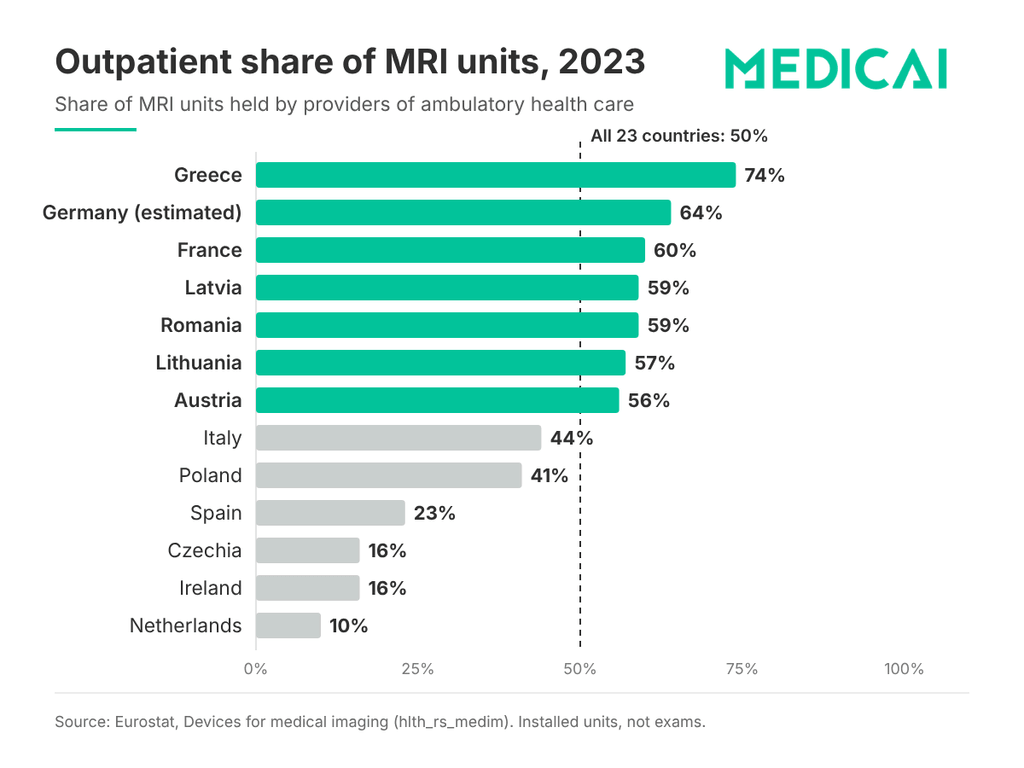
| Country | Outpatient share of MRI units, 2023 | Outpatient MRI units | Hospital MRI units |
|---|---|---|---|
| Greece | 74% | 301 | 106 |
| Germany (estimated) | 64% | 1,990 | 1,100 |
| France | 60% | 785 | 526 |
| Latvia | 59% | 26 | 18 |
| Romania | 59% | 185 | 128 |
| Lithuania | 57% | 31 | 23 |
| Austria | 56% | 135 | 106 |
| Italy | 44% | 865 | 1,119 |
| Poland | 41% | 216 | 310 |
| Spain | 23% | 247 | 810 |
| Czechia | 16% | 23 | 118 |
| Ireland | 16% | 14 | 75 |
| Netherlands | 10% | 28 | 241 |
The direction of travel is not uniform either. Between 2013 and 2023:
- The outpatient share rose in Slovenia (26% to 44%), Latvia (48% to 59%), and Austria (46% to 56%).
- It fell in Croatia (44% to 28%), Ireland (26% to 16%), and Spain (28% to 23%), where hospitals added MRI units faster than outpatient providers did.
Germany alone holds 1,990 outpatient MRI units, 40% of the outpatient total across the 23 reporting countries. Any European picture of outpatient imaging is heavily shaped by Germany.
Why this matters for moving studies between organizations
When half of MRI capacity sits outside hospitals, many studies start in one organization and are needed in another. The Eurostat data does not measure image exchange, so what follows is our reading of what the equipment split implies.
A typical path looks like this:
- A family doctor or specialist refers a patient for an MRI.
- A standalone imaging center performs the scan.
- A radiologist at that center reports it.
- The patient is then treated at a hospital, where a surgeon, oncologist, or neurologist needs the images themselves, not only the written report.
- Months later, a follow-up scan may be done somewhere else, and the radiologist needs the earlier study for comparison.
Every handoff in that path crosses an organizational boundary. Each organization usually runs its own PACS, on its own network, with its own patient identifiers. A hospital PACS is built to serve the departments inside that hospital. It isn’t built to receive studies from dozens of independent centers or send them back out.
The gaps show up in familiar ways:
- studies carried on discs or portable drives
- images that cannot be opened in the receiving system
- prior exams that are unavailable at the time of reading
- scans repeated because the original could not be retrieved in time
The more a country’s imaging capacity sits with independent outpatient providers, the more studies face this problem. In Greece, Germany, and France, that’s where most MRI units are.
What outpatient centers and hospitals need
An imaging network spread across many owners needs infrastructure built for exchange, not only for storage. Five capabilities matter most.
| Capability | What it solves |
|---|---|
| Cloud PACS | An imaging center stores and accesses studies without running its own servers, and scales as it adds scanners or sites |
| Medical imaging exchange | A study moves from the center that acquired it to the hospital that needs it, in DICOM, without discs or manual uploads |
| Zero-footprint DICOM viewer | A referring clinician opens the full study in a browser, with no software to install |
| Vendor neutral archive | Studies from different scanner and PACS vendors sit in one archive, so prior exams follow the patient |
| Access controls and audit trail | Each organization decides who sees which study, and every access is logged |
The needs differ by side of the exchange.
Outpatient imaging centers send studies out all day. They need to deliver images and reports to many referring physicians and hospitals, each with different systems, and to give patients access to their own exams.
Hospitals receive studies from many sources. They need outside exams to arrive in a format their radiologists and clinicians can open alongside in-house studies, matched to the right patient.
Medicai’s platform covers both sides: cloud PACS for storage and reading, and medical imaging exchange for moving studies between organizations.
For a buyer’s checklist, see how to evaluate medical image sharing platforms.
Frequently asked questions
About 50%. In 2023, providers of ambulatory health care held 4,969 of the 9,892 MRI units in the 23 European countries that report the hospital and outpatient split to Eurostat.
About 33%. Outpatient providers held 4,111 of 12,478 CT scanners across 26 reporting countries in 2023, according to Eurostat. CT remains more hospital-based than MRI.
Greece, at 74% in 2023. Germany (64%, estimated) and France (60%) follow. Latvia, Romania, Lithuania, and Austria are also above 50%.
The Netherlands (10% outpatient), Ireland (16%), Czechia (16%), and Spain (23%). Luxembourg, Malta, and Serbia report no MRI units with outpatient providers.
In absolute terms, yes. From 2013 to 2023, in the 22 countries reporting every year, outpatient MRI units rose 75%, against 32% for hospital units. As a share of all units, outpatient MRI rose from 43% to 50%, though outside France the share has been stable near 49% since 2016.
It is the Eurostat category for providers that treat patients without admitting them, such as medical and specialist practices and outpatient clinics. For imaging equipment, Eurostat counts diagnostic imaging services in the same category, so standalone imaging centers are included.
A PACS inside one organization does not move studies to another. When scans are acquired at outpatient centers and needed by hospital clinicians, the two systems must exchange images. That is the role of medical imaging exchange and cloud PACS.
The data comes from Eurostat’s “Devices for medical imaging” dataset (hlth_rs_medim), last updated July 13, 2026. It counts installed equipment, not exams performed.
Sources
- Eurostat, Devices for medical imaging (hlth_rs_medim), last updated July 13, 2026. doi:10.2908/HLTH_RS_MEDIM
- Eurostat, Healthcare resources: reference metadata (provider categories, including diagnostic imaging services, HP.4.2). Read the metadata

Related Articles
Lets get in touch!
Learn more about how Medicai can help you strengthen your practice and improve your patients’ experience. Ready to start your Journey?
Book A Free Demo