What's next for innovative healthcare leaders? (Cloud computing)

Webinar summary
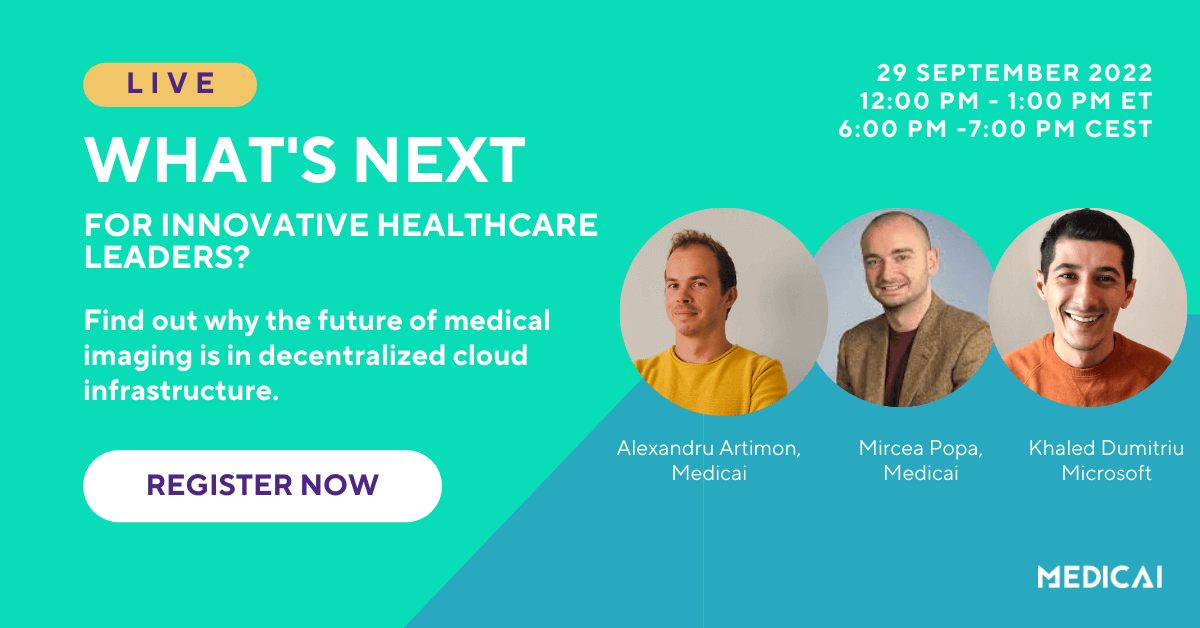
On the 29th of September 2022, Medicai together with Microsoft organised the webinar What’s Next for Innovative Healthcare Leaders? Find out why the future of medical imaging is in decentralized cloud infrastructure.
The debate was hosted by Mircea Popa, CEO Medicai, Alexandru Artimon, CTO Medicai and Khaled Dumitriu, Enterprise Azure Specialist – Data & Artificial Intelligence at Microsoft.
We started the discussion by acknowledging the influx of data in healthcare in the past years – today, approximately 30% of the world’s data volume is generated by the healthcare industry. By 2025, the compound annual growth rate of data for healthcare will reach 36%. With the swift increase of data in the sector, data management has become a bigger challenge and needs to scale up with effective solutions. This is why our topic for the meeting focused on cloud data and why cloud computing is a solution for seamless healthcare data management with enhanced privacy and security.
We then listed the main existent types of cloud computing: public, private and hybrid.
Public cloud is an IT model where on-demand computing services and infrastructure are managed by a third-party provider and shared with multiple organizations using the public Internet.
Private cloud (also known as an internal cloud or corporate cloud) is a cloud computing environment in which all hardware and software resources are dedicated exclusively to, and accessible only by, a single customer.
And hybrid cloud is one in which applications are running in a combination of different environments. Hybrid cloud computing approaches are widespread because almost no one today relies entirely on the public cloud.
We then proceeded to describe the cloud computing models used in healthcare: IaaS (Infrastructure as a Service), PaaS (Platform as a Service) and SaaS (Software as a Service), and we also discussed some advantages and disadvantages of each of those.
We asked ourselves why it is important for healthcare organizations to use the cloud, and the most important reasons we found from our experience were:
- from a patient’s point of view: creating virtual care paths that couldn’t have been possible otherwise, care personalization and access to second opinion.
- from a doctor’s point of view: doctors can obtain tests and analysis results online, track treatment dynamics, and get notifications of any update, they can collaborate with each other, they can share cases and operate in multidisciplinary teams.
- from an organizational point of view: we discussed cost optimizations, scalability, sustainability, security, forecasting options and a more connected environment.
Talking about cloud vs on-prem infrastructure, Alexandru Artimon stated the benefits of cloud:
“For security, for example. You need to hire your own security team or your own engineers, and your engineers need to be top-notch, and you need to do the whole thing in house, whereas for the cloud security is ensured by the provider and for certain services you have things that monitor the infrastructure for you.”
Mircea Popa added: “If you buy something on-prem, which in some cases still works, you pay for it today and you get to use it at maximum exactly at the same point you need to change it and upgrade it. What we saw was that above a certain threshold, performance starts to break down and it doesn’t make sense, because you can’t sustain your flows.”
The use of the cloud provides an opportunity to the health care environment to improve services for patients, to easily share information, improve operational efficiency, and streamline costs. It makes medical record-sharing easier and safer and automates backend operations.
Khaled Dumitriu talked a bit about Microsoft Azure, which is Microsoft’s public cloud computing platform, providing a range of cloud services, including compute, analytics, storage and networking.
We then switched the discussion to whether healthcare organizations are ready to adopt the cloud and towards the end, we touched upon the future of cloud computing in healthcare and what would be the tendencies and opportunities.
As a conclusion, we agreed that cloud technology allows healthcare organizations scale and adapt quickly, accelerating innovation, driving agility, streamlining operations and lowering costs. This will not only help healthcare companies get through different crises (like Covid), but it could also contribute to its improved, long-term growth.
If you’d like to watch the full webinar, please register here for access:

Related Articles



Lets get in touch!
Learn more about how Medicai can help you strengthen your practice and improve your patients’ experience. Ready to start your Journey?
Book A Free Demo