AI MRI Analysis: How AI Improves MRI Reconstruction, Segmentation, and Reporting

AI MRI analysis is the application of machine learning models to magnetic resonance imaging (MRI) studies at three operational points: during image reconstruction to accelerate scan acquisition; during image review to perform segmentation, lesion detection, and quantitative measurement; and during reporting to integrate findings into the diagnostic report. FDA-cleared AI MRI tools include accelerated reconstruction (GE AIR Recon DL, Siemens Deep Resolve, AIRS Medical SwiftMR, Philips SmartSpeed), automated brain volumetrics (Fujifilm Synapse 3D), and prostate gland segmentation (MIM Contour ProtégéAI), with broader applications across cardiac, MSK, and oncology imaging.
MRI stands for magnetic resonance imaging. It is a medical imaging technique that uses a powerful magnetic field and radio waves to produce detailed images of the inside of the body. MRI scanners are typically large, tube-shaped machines on which a person lies during the imaging procedure. MRI is commonly used to diagnose a wide range of medical conditions, including diseases of the brain, spinal cord, and internal organs. It is a non-invasive, painless procedure considered very safe.
AI, on the other hand, stands for artificial intelligence. It is a broad term referring to a machine or computer program’s ability to mimic the cognitive functions of the human brain, such as learning, problem-solving, and decision-making. AI technology has advanced rapidly in recent years and is now used in a wide range of applications, including voice recognition, natural language processing, and self-driving cars.
The three operational categories of AI MRI
AI in MRI operates at three distinct points in the imaging workflow: acquisition (reconstruction), interpretation (analysis), and reporting (integration). Each category solves a different operational problem and is regulated separately by the FDA.
Understanding the distinction matters for buyers because the three categories often ship as separate AI products from different vendors. A hospital can deploy AI reconstruction from its MRI scanner manufacturer (GE, Siemens, Philips), run a separate AI segmentation tool from a third-party vendor, and integrate third-party reporting through its PACS or VNA. The three layers are independent.
Category 1 — AI MRI reconstruction (at acquisition)
AI MRI reconstruction uses deep learning to produce diagnostic-quality images from undersampled MRI data, reducing scan time by 30–60% while maintaining or improving image quality. FDA-cleared reconstruction tools train neural networks on paired datasets of undersampled and fully sampled MRI scans, then apply the trained model at the scanner to fill in missing data during acquisition.
Three FDA-cleared reconstruction tools dominate the OEM market. GE HealthCare’s AIR Recon DL was cleared by the FDA in June 2022 for use across MRI body parts and is now standard on GE 1.5T and 3T scanners. Siemens Healthineers’ Deep Resolve ships on Magnetom platforms and was extended in 2026 with the Magnetom Flow clearance, which combines DryCool magnet technology with AI-driven image quality. Philips SmartSpeed accelerates MRI scans on Philips Ingenia and Elition platforms.
Third-party reconstruction also exists. AIRS Medical’s SwiftMR received expanded FDA 510(k) clearance in 2026 to operate alongside OEM deep-learning reconstruction — running SwiftMR on top of GE AIR Recon DL output reduced brain MRI scan time by an additional six minutes in published vendor results. SwiftMR is vendor-agnostic and covers MRI sequences that OEM reconstruction may not address.
Clinical impact: faster scans translate to higher MRI throughput, reduced patient discomfort (less time in the bore), and reduced motion artifact (shorter scans = less time for the patient to move). For imaging centers, the throughput math often justifies AI reconstruction within 12–18 months, even at a six-figure software cost.
Category 2 — AI MRI analysis (at interpretation)
AI MRI analysis refers to the family of tools that operate on completed MRI studies to perform segmentation (outlining anatomical structures or lesions), detection (flagging suspicious findings), and quantitative measurement (computing volumes, lengths, and signal intensities). This is the largest and fastest-growing category of FDA-cleared MRI AI.
Brain MRI is the most mature segment. Fujifilm’s Synapse 3D system received FDA clearance in January 2021 for automated anatomical segmentation and measurements in brain MRI — the platform identifies anatomical structures, measures volumes, and produces structured reports that radiologists previously generated manually with calipers. Multiple sclerosis lesion-tracking tools (iCometrix iCobrain, Combinostics cMRI) are FDA-cleared for serial volume comparisons across MS imaging follow-ups.
Prostate MRI segmentation is a separate clinical anchor. MIM Software’s MIM Contour ProtégéAI is FDA-cleared (510(k)) and CE-marked (Class IIa MDD) for prostate gland segmentation on T2-weighted MRI sequences, supporting PI-RADS scoring workflows and biopsy planning. Multiple research-stage tools target prostate cancer lesion detection beyond segmentation.
Cardiac MRI AI handles function quantification (ejection fraction, wall motion), scar detection on late gadolinium enhancement, and ventricular volume measurement. MSK MRI AI segments cartilage, identifies ligament tears, and quantifies bone marrow lesions. Oncology MRI AI segments tumors across body sites and tracks treatment response across serial studies.
The unifying pattern: AI MRI analysis tools augment radiologist measurement; they do not replace clinical interpretation. The FDA regulates these tools as decision-support, and the radiologist’s signature on the final report carries legal diagnostic responsibility.
Category 3 — AI MRI reporting integration (at reporting)
AI MRI reporting integration takes the outputs of reconstruction and analysis tools and routes them into the diagnostic report — populating structured templates, generating quantitative tables, and flagging measurements that fall outside reference ranges.
This category is younger than reconstruction or analysis. Most reporting integration in 2026 happens through PACS or RIS workflow extensions rather than standalone AI products. The radiologist’s voice dictation or structured reporting template receives AI-computed measurements (brain volumes, prostate gland size, cardiac ejection fraction) as pre-populated fields. The radiologist verifies, edits, and signs.
Where this matters operationally is in high-volume reading environments. A radiologist reading 80–120 studies per shift saves cumulative time when each brain MRI report ships with precomputed hippocampal volumes from AI segmentation rather than the radiologist manually measuring them. The downstream benefit is consistency — automated measurements don’t drift with rater fatigue across a long shift.
For broader workflow integration patterns, including hanging protocols and structured reporting, see the structured radiology reporting guide and radiology hanging protocols.
FDA-cleared AI MRI tools by category
The table below lists FDA-cleared AI MRI tools across the three operational categories, with vendor, clearance year, and clinical application.
| AI MRI tool | Vendor | Category | FDA status | Clinical application |
|---|---|---|---|---|
| AIR Recon DL | GE HealthCare | Reconstruction | FDA-cleared (2022) | Accelerated MRI reconstruction on GE 1.5T and 3T scanners |
| Deep Resolve | Siemens Healthineers | Reconstruction | FDA-cleared (2026) | Accelerated MRI reconstruction on Siemens Magnetom platforms |
| SmartSpeed | Philips | Reconstruction | FDA-cleared | Accelerated MRI reconstruction on Philips Ingenia and Elition |
| SwiftMR | AIRS Medical | Reconstruction | FDA-cleared (2026) | Vendor-agnostic MRI reconstruction; works alongside OEM AI |
| Synapse 3D | Fujifilm | Analysis | FDA-cleared (2021) | Brain MRI anatomical segmentation and volumetrics |
| MIM Contour ProtégéAI | MIM Software | Analysis | FDA-cleared, CE Class IIa | Prostate gland segmentation on T2-weighted MRI |
| icobrain | icometrix | Analysis | FDA-cleared | Brain volumetrics and MS lesion tracking on serial MRI |
| cMRI | Combinostics | Analysis | FDA-cleared | Brain volumetric analysis for clinical decision support |
This list is representative, not exhaustive. The FDA AI/ML-enabled medical devices list publishes the full registry of cleared products — over 1,000 entries across radiology categories as of 2026. For the complete current list, see the FDA’s published AI/ML-enabled medical devices database.
Where AI fits in the MRI workflow
AI touches the MRI workflow at four distinct points: pre-acquisition (protocol optimization), during acquisition (reconstruction), post-acquisition (analysis), and during reporting (integration). Each touchpoint has different IT requirements and different integration patterns with PACS, RIS, and the EHR.
Pre-acquisition — protocol optimization
AI protocol optimization tools recommend the optimal MRI sequence set for a given clinical indication based on the order text and patient history. These tools are still emerging in 2026 and are most common in academic centers experimenting with workflow standardization. The integration point is the RIS — the order routes through an AI recommendation engine before the technologist begins setup.
During acquisition — reconstruction
Reconstruction AI runs on the scanner itself, integrated by the OEM. The radiologist and reading workflow are unaffected — the scanner produces a faster scan with equivalent or better image quality, and the resulting DICOM study moves through PACS exactly as a non-AI scan would. This is the cleanest integration point because no downstream system needs to be aware of the AI.
Post-acquisition — analysis
Analysis AI runs either on a dedicated workstation, on the PACS, or in the cloud after the study lands in the archive. Output formats vary: some tools produce DICOM Structured Reports (SR) that the radiologist views inline with the study, while others produce separate quantitative outputs that are routed to the radiologist’s viewer via PACS integration. The DICOMweb standard simplifies this integration when both PACS and AI tool support it.
During reporting — integration
Reporting integration pulls analysis outputs into the radiologist’s report. In structured reporting platforms, AI-computed measurements are populated directly into template fields. In voice-dictation workflows, the AI output appears in a sidebar that the radiologist references while dictating. The integration depth varies by platform — fully integrated structured reporting is a 2027+ trajectory for most health systems.
For a complete workflow architecture context, see the AI in radiology guide and the broader teleradiology workflow integration patterns.
Clinical applications of AI MRI by anatomy
AI MRI applications cluster by anatomical region and clinical indication. Brain MRI has the most mature AI tooling, followed by prostate, cardiac, and MSK. Whole-body and oncology applications are emerging.
Brain MRI AI
Brain MRI is the densest AI MRI application area. Automated volumetrics (hippocampal, cortical, ventricular) support cognitive assessment and neurodegeneration tracking. MS lesion segmentation and serial comparison tools (iCobrain, cMRI) replace manual lesion counting across serial studies. Stroke imaging AI flags acute infarcts on diffusion-weighted imaging. Brain tumor segmentation tools support radiation oncology planning and tracking treatment response.
Prostate MRI AI
Prostate MRI AI tools support PI-RADS scoring workflows, the standardized framework for prostate cancer detection on multiparametric MRI. Gland segmentation (MIM Contour ProtégéAI) automates the manual outlining that radiologists previously performed before lesion characterization. Detection tools highlight regions of interest within the gland for biopsy planning. AI in this anatomy is buyer-stage relevant because PI-RADS-driven MRI volume has grown 4-5x over the past 5 years, and radiology practices are seeking efficiency gains.
Cardiac MRI AI
Cardiac MRI AI quantifies left ventricular ejection fraction, ventricular volumes, wall motion abnormalities, and scar tissue on late gadolinium enhancement sequences. The clinical value is consistency across readers — manual cardiac MRI quantification varies meaningfully by rater, whereas AI quantification yields reproducible results across studies.
MSK MRI AI
MSK MRI AI tools segment cartilage (knee, hip, ankle), identify ligament tears, quantify bone marrow lesions, and grade arthritis severity. The clinical use cases skew toward orthopedic surgery planning and sports medicine, where preoperative quantitative measurements support surgical decision-making.
Oncology MRI AI
Oncology MRI AI segments tumors across body sites, tracks treatment response on serial studies, and supports radiation therapy planning. The 2026 research literature increasingly addresses surgical-planning use cases — segmentation outputs converted into patient-specific 3D models that surgeons reference during operative planning, particularly in head-and-neck and brain tumor cases.
Limitations and the human-in-the-loop reality
AI MRI tools operate as decision-support tools, not for autonomous interpretation. The FDA explicitly regulates radiology AI as decision-support, and the signing radiologist retains full clinical authority over the final report. Three operational limitations matter for buyers.
Generalization beyond training data
AI MRI tools perform well on data distributions similar to their training sets and degrade on out-of-distribution inputs. A brain MRI segmentation tool trained primarily on 3T scanners may show reduced accuracy on 1.5T scans. A prostate AI tool trained on Siemens scanners may underperform on GE scans. Buyers should validate AI tools against their own data distribution before deployment, not solely against the vendor’s published benchmarks.
Bias from non-representative training data
AI MRI tools trained on demographically skewed datasets may produce biased outputs across patient populations. Recent research has highlighted disparities in AI performance on brain MRI across race and sex when training data underrepresents those groups. Procurement evaluations should request training data, demographics, and validation performance stratified by patient subgroup.
Validation requirements for clinical use
FDA clearance establishes the AI tool’s safety and effectiveness in the specific context that the FDA evaluated. Clinical use beyond that context — different scanners, different sequences, different patient populations — requires the deploying institution to validate the tool independently. The radiologist who signs reports based on AI outputs is responsible for ensuring that the AI was used appropriately for the specific clinical indication.
How Medicai handles AI MRI integration
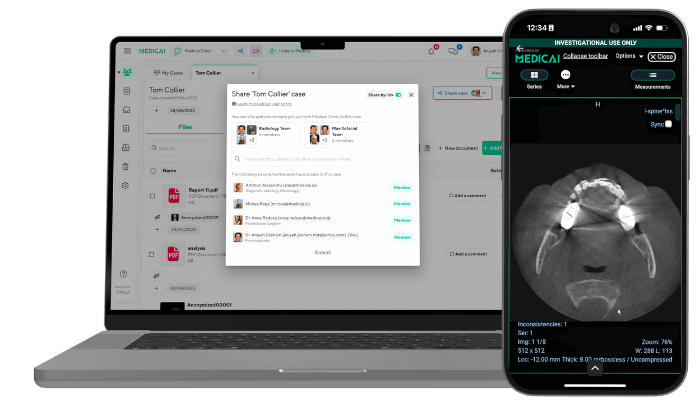
Medicai’s cloud PACS platform supports AI MRI workflow integration through three architectural mechanisms: open API and FHIR integration for third-party AI tools, DICOMweb support for cloud-native AI deployment, and a zero-footprint web viewer that renders AI outputs inline with the source MRI study.
The cloud-native architecture matters for AI MRI specifically because most modern AI tools — particularly third-party reconstruction and segmentation products — are deployed as cloud services rather than on-premises software. The integration pattern is: the MRI study lands in the Medicai cloud archive over DICOMweb STOW-RS, routes to the configured AI tool for analysis, and the AI output returns as a DICOM Structured Report that the radiologist views inline with the source study in the same web viewer.
For imaging centers and specialty clinics deploying AI MRI for the first time, the cloud architecture eliminates the on-premise GPU hardware requirements that legacy on-premise PACS impose for running AI inference locally.
For the broader AI in radiology architecture, see the AI in radiology guide.
Frequently asked questions about AI MRI
How does AI help with MRI?
AI helps with MRI at three operational points: accelerating image acquisition (reconstruction AI reduces scan time 30-60% while maintaining image quality), automating analysis (segmentation, lesion detection, quantitative measurement), and integrating results into the diagnostic report. AI augments the radiologist’s workflow; it does not replace clinical interpretation.
Can AI read MRI scans?
AI tools can perform specific reading tasks on MRI scans — detecting lesions, segmenting anatomy, measuring volumes, identifying suspicious regions — but cannot independently issue diagnostic reports. The FDA regulates radiology AI as decision-support, and a licensed radiologist must verify AI outputs and sign the final report.
What is AI MRI reconstruction?
AI MRI reconstruction uses deep learning to produce diagnostic-quality images from undersampled MRI data, reducing scan time by 30-60% while maintaining image quality. FDA-cleared reconstruction tools include GE HealthCare AIR Recon DL, Siemens Healthineers Deep Resolve, Philips SmartSpeed, and AIRS Medical SwiftMR.
Is AI MRI analysis accurate?
FDA-cleared AI MRI analysis tools demonstrate accuracy within published clinical benchmarks for the specific anatomy and indication they were cleared for. Accuracy can degrade on out-of-distribution inputs — such as different scanners, sequences, or patient populations than those in the training data. Buyers should validate AI tools against their own data before clinical deployment.
What are FDA-cleared AI MRI tools?
FDA-cleared AI MRI tools span three categories: reconstruction (GE AIR Recon DL, Siemens Deep Resolve, AIRS Medical SwiftMR, Philips SmartSpeed), segmentation and analysis (Fujifilm Synapse 3D, MIM Contour ProtégéAI, icometrix icobrain, Combinostics cMRI), and reporting integration. Over 1,000 AI/ML-enabled medical devices appear in the FDA’s published database as of 2026.
Will AI replace MRI radiologists?
No. AI MRI tools operate as decision-support tools, not for autonomous interpretation. The FDA explicitly regulates radiology AI as decision-support tools, the radiologist verifies and signs each AI-informed report, and the radiologist’s signature carries legal diagnostic responsibility. AI changes how radiologists work; it does not replace clinical authority.
How much does AI MRI software cost?
AI MRI pricing varies by category and deployment model. Reconstruction AI typically ships as part of OEM scanner contracts (GE, Siemens, Philips) and is included in the scanner cost or licensed annually. Third-party reconstruction (AIRS Medical SwiftMR) and analysis tools (iCometrix, Combinostics, MIM) are typically licensed per scanner or per study volume. Pricing requires direct vendor quotes.
Does AI MRI work with all MRI scanners?
OEM AI MRI tools work only on the manufacturer’s own scanners — GE AIR Recon DL requires GE scanners, Siemens Deep Resolve requires Siemens scanners. Vendor-agnostic AI tools (AIRS Medical SwiftMR, most third-party analysis tools) work across scanner manufacturers as long as the scanner outputs standard DICOM. Buyers operating multi-vendor MRI fleets should weight vendor-agnostic tools accordingly.
Where AI MRI is heading
Three trends are reshaping AI MRI through 2027 and beyond. Reconstruction AI is consolidating across OEM scanner platforms — by 2027, AI-accelerated reconstruction will be table stakes rather than a differentiator, and differentiation will shift to image-quality benchmarks rather than scan-time reduction. Multi-organ and whole-body AI analysis is moving from research to FDA-cleared products, expanding beyond the brain, prostate, and cardiac focus of 2026. And reporting integration is shifting from manual radiologist verification of AI outputs to fully integrated structured reporting where AI measurements pre-populate report templates and the radiologist edits rather than enters.
For organizations evaluating AI MRI in 2026 and 2027, the practical implication is that the workflow integration architecture matters more than the specific AI tools selected. Today’s tool choice may rotate at the next contract cycle; today’s integration architecture constrains the imaging workflow for the next decade.
For the related teleradiology workflow patterns, see the teleradiology workflow. For the cloud architecture underlying multi-vendor AI integration, see cloud PACS vendors.

Related Articles

Lets get in touch!
Learn more about how Medicai can help you strengthen your practice and improve your patients’ experience. Ready to start your Journey?
Book A Free Demo