

DICOM—a powerful tool in healthcare—is the quiet hero behind the life-saving diagnoses we often take for granted. It ensures medical images can be shared, understood, and acted upon by specialists worldwide.
But does DICOM support teleradiology?
DICOM in teleradiology provides a universal standard for storing, sharing, and securing medical images. Streamlining how these images are transmitted and interpreted makes remote diagnostics possible and dependable.
Keep reading to explore how DICOM transforms teleradiology and the benefits it brings that are changing medical imaging.

How Does DICOM Support Teleradiology?
DICOM is crucial for teleradiology because it is a universal translator for medical imaging devices, systems, and healthcare providers. Its role extends beyond mere image storage; it ensures that every piece of imaging data—whether it comes from or is headed—is accessible, accurate, and secure.
This is where our DICOM viewer comes into action to make every modality easily accessible.
Let’s discover how DICOM powers the seamless operation of teleradiology.

Standardization Across Devices
DICOM’s universal compatibility is what makes teleradiology practical and powerful.
Imagine a hospital radiology department filled with imaging equipment from different manufacturers. Without a common language, these devices would struggle to share information, let alone collaborate.
DICOM eliminates this chaos by standardizing how medical images are stored, formatted, and transmitted. This standardization ensures that an MRI scan taken in a small rural clinic can be sent to a top-tier radiologist in a distant city without compatibility issues.
For healthcare providers, it means faster diagnostics and smoother workflows. For patients, it means quicker access to the expert care they need, regardless of location.
Metadata Integration
Every medical image in a DICOM file comes with embedded metadata, which includes vital information such as:
- Patient demographics (name, age, medical record number).
- Imaging parameters (modality, scan type, resolution).
- Diagnostic notes and timestamps.
The metadata ensures that images are never detached from their clinical context, reducing errors and enhancing diagnostic accuracy. Every file has a built-in narrative connecting it to the patient’s medical history.
For instance, radiologists remotely review a chest X-ray and instantly see relevant details about the patient’s age, symptoms, and clinical history. This streamlines their analysis, reduces errors, and ensures every diagnosis is rooted in context.
Medicai provides DICOM, which empowers providers with the information needed for informed decision-making. It helps build trust and accuracy in remote diagnostics.
Secure Transmission
One of the biggest challenges in teleradiology is securely transmitting sensitive patient data across networks. DICOM rises to this challenge with strong encryption protocols like Transport Layer Security (TLS). It ensures that every image and its metadata are protected during transmission.
But that’s not all. With modern advancements like DICOMweb, healthcare providers can share images through secure, web-based platforms that integrate seamlessly with telemedicine systems. This innovation is a game-changer, especially for providers who manage multiple systems in different locations.
For patients, it means peace of mind knowing their health information is handled with the utmost care. For providers, compliance with regulations like HIPAA is built into the process without compromising on speed or efficiency.
At Medicai, we’re committed to leveraging these capabilities to help healthcare professionals deliver secure, reliable care wherever needed.
Image Compression and Storage
If you’ve ever seen a CT scan or MRI image, you know they’re not small files. Medical imaging data can be enormous, and transmitting these files over a network—especially in areas with limited bandwidth—can be daunting.
That’s where DICOM’s image compression capabilities come in.
By reducing file sizes without compromising image quality, DICOM makes it possible to store and share large volumes of imaging data efficiently. As a result, the specialist can receive the images promptly, analyze them, and provide a diagnosis—all within hours, not days.
Medicai understands that speed and reliability are life-saving benefits. So, by optimizing image storage and transmission, our DICOM helps ensure that no patient’s care is delayed because of technical hurdles.
Integration with PACS and EHR
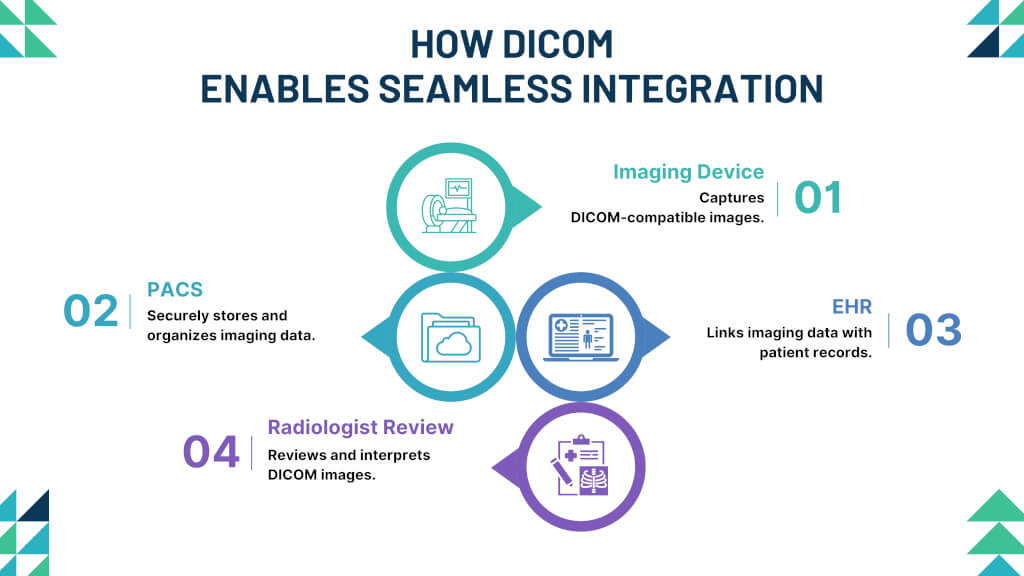
Teleradiology workflows thrive on seamless integration with key systems like PACS and Electronic Health Records (EHR). DICOM acts as the backbone of these integrations, enabling:
- Storage and retrieval of images in PACS for radiologists to have easy access.
- Automatic linking of imaging data to corresponding patient records in EHRs.
This interoperability gives radiologists and clinicians a complete view of a patient’s medical history and imaging data. It helps them to review CT scans and access prior studies and medical history in one system.
DICOM in teleradiology also eliminates the need to switch between platforms, reducing delays and improving diagnostic accuracy.
Benefits of DICOM in Teleradiology
DICOM’s integration into teleradiology systems offers multiple benefits, transforming how healthcare providers deliver diagnostic services.
Enhanced Accessibility
DICOM in teleradiology has indeed broken geographical barriers.
Access to on-site radiologists is limited in many regions, especially rural or underserved areas. DICOM bridges this gap by enabling the transmission of medical images to radiologists anywhere in the world.
If a patient in a remote town needs a chest X-ray evaluated for suspected pneumonia, the DICOM-enabled teleradiology system can help send the image to a specialist far away. The radiologist can review the scan, provide a diagnosis, and recommend treatment—all within hours.
The accessibility ensures that patients receive the care they need without traveling long distances.
Faster Turnaround Times
Time is often the difference between a positive and negative outcome in healthcare. DICOM enables faster transmission and retrieval of medical images, significantly reducing diagnosis turnaround times.
Traditional methods, such as physically transporting film or CDs, can delay critical decisions. However, DICOM eliminates these delays.
A hospital in a smaller city can send a patient’s CT scan to a neuroradiologist in a metropolitan area within minutes. This rapid access allows for immediate evaluation, enabling faster interventions such as thrombolysis or surgery.
At Medicai, we leverage DICOM to streamline workflows, ensuring that radiologists and clinicians can act quickly and confidently, delivering faster results when they matter most.
Improved Patient Outcomes
The combination of enhanced accessibility and faster turnaround times directly impacts patient outcomes. DICOM provides timely diagnoses, which can be life-saving in many cases.
Quick access to diagnostic imaging is critical, whether detecting a tumor early or diagnosing internal injuries after an accident.
For example, a patient in a rural clinic experiences sudden, severe abdominal pain. An ultrasound is sent to a radiologist via a DICOM-enabled system, who diagnoses appendicitis. This timely diagnosis enables the clinic to transfer the patient to a surgical center, preventing complications.
Cost-Effectiveness
Many small clinics and rural hospitals cannot always afford to hire radiologists to work on-site. DICOM-powered teleradiology offers a cost-effective solution: Doctors can read images remotely. This gives facilities access to specialized expertise without needing full-time staff.
Besides, DICOM lowers operational costs by reducing the reliance on physical film storage and transport. Digital images stored in PACS are easier to manage, retrieve, and share, saving time and money.
At Medicai, we’re dedicated to creating solutions that enhance care and make financial sense for providers. Our DICOM-enabled platforms help clinics and hospitals stretch budgets without compromising patient care.
Scalable Solutions
The demand for medical imaging is skyrocketing, driven by factors like aging populations and advances in diagnostic technology. DICOM ensures that teleradiology systems can scale to meet this increasing demand.
DICOM’s standardized framework supports the integration of new imaging modalities, higher data volumes, and expanding healthcare providers’ networks.
A regional hospital network can use a DICOM-based teleradiology system to connect clinics, hospitals, and imaging centers. The system can quickly grow as the network expands, allowing more users, devices, and imaging studies without problems.
Our solutions at Medicai are designed to grow with your needs. No matter how large your network becomes, you’ll always have a reliable, efficient teleradiology system at your fingertips.

Challenges in DICOM Teleradiology
While DICOM teleradiology has transformed healthcare, it comes with challenges that require attention to ensure efficient and secure workflows.
Bandwidth and Storage Limitations
DICOM files are large, and transmission over limited bandwidth and storage is challenging. Facilities in underserved areas often struggle with slow networks and space constraints.
Cloud-based storage solutions provided by platforms like Medicai are becoming increasingly popular. They offer scalable, cost-effective options for storing large volumes of DICOM data.
Data Security and Privacy
Patient data in DICOM files must comply with regulations like HIPAA. Despite advances in encryption and secure transmission protocols, Teleradiology systems remain vulnerable to cyber threats like hacking and data breaches.
End-to-end encryption and regular security audits can safeguard sensitive information, fostering trust and compliance.
System Integration
Healthcare facilities face integration challenges due to modern and legacy systems. Older equipment often lacks DICOM support, slowing workflows and technology adoption.
Integrating DICOM systems with other healthcare infrastructure, such as PACS, EHRs, and telemedicine platforms, requires careful planning and technical expertise.
Middleware and upgrades to DICOM-compliant equipment can unify systems and streamline diagnostic processes. Medicai’s teleradiology solutions prioritize interoperability, helping healthcare providers unify their systems for a cohesive diagnostic ecosystem.
Radiologist Fatigue
With the growing volume of imaging studies and the expectation of quick turnaround times, radiologists often work long hours with the same salary and have heavy workloads. This can lead to fatigue, burnout, and even diagnostic errors.
AI tools and balanced work schedules can support radiologists, enhancing efficiency and accuracy.
Conclusion
DICOM teleradiology is changing how healthcare connects patients with expert care. It helps ensure that diagnoses are both timely and accurate.
However, challenges like large file sizes and difficulties with system integration still exist. Thankfully, new technologies are addressing these problems and promoting progress.
At Medicai, we simplify connections for healthcare providers, enabling collaboration and confident care delivery. Ultimately, it’s about making a real difference for patients, wherever they are.


