DICOM Communication Protocol: How Is It Transforming Modern Medical Imaging Workflows
Picture this: a doctor in one hospital cannot view a life-saving MRI scan done in another hospital simply because the systems aren’t compatible.
What can be scarier than this?
However, it was a common picture when medical imaging lacked standardization. The problem is virtually nonexistent, and the credit goes to the DICOM Communication Protocol.
The DICOM Communication Protocol is a global standard for managing, transmitting, and storing medical imaging data. It ensures devices like MRIs, CT scans, and X-ray machines communicate effortlessly with storage systems and electronic health records (EHRs). The protocol provides interoperability, data integrity, and efficiency, vital for better patient care.
We will explore the DICOM Communication Protocol’s fundamentals, including its architecture, Purposes, and core services.
What Is DICOM?
DICOM (Digital Imaging and Communication in Medicine) is an internationally recognized standard that helps healthcare systems manage imaging data consistently.
Its primary goal is to ensure that imaging devices, such as CT scanners, MRIs, and X-ray machines, can communicate with storage systems, viewing platforms, and other devices.

Before DICOM, digital imaging communication in medicine had serious compatibility issues. Accessing or interpreting a CT scan performed on one device on another system was difficult. This communication issue used to cause insufficiencies and delays in patient care.
To resolve this issue, the American College of Radiology (ACR) and the National Electrical Manufacturers Association (NEMA) collaborated in the 1980s to develop a unified standard. Thus, DICOM came into the picture of healthcare IT.
Over the years, DICOM has evolved into a comprehensive protocol. It efficiently supports imaging workflows and emerging technologies like telemedicine and cloud storage.
Key Components of DICOM
The key components of DICOM include-
- File Formats: DICOM files combine imaging data with metadata, such as patient details, modality types, and imaging parameters.
- Data Structure: DICOM organizes data into structured formats, enabling consistent communication between devices and systems.
- Tags and Elements: Each DICOM file includes unique tags that identify every piece of data, ensuring accuracy and compatibility across platforms.
What Is the DICOM Communication Protocol
The DICOM Communication Protocol is a set of standardized rules that govern how imaging data is exchanged between devices, systems, and storage platforms. It ensures that data remains accurate, accessible, and interoperable.
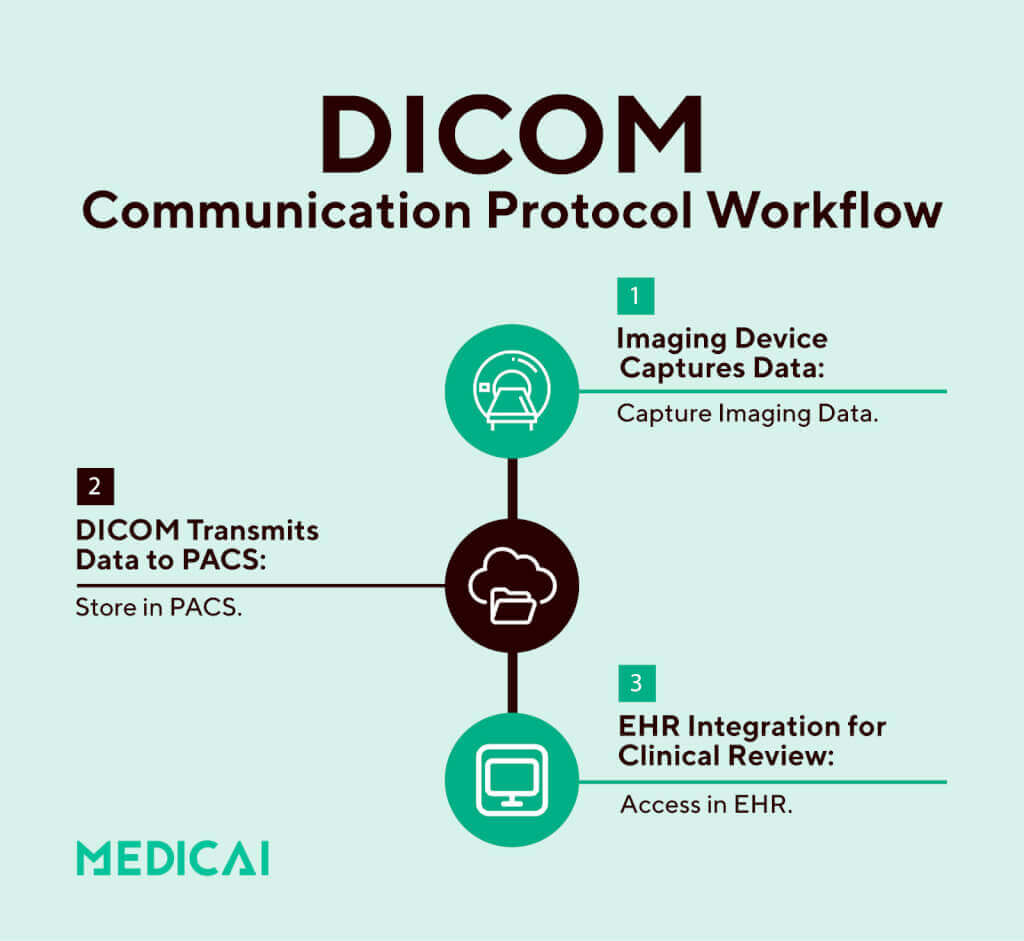
The DICOM Communication Protocol connects imaging devices, PACS, and EHRs (Electronic Health Records). It supports:
- Comprehensive Patient Record: Integrating imaging data into EHRs gives healthcare providers a holistic view of patients’ conditions.
- Telemedicine: It helps remotely share imaging data, allowing specialists to collaborate and consult without geographical constraints.
Core Purpose of DICOM Communication Protocol
At the heart of the DICOM Communication Protocol facilitates:
- Seamless Data Exchange: It helps transmit imaging data, such as X-rays and MRIs, between modalities and systems.
- Data Integrity: It ensures that imaging files retain their quality and metadata during transmission.
- Interoperability: It creates a common language that lets devices from different manufacturers communicate effectively.
With DICOM, a radiologist can retrieve an MRI scan from a PACS (Picture Archiving and Communication System) to make a diagnosis, confident that the data has been accurately transmitted and formatted.
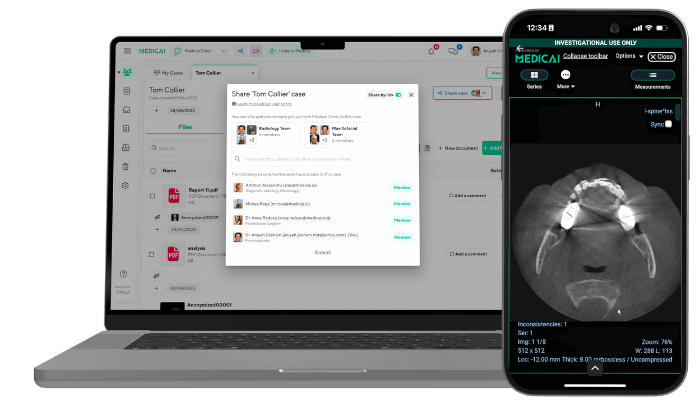
Medicai enhances the DICOM protocol by integrating it with cloud-based technologies. By facilitating real-time access to imaging data for doctors and patients, we streamline workflows and improve collaboration among healthcare providers.
Data Handling
DICOM excels at managing complex imaging datasets.
Binary File Management:
DICOM handles large binary files, which store high-resolution images. Unlike text-based formats, binary files preserve the quality of medical images, ensuring their clinical value.
For example, a single MRI scan may consist of hundreds of high-resolution images, each encoded in the DICOM format to keep its diagnostic clarity.
Metadata Management:
Each DICOM file contains metadata that provides context for the image. These include-
- Patient Demographics: Name, ID, and age
- Imaging Parameters: Modality type, scan resolution, and slice thickness.
- Study Details: Data, referring physicians, and clinical notes.
The Architecture of DICOM
DICOM’s architecture is designed to handle the complexities of imaging workflows while ensuring flexibility and scalability.
Application Entities
The protocol operates on a client-server model where devices communicate through Application Entities (AEs). These are endpoints in the DICOM network, such as imaging devices, PACS servers, or viewing stations.
Each AE is responsible for sending or receiving DICOM messages.
DIMSE Services
DIMSE services come in two forms.
- Composite DIMSE-C: Manages tasks like storing, retrieving, and transferring images.
- Normalized DIMSE-N: Handles administrative tasks like scheduling or updating records.
Message Structure
DICOM’s structured communication system ensures that data remains interoperable and actionable across systems. The messages consist of:
- Command Sets: Instructions that specify actions like storing or retrieving data.
- Data Sets: Contain the actual imaging data and metadata required for interpretation.
Core Services Of The DICOM Communication Protocol
The DICOM protocol provides several services to streamline the medical imaging workflow.
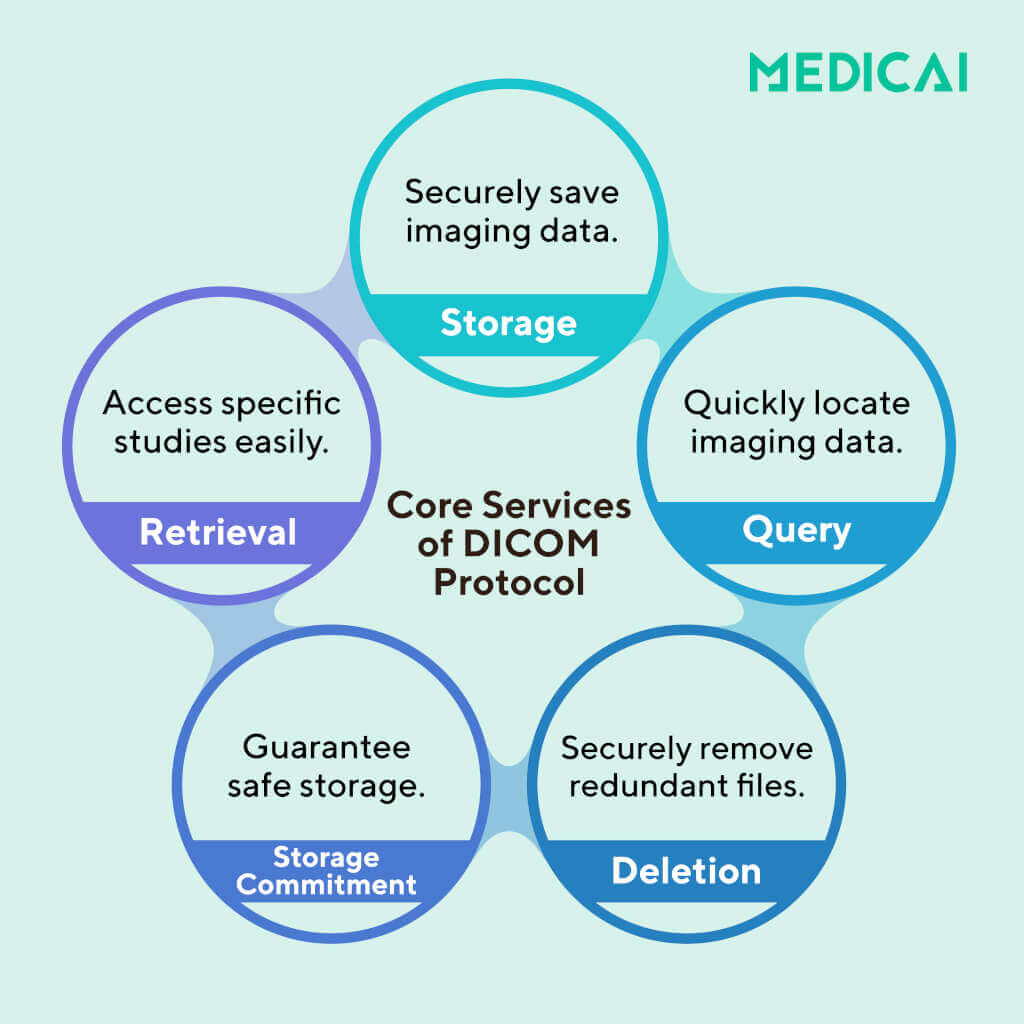
Image Management Services
- Storage: Imaging data is securely stored in PACS or cloud-based systems for long-term access.
- Retrieval: Specialists can access specific imaging studies for diagnosis or review.
- Deletion: Redundant data can be securely removed to optimize storage.
Storage Commitment
DICOM protocol service assures that imaging data has been securely stored and is available for future use. It eliminates the risk of data loss during transmission.
Query or Retrieve Services
DICOM helps find and retrieve imaging studies quickly and efficiently. Now, a radiologist can search for all CT scans performed on a patient within a specific timeframe. A surgeon can also retrieve preoperative imaging studies directly from PACS to start surgical planning.
How DICOM Facilitates Interoperability
Interoperability is the heart of DICOM’s design. It ensures that imaging devices and systems can function cohesively.
DICOM’s standardization lets devices from different vendors share and interpret data seamlessly. Hence, a radiologist workstation can access imaging studies from multiple modalities, regardless of tier origin.
DICOM integrates various imaging systems into a unified workflow, simplifying diagnostics. It facilitates remote sharing, which helps specialists conduct consultations without geographical barriers.
At Medicai, we ensure that you can smoothly access, share, and analyze imaging data across healthcare platforms. This improves patient care and collaboration.
Security Features In DICOM
Securing patient data is a top priority in the healthcare world. DICOM provides strong security measures to protect sensitive information.
DICOM’s security measures include-
- Encryption: DICOM supports secure protocols like TLS to safeguard data during transmission.
- Access Control: ensures that only authorized personnel can access imaging data.
DICOM aligns with global regulations, such as HIPAA. It protects patient privacy and secures compliance with data protection laws.
Medicai strengthens these security measures by offering secure, cloud-based storage solutions. We ensure that imaging data remains protected from any unauthorized access.
Conclusion
The DICOM Communication Protocol is a key part of today’s healthcare system. It provides seamless imaging workflows, secure data exchange, and enhanced collaboration.
Medicai takes these advantages to the next level by harnessing cloud-based solutions, enhancing accessibility, and driving innovation forward.
DICOM and Medicai are shaking things up by changing how we handle and share imaging data. They’re making healthcare more connected and efficient for everyone.


Related Articles
Lets get in touch!
Learn more about how Medicai can help you strengthen your practice and improve your patients’ experience. Ready to start your Journey?
Book A Free Demo