After-Hours Teleradiology Coverage: How the Nighthawk Model Works

After-hours teleradiology coverage is the operational model in which a healthcare facility contracts with a remote radiology group to read imaging studies acquired outside normal business hours — overnight, weekends, and holidays. The dominant pattern, often called the “nighthawk” model after the company that pioneered it in 2001, routes emergency department CT, MRI, and X-ray studies to radiologists in a different time zone (typically across multiple US sites, or to overseas groups in Australia or India) who provide preliminary or final reads within contractually agreed turnaround times — often 30 minutes for STAT cases.
How after-hours teleradiology coverage works
from acquisition at the originating facility to a returned read in roughly 30 to 60 minutes. The model depends on standardized protocols (DICOM and HL7/FHIR) and contractual service-level agreements between the healthcare facility and the teleradiology provider.
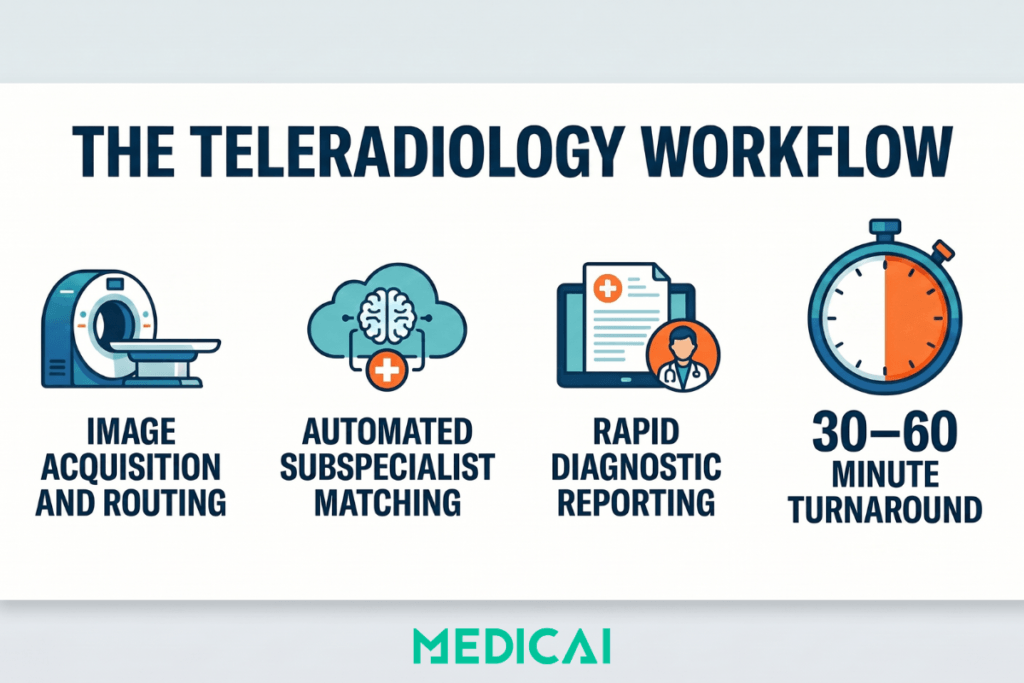
The workflow begins when an emergency department clinician orders an imaging study — most commonly a head CT for trauma, an abdominal CT for acute pain, or a chest CT for suspected pulmonary embolism. The modality acquires the study and routes it to the teleradiology platform using either classic DICOM Store (C-STORE over the hospital network) or modern DICOMweb STOW-RS over HTTPS, depending on the platform’s architecture.
The teleradiology platform then routes the study to an available teleradiologist based on three factors: subspecialty match (a neuroradiology fellowship-trained reader for a complex head CT, a general radiologist for a routine abdominal study), licensing footprint (the radiologist must be licensed in the jurisdiction where the patient was scanned), and contractual turnaround target (STAT cases get prioritized routing, routine after-hours reads enter the standard queue).
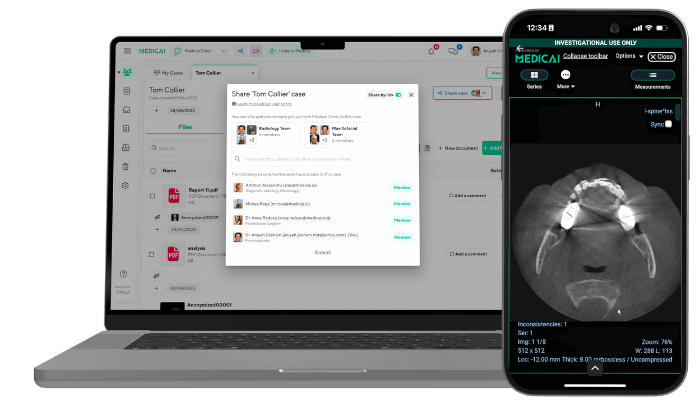
The teleradiologist opens the study in a zero-footprint web-based viewer, reviews the images, compares against any available prior studies, and dictates the diagnostic report. The signed report flows back to the originating facility’s EHR through HL7 ORU messages or a FHIR API integration. The total time from acquisition to report return is typically 30 minutes for STAT cases and under 60 minutes for preliminary after-hours reads — fast enough to support real-time emergency department treatment decisions.
The nighthawk model: historical context
The term “nighthawk radiology” originates from Nighthawk Radiology Services, founded in 2001 in Coeur d’Alene, Idaho, which pioneered the model of US hospitals contracting with radiology groups in Australia and India for overnight emergency reads. The original premise was time-zone arbitrage: a US hospital’s nighttime hours coincide with Australian or Indian daytime hours, so radiologists working their normal shifts could provide live coverage during US nighttime hours without overnight staffing premiums.
Nighthawk was acquired by Virtual Radiologic (vRad) in 2010, and vRad itself merged into MEDNAX in 2015. The original company no longer operates as an independent entity, but the term “nighthawk” entered the industry vocabulary and now refers to the broader after-hours teleradiology coverage model rather than the specific company.
Modern after-hours teleradiology coverage retains the structural principles Nighthawk introduced — time-zone arbitrage, contractual service-level agreements, cross-border licensing arrangements — but the technology stack and coverage options have evolved significantly since 2001. Most US hospitals in 2026 use domestic teleradiology providers rather than international ones, the underlying technology has shifted from VPN tunnels to cloud-native platforms, and AI tools now pre-triage studies before they reach the teleradiologist’s worklist.
Preliminary vs final reads: how the workflow splits
After-hours teleradiology coverage typically splits into a two-tier reading model: a preliminary read provided overnight by the teleradiologist, and a final read provided the following business day by the facility’s in-house radiology team.
The preliminary read is what the emergency department actually uses to make immediate treatment decisions. The teleradiologist delivers it within 30 to 60 minutes of study acquisition. It documents the urgent findings — acute hemorrhage, pneumothorax, free air, large vessel occlusion — and gives the ED clinician enough information to admit, discharge, or escalate. The preliminary read is not the legally binding diagnostic report; it’s a clinical decision-support document timestamped to the moment it was needed.
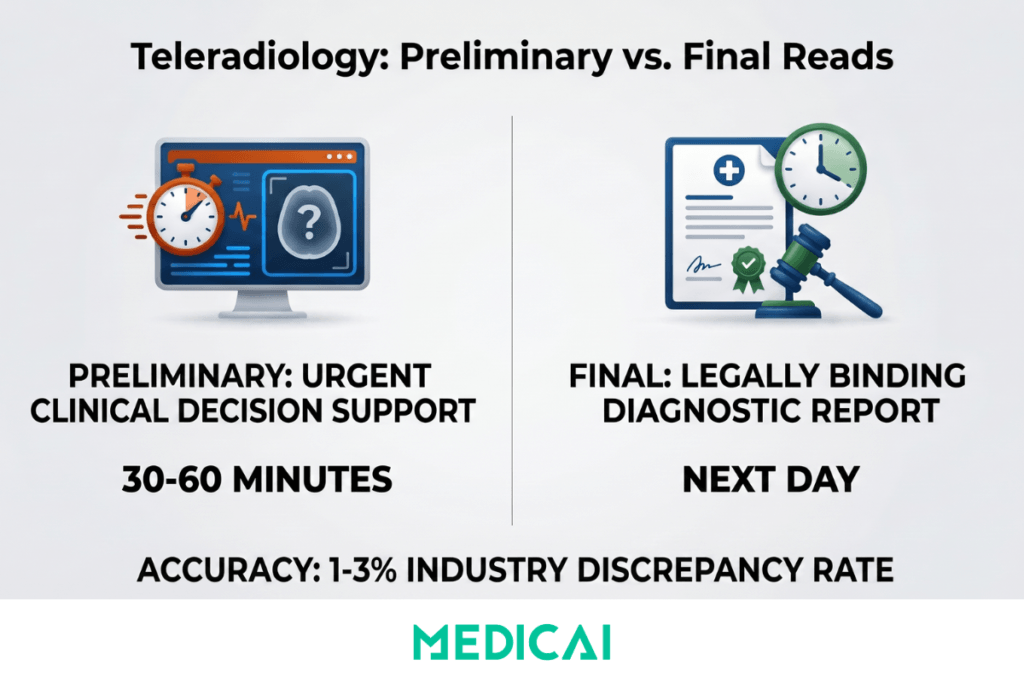
The final read is provided the following business day by the facility’s in-house radiology team, who review the same study (and the preliminary read) and issue the formal diagnostic report. The final read carries legal diagnostic responsibility, populates the patient’s permanent record, and supports downstream billing. Some health systems use a “finalized locally” variation: the after-hours teleradiologist provides the final read, which is signed off by an in-country radiologist to ensure licensing compliance. This pattern is common in international teleradiology arrangements.
Discrepancy rates between preliminary and final reads are typically 1 to 3 percent across the industry. Quality assurance protocols track these discrepancies, route significant ones back to the originating teleradiologist for feedback, and aggregate trend data to identify systematic issues with specific subspecialties, modalities, or readers. A well-run teleradiology operation treats discrepancy tracking as a core quality metric, not an afterthought.
Licensing and credentialing across time zones
A radiologist reading a study from another state or country must be licensed to practice in the jurisdiction where the patient was scanned — not where the radiologist is physically located. This single rule has cascading operational consequences for how after-hours teleradiology partnerships get structured.
In the United States, a teleradiologist physically located in California who reads a study from a hospital in Texas needs an active Texas medical license. The Interstate Medical Licensure Compact, adopted by most US states, streamlines the multi-state licensing process for qualified physicians but does not eliminate the requirement. Most production teleradiology groups maintain active licenses for their readers across the states where their hospital clients operate — a roster of 30-plus state licenses per teleradiologist is common at larger national providers.
Cross-border reads — US radiologists reading studies from EU hospitals or vice versa — add an additional regulatory layer. Most international teleradiology operates under “preliminary read, finalized locally” arrangements: the international radiologist provides a preliminary interpretation, and an in-country radiologist signs the final report. This structure satisfies the licensing requirement in the patient’s jurisdiction while preserving the time-zone advantage of international coverage.
Beyond state licensing, each covered hospital separately credentials the teleradiologist through its medical staff office before that radiologist can read for that facility. Credentialing typically covers medical license verification, board certification confirmation, malpractice history review, peer references, and DEA registration, where applicable. Credentialing timelines run 60 to 120 days per hospital, which is why teleradiology groups maintain large credentialing operations rather than relying on ad-hoc onboarding.
Subspecialty considerations layer on top of geographic licensing. Pediatric teleradiology, neuroradiology, and musculoskeletal reads often require subspecialty fellowship training in addition to state licensing and hospital credentialing. Larger teleradiology providers automatically route subspecialty cases to fellowship-trained readers; smaller providers may require subspecialty cases to be flagged manually at the originating site.
Cost structures and service-level agreements
After-hours teleradiology pricing falls into two main models: per-study and subscription. The choice depends primarily on study volume predictability and contract length.
Per-study pricing typically ranges from $4 to $25 for routine reads and $30 or more for subspecialty cases (pediatric, neuroradiology, MSK) and STAT reads. The lower end covers high-volume routine work, such as overnight extremity X-rays or chest radiographs; the upper end covers complex cross-sectional imaging with rapid turnaround requirements. Per-study pricing fits hospitals with variable or unpredictable overnight volume — the cost scales naturally with usage.
Subscription pricing covers predictable monthly volume at a flat rate and is often used by mid-sized hospitals and multi-site networks that can reliably forecast overnight study volume. Subscription contracts typically include a volume ceiling beyond which per-study overage rates apply, as well as pricing tiers based on subspecialty mix and turnaround SLAs. The economic advantage of subscription pricing surfaces when overnight volume is high enough that the per-study equivalent would exceed the subscription rate; below that crossover point, per-study pricing is more economical.
Service-level agreements typically include STAT turnaround targets of 30 minutes from acquisition to report return, a preliminary after-hours turnaround of under 60 minutes, and a routine after-hours turnaround of within 4 hours for non-urgent overnight studies. Larger contracts include penalty clauses for missed SLAs — typically prorated credits applied to the next billing cycle — and incident review processes for recurring SLA failures.
When after-hours teleradiology makes sense vs in-house overnight coverage
The decision between contracted after-hours teleradiology and in-house overnight radiology coverage comes down to one structural question: Is overnight imaging volume high enough and consistent enough to justify the fixed cost of dedicated radiologist staffing?
In-house overnight coverage means employing radiologists who work dedicated overnight shifts at the hospital or are on call remotely from home. The fixed cost is high — overnight radiologist salaries plus benefits, premium pay for unsocial hours, and the operational overhead of scheduling around vacations and illness. The advantage is responsiveness: an attending radiologist can issue final reads immediately, handle telephone consults with the ED in real time, and intervene on complex cases without the latency of a contractual teleradiology engagement.
After-hours teleradiology converts that fixed cost into variable cost. The hospital pays per study or per subscription tier, scales coverage up or down based on volume, and avoids the operational complexity of overnight staffing. The tradeoffs are the contractual SLA latency (30 minutes for STAT rather than minutes for on-site coverage), the preliminary-versus-final read split that delays the legally binding report, and the indirect communication path between the teleradiologist and the ED clinician.
| Dimension | After-hours teleradiology | In-house overnight coverage |
|---|---|---|
| Cost structure | Variable cost: pay per study or per subscription tier | Fixed cost: overnight radiologist salaries plus benefits |
| Best fit | Mid-sized hospitals, urgent care, and multi-site networks with low-to-moderate overnight volume | Large hospitals and Level I trauma centers with consistent high overnight volume |
| STAT turnaround | 30 minutes via contractual SLA, with the radiologist reading from any authorized location | 10 to 20 minutes typically, with the radiologist on-site or remote-on-call |
| Quality assurance | Preliminary reads requiring next-day final from in-house team | Final reads issued immediately by the attending radiologist |
| Scalability | Elastic, with volume spikes absorbed by the platform’s broader radiologist pool | Inelastic, with hiring overnight radiologists requiring 60 to 120-day onboarding cycles |
| Subspecialty access | Broad subspecialty pool with neuroradiology, pediatric, and MSK reads routed to fellowship-trained subspecialists | Limited to subspecialty coverage of whichever radiologist is on shift overnight |
Hybrid arrangements are common in 2026. A mid-sized hospital may employ a single overnight radiologist for high-volume hours (typically 6 PM to midnight) and contract with a teleradiology provider for the lower-volume overnight tail (midnight to 6 AM). Large academic centers may contract with teleradiology for subspecialty reads outside the in-house team’s expertise, even when the in-house team handles general overnight coverage. The right structure for any given hospital depends on study volume, subspecialty mix, and existing staffing economics.
Modern cloud-native after-hours teleradiology
The technology stack that enables after-hours teleradiology has evolved significantly since the original Nighthawk model. The 2001-era workflow depended on dedicated VPN tunnels between the hospital PACS and the teleradiology group’s reading infrastructure — a setup that required IT engineering for every hospital onboarded, scaled poorly across multi-site networks, and broke whenever VPN credentials expired or hospital firewalls were updated.
Modern cloud-native platforms eliminate the need for a VPN. Secure HTTPS/TLS replaces the dedicated tunnel; studies move from the hospital’s modality or PACS to the cloud archive over standard internet connections, encrypted in transit and at rest. Onboarding a new hospital becomes a configuration task rather than a network engineering project. Multi-site networks operate from a single cloud archive rather than a mesh of point-to-point VPN tunnels.
Zero-footprint web viewers replace thick-client diagnostic workstations. A teleradiologist reading from home, from a remote office, or from a colocation reading center logs into the platform through a standard browser — no local software installation, no per-workstation licensing, no GPU hardware refresh cycles. Diagnostic-grade rendering happens server-side; the browser displays the rendered output. This shift unlocks geographic flexibility for the teleradiology workforce and reduces capital infrastructure for the platform operator.
DICOMweb (WADO-RS, QIDO-RS, STOW-RS) replaces classic DIMSE network protocols (C-FIND, C-MOVE, C-STORE) at the platform level. The shift sounds technical, but it has real workflow consequences: DICOMweb operates over standard HTTPS, traverses firewalls cleanly, and supports REST-based queries that integrate naturally with cloud architectures. The legacy DIMSE protocols still work, but require dedicated TCP ports and network engineering that DICOMweb avoids.
AI-assisted triage is now standard on modern teleradiology platforms. Tools like Aidoc, Viz.ai, and RapidAI run inference on incoming studies before they reach the teleradiologist’s worklist, flagging suspected stroke, intracranial hemorrhage, pulmonary embolism, and acute abdominal findings. The teleradiologist opens the worklist already sorted by suspected severity rather than by chronological arrival — high-acuity findings are read first, regardless of when they arrived. This is particularly valuable for after-hours coverage, where a single teleradiologist may be responsible for studies arriving from multiple hospitals simultaneously.
Multi-site unified worklists allow a teleradiology group to cover multiple hospitals through a single interface. A teleradiologist working an overnight shift sees a combined worklist from every hospital their group covers, routed by subspecialty and licensing match rather than originating site. The legacy workflow — log in to each hospital’s PACS separately, check each worklist, manually balance the load across hospitals — disappears entirely.
For organizations evaluating cloud-native after-hours teleradiology, the practical architectural decision is whether to contract with a teleradiology provider operating on a modern platform or to deploy a cloud-native imaging platform internally and integrate teleradiology providers on top of it. The second approach gives hospitals more control over study flow, AI integration, and reporting — and platforms like Medicai’s teleradiology platform are designed specifically for this architecture, supporting multi-site coverage, AI orchestration, and zero-footprint reading from any authorized location.
Where after-hours teleradiology is heading
Three trends are reshaping after-hours teleradiology coverage through 2027 and beyond, and the strategic question for any hospital evaluating coverage today is whether the chosen contract structure accommodates these changes or constrains overnight imaging operations over the next 5 to 7 years.
AI-augmented preliminary reads are moving from pilot to standard practice. The current generation of FDA-cleared triage AI flags suspected pathology on arrival; the next generation handles structured preliminary findings, automated measurements, and prepopulated report templates. The teleradiologist’s role shifts from generating reports to verifying AI-generated findings — a workflow that shortens time-to-report without removing clinical responsibility from the radiologist. Hospitals that contract for teleradiology coverage in 2026 should expect AI augmentation to be baseline by 2028.
Domestic-only nighthawk coverage has become dominant in the US market. The original Nighthawk model relied on international time-zone arbitrage, but licensing complexity, malpractice insurance considerations, and the growth of US-based teleradiology groups operating across multiple time zones have shifted most US hospitals toward domestic providers. The time-zone advantage of international coverage no longer outweighs the regulatory and operational complexity for most US hospital clients.
Hybrid coverage models — combining cloud teleradiology platforms with in-house remote-on-call radiologists — are becoming common at mid-sized hospitals that want the cost flexibility of teleradiology with the responsiveness of in-house. The hospital’s own radiology team handles overnight calls from home through the same cloud-native platform a teleradiology group would use, with contracted overflow capacity for volume spikes or subspecialty cases that the in-house team can’t cover. This hybrid pattern blurs the categorical distinction between “in-house” and “teleradiology” coverage and points to an industry where the technical platform matters more than the radiologist’s employment model at 3 AM.
Frequently asked questions about after-hours teleradiology coverage
These eight questions cover the queries hospital administrators, IT directors, radiology managers, and procurement teams most often search for when evaluating after-hours teleradiology coverage. Each answer is structured for direct citation in AI Overview and PAA boxes.
After-hours teleradiology coverage is the operational model in which a healthcare facility contracts with a remote radiology group to read imaging studies acquired overnight, weekends, and holidays. The remote radiologists provide preliminary or final reads within contractually agreed turnaround times — typically 30 minutes for STAT cases.
The Nighthawk model is the after-hours teleradiology approach pioneered by Nighthawk Radiology Services in 2001, in which US hospitals contracted with radiology groups in Australia and India for overnight emergency reads. The term now refers to the broader after-hours teleradiology coverage model rather than the original company.
A preliminary read is provided by the after-hours teleradiologist within 30 to 60 minutes, used by the ED for immediate treatment decisions. A final read is provided by the facility’s in-house radiology team the following business day and becomes the legally binding report. Discrepancy rates between the two are typically 1 to 3 percent.
Yes. A radiologist must be licensed in the jurisdiction where the patient was scanned, regardless of the radiologist’s physical location. The Interstate Medical Licensure Compact streamlines US multi-state licensing for qualified physicians, but does not eliminate the requirement. Each covered facility also credentials the teleradiologist separately.
Per-study pricing typically ranges from $4 to $25 for routine reads and from $30 to $50 for subspecialty and STAT reads. Some teleradiology providers offer subscription pricing for predictable monthly volume. Specific costs vary by modality, urgency, subspecialty, and contractual SLAs.
After-hours teleradiology is well-suited to mid-sized hospitals, urgent care centers, and multi-site networks with low-to-moderate overnight volume — the variable cost scales with usage. In-house overnight coverage fits large hospitals and Level I trauma centers with consistent high overnight volume where fixed-cost staffing is economical.
Nighthawk Radiology Services was acquired by Virtual Radiologic (vRad) in 2010, and vRad subsequently merged with MEDNAX in 2015. The original company no longer operates as an independent entity. However, vRad continues to operate as one of the largest US teleradiology providers, having absorbed Nighthawk’s customer base, operations, and proprietary workflow technology.
AI tools (Aidoc, Viz.ai, RapidAI) pre-flag studies for stroke, intracranial hemorrhage, pulmonary embolism, and trauma before the teleradiologist opens them. This shortens time-to-treatment, prioritizes worklists by suspected severity, and reduces missed findings on overnight reads — though final interpretation remains the radiologist’s clinical responsibility.


Related Articles

Lets get in touch!
Learn more about how Medicai can help you strengthen your practice and improve your patients’ experience. Ready to start your Journey?
Book A Free Demo