Top AI Diagnostic Vendors and Platforms for Healthcare
AI diagnostic vendors develop software that helps healthcare organizations analyze medical images, pathology slides, laboratory data, and patient-reported symptoms. These tools can support clinicians by prioritizing time-sensitive cases, automating measurements, standardizing imaging data, identifying potential findings, organizing laboratory information, and guiding care pathways.
The term AI diagnostics covers several distinct markets. A radiology department evaluating CT-triage software has different requirements from a pathology laboratory deploying whole-slide image analysis, a diagnostic laboratory introducing AI-assisted lab-result interpretation, or a health system implementing patient symptom assessment and triage.
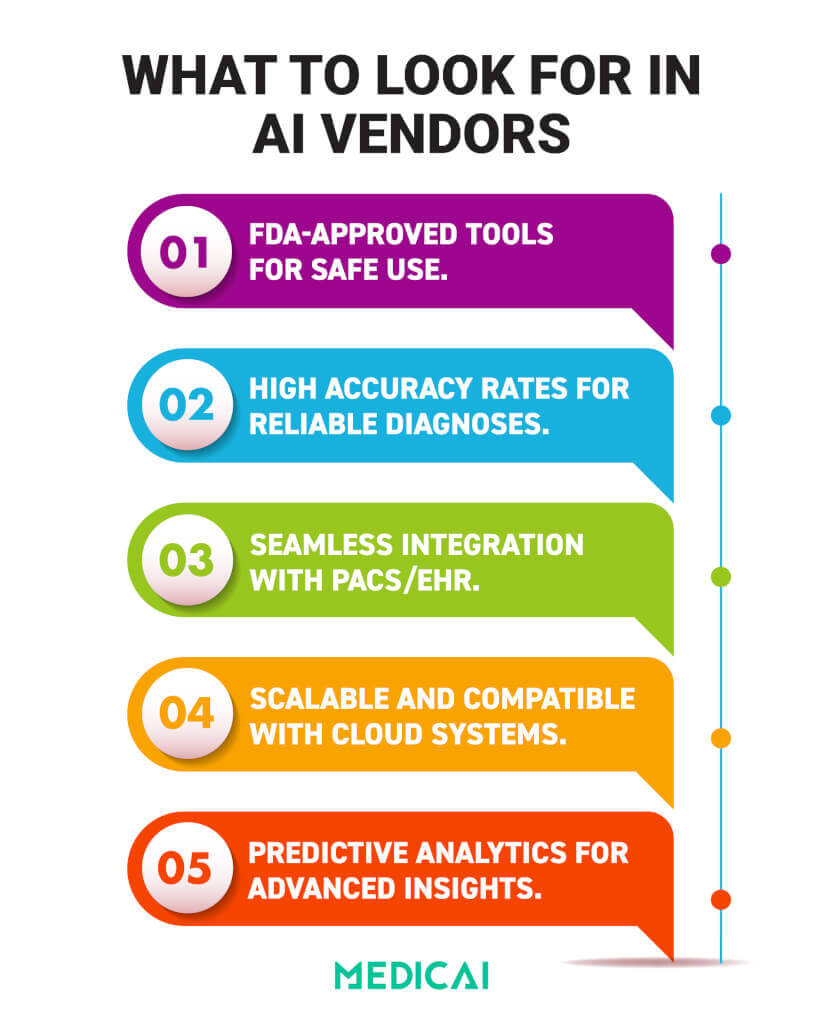
This guide compares top AI diagnostic vendors and platforms across clinical domains, workflow roles, and buyer fit. There is no universal ranking: the best AI diagnostic software depends on the intended use, clinical specialty, regulatory authorization, evidence base, data environment, and integration with existing PACS, RIS, VNA, EHR, LIS, and cloud infrastructure.
Clinical and regulatory note: AI-enabled diagnostic tools aka AI diagnosis are designed to support clinical workflows and qualified healthcare professionals—not replace them. Before procurement, verify the product’s current intended use, regulatory authorization, clinical evidence, interoperability, security controls, and availability in your country. As AI-generated visuals become more common online, researchers and medical teams may also rely on a reliable AI image detector to verify whether an image is authentic or artificially generated before using it as a reference or for analysis.
Top AI Diagnostic Platforms at a Glance
| Vendor | Primary category | Typical data modality | Best-fit buyer | Core role |
|---|---|---|---|---|
| Aidoc | Imaging AI and workflow triage | CT, X-ray, and other imaging modalities depending on algorithm | Radiology departments, emergency care, stroke and trauma programs | Prioritizes potentially urgent imaging findings and supports clinical workflows |
| Siemens Healthineers | Enterprise imaging and radiology AI | CT, MRI, X-ray | Hospitals and enterprise imaging networks | Automates measurements, post-processing, and reporting support |
| Philips | Imaging AI and clinical workflow | CT, MRI, ultrasound, enterprise imaging data | Hospitals and imaging networks | Supports image analysis, workflow, and enterprise imaging operations |
| Lunit | Cancer imaging and pathology AI | Chest X-ray, mammography, digital pathology | Cancer centers, screening programs, pathology teams | Supports cancer-screening and oncology workflows |
| Viz.ai | Care-coordination and diagnostic workflow AI | Neurovascular and cardiovascular imaging data | Stroke, cardiovascular, and emergency-care teams | Identifies time-sensitive cases and coordinates clinical teams |
| RapidAI | Neuroimaging and vascular AI | CT, CTA, CTP, MRI | Stroke and neurovascular programs | Supports neurovascular image analysis and treatment workflows |
| Nanox.AI | Population-health and imaging AI | Imaging data, including CT and X-ray workflows | Health systems, imaging networks, population-health programs | Provides AI-assisted imaging insights and population-health support |
| Tempus Pixel | Medical imaging AI | Cardiac, lung, liver, and other imaging workflows | Hospitals, imaging groups, life-sciences organizations | Supports imaging analytics and precision-medicine workflows |
| Enlitic | Imaging data standardization and AI operations | DICOM metadata and imaging data | Enterprise imaging and PACS leaders | Standardizes imaging data and supports scalable AI deployment |
| PathAI | Digital pathology and biomarker AI | Whole-slide pathology images | Pathology labs, biopharma, oncology research teams | Supports digital pathology, image management, and biomarker analysis |
| Paige | Digital pathology AI | Whole-slide pathology images | Cancer centers and pathology labs | Supports AI-enabled cancer pathology workflows |
| Proscia | Digital pathology software and AI platform | Whole-slide pathology images | Pathology departments and lab networks | Supports digital pathology operations and AI-enabled workflows |
| Ibex Medical Analytics | Pathology AI | Digital pathology slides | Pathology and oncology teams | Supports AI-assisted pathology review and cancer-related workflows |
| Docus | Laboratory-result interpretation AI | Laboratory data and clinical context | Diagnostic labs and health platforms | Produces clinician-facing and patient-friendly lab-result explanations |
| Ubie | Symptom assessment and digital triage | Patient-reported symptoms | Provider websites, patient-engagement teams, navigation programs | Supports symptom assessment, triage, and care guidance |
What Are AI Diagnostic Vendors?
AI diagnostic vendors provide software that uses machine learning, computer vision, natural-language processing, or other AI methods to support diagnostic workflows. Depending on the product, AI diagnostic tools may help healthcare organizations:
- Detect, segment, measure, or prioritize potential findings on medical images.
- Analyze CT, MRI, X-ray, mammography, ultrasound, or digital pathology data.
- Standardize DICOM metadata and improve imaging-data quality.
- Support pathologists with whole-slide image review and biomarker quantification.
- Organize laboratory data and generate clinician-reviewed interpretations.
- Identify patients who may need urgent review or specialist escalation.
- Support patient symptom assessment, care navigation, and digital triage.
- Automate measurements, reporting steps, quality assurance, follow-up, and care-coordination workflows.
In the United States, AI-enabled medical-device products are regulated according to their specific intended use. The FDA maintains an AI-Enabled Medical Device List that identifies products authorized for marketing in the United States, but it should not replace a product-level regulatory review during procurement.
Examples of AI in Medical Diagnosis
AI in medical diagnosis is not a single technology or workflow. The following examples show how AI diagnostic software can be used across healthcare settings.
Stroke and neurovascular triage
AI can analyze CT, CTA, CTP, or MRI studies to identify imaging patterns that may require urgent review. Healthcare organizations can use these tools to support stroke-team notification, radiology worklist prioritization, specialist communication, and transfer coordination.
Cancer screening and imaging support
Mammography and chest-imaging AI tools can help prioritize studies, identify suspicious regions for clinician review, quantify findings, or support follow-up workflows. These systems must be evaluated for their intended use and should be used within an appropriate radiologist-led workflow.
Lung, cardiac, and abdominal imaging analysis
AI imaging software can help clinicians and radiologists perform measurements, segment anatomical structures, track lesions, standardize assessments, or prepare report-ready outputs. These capabilities may support efficiency and consistency, but they do not remove the need for clinical interpretation.
Digital pathology and biomarker analysis
Digital pathology platforms can manage whole-slide images and use AI to assist with selected review, quantification, classification, or biomarker-analysis tasks. Some products are intended for clinical diagnostic workflows, while others are research use only.
Laboratory-result interpretation
Laboratory AI platforms can organize test data, flag notable patterns, generate clinician-facing summaries, and provide patient-friendly explanations. Clinical governance and qualified review remain essential because laboratory results require patient-specific interpretation.
Symptom assessment and care navigation
Patient-facing AI tools can collect symptom information, guide people to the appropriate care setting, and support navigation within the health system. These tools should be positioned as symptom assessment and triage support—not as autonomous diagnostic systems. This level of specialization is not unique to diagnostics. In other areas of healthcare, such as behavioral therapy, professionals often rely on tools like the best applied behavior analysis software to manage highly individualized care plans and track progress over time.
How We Selected These AI Diagnostic Companies
This is a practical buyer’s guide rather than a formal scorecard or universal ranking. The vendors were selected because they are relevant to diagnostic workflows and represent different segments of the healthcare AI market.
Selection considerations include:
- Clinical domain and intended use.
- Product maturity and current market positioning.
- Regulatory authorization where applicable.
- Relevance to diagnostic, imaging, pathology, laboratory, or triage workflows.
- Integration potential with PACS, RIS, VNA, EHR, LIS, and cloud systems.
- Publicly described clinical evidence and implementation capabilities.
- Suitability for hospitals, imaging centers, pathology laboratories, diagnostic labs, or health systems.
Product capabilities, pricing, market availability, regulatory clearances, and integrations can change. Buyers should verify current information directly with each vendor.
Top AI Diagnostic Imaging and Radiology AI Companies
Aidoc
Aidoc develops AI-powered imaging workflow tools that help healthcare teams identify and prioritize potentially urgent findings. Its platform is commonly evaluated for radiology workflow support, worklist prioritization, acute-care imaging, incidental-finding management, and multi-algorithm AI operations.
Aidoc should be understood as a clinical workflow-support and imaging-triage vendor, rather than an autonomous diagnostic platform. Its tools can flag studies for review, route notifications, and help care teams prioritize imaging workflows according to configured clinical pathways.
Best for:
- Radiology departments managing high imaging volumes.
- Emergency, trauma, and acute-care imaging workflows.
- Health systems seeking to prioritize potentially urgent studies.
- Organizations evaluating a centralized approach to multiple imaging-AI algorithms.
Questions to ask:
- Which algorithms are available for our required modality and clinical indication?
- Which product versions are authorized for use in our country?
- How does Aidoc integrate with our PACS, RIS, EHR, reporting system, and worklist?
- Can the platform support third-party AI algorithms?
- How are alerts configured, monitored, escalated, and audited?
Siemens Healthineers AI-Rad Companion
Siemens Healthineers offers AI-Rad Companion, a family of AI-powered radiology workflow tools that support automated post-processing, measurements, and preparation of images and report-ready outputs. It is relevant across CT, MRI, X-ray, and modality-specific imaging workflows.
The platform is particularly relevant for organizations that use Siemens imaging infrastructure or need AI capabilities within a broader enterprise imaging ecosystem.
Best for:
- Hospitals with established Siemens imaging environments.
- Radiology teams seeking automated measurements and post-processing.
- Imaging networks standardizing reporting workflows.
- Organizations evaluating modality-specific AI in a broader imaging ecosystem.
Buyer considerations:
- Confirm which AI-Rad Companion modules are appropriate for the intended modality and specialty.
- Evaluate integration with non-Siemens PACS, RIS, reporting systems, and archives.
- Verify product-level regulatory authorization and geographic availability.
- Assess whether the software supports local reporting templates and clinical workflow.
Philips
Philips offers AI-enabled imaging, image analysis, enterprise informatics, visualization, and workflow products across radiology and other clinical specialties. It may be a relevant option when the buyer needs a broader imaging and informatics ecosystem rather than a single-point AI algorithm.
Best for:
- Multi-site health systems with complex imaging operations.
- Hospitals combining imaging, informatics, workflow, and enterprise image-management procurement.
- Organizations seeking long-term integration across modalities and sites.
Buyer considerations:
- Determine whether a needed AI capability is native, partner-delivered, or marketplace-based.
- Verify modality, clinical indication, product version, and regulatory status.
- Assess interoperability with existing non-Philips PACS, RIS, VNA, and EHR systems.
- Request implementation details for data migration, workflow configuration, support, and training.
Lunit
Lunit develops AI tools for cancer care, including imaging-based screening and pathology or biomarker-related oncology applications. Its imaging portfolio includes AI for chest X-ray and mammography, while its broader oncology portfolio may be relevant to teams evaluating cancer workflows across imaging and pathology.
Lunit may be particularly suitable for cancer-screening programs, breast-imaging centers, thoracic imaging teams, and organizations looking to connect imaging and oncology AI strategy.
Best for:
- Mammography and breast-screening programs.
- Chest X-ray and lung-health workflows.
- Cancer centers and oncology programs.
- Organizations seeking AI support across imaging and pathology-related oncology workflows.
Buyer considerations:
- Distinguish imaging screening, reading support, risk assessment, pathology, and biomarker products.
- Verify the intended use and applicable regulatory authorization for the selected module.
- Review clinical evidence relevant to your patient population and reader workflow.
- Assess integration with mammography, PACS, RIS, reporting, patient-navigation, and oncology systems.
Viz.ai
Viz.ai provides AI-supported care coordination and clinical workflow software for time-sensitive conditions, particularly in neurovascular and cardiovascular care. Its differentiation is the combination of image and clinical data analysis with mobile communication, specialist notification, and pathway coordination.
Viz.ai is not simply an imaging-algorithm vendor. It may be particularly relevant when a health system wants to improve the time between image acquisition, clinical review, specialist notification, treatment decision, and interfacility transfer.
Best for:
- Stroke and neurovascular care programs.
- Cardiovascular and emergency-care pathways.
- Multi-hospital systems coordinating time-sensitive care.
- Organizations seeking mobile communication and care-coordination capabilities alongside AI-supported identification.
Buyer considerations:
- Define the clinical pathway before selecting the technology.
- Measure current time to review, notification, treatment decision, and transfer.
- Confirm integrations with imaging systems, EHRs, and clinical communication tools.
- Evaluate product modules separately because intended use and regulatory status can differ.
RapidAI
RapidAI provides AI-powered imaging analysis and workflow support for neurovascular care. Its software is often evaluated for acute stroke and neurovascular workflows involving CT, CTA, CTP, and MRI data, depending on the product and protocol.
RapidAI is best assessed as part of an end-to-end neurovascular workflow involving radiology, neurology, emergency medicine, neurointerventional teams, and transfer centers.
Best for:
- Comprehensive and primary stroke centers.
- Telestroke and neurovascular networks.
- Emergency imaging teams.
- Health systems seeking imaging support for stroke, aneurysm, hemorrhage, and related pathways.
Buyer considerations:
- Confirm which modalities, protocols, and clinical use cases are supported.
- Test performance with local scanner fleets, contrast protocols, and patient populations.
- Assess mobile alerts, image sharing, and specialist communication workflows.
- Review workflow outcomes in addition to model-performance metrics.
Nanox.AI
Nanox.AI is the current identity associated with the former Zebra Medical Vision business, which Nanox acquired in 2021. It should not be represented as though Zebra Medical Vision remains an independent current vendor.
Nanox.AI focuses on AI-enabled imaging and population-health applications. It may be relevant to organizations exploring opportunistic findings, imaging-derived population health insights, screening workflows, or AI-enabled imaging strategies.
Best for:
- Health systems with population-health imaging initiatives.
- Imaging providers exploring screening and opportunistic-finding workflows.
- Organizations evaluating imaging AI alongside connected or digital X-ray strategies.
Buyer considerations:
- Confirm the current product name, commercial availability, and geographic support.
- Verify algorithm-level clinical evidence and regulatory status.
- Ask how imaging findings connect to PACS, EHR, care-management, and follow-up workflows.
- Assess the governance of population-health alerts and downstream patient outreach.
Tempus Pixel
Tempus Pixel is the current imaging-AI portfolio associated with Tempus’ acquisition of Arterys. Arterys was acquired in 2022 and should not be presented as a standalone contemporary vendor.
Tempus Pixel may be relevant to organizations seeking AI-supported imaging workflows across cardiac, lung, and liver applications, as well as precision medicine. Its value proposition may be stronger for buyers interested in imaging analytics integrated with broader clinical data and life sciences capabilities.
Best for:
- Cardiac, thoracic, and liver-imaging teams.
- Health systems developing precision-medicine capabilities.
- Imaging groups and life-sciences organizations.
- Organizations that need imaging analytics alongside clinical-data platforms.
Buyer considerations:
- Confirm which of Arterys’ former capabilities are currently available under Tempus Pixel.
- Determine whether a module is designed for clinical care, clinical research, or both.
- Verify regulatory authorization by product and market.
- Evaluate PACS, VNA, EHR, cloud, and data-platform integration.
Enlitic
Enlitic focuses on imaging-data standardization, DICOM quality, and the operational infrastructure required to deploy imaging AI at scale. It is more accurately categorized as an imaging-data and AI-operations platform than a single-condition diagnostic-detection vendor.
This category matters because inconsistent DICOM metadata and imaging-study descriptions can create problems for PACS operations, imaging migrations, worklists, AI deployment, analytics, billing, research, and longitudinal patient-image management.
Best for:
- Enterprise imaging leaders.
- Health systems consolidating PACS or VNA environments.
- Organizations preparing imaging data for AI deployment.
- Imaging networks facing inconsistent DICOM metadata and study descriptions.
Buyer considerations:
- Identify existing imaging-data quality and standardization issues.
- Confirm compatibility with PACS, RIS, VNA, reporting systems, and archives.
- Evaluate governance, auditability, and reversibility of metadata changes.
- Determine whether the platform supports a broader multi-vendor imaging-AI environment.
Aidoc vs. Viz.ai vs. RapidAI: Key Differences
Aidoc, Viz.ai, and RapidAI may all appear in evaluations of urgent-care imaging workflows, but they are not interchangeable. Their core roles differ.
| Vendor | Primary workflow role | Typical clinical focus | Best suited to |
|---|---|---|---|
| Aidoc | Imaging triage and enterprise AI orchestration | Acute and incidental imaging findings, depending on the algorithm | Radiology teams seeking worklist prioritization and multi-algorithm AI operations |
| Viz.ai | AI-supported care coordination and clinical communication | Neurovascular, cardiovascular, and other time-sensitive pathways | Health systems prioritizing specialist alerting, transfer coordination, and pathway execution |
| RapidAI | Imaging analysis for neurovascular workflows | Stroke, hemorrhage, aneurysm, and related neurovascular conditions | Stroke and neurovascular programs requiring CT- and MR-based imaging analysis |
A hospital should choose based on the specific clinical and operational problem it needs to solve:
- Choose an imaging-triage and orchestration approach when the main goal is to prioritize radiology studies and deploy multiple algorithms across imaging workflows.
- Choose an AI-enabled care-coordination approach when the biggest challenge is rapidly notifying specialists, coordinating interfacility transfers, and managing pathway execution.
- Choose a neurovascular imaging-analysis approach when the organization needs detailed support for stroke and neurovascular imaging protocols.
Some health systems may use more than one platform. Procurement teams should assess whether the products overlap, integrate, or create duplicate alerts and workflow complexity.
Top AI Pathology Companies and Digital Pathology Platforms
Pathology AI should be evaluated separately from radiology AI. Digital pathology platforms integrate with whole-slide images, pathology scanners, image management systems, laboratory information systems, pathologist review workflows, and clinical or research validation requirements.
PathAI
PathAI provides AI-powered pathology products for pathology laboratories, biopharma organizations, researchers, and clinicians. Its portfolio includes digital pathology image management, pathology algorithms, biomarker quantification, and tools for oncology, liver disease, inflammatory conditions, and research workflows.
PathAI’s AISight Dx is positioned as a digital pathology platform and an image management system. Buyers should distinguish between products intended for clinical diagnostic use and research-use-only tools.
Best for:
- Digital pathology laboratories.
- Cancer centers and pathology departments.
- Biopharma and translational-research organizations.
- Organizations implementing whole-slide image-management infrastructure.
Paige
Paige develops AI-enabled digital pathology products focused on cancer and pathology workflows. It may be relevant to organizations deploying digital pathology at scale and seeking AI-supported review or oncology workflows.
Best for:
- Cancer centers.
- Pathology labs moving to whole-slide imaging.
- Enterprise pathology programs seeking AI-enabled cancer workflows.
Proscia
Proscia provides digital pathology software and AI-enabled workflow capabilities. It may be relevant for pathology departments and lab networks transitioning from glass slides to digital image management, collaboration, and AI-supported workflows.
Best for:
- Pathology departments beginning or expanding digital transformation.
- Laboratory networks that need image-management and workflow infrastructure.
- Organizations considering an AI-ready pathology platform.
Ibex Medical Analytics
Ibex Medical Analytics develops AI-supported pathology tools focused on cancer-related pathology workflows. It may be relevant to pathology teams seeking AI assistance for selected diagnostic-review processes.
Best for:
- Pathology departments supporting oncology workflows.
- Cancer programs evaluating AI-assisted pathology review.
- Labs looking for targeted pathology AI rather than a broad enterprise platform.
Lunit Pathology and Oncology AI
Lunit’s oncology portfolio can also be relevant to pathology and biomarker-analysis workflows. Buyers should confirm whether an individual product is intended for clinical use, research, biomarker analysis, or therapeutic-response evaluation.
Best for:
- Cancer centers.
- Biopharma organizations.
- Pathology and oncology teams connecting imaging, pathology, and biomarker programs.
Pathology AI Comparison
| Vendor | Primary pathology focus | Suitable buyer |
|---|---|---|
| PathAI | Digital pathology, image management, AI algorithms, biomarker analysis | Pathology labs, cancer centers, biopharma |
| Paige | AI-enabled cancer pathology and digital pathology workflows | Cancer centers and enterprise pathology programs |
| Proscia | Digital pathology software and AI-ready workflow platform | Pathology departments and lab networks |
| Ibex Medical Analytics | AI-assisted pathology review and oncology-related workflows | Pathology and oncology teams |
| Lunit | Oncology AI, pathology, and biomarker-related applications | Cancer centers and biopharma teams |
Important: Regulatory authorization, intended use, geographic availability, and evidence differ by product. Do not assume that a pathology platform or algorithm is authorized for primary diagnosis unless the vendor provides product-specific documentation.
AI Diagnostic Software for Laboratories
AI diagnostic laboratory software can help laboratories and health systems organize test data, identify notable patterns, create clinician-facing summaries, support patient communication, and coordinate follow-up. These platforms differ from imaging AI and digital pathology products in that they depend on laboratory information systems, middleware, structured test results, clinical context, and patient-specific governance.
Docus
Docus provides an AI layer for diagnostic laboratories that can turn laboratory results into clinician-facing reports and patient-friendly explanations. Its stated capabilities include differential diagnosis suggestions, follow-up recommendations, clinical plans, and support for interpreting lab results.
Docus should be evaluated as a laboratory interpretation and clinical decision support platform—not as a substitute for laboratory directors, pathologists, or treating clinicians.
Best for:
- Diagnostic laboratories seeking more actionable result reporting.
- Health platforms integrating laboratory data into patient experiences.
- Health systems seeking clinician-facing and patient-facing explanations of test results.
- Organizations designing post-result engagement and follow-up workflows.
Buyer considerations:
- Confirm integration with LIS, laboratory middleware, EHR, and patient portals.
- Assess how laboratory data are ingested, mapped, normalized, and validated.
- Review clinician oversight, audit trails, source transparency, and escalation workflows.
- Confirm how differential-diagnosis suggestions and clinical recommendations are presented.
- Review privacy, security, data retention, and compliance controls.
Patient-Facing AI Symptom Assessment and Triage
Ubie
Ubie provides AI-supported symptom assessment and digital triage tools for patients. Its symptom-checking workflow collects patient-reported information and can return possible causes, symptom severity, treatment information, and guidance on when to seek care.
Ubie should not be considered equivalent to a radiology AI platform, pathology algorithm, or laboratory diagnostic system. Its primary role is patient engagement, symptom assessment, digital triage, and care navigation.
Best for:
- Hospital websites and patient portals.
- Primary care, virtual care, and access center programs.
- Health systems improving digital care navigation.
- Organizations seeking symptom-guided service-line routing.
Buyer considerations:
- Position the platform as triage support, not autonomous diagnosis.
- Review escalation logic for urgent or red-flag symptoms.
- Test language support, accessibility, fairness, and local care-pathway accuracy.
- Confirm patient-data handling, consent, retention, and EHR integration.
How to Choose AI Diagnostic Software
A successful AI diagnostic software selection process should begin with the clinical and workflow problem—not a vendor feature list.
1. Define the diagnostic use case
Identify the intended problem:
- Prioritizing time-sensitive imaging studies.
- Supporting stroke, cardiac, trauma, or emergency-care pathways.
- Automating imaging measurements and reporting tasks.
- Improving cancer screening workflows.
- Standardizing DICOM metadata and imaging data.
- Supporting whole-slide pathology review.
- Quantifying biomarkers or supporting oncology research.
- Interpreting laboratory results.
- Improving patient symptom assessment and navigation.
A tool designed for one use case should not be assumed to solve another.
2. Verify product-level regulatory status
Ask for current documentation covering:
- Product and software version.
- Intended use and clinical indication.
- Supported modalities, protocols, or input data.
- FDA 510(k), De Novo, PMA, CE marking, CE-IVD, UKCA, or other applicable authorization.
- Geographic availability.
- Contraindications, exclusions, and known limitations.
Do not rely on broad statements such as “FDA-cleared AI vendor.” Regulatory clearance applies to specific products, versions, and intended uses.
3. Review clinical evidence
Ask for evidence that reflects the setting where the tool will be used:
- Peer-reviewed validation studies.
- External-validation and reader-performance studies.
- Sensitivity, specificity, positive predictive value, and negative predictive value.
- Evidence across relevant patient populations, disease prevalence, scanner types, and care settings.
- False-positive and false-negative implications.
- Workflow outcomes, including time to review, reporting turnaround time, time to treatment, or transfer coordination.
A retrospective accuracy statistic alone may not prove value in a live clinical workflow.
4. Assess interoperability
For imaging AI, assess:
- DICOM support.
- PACS, RIS, VNA, reporting system, and worklist integration.
- Image routing and results display.
- Audit trails.
- HL7 and FHIR capabilities where relevant.
- Third-party algorithm support and AI orchestration.
For pathology and laboratory AI, assess:
- Whole-slide scanner compatibility.
- Image-management and pathology-workflow integration.
- LIS, middleware, EHR, and patient-portal connectivity.
- Structured reporting.
- Clinical-decision-support governance.
5. Evaluate security, privacy, and governance
Review:
- HIPAA, GDPR, and local privacy obligations.
- Data-processing and business-associate agreements.
- Data residency and cloud-hosting location.
- Encryption, identity management, access controls, and audit logs.
- Data retention, deletion, and ownership.
- Whether customer data can be used for model training or improvement.
- Model monitoring, version control, change management, and incident response.
6. Calculate total cost of ownership
AI diagnostic software costs can include more than a subscription fee. Evaluate:
- Per-study, per-site, per-algorithm, per-user, or enterprise pricing.
- Implementation, integration, and professional-services costs.
- Cloud, storage, hardware, network, and cybersecurity costs.
- Training and clinical-change-management requirements.
- Ongoing validation, monitoring, support, and upgrades.
- Service-level agreements and exit terms.
- Data portability if the organization changes vendors.
Beyond individual diagnostic tools, healthcare organizations are increasingly exploring AI agents to coordinate more complex, multi-step workflows in clinical decision-making. With AI agent development services, providers can build specialized agents that retrieve relevant patient information, analyze data from connected systems, prepare structured case summaries, and route findings or alerts to clinicians for review. In diagnostic settings, this can reduce time spent gathering and processing information while keeping medical professionals responsible for interpreting results and making final clinical decisions.
Frequently Asked Questions
An AI diagnostic vendor develops software that supports diagnostic workflows using artificial intelligence. Depending on the product, the software may analyze medical images, pathology slides, laboratory data, or patient-reported symptoms to help clinicians prioritize cases, make measurements, identify possible findings, standardize data, or guide next steps.
There is no single best AI for medical diagnosis because different tools address different clinical tasks. Radiology departments may need imaging-triage or measurement software; stroke programs may need neurovascular imaging analysis and care coordination; pathology labs may need whole-slide image management and biomarker analysis; diagnostic laboratories may need result-interpretation support; and health systems may need patient-triage tools.
The best choice depends on the clinical use case, product-level regulatory authorization, evidence, local patient population, interoperability, clinician workflow, data governance, and total cost of ownership.
Top AI diagnostic platforms vary by category. Examples include Aidoc for imaging workflow and triage, Siemens Healthineers and Philips for enterprise imaging AI, Lunit for cancer-imaging and oncology workflows, Viz.ai and RapidAI for time-sensitive neurovascular and care-coordination workflows, Enlitic for imaging-data standardization, PathAI and other pathology vendors for digital pathology, and Docus for laboratory-result interpretation.
The appropriate platform depends on the specific clinical and operational problem being addressed.
AI diagnostic software uses AI methods such as machine learning, computer vision, and natural-language processing to assist diagnostic workflows. It may help analyze imaging studies, identify possible findings, automate measurements, prioritize worklists, manage pathology slides, interpret laboratory data, or support symptom assessment and care navigation.
Some AI-enabled medical-device products are FDA-cleared, authorized, or otherwise permitted for specific intended uses. However, clearance or authorization applies to a particular product, software version, clinical indication, and use environment—not to an entire vendor’s portfolio.
Before procurement, request the exact regulatory documentation for the product and indication you intend to use.
The appropriate vendor depends on the use case. Aidoc may fit imaging triage and workflow prioritization; Siemens Healthineers and Philips may fit organizations seeking enterprise imaging ecosystems; Lunit may fit cancer-screening workflows; Viz.ai and RapidAI may fit time-sensitive neurovascular or cardiovascular pathways; Nanox.AI may fit imaging and population-health applications; Tempus Pixel may fit selected imaging analytics and precision-medicine workflows; and Enlitic may fit DICOM standardization and imaging-AI operations.
Relevant AI pathology companies include PathAI, Paige, Proscia, Ibex Medical Analytics, and Lunit. Their products differ in intended use, clinical evidence, deployment model, digital pathology infrastructure, biomarker capabilities, research orientation, and regulatory status. Buyers should evaluate each product individually.
Hospitals should use a multidisciplinary process involving clinical leaders, radiologists or pathologists, IT, cybersecurity, privacy, legal, procurement, quality, compliance, and data-science teams. Validation should assess clinical fit, regulatory authorization, local performance, workflow impact, integration reliability, alert burden, equity considerations, staff training, and post-deployment monitoring.
Final Thoughts
The best AI diagnostic vendor is not necessarily the company with the longest list of algorithms or the strongest standalone marketing claim. The right platform has a clear clinical purpose, appropriate regulatory status, reliable integration, relevant evidence, effective clinician oversight, and a workflow that teams can adopt safely.
For radiology organizations, the evaluation often starts with PACS and RIS integration, DICOM data quality, worklist design, alert governance, and the need for modality-specific AI. For pathology and laboratory teams, priorities may include image management, LIS integration, clinical validation, oversight of AI-generated outputs, and data governance. For patient-engagement teams, safe triage, escalation pathways, accessibility, and accuracy of local care navigation are central.
A structured vendor-selection process helps hospitals and diagnostic organizations move beyond generic “AI diagnosis” claims and select tools that deliver measurable clinical and operational value.


Related Articles
Lets get in touch!
Learn more about how Medicai can help you strengthen your practice and improve your patients’ experience. Ready to start your Journey?
Book A Free Demo