The Critical Importance of Improving Data Accessibility in Healthcare

Improve Data accessibility for better patient outcomes. Learn about the benefits of data analytics, visualization tools, and interoperable systems.
Andra Bria
Andra Bria
Andra Bria
About Andra Bria
Experienced marketer, she is interested in health equity, patient experience and value-based care pathways. She believes in interoperability and collaboration for a more connected healthcare industry.
Fact checked by Andrada Costache, MD
Andrada Costache, MD
About Andrada Costache, MD
Dr. Costache is a radiologist with over 10 years of experience. She specializes in thoracic radiology.
Feb 23, 2026
2 minutes
The Critical Importance of Improving Data Accessibility in Healthcare

The Growing Importance of Data Accessibility in Healthcare

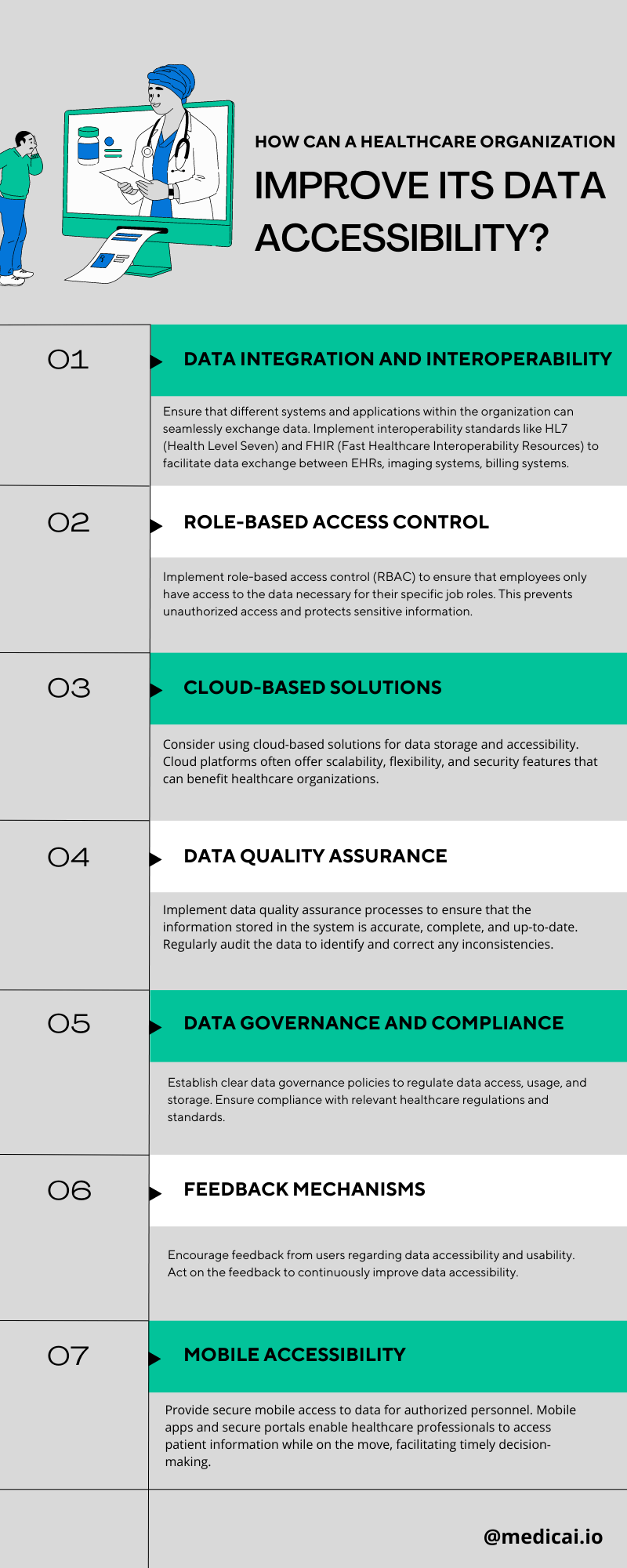
Data is a vital aspect of healthcare today, and with the advancements in technology, healthcare providers now have access to more data than ever before. This data can help doctors and other healthcare professionals make more informed decisions about patient care, ultimately leading to better patient outcomes. However, despite the abundance of data available, many healthcare providers struggle with making it accessible and actionable. This post will explore the need to improve data accessibility in healthcare and the benefits it can bring.

Challenges in Data Accessibility: Overcoming Siloed Systems

Access to data is essential for healthcare providers to make informed decisions about patient care. It allows them to track patient progress, identify trends, and predict future health outcomes. However, data is often siloed, meaning it is not easily accessible across different systems and platforms. This makes it difficult for healthcare providers to access the information they need to make informed decisions. In order to overcome this challenge, healthcare providers must find ways to make data more accessible.

Leveraging Interoperability to Enhance Data Accessibility in Healthcare

Another way to improve data accessibility is through the use of interoperable systems. Interoperable systems allow healthcare providers to access and share data across different platforms and systems. This means that healthcare providers can access patient information from multiple sources, such as electronic health records, lab results, and imaging studies, all in one place. This makes it easier for healthcare providers to make informed decisions about patient care and improve patient outcomes.

The Impact of Improved Data Accessibility on Patient Outcomes

Improving data accessibility in healthcare also has the potential to lower costs. With better access to data, healthcare providers can identify inefficiencies and waste areas, such as redundant tests or procedures. By addressing these issues, healthcare providers can reduce costs and improve patient outcomes.

In conclusion, data accessibility is a crucial aspect of healthcare, and it is essential for healthcare providers to have easy access to it. By improving data accessibility through the use of data analytics and visualization tools and interoperable systems, healthcare providers can make more informed decisions about patient care, ultimately leading to better outcomes for patients. Additionally, it also has the potential to lower costs. Improving data accessibility in healthcare should be a top priority for healthcare providers and organizations.

data accessibility in healthcare
Andra Bria
Article by
Andra Bria
Experienced marketer, she is interested in health equity, patient experience and value-based care pathways. She believes in interoperability and collaboration for a more connected healthcare industry.

Related Articles

Radiology Information System (RIS): Modules, Chain Position, KPIs, and How It Connects HIS and PACSRadiology Information System (RIS): Modules, Chain Position, KPIs, and How It Connects HIS and PACS Healthcare Trends and Innovations Cloud PACS Data Security and Interoperability Patient Empowerment and Data Security Radiology Information System (RIS): Modules, Chain Position, KPIs, and How It Connects HIS and PACS RIS is the administrative and operational nervous system of a radiology department. It manages every event in the patient’s radiology journey, excluding the image itself — the referral, scheduling, patient check-in, exam tracking, report distribution, billing, and department statistics. While... By Mircea Popa Mar 4, 2026
Cardiology PACS Systems, Features, CVIS Integration, and Workflow BenefitsCardiology PACS Systems, Features, CVIS Integration, and Workflow Benefits Healthcare Trends and Innovations Cloud PACS Cardiology PACS Systems, Features, CVIS Integration, and Workflow Benefits Cardiology PACS systems keep cardiovascular imaging usable, implied, not just stored. Cardiology PACS systems handle cine loops from echocardiography, angiography runs from catheterization, vascular ultrasound clips, and cardiac MRI series, and make priors easy to compare when the next follow-up... By Mircea Popa Feb 19, 2026
Mammography Workflow for Women Under 50: What 11-Year Clinical Data Means for PACS and Diagnostic Imagingmammography pacs for early breast cancer detection Cloud PACS Healthcare Trends and Innovations Medical Imaging Technology Mammography Workflow for Women Under 50: What 11-Year Clinical Data Means for PACS and Diagnostic Imaging The landscape of breast cancer detection is shifting. While much of the public health focus remains on women over 50, recent data suggests that younger women represent a substantial and consistently high-risk portion of the patient population. For MedTech providers... By Andrei Blaj Jan 23, 2026

Lets get in touch!

Learn more about how Medicai can help you strengthen your practice and improve your patients’ experience. Ready to start your Journey?

Book A Free Demo
f93dd77b4aed2a06f56b2ee2b5950f4500a38f11