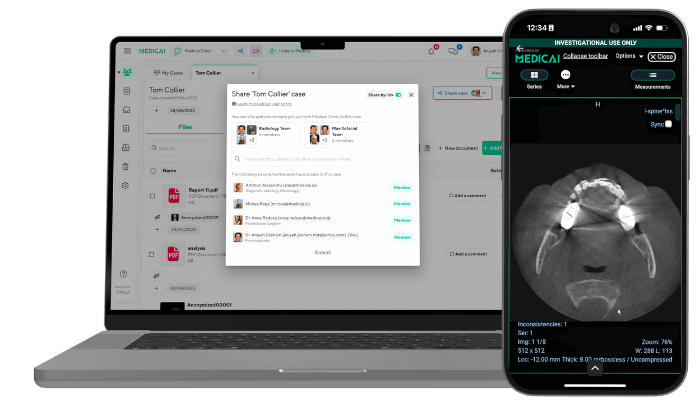
How AI is Shaping the Next Era of Medical Imaging
What if a simple scan could detect disease before symptoms even appear or guide a surgeon’s hands precisely during a life-saving procedure?
This isn’t just a futuristic dream—it’s the power and future of AI in medical imaging today.
AI in medical imaging helps doctors diagnose patients, streamline workflows, and support personalized care. By analyzing imaging data, it detects diseases early and offers real-time surgical guidance, which improves patient outcomes.
Let’s explore AI’s transformative role in medical imaging, its applications, challenges, and impact on personalized medicine and precision care.
Current Role of AI in Medical Imaging
AI tools are now essential in medical imaging. Our Radiology AI Co-Pilots help improve the accuracy of diagnoses, make workflows more efficient, and enhance the quality of images.
Let’s explore how AI is currently being used in medical imaging.
Diagnostic Accuracy
AI is incredible because it improves doctors’ ability to read medical images accurately. Deep learning tools, like Convolutional Neural Networks (CNNs), can precisely analyze images. These tools often find details too small for the human eye to see.
For instance, AI systems are now adept at identifying early signs of diseases like lung cancer by analyzing CT scans. They flag suspicious nodules that may go unnoticed in a busy clinical setting.
Similarly, AI enhances mammography by highlighting areas of concern, leading to fewer false negatives and improved early detection. It’s especially useful for complex conditions like Alzheimer’s, where it analyzes subtle changes in brain scans for early intervention.
By integrating advanced neural networks, these systems provide radiologists with a second set of “eyes,” ensuring no detail is overlooked.
Workflow Optimization
AI is revolutionizing medical imaging workflows by automating routine and time-intensive tasks. AI algorithms can quickly segment anatomical structures, such as highlighting tumors in an MRI scan.
It helps radiologists focus on complex cases that require their expertise and saves hours of manual effort.
Another significant contribution is AI’s ability to prioritize cases based on urgency.
Imagine an emergency department uploading dozens of imaging studies simultaneously. An AI system quickly analyzes medical studies to find serious cases, such as brain hemorrhages or strokes and prioritizes them for the radiologist.
Platforms like Medicai integrate AI prioritization features to enhance emergency care and save lives.
Improved Imaging Techniques
AI is also advancing imaging techniques. It ensures that medical images are more detailed and safer for patients. Noise reduction in low-dose imaging is a prime example.
Reducing radiation exposure in procedures like CT scans has traditionally led to poorer image quality. AI now bridges this gap by using advanced algorithms to clean up noisy images, producing high-quality visuals while minimizing patient risk.
Enhanced resolution is another area where AI shines. AI applies super-resolution techniques to reconstruct sharper images from lower-quality scans, helping radiologists view finer details.
The improvement is particularly impactful in areas like oncology, where precise imaging is crucial for assessing tumor boundaries.
Future Of AI In Medical Imaging
Technological advancements are shaping the future of AI in medical imaging. Innovations like deep learning and real-time integrations make healthcare more precise and patient-centered.
Let’s learn more about how AI may change medical imaging.
Deep Learning and Vision Transformation
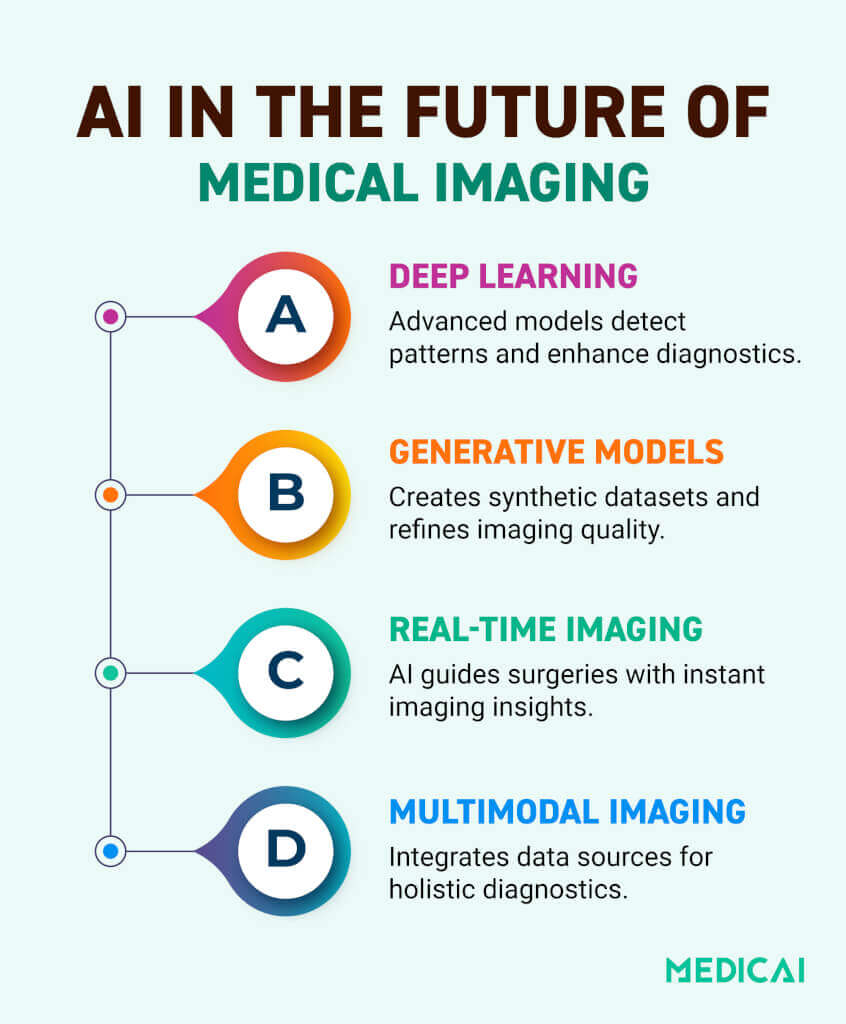
Deep learning models, especially Convolutional Neural Networks (CNNs), play a crucial role in AI for medical imaging. However, Vision Transformers (ViTs) are now bringing new advancements to the field.
Unlike CNNs, which focus on local image patterns, Vision Transformers analyzes entire images globally. They are showing promise in analyzing high-dimensional imaging data, such as 3D MRIs, where they identify intricate details with unparalleled precision.
These models are great at finding multiple problems in one scan and noticing small differences across different datasets. They learn from the context, which helps them perform better than traditional methods in detecting tumors and tracking disease progression.
Generative Models (GANs)
Generative Adversarial Networks (GANs) are changing how artificial intelligence learns and uses medical imaging. One significant way they do this is by creating synthetic datasets. These datasets are very useful for addressing limitations in available data.
AI models often require vast amounts of labeled data, which is difficult to obtain in healthcare due to privacy and regulatory constraints. GANs can generate realistic, anonymized images that mimic real-world data, offering AI systems a safe and effective training ground.
Besides, GANs enhance image quality by reconstructing high-resolution images from low-quality scans. For instance, they can “fill in the gaps” in an incomplete dataset or improve the clarity of a blurry ultrasound image, making diagnostics more reliable.
Integration With Real-Time Imaging
Imagine a surgeon performing a minimally invasive procedure while an AI system analyzes images immediately. The AI can highlight vital areas and help guide the surgeon’s actions.
Medicai provides real-time imaging solutions for critical surgical and diagnostic needs. The integration minimizes risks and enhances surgical precision.
AI tools are also changing how doctors diagnose medical conditions. For example, radiologists can use these tools during imaging to obtain quick information, such as spotting suspicious areas on a CT scan immediately. This is especially important in emergencies, where every second matters.
AI in Multimodal Imaging
Multimodal imaging combines information from different sources, such as CT scans, MRIs, and patient medical histories, to give a complete picture of a patient’s health. AI helps to bring this information together for a clearer analysis. It offers insights that individual tests alone cannot deliver.
For example, AI can merge imaging data with genomic profiles to predict how a patient might respond to specific treatments. The combination allows healthcare providers to make more informed decisions and tailor interventions to patients’ needs.
Applications of AI in Medical Imaging
AI is introducing a new future for radiology and diagnostics applications that improve diagnostics, treatment personalization, and research capabilities.
Personalized Medicine
AI enhances personalized medicine by analyzing medical imaging data with other patient metrics, such as genetic profiles and medical histories. The holistic approach helps healthcare providers to tailor treatments to each individual’s unique needs.
As a result, it improves outcomes and reduces risks.
For instance, in oncology, AI algorithms can assess tumor characteristics from imaging data to predict how a patient might respond to specific therapies. This optimizes treatments like chemotherapy or radiation and minimizes unnecessary interventions and side effects.
Similarly, in cardiology, AI analyzes arterial blockages using imaging data from CT or MRI scans. It helps cardiologists devise treatment plans tailored to the patient’s condition.
Early Disease Detection
Early detection is crucial for improving patient outcomes, and AI excels in identifying the earliest signs of disease. The system examines imaging data in detail beyond what humans can do.
This helps detect problems like small lumps in lung cancer or minor changes in brain structure that may suggest Alzheimer’s disease. Finding these issues early can significantly improve survival rates and simplify treatments by preventing diseases before they get worse.
In mammography, AI tools find breast cancer at earlier stages with greater accuracy and fewer missed cases than traditional methods. For brain scans, AI analyzes MRIs to spot micro-bleeds or plaques linked to degenerative diseases.
Image-Guided Surgery
AI is crucial in image-guided surgeries because it provides real-time insights during procedures. The integration enhances surgical precision, reduces risks, and improves patient outcomes.
For example, during minimally invasive spinal surgeries, AI systems use imaging data to identify critical anatomical landmarks. They guide surgeons in real-time, minimizing damage to surrounding tissues.
In neurosurgery, AI tools analyze preoperative and intraoperative imaging to help surgeons navigate complex brain structures. They help avoid critical areas like motor or speech centers.
Synthetic Data for Research
AI is used in medical imaging to create synthetic datasets with tools like GANs (Generative Adversarial Networks). These datasets look similar to real medical images and help researchers train AI algorithms. This approach protects patient privacy and addresses the problem of not having enough data.
Synthetic data speeds up AI diagnostics by helping systems learn from rare conditions and underrepresented groups. It also reduces costs and difficulties in gathering diverse training data, making AI development easier for researchers.
Addressing Challenges in AI for Medical Imaging
AI adoption in medical imaging has significant challenges that need careful consideration.
Data Privacy and Security
Training AI algorithms require large medical image datasets, often containing sensitive patient information. It creates concerns about potential data breaches, misuse, or unauthorized access.
Solutions:
- Platforms like Medicai implement encryption to ensure data remains secure during transmission and storage.
- Following HIPAA in the U.S. and GDPR in Europe ensures the legal and ethical use of patient data.
- Removing personal information from datasets protects privacy while allowing data to be used for AI training.
Bias and Generalizability
Overrepresenting certain groups, such as age or gender, can distort AI model performance. Historical healthcare biases may also appear in AI, leading to unfair treatment.
Solutions:
- Including imaging data from various populations ensures that AI models are representative and perform reliably across demographics.
- Incorporating metrics to identify and measure biases within AI systems helps mitigate them.
- Regularly updating AI models with new data ensures they remain generalizable and equitable.
Interpretability and Trus
AI systems sometimes act like “black boxes,” giving results without explaining how they got there. This lack of clarity can make it hard for clinicians to trust and use them.
Solutions:
- Interpretable AI tools, like heatmaps and decision trees, help doctors understand how AI makes its decisions.
- AI tools need thorough testing in real-life clinical settings to ensure reliability and trustworthiness.
Regulatory and Ethical Considerations
The rapid growth of AI in medical imaging has outpaced the rules for its use and approval, creating confusion about using it ethically and getting it approved for clinical use.
Solutions:
- They need international standards for AI in healthcare to ensure reliability.
- Ethics committees should review AI for biases, safety, and societal impact.
- AI developers should obtain certifications from bodies like the FDA in the U.S. and CE marking in Europe.
Conclusion
AI improves medical imaging by making diagnoses more accurate and speeding up processes. It helps detect diseases early and guides surgeries, showing great potential for the future.
Platforms like Medicai are leading this transformation by integrating cutting-edge AI tools into secure, interoperable solutions. We are empowering healthcare providers to deliver smarter, more efficient care.


Related Articles


Lets get in touch!
Learn more about how Medicai can help you strengthen your practice and improve your patients’ experience. Ready to start your Journey?
Book A Free Demo