HL7 vs DICOM: Decoding the Backbone of Healthcare IT

HL7 vs DICOM is a standards comparison: HL7 handles clinical and administrative messages such as admissions, orders, and results, while DICOM handles medical imaging objects and imaging metadata.
Every second counts when a clinician is waiting on the right patient context or the right imaging study. HL7 keeps patient identity, scheduling, and result status consistent across systems. DICOM keeps imaging studies readable and shareable across modalities, PACS, and viewers.
HL7 and DICOM serve different roles in healthcare IT, but they work together in daily workflows. HL7 carries events and text-based data such as ADT updates, orders, and results. DICOM stores imaging data such as X-rays, CT, and MRI, along with the metadata that makes studies searchable and traceable.
This guide explains HL7 vs DICOM differences and where each standard fits in clinical and imaging workflows.
HL7 vs DICOM: The Key Differences
- HL7 scope, clinical workflow messages, demographics, orders, and results.
- DICOM scope, imaging objects, pixels, plus metadata, study, and series structure.
- HL7 payload, text-based clinical data, and events.
- DICOM payload, images plus imaging metadata, study identifiers.
- HL7 transport, interface engine messaging in many hospitals.
- DICOM transport, imaging network services, and file objects between modalities, PACS, and viewers.
- HL7 output, the right patient context, and exam status in downstream systems.
- DICOM output, a readable study that any compliant viewer or archive can store and retrieve.
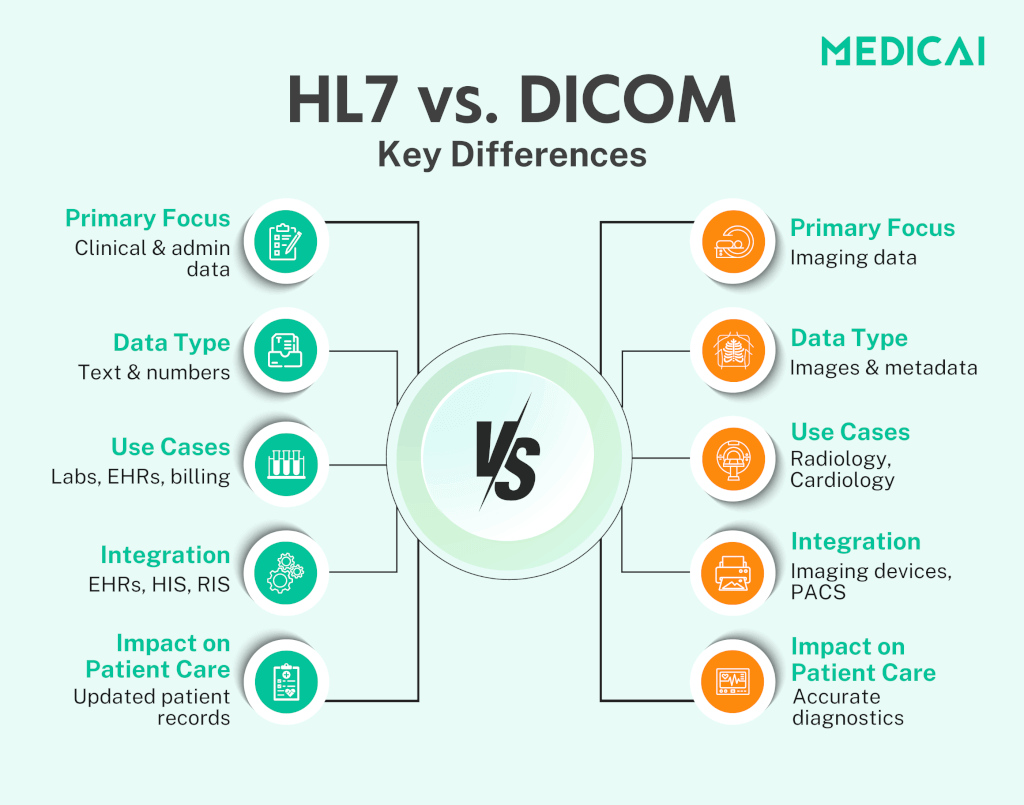
| Aspect | DICOM | HL7 |
|---|---|---|
| Primary Focus | Standardizes medical imaging data handling and transfer. | Standardizes clinical and administrative data exchange. |
| Standards Versions | Stable and less frequently updated. | Evolving (HL7 standards include v2.x, v3, and the modern FHIR). |
| Core Functionality | Manages image storage, retrieval, and sharing. | Facilitates the exchange of electronic health information. |
| Data Type | Binary files (images) with metadata. | Text-based data like patient records and lab results. |
| Use Cases | Imaging departments (radiology, cardiology). | Broad use in labs, pharmacy, billing, and EHRs. |
| Network Protocol | Uses TCP/IP for image transfer. | Uses varied protocols tailored to implementation. |
| Integration | Works with imaging devices and PACS. | Integrates with EHRs, lab systems, and HIS. |
| Interoperability | Ensures imaging systems work together. | Promotes data exchange across diverse healthcare systems. |
| Impact on Patient Care | Enables accurate diagnoses with high-quality images. | Ensures accurate, updated patient data for care teams. |
| Compliance | Meets imaging-related data regulations. | Supports compliance for health data exchange. |
Let’s look at the differences between DICOM and HL7 in detail.
Data Focus
HL7 primarily deals with clinical and administrative data. It includes patient demographics, such as names, medical record numbers, contact details, lab test results, appointment schedules, and treatment plans. It ensures that the textual and numeric data flows smoothly between EHRs and billing platforms.
On the other hand, DICOM specializes in managing medical imaging data. This data includes diagnostic images like X-rays, MRIs, CT scans, patient details, the imaging modality, and scan settings.
Primary Use Case
HL7 is primarily used for workflows involving patient management and administrative tasks. It ensures that all clinical data, such as patient admission, lab order management, scheduling, and billing, is updated and accessible across departments.
DICOM’s primary use is in imaging workflows. It is responsible for acquiring, storing, and transmitting diagnostic images. For example, a DICOM-enabled PACS lets radiologists access and analyze images captured by various imaging devices.
Communication and Protocols
HL7 uses structured, text-based messages to exchange data. These messages are organized into segments, making them compatible with various healthcare systems. For example, a message for a lab order might include fields for patient information, test type, and priority.
DICOM relies on binary data formats to manage large imaging files. A DICOM file includes the image itself and metadata, ensuring the preservation of visual data and its context during transmission.
System Integration
HL7 integrates systems that manage clinical and administrative workflows, such as EHRs, RIS, and HIS. It facilitates seamless communication across various healthcare systems, allowing departments to share and retrieve data efficiently.
DICOM connects imaging devices, PACS, and diagnostic systems. It ensures that images from modalities like MRIs or CT scanners can be stored, accessed, and analyzed across different platforms.
Workflow Integration
HL7’s workflows involve clinical data. It automates sending lab test results from a laboratory system back to a physician’s EHR, ensuring data consistency and accuracy.
DICOM focuses on imaging workflows. It ensures that device data is accurately stored in PACS and made accessible for analysis.
Data Types Handled
HL7 handles structured textual and numeric data, such as patient vital signs, lab results, and clinical notes. It’s ideal for managing administrative and documentation tasks in healthcare.
DICOM manages binary image data. A DICOM file might contain a high-resolution X-ray with metadata about the imaging modality and patient details. It’s crucial for accurate diagnostics and reporting.
How do DICOM and HL7 work together?
DICOM and HL7 serve distinct purposes; however, proper integration is crucial for efficient and unified workflow. Integrating HL7 and DICOM ensures that healthcare providers have a holistic view of the patient’s condition, improving the accuracy and efficiency of diagnoses.
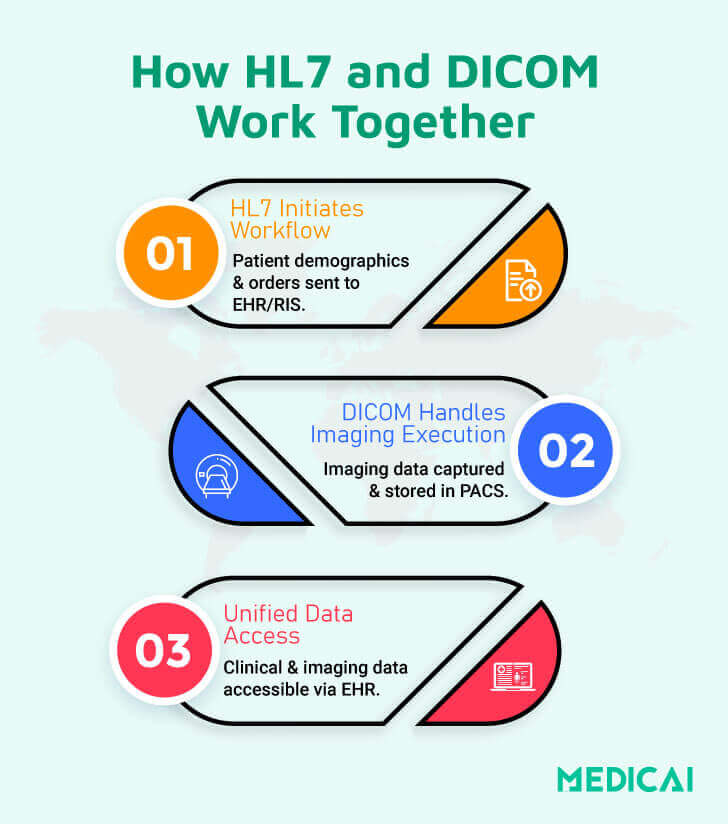
Workflow Initiated By HL7
The interaction between DICOM and HL7 typically begins with HL7 initiating the workflow. When a physician orders an imaging study—MRI or CT scan—through EHR systems, HL7 transmits the request to the radiology system (RIS).
The HL7 message carries information including-
- Patient demographics (name, ID, date of birth)
- Study details (modality type. Imaging protocol, priority)
- Scheduling information (appointment date and time)
The HL7 message ensures that the radiology department and imaging modalities get the information correctly and start the procedure.
Imaging Execution By DICOM
DICOM manages the imaging process once the HL7 message reaches the radiology system. The imaging modality retrieves patient and study details from the RIS via the DICOM Modality Worklist (MWL). The DICOM Modality Worklist is critical because it:
- Ensures accurate patient identification, reducing the risk of manual data entry errors.
- Automatically configures the imaging device according to the study requirements.
DICOM acquires, stores, and transmits the resulting images, ensuring they are compatible with PACS (Picture Archiving and Communication Systems) and other viewing systems. PACS acts as the central archive for all DICOM files.
Unified Data Access
After the imaging study, the diagnostic images are stored in a PACS system using the DICOM standard. These images are then linked to the patient’s clinical record in the EHR.
It helps-
- Radiologists analyze the images alongside clinical notes, lab results, and other patient data.
- Physicians can access both imaging and clinical data through a single interface.
- Seamless collaboration between specialists enhances the decision-making process.
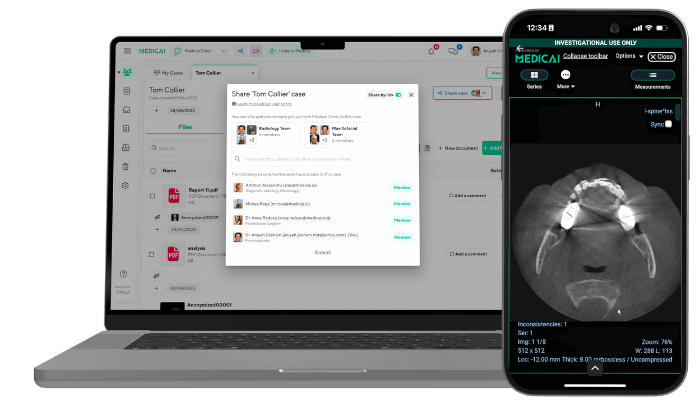
Platforms like Medicai simplify this integration by providing cloud-based solutions that efficiently connect HL7 and DICOM. These solutions ensure real-time data access and collaboration.
Benefits of HL7 and DICOM Integration
Integrating HL7 and DICOM helps healthcare providers deliver seamless, patient-centered care.
- Improved Efficiency: Automated data exchange reduces manual tasks and accelerates workflows.
- Accurate Diagnoses: Unified access to clinical and imaging data helps in more informed decision-making.
- Enhanced Collaboration: Thanks to centralized and consistent data, specialists across departments can collaborate effectively.
HL7 and DICOM Integration Challenges
Integrating HL7 and DICOM may present technical and operational challenges.
Different Data Format
HL7 uses text-based messages to encode patient and clinical data, while DICOM uses binary formats to manage imaging files. This discrepancy requires strong IT systems to translate and manage both formats efficiently.
Vendor Compatibility
Healthcare systems often use devices and platforms from multiple manufacturers. Each has its implementation of DICOM and HL7 standards. So, ensuring compatibility across these systems can be technically demanding and resource-intensive.
Data Security and Privacy
Integrating clinical and imaging data requires strong security measures to protect sensitive patient information. Both HL7 and DICOM must follow healthcare rules like HIPAA. However, ensuring data is securely exchanged between systems can take time and effort.
Maintenance and Updates
Healthcare IT systems require regular updates to stay compatible with evolving HL7 and DICOM standards. Maintaining these systems while avoiding downtime can be a logistical challenge for healthcare providers.
Medicai bridges HL7 and DICOM integration with secure, cloud-based solutions, enabling seamless communication between text-based HL7 messages and binary DICOM files. The platform offers seamless data exchange, real-time access, and vendor-neutral interoperability, streamlining workflows and enhancing patient care.
Conclusion
HL7 and DICOM are the two main ingredients of modern healthcare IT. They create unified workflows that streamline data exchange, enhance collaboration, and improve patient care.
With Medicai, healthcare providers can unlock the full potential of these two standards. Our cloud-based platform bridges the gap between clinical and imaging data, ensuring real-time access, enhanced collaboration, and secure interoperability.


Related Articles

Lets get in touch!
Learn more about how Medicai can help you strengthen your practice and improve your patients’ experience. Ready to start your Journey?
Book A Free Demo