Orthopedic PACS & Templating: Why Generic Viewers Fail the Surgeon

In general radiology, the goal of a PACS is Diagnosis: “Is the bone broken?” In orthopedics, the goal of orthopedic PACS is Reconstruction: “How do I fix it, and what size implant do I need?”
This fundamental difference is why generic PACS viewers often frustrate orthopedic surgeons. A standard viewer allows you to see the fracture, but it lacks the engineering tools required to plan the repair.
For high-volume orthopedic practices, Digital Templating and Pre-Operative Planning capabilities are not “nice-to-haves”—they are operational necessities. This guide explores why moving to a specialized Ortho-ready PACS architecture is critical for reducing OR time and improving surgical outcomes.

From Acetate to Digital: The Evolution of Templating
Years ago, surgeons planned total joint replacements using physical acetate overlays on printed X-ray films. Today, film is gone, but the need for precise measurement remains.
Digital Templating is the software attribute that replaces those acetate sheets. It allows surgeons to overlay digital representations of prosthetics (hips, knees, shoulders) directly onto the digital X-ray image.
The “Calibration” Factor
The single most critical technical vector in Ortho PACS is Calibration.
- The Problem: Digital X-rays have no inherent scale. Depending on the patient’s distance from the detector, the bone might appear 10% larger or smaller than it actually is.
- The Solution: A specialized Ortho PACS detects the Calibration Marker (usually a 25mm metal ball placed in the field of view). It automatically scales the image so that 1mm on the screen equals 1mm in the patient’s body.
- The Result: When you drop a size 5 femoral stem template onto the image, you know it will fit the actual patient.
The Workflow: Pre-Operative Planning Software
Modern Orthopedic PACS integrates planning directly into the image lifecycle. This moves the workflow from “guessing” to “engineering.”
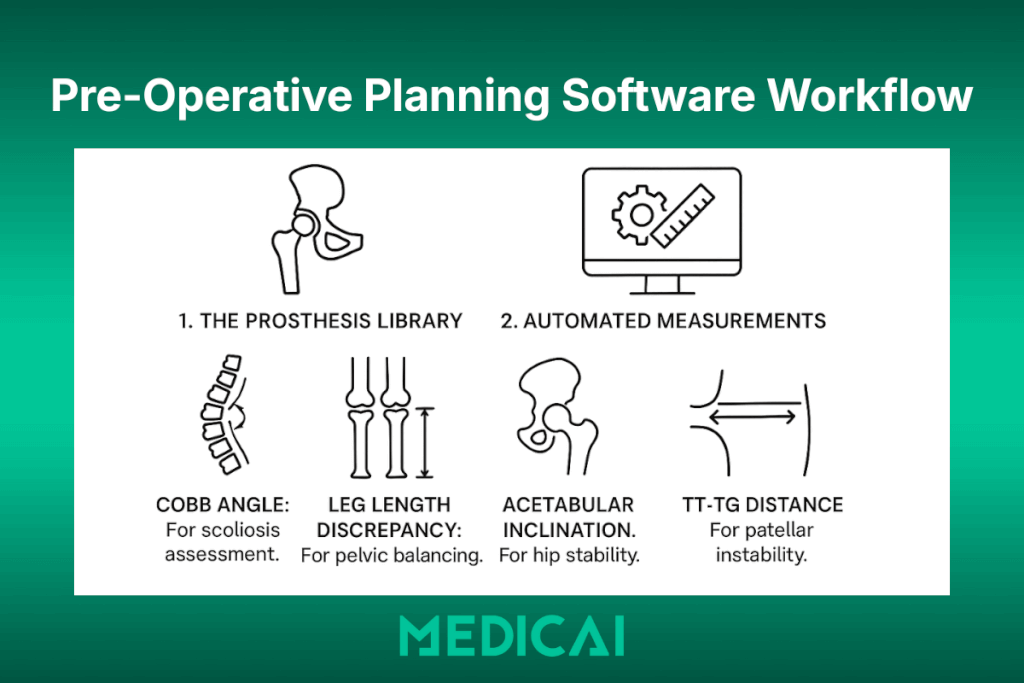
1. The Prosthesis Library
A robust planning suite connects to a cloud-based library of implant manufacturers (Stryker, DePuy, Zimmer Biomet, etc.). This ensures that the surgeon has access to the latest templates without manual updates.
2. Automated Measurements
Beyond implants, orthopedic surgeons need specific geometric measurements that generic viewers make difficult:
- Cobb Angle: For scoliosis assessment.
- Leg Length Discrepancy: For pelvic balancing.
- Acetabular Inclination: For hip stability.
- TT-TG Distance: For patellar instability.
An Ortho-ready viewer allows these measurements to be saved as a “Planning Layer” on top of the DICOM image, separate from the diagnostic report.
The Operational ROI: Why It Matters to the Administrator
For the Practice Manager or CIO, investing in Orthopedic digital planning delivers measurable ROI:
- Reduced Inventory Waste: By knowing the exact implant size beforehand, the hospital doesn’t need to open (and potentially waste) multiple trial sizes in the OR.
- Shorter Surgery Times: A surgeon with a solid pre-operative plan spends less time sizing and measuring while the patient is under anesthesia.
- Surgeon Satisfaction: Providing tools that mirror the surgeon’s mental workflow acts as a powerful retention tool.
The Medicai Advantage: Bringing the Plan to the O.R.
The biggest limitation of legacy on-premise Ortho PACS is access. Planning often takes place in the clinic office, but the surgery is performed in the hospital OR.
Medicai bridges this gap through its Cloud-Native VNA Architecture.
1. Plan Anywhere, View Anywhere
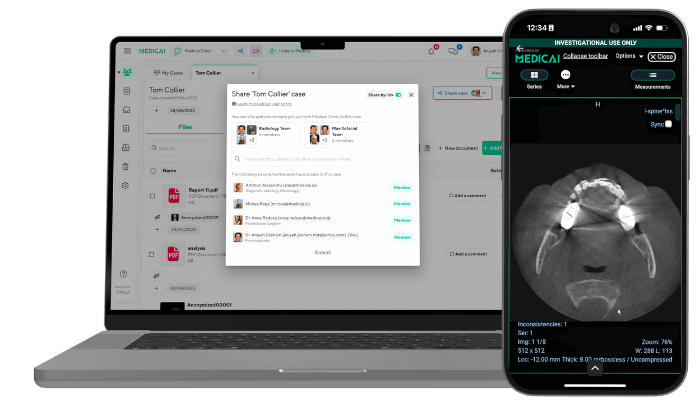
With Medicai’s Zero-Footprint Viewer, a surgeon can perform their digital templating on a desktop in their private clinic, save the plan, and then instantly pull up the same plan on an iPad or a wall monitor in the hospital Operating Room. No VPNs, no thumb drives.

2. Interoperability with Specialized Suites
Medicai acts as the central Image Backbone. Because we use open standards (DICOMweb), we integrate seamlessly with advanced third-party AI planning suites and robotic surgery platforms. We handle storage, calibration, and delivery of the image, ensuring your specialized tools receive high-quality data.
3. Sharing with Reps
Device representatives often need to review X-rays to ensure the correct kit is delivered to the OR. Medicai’s secure Sharing Portal allows surgeons to send a secure, time-limited link to the device rep, ensuring everyone is prepared for surgery day without violating HIPAA.
Conclusion
Orthopedics is a discipline of precision. Your imaging software should match that standard. If your surgeons are still holding plastic rulers up to computer screens, it is time to upgrade.
Equip your surgeons with the right tools. Move to a PACS that understands the difference between Diagnosis and Reconstruction. Contact Medicai today to see how our cloud platform supports the modern orthopedic workflow.


Related Articles


Lets get in touch!
Learn more about how Medicai can help you strengthen your practice and improve your patients’ experience. Ready to start your Journey?
Book A Free Demo