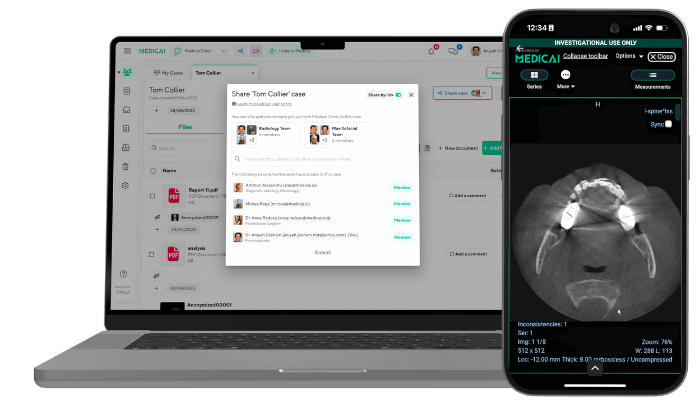
Integrated web-based DICOM viewer: Reasons to choose Medicai
DICOM, or the Standard for Digital Imaging and Communication in Medicine, started to be developed in 1983 when ACR (American College of Radiology) and NEMA (National Electrical Manufacturers Association) allied to fulfill the needs of radiologists, physicists, and equipment vendors.
Decoding the images exported by medical imaging modalities, such as CT and MRI, took a lot of work for everyone apart from manufacturers. The first Standard version was named ACR-NEMA 300 in 1985. In 1993, after three more iterations of ACR-NEMA 300, the new Standard released was named DICOM and it utilized local area networks like Ethernet.
What is a DICOM viewer?
A DICOM viewer is a tool that allows doctors to see medical images (DICOM files) exported by modalities or machines (CT, X-ray, MRI,…). This tool can be accessed by a downloadable application (Desktop version) or online in a web-based platform (Web version). You can see a PACS as the memory of your smartphone, then the DICOM images would be the “picture.jpg,” and the DICOM viewer would be the app that allows you to see the picture.
The significant advantage of a web version is that it will save doctors time by eliminating the need to install desktop DICOM viewer applications on local PCs. It is convenient while doctors are on the go and away from their workstations.
Things to Consider for a Web-based DICOM viewer
Many free web-based DICOM viewers in the market allow doctors to upload, store, edit, centralize, share, anonymize and measure medical images. An ideal tool, should also have the component of managing the patient case with any additional health records securely and in-cloud.
In the following paragraph, we will focus on the essential particulars for a successful web-based DICOM viewer integration.
Connectivity & Security
A new integration in your system should make everyone’s life easier and not require additional changes to the initial infrastructure. An adequate integration should connect and sync current PACS/ VNA securely. Data should always be backed-up in case of any disaster and anonymized because of its sensitive character.
To be secure and covered regarding any loss or legal aspect, ensure your vendor offers HIPAA and GDRP compliance.
Storage
An important topic to consider for a new integration is how much you should pay and how simple is the access to your data. File sizes of images from different imaging modalities are:
- 131 KB/ image for MRI
- 524 KB/ image for CT Scan
- 262 KB/ image for UltraSound
- 442 KB/ image for Color Doppler
- Up to 18 MB/ image for Digital radiography
- 27 MB/ image for Digital mammography
- 30 MB/ image for Computed radiography
The vendor should lower the cost of long-term data storage and open the opportunity for business scalability. Also, operating with Petabytes of data will create data silos if the data is not stored in a single place and in a way that allows easy, complete, and granular access. How you archive and retrieve that data will significantly impact your cost.
Medicai
Medicai is a modern decentralized cloud-native infrastructure solution for medical imaging. It integrates with any existing infrastructure (PACS, VNA, imaging modalities) and unifies access to medical imaging or acts as a Cloud PACS solution.
It offers granular, remote, and fast access to patient data and secures any existing legacy systems offering GDPR and HIPAA compliance.
Medicai also offers an app and web-based end-to-end solution that enables doctors and patients to collaborate and access medical imaging from anywhere asynchronously. Doctors can share, manage, store patients’ cases, chat, and create video calls with patients or other doctors.
With the online DICOM Viewer, doctors can view imaging investigations in their Medicai account, directly from a web browser, from any device, anywhere. The DICOM viewer can display any MRI, CT, or PET-CT scan directly online.
If you’d like to test for yourself Medicai’s DICOM Viewer, please book a demo below or contact our sales team.

Related Articles



Lets get in touch!
Learn more about how Medicai can help you strengthen your practice and improve your patients’ experience. Ready to start your Journey?
Book A Free Demo