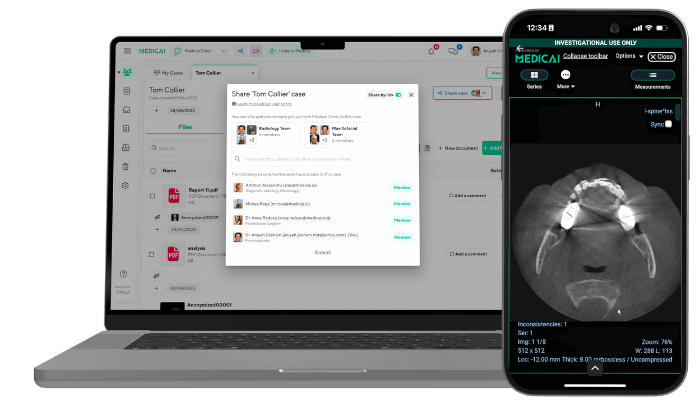
KI-gestützte Radiologie: Intelligenter strukturierter Bericht

Was wäre, wenn radiologische Berichte nicht nur Ergebnisse, sondern auch schnellere Entscheidungen und bessere Ergebnisse liefern könnten? Nun, KI-gesteuertes strukturiertes radiologisches Reporting (SRR) verspricht tatsächlich, dieses Ziel zu erreichen, wo fortschrittliche Technologie auf präzise Patientenversorgung trifft.
Im Jahr 2022 verwendeten 77 % der Radiologen und überweisenden Ärzte strukturiertes Reporting (SR). Jetzt wird KI beim strukturierten radiologischen Reporting angewendet.
KI-gesteuertes SRR nutzt intelligente Automatisierung, um standardisierte, fehlerfreie radiologische Berichte zu erstellen. Die Integration strukturierter Vorlagen mit KI-Einsichten optimiert Arbeitsabläufe, verbessert die diagnostische Genauigkeit und fördert nahtlose Zusammenarbeit im Gesundheitswesen.
Ergreifen Sie den nächsten Schritt in der radiologischen Innovation und entdecken Sie, wie KI-gestütztes SRR Ihren Berichterstattungsprozess revolutionieren und die Patientenversorgung verbessern kann.

Was ist strukturiertes radiologisches Reporting (SRR)?
Strukturiertes radiologisches Reporting (SRR) erstellt systematisch radiologische Berichte mithilfe vordefinierter Vorlagen und strukturierter Formate. Es ersetzt freie, narrative Berichterstattung durch eine organisiertere Methode, die Konsistenz, Klarheit und Standardisierung in Berichten gewährleistet.
Tatsächlich sind Radiologen und überweisende Ärzte mit SRR zufriedener als mit Freitextberichten (FTR), insbesondere bei Trauma-CT, fokussierter Beurteilung mit Ultraschall bei Trauma (FAST) und Prostata-MRT.
Jedes in dem radiologischen Bericht dokumentierte Merkmal, z.B. der Grund für den Test, die Patientenanamnese, das Verfahren, die Technik, die Befunde, der Eindruck (die Zusammenfassung der Befunde durch den Radiologen, einschließlich möglicher Ursachen) und Empfehlungen, ist in jedem SRR enthalten. Die Daten sind jedoch in einem standardisierten Muster integriert, um bessere Klarheit und medizinische Kommunikation zu gewährleisten.
SRR zielt darauf ab, die Qualität und den Nutzen von radiologischen Berichten zu verbessern, was sowohl Radiologen als auch dem breiteren Gesundheitsökosystem zugutekommt.
Die Hauptmerkmale von SRR umfassen-
- Standardisierung: Vordefinierte Vorlagen gewährleisten konsistente Berichtstrukturen unter Radiologen und verbessern die Einbeziehung kritischer Informationen und die Integration mit EMRs und RIS.
- Klarheit: SRR stellt Befunde und Empfehlungen klar und präzise dar, minimiert Fehlinterpretationen durch überweisende Ärzte und sorgt für ein schnelles Verständnis der wichtigsten Erkenntnisse.
- Verbesserte Kommunikation: Das strukturierte Format von SRR verbessert die Kommunikation zwischen Radiologen und Gesundheitsdienstleistern durch die Verwendung standardisierter Sprache, was die Berichte in interdisziplinären Kontexten leserlicher und umsetzbarer macht.
- Datenintegration: SRR integriert sich in Gesundheitssysteme wie PACS und EMRs, was den Datenaustausch und die Abfrage für einen effektiveren Zugriff auf radiologische Daten vereinfacht.
Darüber hinaus verbessert SRR die Interoperabilität zwischen verschiedenen Plattformen durch die Erstellung strukturierter Daten und ermöglicht damit fortgeschrittene Analysen und Forschung.
Strukturierte Berichte erfüllen auch unmittelbare klinische Bedürfnisse und verbessern die langfristige Gesundheitsversorgung, indem sie Bevölkerungsstudien und KI-Training unterstützen.
Strukturiertes Reporting: Ein Schlüssel zur Verringerung von Burnout und Verbesserung der Patientenversorgung
Radiologen in Nordamerika kämpfen mit einer ständig steigenden Arbeitslast. Ihre Rollen haben sich erheblich erweitert, von der Interpretation komplexer Bildgebungsstudien bis hin zur Verwaltung administrativer Aufgaben.
Diese vielschichtige Nachfrage, verstärkt durch Personalmangel und ein wachsendes Volumen an fortgeschrittenen Bildgebungsstudien, trägt zu etwa 49 % Burnout in der Branche.
Burnout, gekennzeichnet durch emotionale Erschöpfung und reduzierte Effizienz, wirkt sich auf das Wohlbefinden der Radiologen aus und kann die Qualität der Patientenversorgung gefährden.
Auswirkungen des strukturierten Reportings auf Radiologen
Strukturiertes Reporting verbessert die Effizienz und verringert die kognitive Belastung der Radiologen, indem es standardisiert, wie diagnostische Informationen dokumentiert und geteilt werden.
Im Gegensatz zu traditionellen Freitextberichten verwenden strukturierte Berichte vordefinierte Vorlagen, die Konsistenz, Genauigkeit und Klarheit gewährleisten.
Für Radiologen bedeutet dies eine schnellere Berichterstellung, weniger Unklarheiten und reduzierte Zeit für sich wiederholende Aufgaben.
Studien haben gezeigt, dass strukturiertes Reporting die Bearbeitungszeiten für Bildgebungsstudien erheblich verbessern kann, sodass Radiologen sich stärker auf kritische diagnostische Aufgaben und Patienteninteraktionen konzentrieren können.
Verbesserung der Patientenversorgung
Strukturiertes Reporting kommt auch Gesundheitsdienstleistern zugute, indem es die Kommunikation unter den Pflegeteams verbessert. Klare, standardisierte Berichte verringern das Risiko von Fehlinterpretationen und erleichtern rechtzeitige und genaue Behandlungsentscheidungen. Dies verbessert die Patientenergebnisse und stärkt das Ansehen der Gesundheitseinrichtungen.
Die Einführung von strukturiertem Reporting steht im Einklang mit umfassenderen Zielen für betriebliche Effizienz und Qualitätsverbesserung für Gesundheitsmanager. Mit optimierten Arbeitsabläufen und besserer Ressourcennutzung wird es möglich, das Burnout des Personals anzugehen, während eine hochwertige Patientenversorgung sichergestellt wird.
Wie KI strukturiertes radiologisches Reporting verbessert?
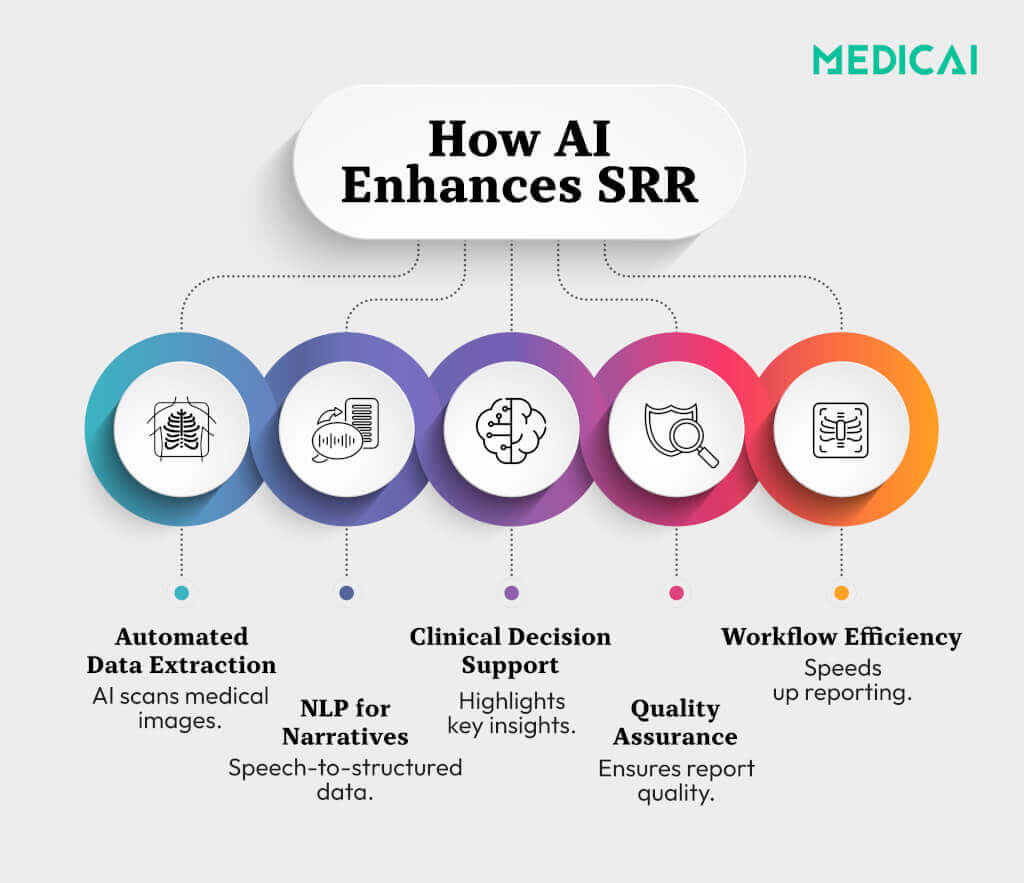
Künstliche Intelligenz (KI) transformiert strukturiertes radiologisches Reporting (SRR), indem sie Arbeitsabläufe automatisiert, Fehler reduziert und die Effizienz verbessert.
Automatisierte Datenerfassung
KI vereinfacht die Datenerfassung, indem sie Bilddaten analysiert, wie MRTs und Röntgenstrahlen, und strukturierte Vorlagen ausfüllt. So ist eine manuelle Eingabe nicht mehr notwendig, was zeitaufwendig und fehleranfällig ist.
Beispielsweise kann KI in der Mammographie Verkalkungen oder Massen erkennen und die Berichtsvorlagen automatisch mit genauen Messungen ausfüllen. Der Prozess spart Zeit und sorgt für Konsistenz und Genauigkeit.
Die Automatisierung der Datenerfassung hilft Radiologen auch, sich auf die Interpretation statt auf administrative Aufgaben zu konzentrieren. Dadurch wird die Berichterstellung beschleunigt und die Wahrscheinlichkeit verringert, kritische Informationen zu übersehen.
Medicai automatisiert Aufgaben für Radiologen und ermöglicht es ihnen, sich auf die Interpretation von Bildern zu konzentrieren. Dies beschleunigt die Erstellung von Berichten und verringert das Risiko, wesentliche Befunde zu übersehen.
Natürliche Sprachverarbeitung (NLP) im SRR
Natürliche Sprachverarbeitung (NLP) verbindet die Freitextberichterstattung und strukturierte radiologische Formate. Radiologen können ihre Befunde in einem gesprächigen Ton schildern, und NLP-Tools wandeln diese Narrative in strukturierte Vorlagen um.
Der Prozess stellt sicher, dass wichtige Erkenntnisse in einem konsistenten Format erfasst werden.
Mit NLP-Tools kann die Notfallradiologie diktierte Traumascannberichte verarbeiten und Begriffe wie „Fraktur“ oder „innere Blutung“ identifizieren und sie in vordefinierte Felder strukturieren.
Es kann auch verwendet werden, um retrospektiv Altberichte zu strukturieren und unstrukturierte Daten für Analysen und Forschung nutzbar zu machen.
Klinische Entscheidungsunterstützung
KI fungiert als diagnostischer Assistent, indem sie Bilddaten wie Röntgen- oder CT-Scans in Echtzeit analysiert und potenzielle Befunde vorschlägt. Sie hebt Anomalien hervor, die möglicherweise unbemerkt bleiben, wie subtile Frakturen oder frühzeitige Krankheiten.
Zum Beispiel kann KI in der Onkologie kleine Lungenknoten identifizieren, die auf eine frühe Krebserkrankung hindeuten. Solche KI-gestützte Diagnosen fordern weitere Untersuchungen.
Diese zusätzliche Unterstützungsschicht kommt Radiologen zugute, insbesondere in Umgebungen mit hohem Volumen oder hohem Druck. Sie verringert diagnostische Fehler und sorgt dafür, dass kritische Befunde schnell gekennzeichnet werden.
Der kollaborative Ansatz hilft Radiologen, fundiertere Entscheidungen zu treffen, während sie ihre Rolle als endgültige Entscheidungsträger beibehalten.
Qualitätssicherung und Fehlerreduktion
KI verbessert die Qualitätskontrolle im SRR, indem sie sicherstellt, dass Berichte vordefinierten Standards entsprechen. Sie vergleicht den Inhalt von Berichten mit festgelegten Richtlinien und identifiziert fehlende oder inkonsistente Informationen.
Beispielsweise kann, wenn ein Bericht versäumt, kritische Tumordimensionen zu dokumentieren, KI in Medicai die Auslassung zur Aufmerksamkeit des Radiologen bringen.
Echtzeit-Fehlererkennung verringert die Variabilität zwischen Radiologen, was zu zuverlässigeren und standardisierten Berichten führt. Durch die Minimierung von Fehlern unterstützt KI auch die Einhaltung von gesetzlichen und akkreditierungsbezogenen Standards.
Verbesserte Workflow-Effizienz
KI optimiert die radiologischen Arbeitsabläufe, indem sie sich wiederholende Aufgaben automatisiert und die Berichterstellung strafft. Durch die Analyse von Bilddaten und das Vorbefüllen strukturierter Vorlagen reduziert KI erheblich die Zeit, die für die Erstellung von Berichten benötigt wird.
Außerdem verbessert KI bei Medicai die Zusammenarbeit zwischen Radiologen und überweisenden Ärzzten.
Strukturierte Berichte, die mit KI erstellt wurden, helfen Ärzten, die wichtigen Befunde und Empfehlungen leichter zu verstehen. Die nahtlose Integration mit PACS und EMRs verbessert zudem den Datenaustausch und die Interoperabilität.
Schnellere Berichterstattung, kombiniert mit verbesserter Kommunikation, stellt sicher, dass Patienten rechtzeitig Diagnosen und Behandlungspläne erhalten. Plattformen wie Medicai unterstützen radiologische Teams in Umgebungen mit hohem Volumen dabei, die Qualität bei gestiegenen Arbeitslasten aufrechtzuerhalten.
Vorteile des KI-gesteuerten strukturierten radiologischen Reportings
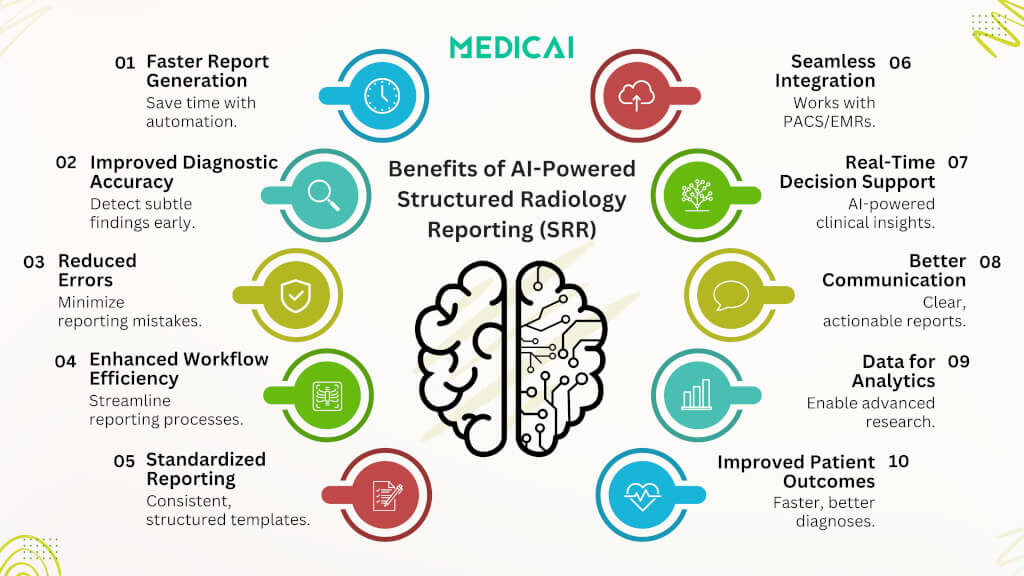
KI-gesteuertes strukturiertes radiologisches Reporting (SRR) transformiert das radiologische Ökosystem und bietet unvergleichliche Vorteile für Radiologen, Gesundheitsdienstleister und Patienten.
Vorteile für Radiologen
Radiologen spielen eine zentrale Rolle bei der Interpretation medizinischer Bilder und der Sicherstellung, dass Befunde genau kommuniziert werden. KI im SRR ist ein mächtiger Verbündeter, der Radiologen hilft, ihre zunehmenden Arbeitslasten zu bewältigen und gleichzeitig die Qualität ihrer Arbeit zu verbessern.
- Reduzierte Arbeitslast und Fokus auf komplexe Fälle: KI automatisiert Routineaufgaben wie Bildanalyse, Messberechnungen und das Ausfüllen von Berichtsvorlagen, sodass Radiologen sich auf die Interpretation komplexer Fälle konzentrieren können.
- Verbesserte Berichtstandardisierung und Qualität: KI standardisiert Berichte, indem sie sicherstellt, dass sie konsistenten Strukturen und Vorlagen folgen. Dies reduziert die Variabilität zwischen Radiologen und verbessert die Qualität und Klarheit der erfassten Informationen.
- Verbesserte Genauigkeit mit KI-Unterstützung: KI hebt subtile Befunde hervor, die diagnostische Fehler verringern und Radiologen helfen, auch unter anspruchsvollen Bedingungen eine hohe Genauigkeit aufrechtzuerhalten.
Vorteile für Gesundheitsdienstleister
Gesundheitsdienstleister, einschließlich überweisender Ärzte, sind auf radiologische Berichte für kritische Entscheidungsfindungen angewiesen. Daher profitieren sie immens von KI-unterstütztem SRR, einschließlich-
- Verbesserte Kommunikation mit klaren, umsetzbaren Berichten: Es präsentiert prägnante und organisierte Befunde, die es überweisenden Ärzten erleichtern, sie zu interpretieren, ohne lange Narrative durchforsten zu müssen.
- Nahtlose Integration mit EMR/PACS-Systemen: Es integriert sich nahtlos in EMRs und PACS, wodurch Anbieter auf radiologische Daten innerhalb der Patientenakten zugreifen können, was den Workflow und die Teamkoordination verbessert.
- Schnellere Bearbeitungszeiten für kritische Fälle: KI kennzeichnet kritische Befunde und beschleunigt die Berichterstellung, was eine zeitnahe Behandlung in Notfällen sicherstellt und die Patientenergebnisse verbessert.
Vorteile für Patienten
Patienten haben die meisten Vorteile von KI-gesteuertem SRR, da es sich direkt auf die Geschwindigkeit, Genauigkeit und Effizienz ihrer Diagnosen und Behandlungen auswirkt.
- Schnellere Diagnose- und Behandlungspläne: Die Automatisierung der Berichterstellung beschleunigt den radiologischen Workflow und ermöglicht eine schnellere Kommunikation der Befunde an die behandelnden Ärzte.
- Weniger Fehler und verbesserte Ergebnisse: Die Fähigkeit der KI, Anomalien hervorzuheben, Daten zu überprüfen und die Vollständigkeit von Berichten sicherzustellen, reduziert erheblich das Risiko von Fehldiagnosen oder übersehenen Befunden.
- Verbessertes Verständnis und Vertrauen: Strukturierte, KI-verbesserte Berichte sind für Patienten leicht verständlich, sodass sie ihre Diagnosen und Behandlungsoptionen umfassend nachvollziehen können.
SRR vs. traditionelle Berichterstattungsmethoden
Wie unterscheidet sich die traditionelle Berichterstattungsmethode vom KI-gestützten strukturierten radiologischen Reporting? Nun, lassen Sie es uns herausfinden.
| Merkmal | Traditionelle Berichterstattung | Strukturiertes radiologisches Reporting |
| Format | Narrative, freitextliche Art | Vordefinierte Vorlagen mit strukturierten Feldern |
| Konsistenz | Hochvariabel; hängt vom Radiologen ab | Standardisiert bei allen Nutzern |
| Klarheit | Kann mehrdeutigen oder übermäßig detaillierten Text enthalten | Klar, präzise und fokussiert |
| Zeitliche Effizienz | Es kann länger dauern, zu überprüfen und zu interpretieren | Schnell und einfach zu verstehen |
| Integration mit Systemen | Eingeschränkte Integration mit der Gesundheits-IT | Integriert sich nahtlos in PACS, EMRs usw. |
| Datenanalyse | Schwierig zu analysieren aufgrund unstrukturierter Daten | Strukturierte Daten ermöglichen fortgeschrittene Analysen |
| Fehlerreduzierung | Anfällig für Auslassungen oder Fehler | Reduziert Fehler mit Prüflisten-ähnlichen Vorlagen |
Herausforderungen des KI-gesteuerten strukturierten radiologischen Reportings
Die Implementierung von KI-gesteuertem strukturiertem radiologischem Reporting (SRR) hat Herausforderungen, die Sie angehen sollten, um ihr volles Potenzial zu erreichen.
Interoperabilitätsprobleme
Eine der wichtigsten Herausforderungen bei der Implementierung von KI im SRR ist die Integration mit bestehenden Gesundheitssystemen. Radiologieabteilungen verwenden verschiedene Plattformen wie PACS, RIS und EMRs. Diese Systeme sind nicht immer so gestaltet, dass sie effektiv mit KI-Tools kommunizieren, was zu Kompatibilitätsproblemen führt.
Dieser Mangel an Interoperabilität kann zu fragmentierten Arbeitsabläufen, Ineffizienzen und Verzögerungen bei der Patientenversorgung führen.
Anbieter und Gesundheitseinrichtungen müssen offene Standards für den Datenaustausch priorisieren.
KI-Plattformen wie Medicai bieten nahtlose Integration mit bestehenden Systemen und sorgen dafür, dass Daten reibungslos zwischen Plattformen fließen, ohne die Arbeitsabläufe zu stören.
Voreingenommenheit in KI-Algorithmen
Die KI-Modelle können voreingenommene oder ungenaue Ergebnisse liefern, wenn die Trainingsdatensätze nicht vielfältig sind. Beispielsweise kann ein KI-Modell, das hauptsächlich mit Bilddaten aus einer bestimmten Population trainiert wurde, bei Patienten aus anderen demografischen Gruppen, wie Alter, Geschlecht oder Ethnie, unterperformen.
Voreingenommenheit kann schwerwiegende Folgen in der Radiologie haben und zu Fehldiagnosen oder ungleicher Behandlung führen.
Daher müssen KI-Modelle an großen, vielfältigen Datensätzen trainiert werden, die ein breites Spektrum an Populationen, Bildgebungsmodalitäten und Bedingungen repräsentieren. Eine kontinuierliche Überwachung und Validierung sind erforderlich, um zu verstehen und die Voreingenommenheit der KI-gesteuerten medizinischen Bildanalyse zu mildern..
Datensicherheit
Gesundheitsdaten sind ein primäres Ziel für Cyberangriffe, und jede Verletzung kann schwerwiegende Folgen haben, einschließlich rechtlicher Haftungen und Vertrauensverlust.
Die Implementierung fortschrittlicher Verschlüsselungstechniken zur Sicherung von Daten im Ruhezustand und während der Übertragung ist entscheidend.
Außerdem können regelmäßige Prüfungen und Compliance-Kontrollen sicherstellen, dass gesetzliche und regulatorische Standards eingehalten werden.
Medicai sorgt für Datensicherheit mit fortschrittlicher Verschlüsselung, sicherer Cloud-Infrastruktur und strengen Compliance-Protokollen zum Schutz von Patientendaten.
Adoptionsbarrieren
Der Einsatz von KI-Tools in der Radiologie erfordert Änderungen in den Arbeitsprozessen, was für Radiologen und Gesundheitsdienstleister herausfordernd sein kann. Viele Radiologen verlassen sich auf traditionelle Berichterstattung, sodass sie möglicherweise Widerstand gegen KI leisten aus Angst vor Arbeitsplatzverlust, reduzierter Vergütung durch die standardisierte Vergütung von Radiologen, oder Unkenntnis über die Technologie.
Schulung ist eine weitere bedeutende Barriere. Radiologen und Mitarbeiter müssen in der Lage sein, KI effektiv zu nutzen, ihre Einsichten zu interpretieren und sie in die tägliche Praxis zu integrieren. Ohne angemessene Schulung könnten die Vorteile von KI nur unzureichend genutzt oder missbraucht werden.
Maßgeschneiderte Schulungsprogramme für Radiologen, einschließlich praktischer Workshops und laufender Unterstützung, können hilfreich sein. Außerdem sollte eine kollaborative Kultur gefördert werden, in der Radiologen sich ermächtigt fühlen, mit KI zu arbeiten, anstatt sie als Bedrohung zu sehen.
Fazit
Das strukturierte radiologische Reporting (SRR), unterstützt von KI, verändert, wie Radiologen genaue, effiziente und standardisierte Versorgung leisten. Durch die Automatisierung von Arbeitsabläufen, die Reduzierung von Fehlern und die Verbesserung der Kommunikation ermächtigt KI-gestütztes SRR Radiologen, verbessert die Zusammenarbeit zwischen Gesundheitsdienstleistern und gewährleistet bessere Patientenergebnisse.
Plattformen wie Medicai stehen an der Spitze dieser Transformation, bieten nahtlose Integration, fortschrittliche Werkzeuge und sichere Systeme zur Neudefinition der modernen Radiologie.
Umarmen Sie die Zukunft der Radiologie mit Medicai – wo Innovation auf außergewöhnliche Patientenversorgung trifft.



Verwandte Artikel
Das Gespräch beginnen
Erfahren Sie mehr darüber, wie Medicai Ihnen helfen kann, Ihre Praxis zu stärken und die Patientenerfahrung zu verbessern. Sind Sie bereit, Ihre Reise zu beginnen?
Kostenlose Demo buchen