HL7 FHIR vs. V2 in Imaging: Why Your PACS Needs a Modern API

For over 30 years, healthcare interoperability has spoken one language: HL7 V2.
If you are a PACS Administrator, you know the drill. An order is placed in the EMR, an ORM message fires over a VPN tunnel, the RIS catches it, and eventually, an ORU message sends the result back. It is a “push-based” system, reliable, but rigid.
But as healthcare moves toward Enterprise Imaging and Patient-Centric Care, the limitations of V2 are becoming bottlenecks. The industry is shifting to HL7 FHIR (Fast Healthcare Interoperability Resources).
This isn’t just a version upgrade. It is a fundamental architectural shift from “Messaging” to “APIs.”
This guide explores the technical differences between HL7 V2 and FHIR in the context of medical imaging and why your next PACS must be FHIR-native. For the broader foundational coverage of HL7 standards including V2, V3, CDA, and FHIR, see the What Is HL7 guide.
The Old Way: HL7 V2 (The “Push” Model)
When comparing DICOM vs HL7, the HL7 V2 is an event-driven messaging standard. It works like a fax machine, sending digital text.
How it works in Radiology:
- Trigger Event: A doctor signs an order in Epic/Cerner.
- The Push: The EMR generates a pipe-delimited text string (e.g.,
MSH|^~&|EPIC|...). - The Blind Handshake: It sends this message to an Interface Engine (such as Mirth or Cloverleaf), which translates it and sends it to the PACS.
The Problem with V2 in 2025:
- No “Pull” Capability: If the PACS wants to know the patient’s creatinine level before a contrast CT, it can’t ask. It has to wait for the EMR to decide to send it.
- Data Silos: V2 messages are transactional. They don’t create a shared, longitudinal record; they just copy data from System A to System B.
- Integration Cost: Each new connection requires a custom point-to-point interface, which takes time and money.
The New Way: HL7 FHIR (The “API” Model)
FHIR (pronounced “Fire”) brings modern web technology (RESTful APIs, JSON, XML) to healthcare. It works like the internet.
How it works in Radiology:
Instead of waiting for a message, the PACS can actively “browse” the EMR’s data using standard web requests (GET, POST).
The FHIR Advantage:
- Query-Based (“Pull”): The PACS can actively query the EMR: “GET Patient/123/Observation?code=Creatinine.” The EMR responds instantly with the JSON data.
- Mobile Ready: FHIR is lightweight and designed for mobile apps, making it perfect for Zero-Footprint Viewers and patient portals.

- Granularity: You don’t need to ingest a massive patient record; you can request just the specific data points (Resources) you need.
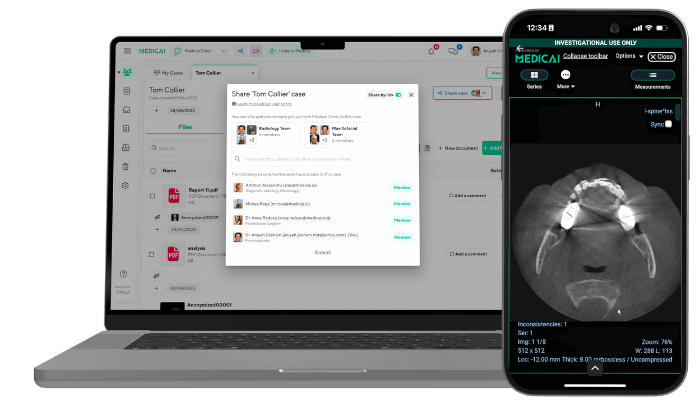
(Note: While this diagram represents cloud architecture, the concept of modern API connectivity within a hybrid environment is relevant here. A diagram specifically showing “Point-to-Point V2 vs. Centralized FHIR API” would be ideal if available in the future.)
FHIR vs HL7 V2: The Head-to-Head Comparison
The architectural differences between HL7 V2 and FHIR fall across seven dimensions that affect healthcare IT decision-making. The comparison below summarizes the practical differences healthcare leaders should weigh when evaluating integration strategies.
| Dimension | HL7 V2 | HL7 FHIR |
|---|---|---|
| Architecture | Event-driven messaging (push model) | RESTful API (pull model with push capability) |
| Format | Pipe-delimited text with structured segments and fields | JSON or XML resources accessed via REST endpoints |
| Year introduced | Late 1980s | 2014 |
| Flexibility | Rigid, requires interface engines (Mirth, Cloverleaf, Rhapsody) | Flexible REST API patterns familiar to modern developers |
| Imaging context | Standard for orders and results in legacy radiology systems | Essential for AI integration, mobile viewers, and patient portals |
| Data access pattern | Push: “Here is the data I sent you” | Pull: “What data do you need?” plus push capability for events |
| Regulatory status | Dominant in production hospital IT worldwide | Mandated by 21st Century Cures Act for certified EHR APIs |
Why FHIR Matters for Your Imaging Strategy
Why should a CIO care about the plumbing? Because FHIR unlocks workflows that V2 cannot handle.
1. Enabling AI and Machine Learning
AI algorithms need context. A V2 message tells the AI “Head CT.” A FHIR query allows the AI to look up the patient’s history: “Does this patient have a history of stroke?”
This context allows the AI to provide more accurate triage and diagnostic support. For broader coverage of how AI integrates with radiology workflows, see What Is DICOM which covers the imaging data standards AI systems work with alongside FHIR.
2. True Longitudinal Patient Records
With FHIR, the PACS doesn’t just store images. It becomes a window into the patient’s health. A radiologist viewing an X-ray can pull live lab values or pathology reports directly from the EMR into the PACS sidebar, without leaving their workflow.
3. Patient Portals and Image Sharing
Patients want to see their images on their phones. V2 cannot support this securely. FHIR integration allows patient-facing apps (like Apple Health) to securely authenticate and retrieve imaging reports and links to view images via DICOMweb.
The combined effect across these three workflows is that FHIR-native imaging infrastructure enables clinical and patient experiences that V2-only infrastructure cannot support. The capability gap drives healthcare organizations toward FHIR adoption regardless of regulatory pressure.

Medicai: Native FHIR for the Connected Enterprise
Medicai’s cloud imaging platform was built with FHIR and DICOMweb as native interfaces rather than translation layers. The implementation pattern matters because FHIR-native systems integrate differently from systems that translate V2 messages into FHIR resources on the fly.
Medicai supports the three core DICOMweb services (WADO-RS for imaging study retrieval, QIDO-RS for query, STOW-RS for storage) alongside FHIR resources including ImagingStudy, DiagnosticReport, ServiceRequest, and Patient. The combination lets imaging studies flow into EHR and EMR systems through standardized APIs without requiring custom point-to-point integration engineering for each connection.
The practical advantages for healthcare organizations include direct EMR integration via standard FHIR APIs rather than custom interface engine configurations, open API documentation that supports internal developers in building custom research tools or patient applications on top of the platform, and compliance with the 21st Century Cures Act information blocking requirements through native FHIR endpoint support.
For healthcare organizations evaluating cloud-native imaging infrastructure that handles HL7 V2, HL7 FHIR, and DICOMweb in a unified architecture, see Medicai’s imaging-EHR integration patterns.
Frequently asked questions about HL7 FHIR vs HL7 V2
HL7 V2 is a push-based messaging standard from the late 1980s using pipe-delimited text messages between hospital systems for orders, results, and patient registration. HL7 FHIR is a pull-based REST API standard from 2014 using JSON resources accessed via standard HTTP requests. V2 dominates operational hospital messaging; FHIR is mandated by the 21st Century Cures Act for certified EHR API access. Most healthcare environments in 2026 run both.
HL7 FHIR (Fast Healthcare Interoperability Resources) is the modern healthcare interoperability standard introduced in 2014 by Health Level Seven International. FHIR uses RESTful APIs with JSON or XML resources rather than the pipe-delimited messaging of V2. The specification defines resources for common healthcare data (Patient, Observation, DiagnosticReport, ImagingStudy, others) with REST endpoints supporting standard HTTP operations. FHIR is the technical foundation of patient portal APIs, third-party health apps, and TEFCA national exchange.
FHIR is replacing V2 for new healthcare integrations because of three structural drivers. First, regulatory pressure from the 21st Century Cures Act mandates FHIR APIs for certified EHRs. Second, patient empowerment use cases (patient portals, personal health apps) require API access that V2 push messaging cannot support. Third, modern cloud architectures expect REST APIs as the integration default. V2 remains operationally dominant for internal hospital messaging while FHIR handles new external integrations.
Yes. Most healthcare environments in 2026 run both standards in parallel. HL7 V2 handles real-time operational messaging including orders, results, and patient registration. FHIR handles API-based integration including patient portals, third-party app access, and cross-organizational data exchange. Cloud imaging platforms typically translate V2 messages into FHIR resources internally so the same data is accessible through both interfaces. The two standards complement rather than replace each other in modern healthcare IT architecture.
HL7 V2 messaging is event-driven push communication where sending systems generate messages on clinical events and push them to receiving systems. FHIR APIs are query-driven pull communication where systems expose resources that other systems request on demand via REST endpoints. The push model suits real-time clinical workflows like ordering and results. The pull model suits use cases like patient portal access where the requesting system does not know when data will be available and queries when needed.
Yes. HL7 V2 remains the dominant operational messaging standard in hospital interoperability worldwide. Approximately 95 percent of US hospitals run V2 messaging in production for real-time clinical workflows including EHR to RIS to PACS integration. V2 is not being replaced in the near term because the installed base is too large and the operational workflows depend on it. FHIR adoption complements V2 rather than replacing it, with both standards expected to coexist for the next decade or more.
HL7 V2 will remain operationally important through the next decade because of its installed base in hospital systems. New integrations are increasingly FHIR-first while V2 continues handling internal hospital workflows. The transition is layered rather than replacement: V2 for operational messaging, FHIR for APIs and external data exchange. Healthcare organizations should plan for continuing V2 investment alongside expanding FHIR capability rather than treating V2 as legacy to be replaced.
FHIR works with medical imaging through dedicated resources including ImagingStudy (which references imaging metadata stored in PACS), DiagnosticReport (which carries radiology reports), and ServiceRequest (which represents imaging orders). FHIR resources reference rather than store the imaging pixel data itself, which travels through DICOMweb interfaces (WADO-RS, QIDO-RS, STOW-RS). Modern cloud imaging platforms expose both FHIR and DICOMweb interfaces, letting clinicians access imaging studies and metadata through either API depending on the use case.
Conclusion: Building for the Connected Imaging Future
HL7 V2 has enabled healthcare interoperability for over 30 years and continues to operate in most hospitals today. But V2 was not built for the age of AI clinical decision support, cloud-native architecture, and patient-controlled mobile access.
Healthcare organizations building imaging infrastructure for the next decade need platforms that support both standards as native capabilities. V2 for real-time operational messaging that hospital workflows depend on. FHIR for API access, patient portals, AI integration, and cross-organizational data exchange that modern healthcare delivery requires. The question for healthcare leaders is not whether to adopt FHIR (regulatory pressure and clinical needs make adoption inevitable), but how to architect the migration so V2 and FHIR coexist effectively during the transition.
For the foundational coverage of HL7 standards, including V2 message types, FHIR resources, and clinical workflow integration, see the What Is HL7 guide. For broader healthcare interoperability context including standards, benefits, and implementation challenges, see Benefits and Challenges of Interoperability in Healthcare.


Related Articles
Lets get in touch!
Learn more about how Medicai can help you strengthen your practice and improve your patients’ experience. Ready to start your Journey?
Book A Free Demo