AI-Assisted Neuroimaging Analysis in Modern Psychiatry

Modern psychiatry is undergoing a technological revolution. Artificial intelligence is shifting diagnostic practices from subjective behavioral evaluations toward objective, data-driven biological phenotyping.
Data show that over 23% of American adults, roughly 59.3 million individuals, live with a mental illness. Deploying advanced deep learning models to analyze neuroimaging data helps clinicians uncover clear, reproducible markers of mental illness. This integration of medical imaging and predictive analytics bridges the gap between raw data and precise therapeutic interventions.
The Shift from Behavioral Nosology to Biological Phenotyping
Transforming Subjective Diagnostics into Quantifiable Metrics
Historically, psychiatric disorders were diagnosed purely through behavioral assessments. Today, AI helps translate these disorders into measurable, biological phenotypes. Psychiatric assessments suffered from high inter-rater variability due to their reliance on diagnostic manuals. Modern clinicians deploy deep learning models to process large datasets. These systems convert qualitative behavioral observations into clear, quantitative biological profiles.
AI changes how clinicians classify mental illness. Convolutional Neural Networks (CNNs) extract hierarchical features from complex, standard neuroimaging datasets. This processing captures micro-level brain alterations invisible to human evaluation. Advanced machine learning algorithms categorize phenotypic subtypes across major depressive disorder and schizophrenia. This categorization shifts psychiatry toward the data-driven model used in neurology.
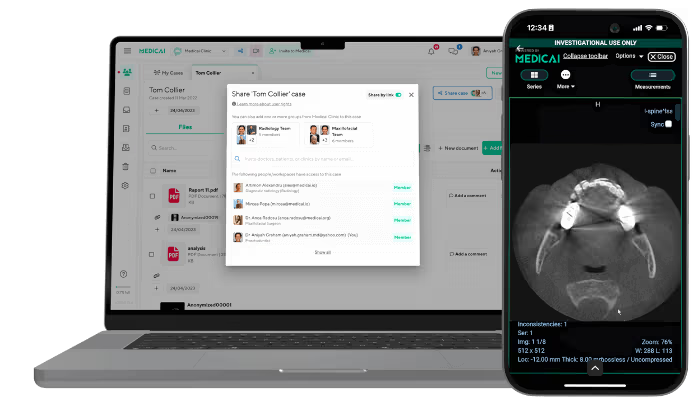
Medical imaging software platforms streamline multidisciplinary case management. Radiologists regularly process brain morphology data that directly influences psychiatric treatment pathways. Secure cloud platforms allow seamless sharing of diagnostic data with professionals who manage ongoing patient therapy and cognitive interventions.
Mapping Cortical Structures with Machine Learning
Structural MRI (sMRI) algorithms analyze cortical folding, gray matter volumes, and white matter tracts. This analysis detects subtle neurodevelopmental anomalies seen in conditions like schizophrenia. Specialized machine learning architectures calculate precise changes in cortical folding patterns. They also calculate local gray matter volume reductions.
Deep neural networks review diffusion tensor imaging (DTI) data to map disruptions in structural connectivity. This white matter tractography analysis helps identify early signs of schizophrenia. Algorithmic tools automatically measure hippocampal and prefrontal cortex volumes, which provide accurate quantitative metrics during patient intake workflows. Early tracking allows clinicians to deploy preventative therapies faster.
Technical Mechanization of Advanced Neuroimaging Modalities
Decoding Dynamic Functional Brain Networks
Functional MRI (fMRI) evaluates blood-oxygen-level-dependent (BOLD) signals. This evaluation maps functional brain connectivity networks to identify resting-state abnormalities in patients with Major Depressive Disorder (MDD). Machine learning models track variations in BOLD imaging to evaluate real-time regional brain activity. Advanced algorithms classify abnormalities within the default mode network and executive control networks.
Functional imaging produces large amounts of time-series data. Spatiotemporal neural networks process complex time-series data to isolate transient functional states linked to major depression. Artificial intelligence models find complex correlations within these blood-oxygenation maps to establish a patient’s functional connectome. The network maps expose hidden synchronization errors between distinct brain regions. For instance, the default mode network often shows hyper-connectivity during depressive episodes.
Signal Processing in Advanced Brain Wave Classification
Electroencephalography (EEG) analysis uses deep neural networks to process brain waves. This system reviews alpha and beta band powers to classify conditions such as treatment-resistant depression with over 90% accuracy. EEG offers exceptional temporal resolution to capture immediate neural activity. Computational algorithms measure alpha and beta power bands to capture real-time neurophysiological anomalies.
Deep learning pipelines analyze non-linear wave patterns across multi-channel arrays. Deep neural networks remove environmental noise and muscle movement artifacts from these signal streams. By analyzing these clean brainwave frequencies, optimized machine learning classifiers achieve diagnostic accuracy scores over 90% when identifying specific neural phenotypes. Digital classifiers map wave patterns within seconds, providing objective biological confirmation.
High Value Clinical Applications and Precision Psychiatry
Resolving Differential Diagnosis Challenges at First Episode
Modern psychiatry is moving toward precision medicine, and AI imaging is at the center of this shift. AI algorithms have demonstrated pooled diagnostic accuracy ranging from 84% to 97% in distinguishing complex conditions.
Supervised machine learning models can differentiate bipolar disorder from unipolar major depressive disorder using verified pooled accuracy rates. They separate Bipolar Disorder from Unipolar MDD, which represents a common diagnostic challenge at the first episode.
Misdiagnosis often leads to incorrect medication choices that can inadvertently trigger manic episodes. Advanced diagnostic platforms solve this issue by identifying specific structural and functional patterns. To maximize diagnostic certainty, machine learning systems combine imaging biomarkers with non-imaging clinical data.
Academic curricula in universities or accredited online clinical mental health counseling programs increasingly emphasize data-driven clinical decision-making. These advanced programs prepare modern therapists to properly interpret objective radiological insights during patient intake and monitoring workflows.
This interdisciplinary training helps clinicians reduce initial diagnostic mistakes. American International College notes that CACREP-aligned curricula integrate DSM diagnostic evaluations alongside evidence-based clinical practices to minimize intake errors.
Personalizing Therapeutic Interventions and Managing Treatment Selection
By analyzing brain biomarkers before treatment initiation, predictive AI models can determine patient responses. They reveal which individuals are most likely to respond to specific antidepressants or cognitive behavioral therapy (CBT).
This predictive filtering reduces the duration of trial-and-error prescribing. Psychiatric prescribing historically relied on a lengthy process of trial and error. Predictive artificial intelligence platforms change this approach by analyzing pretreatment biomarkers.
Systems evaluate baseline functional connectivity and structural volumes to forecast medication reactions. This targeted selection avoids ineffective treatments. Automated patient stratification matches individuals with targeted treatments, shortening the path to clinical recovery.
Longitudinal Prognosis and Early Risk Stratification
Longitudinal data coupled with AI can model trajectories of illness. This modeling allows clinicians to screen for at-risk mental states. It also predicts the likelihood of future substance abuse or cognitive decline.
Evaluating a patient’s current mental state provides only a snapshot of their health. Longitudinal artificial intelligence models process multi-year imaging datasets. Trajectory modeling frameworks analyze historical patient data to map the long-term progression of chronic psychiatric conditions.
Advanced screening tools review neuroimaging data to identify individuals showing early signs of prodromal psychosis. Predictive algorithms detect specific neurobiological vulnerabilities to calculate a patient’s risk for future substance use disorders. Early intervention becomes possible when computers flag predictive markers.
Technical Bottlenecks and Future Frameworks
Overcoming the Black Box Limitation with Explainable AI
While AI offers significant enhancements, it currently acts as an adjunct tool rather than a replacement for clinical judgment. System implementations still face a few hurdles, particularly algorithmic transparency. The “black box” nature of deep learning makes it difficult for clinicians to interpret exactly why a model reached a specific conclusion.
This clinical obscurity creates an urgent need for explainable AI (XAI). Explainable artificial intelligence frameworks reveal the underlying mathematical logic behind complex algorithmic decisions.
Integrated gradient methods generate heatmaps directly on brain images to highlight the exact anatomical regions driving a diagnosis. Visual attention maps create precise anatomical heatmaps. Transparent workflows give physicians clear, visual justifications for automated findings, ensuring human-in-the-loop oversight.
Data Privacy and Generalizability Across Multicenter Networks
System implementations still struggle with data privacy and generalizability. Models require larger, multi-centric datasets across diverse populations to prevent bias. Broad demographic samples ensure models work accurately across different geographic locations and hospital machines. Artificial intelligence models often lose accuracy when deployed on unfamiliar hardware, while scanner variations corrupt automated calculations.
Overcoming this requires strict data standardization protocols to eliminate variance between scanner manufacturers. Additionally, federated learning frameworks train models on decentralized datasets without moving sensitive patient files. Distributed machine learning architectures preserve patient confidentiality, whereas training models on diverse, international datasets ensures high diagnostic accuracy across varied populations.
As Professor Hongyan Zheng and Dr. Xizhe Zhang note in a publication on Frontiers in Public Health, contemporary medical training programs must evolve through systematic curricular redesign. Incorporating computational and data science competencies ensures future physicians can safely manage these distributed networks.
Frequently Asked Questions
What technologies are used for AI imaging analysis in psychiatry?
The technologies currently used for AI imaging analysis in psychiatry are:
- Clinics use Convolutional Neural Networks (CNNs) to extract structural features from neuroimaging files.
- Recurrent Neural Networks (RNNs) and spatiotemporal architectures analyze functional time-series data from fMRI scans.
- Cloud-native DICOM web viewers stream high-resolution neuroimaging data directly to computational pipelines.
- Algorithms process blood-oxygen-level-dependent (BOLD) signals to map functional connectivity. Machine learning toolkits also handle artifact removal in Electroencephalography (EEG) signal processing arrays.
What are the limitations of AI imaging in psychiatry?
Due to the “black box” nature of deep learning models, clinicians cannot easily trace the mathematical path to a diagnosis. Data variability between different MRI scanner brands also degrades algorithmic performance.
Small training datasets create demographic biases that reduce generalizability across diverse populations. Finally, current systems require massive computational power, complicating local deployment in under-resourced hospitals.
What types of images are analyzed in psychiatric AI?
AI platforms analyze structural MRIs (sMRI) to evaluate grey matter volume and cortical folding. Functional MRIs (fMRI) track dynamic brain connectivity via blood-oxygenation variations. Diffusion Tensor Imaging (DTI) maps white matter tractography to identify structural circuit damage. Additionally, systems process multi-channel electroencephalography (EEG) data to classify real-time electrical brainwave frequencies.
How accurate is AI imaging analysis in psychiatry?
Supervised machine learning models achieve a pooled diagnostic accuracy between 84% and 97% when distinguishing bipolar disorder from major depression. Deep learning architectures process clean EEG brainwave frequencies to identify treatment-resistant depression with over 90% accuracy. However, performance can drop when models encounter data from unfamiliar hospital scanners.
Psychiatric AI Metrics and Technologies
| U.S. Mental Health Burden | Over 23% of American adults (approximately 59.3 million individuals) live with a mental illness. |
| Structural MRI (sMRI) | Convolutional Neural Networks (CNNs) extract hierarchical features to analyze gray matter volumes and cortical folding. |
| White Matter Tractography | Deep neural networks process Diffusion Tensor Imaging (DTI) data to map structural connectivity disruptions. |
| Functional MRI (fMRI) | Spatiotemporal networks evaluate blood-oxygen-level-dependent (BOLD) signals to map resting-state circuit abnormalities. |
| EEG Signal Classification | Deep learning pipelines process alpha and beta band powers to identify treatment-resistant depression with over 90% accuracy. |
| Differential Diagnosis | Supervised machine learning models achieve 84% to 97% pooled diagnostic accuracy distinguishing Bipolar Disorder from Unipolar MDD. |
| Precision Interventions | Predictive analytics evaluate baseline imaging markers to forecast response to specific antidepressants or cognitive behavioral therapy. |
| Technical Bottlenecks | Implementations face deep learning “black box” limitations, scanner hardware variations, and localized demographic data biases. |
| System Solutions | Explainable AI (XAI) using integrated gradient heatmaps clarifies logic, while federated learning frameworks protect multi-centric data privacy. |
Conclusion
AI-assisted neuroimaging analysis marks a paradigm shift toward precision medicine in behavioral healthcare. Despite structural bottlenecks like algorithmic transparency and data privacy, technologies like explainable AI and federated learning pave a sustainable path forward. Integrating these objective platforms enhances diagnostic accuracy, personalizes therapy selection, and fundamentally improves long-term patient outcomes.

Related Articles



Lets get in touch!
Learn more about how Medicai can help you strengthen your practice and improve your patients’ experience. Ready to start your Journey?
Book A Free Demo