Top 10+ AI Solutions for Transforming Diagnostics Today
Picture a world where diseases are detected early, radiologists and pathologists have advanced tools to identify hidden issues, and rapid diagnostics save lives daily.
…That world is no longer a vision of the future—thanks to AI for medical diagnosis, it’s happening now.
From identifying critical abnormalities in seconds to streamlining entire workflows, diagnostic AI empowers healthcare professionals to deliver smarter, faster, and more personalized care.
As AI-generated visuals become more common online, researchers and medical teams may also rely on a reliable AI image detector to verify whether an image is authentic or artificially generated before using it as a reference or for analysis.
But which artificial intelligence healthcare solution companies are leading this transformation?
The AI Diagnostic Landscape: Best-in-Class Vendors for Medical Diagnosis
There is no single “best” AI solution for medical diagnosis. Instead, the leading vendors have developed highly specialized tools that excel in distinct areas—from advanced image analysis for clinicians to user-friendly symptom checking for patients. Crucially, all these systems are designed to assist, not replace, human medical professionals.
Here is a breakdown of the key AI players revolutionizing the diagnostic process:
For Medical Professionals: Clinical Decision Support & Deep Analysis
These tools integrate into clinical workflows to help doctors analyze complex data and high-volume medical images with unparalleled speed and precision.
| Vendor / Model | Core Specialization | Key Function |
| Google Health (Med-PaLM/MedLM) | Large Language Models (LLMs) | Provides expert-level accuracy on medical questions; foundational models for various clinical applications. |
| PathAI | Digital Pathology | Uses machine learning to analyze tissue samples (e.g., cancer slides) with greater speed and diagnostic precision than manual review. |
| Viz.ai | Medical Imaging & Care Coordination | Analyzes CT scans and other images to rapidly detect time-sensitive conditions (like stroke/PE) and automatically alert the appropriate care team. |
| Merative (formerly IBM Watson Health) | Data Management & Predictive Analytics | Employs NLP to extract key insights from vast patient records, supporting complex clinical decision-making. |
| Consensus AI | Medical Literature Review | Specialized search engine that summarizes scientific consensus from millions of research papers for fast, evidence-based clinician support. |
For Patient Use: The Symptom Checkers
These applications serve as intelligent health assistants, providing preliminary assessments and guidance on whether to seek professional care.
| Vendor | Primary Use | Core Benefit |
| Ada Health | Symptom Assessment & Triage | Uses a vast, AI-based knowledge base to analyze user symptoms and suggest potential conditions with high reported accuracy. |
| Babylon Health | Symptom Check & Telemedicine | Offers AI-powered symptom checking and integrates with the option for live video consultations with licensed doctors. |
| Buoy Health | Symptom Check & Actionable Recommendations | Developed on extensive clinical data to give users preliminary assessments and guidance on next steps (e.g., self-care, urgent care). |

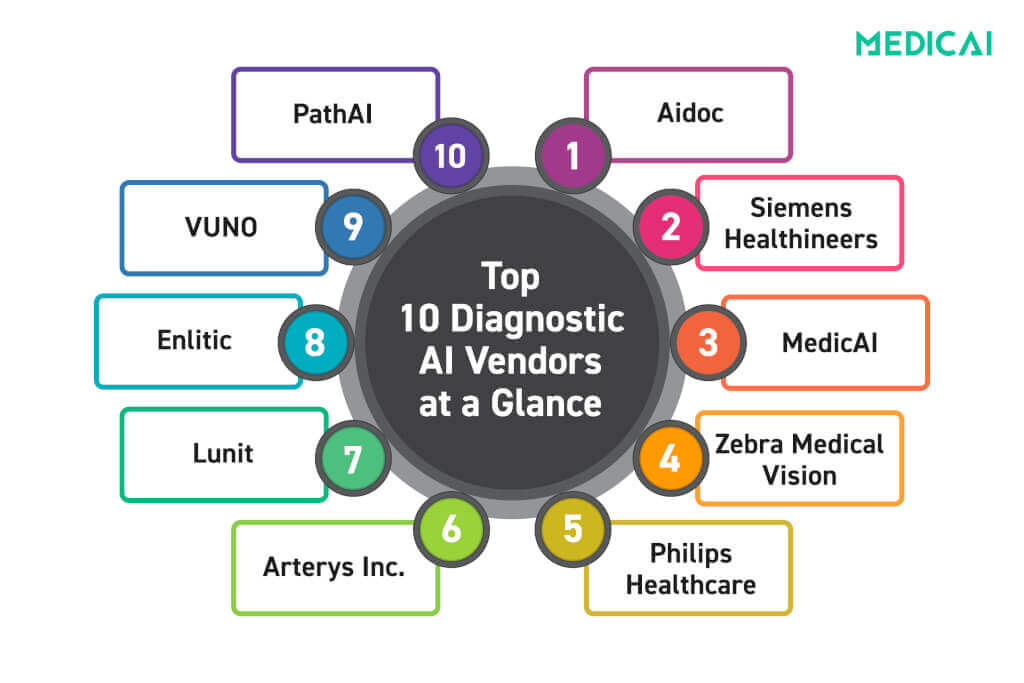
The Top 10+ AI Diagnosis Vendors Transforming Healthcare
Artificial Intelligence (AI) has become a transformative technology in healthcare, revolutionizing diagnostics. Its capacity to analyze complex medical data with unmatched speed and accuracy makes it essential for providers.
AI helps detect abnormalities in imaging, predict patient outcomes, and optimize workflows, enabling clinicians to deliver faster, more personalized care.
Let’s explore the 10 top medical AI companies that can change your healthcare experience.
Medicai
Founded in the early 2020s, Medicai was born out of a pressing need for smarter, more efficient healthcare solutions. Its mission is simple but impactful: to bridge the gap between advanced technology and everyday clinical practice as an AI medical diagnosis company.
Medicai has carved out a niche in the competitive AI healthcare market in just a few years. Through strategic partnerships with hospitals and healthcare organizations, Medicai has expanded its reach and demonstrated its value in real-world clinical settings.
Its suite of AI-driven tools is designed to assist healthcare professionals in various applications. These solutions enhance diagnostic precision, help predict patient outcomes, and personalize treatment plans in fields ranging from radiology to genomics.
Let’s check Medicai’s key AI diagnostic tools and platforms:
- Computer-Aided Detection (CAD): A core AI for diagnostics feature that automatically identifies and highlights suspicious regions in medical images.
- Tumor Segmentation: Advanced AI algorithms enable precise tumor segmentation, providing detailed measurements of tumor size, growth rates, and therapy responses.
- Workflow Optimization: Automates repetitive tasks, such as sorting and prioritizing images, preprocessing data, and generating preliminary reports.
- Real-Time Reporting Assistance: The AI Co-Pilot feature automates dictation and drafting medical reports in real time.
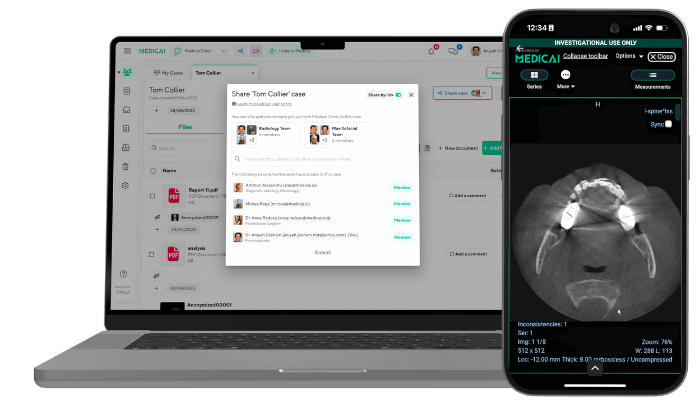
- Cloud Infrastructure Integration: Medicai’s cloud platform provides secure access to imaging data and enables collaboration via a web-based DICOM Viewer for analysis anytime, anywhere.
- Predictive Modeling and Analytics: Medicai uses predictive analytics to forecast disease progression, positioning it as a leading source of medical diagnosis software insights.
Medicai understands that technology should fit seamlessly into existing healthcare workflows. That’s why its solutions integrate effortlessly with EHR and other hospital information systems. This ensures clinicians can access AI insights without disrupting their processes.
Additionally, their intuitive interfaces make the platform easy to navigate, even for those new to AI.

Docus AI
Docus AI is the first AI layer built specifically for diagnostic laboratories. The platform turns lab test results into doctor-ready AI clinical reports and clear, patient-friendly explanations, helping both clinicians and patients better understand complex lab data. By connecting lab data, clinicians, and patients in one workflow, Docus enables a more complete end-to-end diagnostic experience.
Its AI-driven solutions are designed to support laboratory workflows and improve both clinical efficiency and patient understanding. Key capabilities include:
- Doctor-Ready AI Clinical Reports: Converts lab test results into structured clinical reports with clinical context, differential diagnosis, and follow-up test suggestions.
- Patient-Friendly Explanations: Translates complex lab findings into clear, easy-to-understand insights for patients.
- AI Medical Assistant: Supports deeper exploration of lab results, trends, and related health questions.
- Follow-Up Testing Support: Suggests timely follow-up tests and reminders to support continuity of care.
- End-to-End Lab Experience: Connects laboratory data, clinicians, and patients within a single workflow.
Docus AI is designed to integrate seamlessly into existing laboratory and healthcare systems, allowing labs to enhance diagnostic value without disrupting established processes.
Aidoc
Aidoc is a leading radiology AI company, transforming radiology with diagnostic AI that enhances speed, accuracy, and reliability for healthcare professionals. Founded in 2016 in Tel Aviv, Israel, Aidoc aims to streamline radiology workflows and address significant healthcare challenges to save lives.
The vendor aims to harness artificial intelligence to enhance radiology’s speed and effectiveness. Aidoc is dedicated to transforming the field and is trusted by over 900 hospitals, including Cedars-Sinai Medical Center and Yale New Haven Hospital.
Aidoc’s AI solutions work silently yet powerfully behind the scenes, analyzing medical imaging to detect acute abnormalities in real-time. These include:
- AI for neurology imaging, such as brain hemorrhages
- AI for pulmonology, such as pulmonary embolisms
- AI for orthopedy, such as cervical fractures
- Intra-abdominal free gas
This diagnostic AI vendor’s priority-based triage system acts like an always-alert assistant, continuously reviewing imaging data and flagging urgent cases. This “Always-on AI” simplifies radiologists’ work, helps prevent missed diagnoses, and prioritizes critical patients.
Aidoc’s AI algorithms boast 93% sensitivity rates for detecting pulmonary embolisms. That level of accuracy inspires confidence and saves lives. Hospitals using Aidoc’s solutions have also reported a 30% reduction in turnaround time for critical cases.
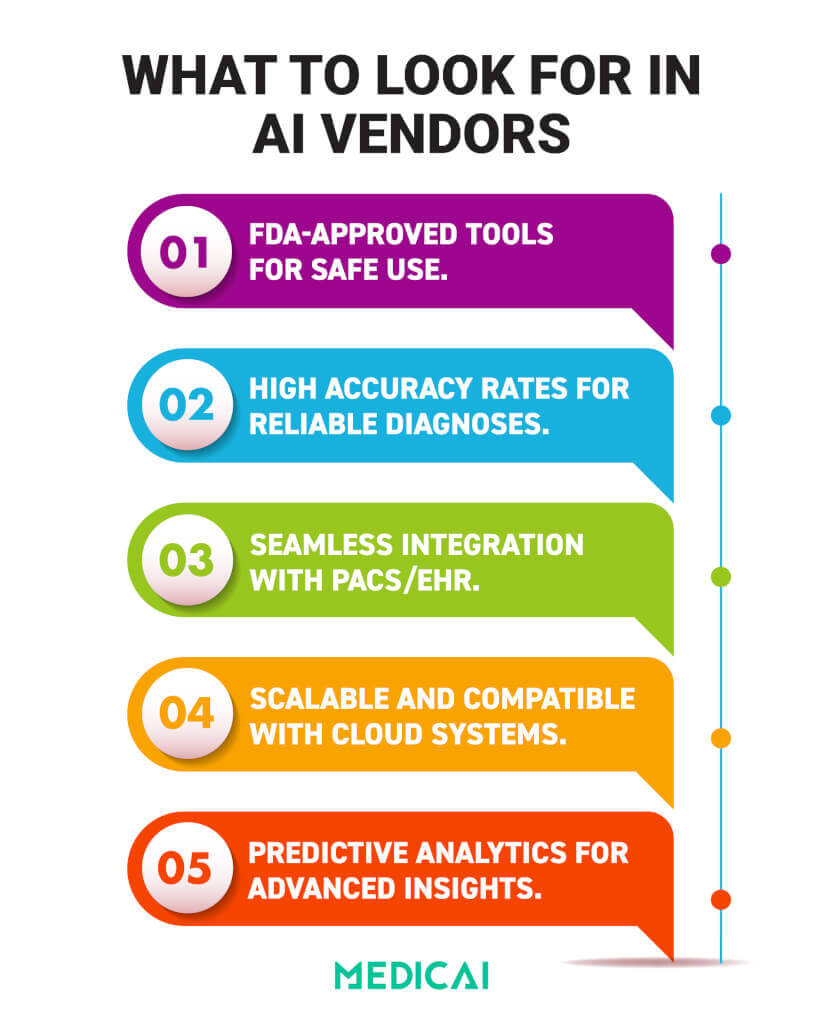
One of the best things about Aidoc is its integration with existing healthcare systems, such as PACS and EMRs. There is no need for massive overhauls or complicated installations—Aidoc simply fits in and gets to work.
Ubie Health
Ubie Health is a healthcare AI company best known for its Digital Symptom Checker, designed to improve early diagnosis and patient understanding through intelligent, AI-driven symptom assessment. Founded in Japan, Ubie’s mission is to reduce diagnostic delays and help both patients and clinicians navigate complex symptoms with greater clarity and confidence.
The company combines deep medical expertise with advanced artificial intelligence to support better decision-making across the healthcare journey. Ubie’s Digital Symptom Checker is used by patients, hospitals, and healthcare organizations worldwide to improve triage, reduce unnecessary visits, and surface potential conditions earlier.
At the core of Ubie Health’s offering is its AI-powered symptom checker, which asks adaptive, clinically informed questions to narrow down possible causes. The platform supports use cases such as:
- AI-driven symptom assessment for patients
- Clinical decision support for healthcare providers
- Digital triage for hospitals and health systems
- Patient education with condition-specific insights
Ubie’s AI acts as a structured, always-available guide, helping users understand what their symptoms may indicate and what next steps to consider. By translating complex medical logic into clear, user-friendly interactions, the platform helps reduce uncertainty and anxiety while supporting more efficient care pathways.
One of Ubie Health’s key strengths is its strong clinical foundation. Its algorithms are built with input from medical professionals and are continuously refined using real-world data. This focus on medical accuracy has helped Ubie gain trust among healthcare providers and institutions.
Ubie Health also integrates smoothly into existing digital health ecosystems, making it suitable for use on hospital websites, patient portals, and health apps. Rather than replacing clinicians, Ubie is designed to support them, saving time, improving patient preparedness, and enabling more informed conversations during care.
Siemens Healthineers
Siemens Healthineers, with a 120-year legacy, is now focused on becoming a leader among medical imaging AI companies to improve diagnostic precision. The company recently focused on artificial intelligence to improve diagnostic precision, streamline workflows, and enhance patient outcomes.
Siemens Healthineers offers a range of AI-driven tools designed to tackle complex diagnostic challenges. Key solutions include:
- AI-Pathway Companion: This tool integrates clinical guidelines with patient data, empowering clinicians to make evidence-based decisions easily.
- AI-Rad Companion: A virtual assistant for radiologists, this tool helps identify anatomical structures and potential abnormalities in imaging studies, reducing interpretation errors.
Siemens Healthineers is transforming healthcare with the Syngo Virtual Cockpit, which provides remote imaging assistance and streamlines workflows. Its AI-powered Digital Twin technology predicts patient health outcomes, supporting personalized medicine.
The company has a database of over 1.2 billion medical images and clinical data points that train its AI algorithms. Their technologies, including AI in imaging devices and tools to enhance patient positioning, integrate smoothly into the healthcare system.
NollaHealth
NollaHealth is redefining modern healthcare by combining technology, preventive care, and personalized wellness solutions. Built with a focus on early intervention and long-term health outcomes, NollaHealth leverages data-driven insights and digital tools to help individuals and healthcare providers take a proactive approach to care. Their mission centers on improving overall well-being while reducing the burden of chronic diseases through accessible, tech-enabled healthcare services.
NollaHealth’s suite of intelligent health solutions is designed to simplify care management and empower users with actionable insights. Some of its key offerings include:
Personalized Preventive Care Programs: NollaHealth uses data analytics to create tailored health plans that focus on early detection, lifestyle improvements, and risk reduction, helping individuals stay ahead of potential health issues.
Digital Health Monitoring Tools: Through connected platforms, users can track vital health metrics in real time, enabling continuous monitoring and timely interventions when needed.
AI-Driven Health Insights: Advanced algorithms analyze user data to provide meaningful recommendations, supporting both patients and clinicians in making informed decisions.
Integrated Care Coordination: NollaHealth brings together various aspects of healthcare—ranging from diagnostics to follow-ups—into a unified system, ensuring seamless communication between patients and providers.
On the digital care front, NollaHealth emphasizes remote accessibility, enabling users to engage with healthcare services from anywhere. Its platform is designed to integrate smoothly with existing healthcare systems, making adoption easier for providers without significant infrastructure changes.
Each solution is built with reliability and usability in mind, ensuring consistent performance in real-world scenarios. By simplifying workflows and enhancing access to health data, NollaHealth not only improves care delivery but also enhances the overall experience for both patients and healthcare professionals.
Zebra Medical Vision
Zebra Medical Vision, founded in 2014 in Herzliya, Israel, is a leader in healthcare. It enhances medical imaging diagnostics with AI-driven solutions. Its mission is to improve accuracy and accessibility in healthcare, empowering clinicians to make faster, informed decisions.
At the heart of Zebra Medical Vision’s offerings is its AI-powered imaging platform, designed to analyze medical data and detect patients at risk of chronic conditions. Whether identifying cardiovascular issues, liver disease, or osteoporosis, their tools help clinicians catch problems early, improve diagnostic accuracy, and ultimately enhance patient outcomes.
Their Imaging Analytics Platform provides healthcare providers the tools to shift from reactive to proactive care. A standout feature is the AI1 Solution, a subscription-based model that offers unlimited access to all of Zebra’s AI algorithms at a fixed annual fee.
Their AI tools integrate effortlessly with existing PACS and EMR systems, eliminating the need for costly upgrades or complicated installations. For healthcare providers, it means less downtime and more time focused on patient care.
Zebra Medical Vision has FDA-approved AI tools that help doctors quickly diagnose serious health issues, such as bleeding in the brain and collapsed lungs. These tools support healthcare professionals in urgent situations.
The platform features an intuitive interface that is easy to use and requires minimal training. Whether you’re a seasoned professional or new to AI-driven tools, Zebra ensures you can hit the ground running without disrupting your workflow.
Philips Healthcare
For over a century, Philips Healthcare has advanced medical technology, beginning with imaging devices and focusing on AI-driven solutions. They aim to improve patient outcomes through integrated healthcare systems that use innovative technology and focus on sustainability.
Philips’ portfolio of AI-enabled tools is designed to elevate diagnostic capabilities and streamline clinical workflows. Some standout innovations include:
- Philips SmartSpeed: This tool enhances the speed and quality of MRI imaging, ensuring faster and more accurate results.
- AI-Powered CT Tools: These include specialized features for liver analysis and stroke assessment, which assist clinicians in identifying critical conditions precisely.
- Advanced Visualization Workspace: A unified platform integrating imaging modalities across radiology, cardiology, oncology, and neurology, fostering better collaboration and data sharing among healthcare teams.
Philips eCareManager supports remote patient monitoring on the telehealth front, offering real-time AI-driven insights that empower clinicians to make proactive care decisions. Ensuring its vendor-neutral systems makes it easy for hospitals to adopt these technologies without overhauling their infrastructure.
Each AI application is thoroughly tested to ensure it performs reliably in clinical settings. Features like web-based solutions simplify processes such as patient scheduling and data access, reducing healthcare professionals’ workload and enhancing their overall satisfaction.
Arterys Inc.
Arterys aims to enhance healthcare by integrating AI and cloud computing to analyze medical images better. The company has significantly reduced diagnosis variability, eased radiologists’ workloads, and improved patient outcomes.
In 2022, Arterys was acquired by Tempus, further expanding its capabilities and reach within the healthcare sector.
Arterys provides AI tools for medical imaging, enhancing clinicians’ efficiency in data analysis. Key solutions include:
- CardioAI: Simplifies cardiac imaging by automating tasks like measuring ejection fractions and cardiac volumes, reducing analysis time from minutes to seconds.
- LiverAI: Assists with liver assessments, providing accurate and actionable insights for complex diagnoses.
- LungAI: this AI for pulmonology supports lung cancer diagnostics by accurately identifying nodules in CT scans.
What sets Arterys apart is its cloud-based platform, which allows clinicians to access AI-driven insights from any validated device—no need for costly infrastructure upgrades. Built on strong GPU architectures, the platform offers real-time interaction with deep learning algorithms.
Arterys’s platform integrates smoothly with current systems like PACS and EHR. It allows healthcare providers to use AI tools without interrupting their daily tasks.
Lunit
Lunit is a top-tier pathology AI company that began with a bold vision: to harness the power of AI in the fight against cancer. Its suite of AI diagnostic tools includes Lunit INSIGHT, which is used in over 4,500 hospitals in 55+ countries, enhancing early detection and personalized treatment.
Its products are widely adopted for enhancing diagnostic processes, making it a valuable asset for radiologists and pathologists. They include-
- Lunit INSIGHT: This suite of tools helps radiologists interpret chest X-rays and mammograms more accurately. It enhances early lung and breast cancer detection, improves diagnostic precision, and reduces radiologists’ workloads.
- Lunit SCOPE: This platform focuses on cancer therapeutics. It aids pathologists in analyzing tissue samples and predicting patient responses to immunotherapy to create personalized treatment plans.
Lunit’s AI technology is powered by advanced deep learning algorithms that can detect cancer types with high sensitivity and specificity. This AI for oncology imaging is crucial for timely interventions, particularly in high-risk cases.
The company’s recent acquisition of Volpara Health Technologies further strengthens its expertise in breast health diagnostics by integrating comprehensive data analytics with imaging solutions.
Enlitic
Enlitic stands out by going beyond AI for imaging—it’s rethinking the entire ecosystem. Its solutions focus on improving medical imaging data management, streamlining workflows, and unlocking valuable insights from archived information.
At the core of Enlitic’s offerings is the Enlitic Curie platform, an extensible AI framework designed to integrate seamlessly into healthcare workflows. This innovative platform combines historical diagnostic images with real-time data to create the industry’s first localized real-world database.
Other key products include:
- ENDEX: Standardizes medical image data nomenclature, improving consistency and efficiency in radiology workflows.
- ENCOG: Anonymizes imaging data while retaining clinically relevant information, ensuring privacy without compromising quality.
- ENSIGHT: Enhances workflow efficiency in radiology departments, making processes faster and more effective.
Enlitic uses advanced technology to standardize DICOM data, creating a unified system for imaging information management. With 93 patents in image processing and network protocols, it advances healthcare by helping providers build evidence databases and optimize AI orchestration.
Vuno
VUNO has cemented its position as a pioneer among medical diagnostics software providers. Their AI for diagnostics tools include VUNO Med®-BoneAge and VUNO Med®-DeepBrain, demonstrating excellence among AI medical imaging companies.
VUNO offers a comprehensive range of AI-powered diagnostic tools, each designed to address critical healthcare needs:
- VUNO Med®-BoneAge: The first AI-approved diagnostic software in Korea, providing bone age assessments from hand X-rays in just five seconds.
- VUNO Med®-DeepBrain: This AI for neurology imaging analyzes brain MRI data to assess cortical thickness, aiding in early Alzheimer’s diagnosis.
- VUNO Med®-Chest X-Ray: Enhances detection of thoracic diseases through AI-powered chest X-ray analysis.
- VUNO Med®-Fundus AI: Automatically detects and classifies retinal lesions, supporting the diagnosis of retinal diseases.
- VUNO Med®-LungCT AI: Identifies and quantifies pulmonary nodules, helping in the early detection of lung cancer.
VUNO uses advanced deep-learning algorithms to analyze medical data from X-rays, MRIs, and biosignals. Its multi-modal analysis enhances clinical decision-making and supports global expansion and ongoing research in AI healthcare.
Path AI
PathAI has earned its place among the top innovators in healthcare technology and is among the top 25 AI healthcare startups. The company leverages a vast network of over 450 pathologists and 15 million annotations to train its machine-learning models, ensuring unparalleled diagnostic accuracy and reliability.
PathAI’s flagship platform, AISight, is a cloud-native solution to optimize digital pathology workflows. From streamlining case management to integrating advanced AI applications, AISight enhances the speed and accuracy of histopathology analysis.
Key features include:
- Improved Diagnostic Accuracy: Advanced algorithms analyze highly precise tissue samples, supporting more confident diagnoses.
- Enhanced Workflow Efficiency: The platform integrates seamlessly into laboratory operations, reducing bottlenecks and facilitating collaboration among pathologists.
PathAI also provides tailored services for biopharma companies, including algorithm deployment for clinical trials and specialized wet lab services. These offerings help accelerate drug development and improve laboratory efficiency, making PathAI a trusted partner in the biopharma industry.
Conclusion
The rise of AI in medical diagnostics is more than just a technological evolution—it’s a healthcare revolution. The Top 10 AI Diagnostics Companies are at the forefront, reshaping how we diagnose, treat, and care for patients.
Their groundbreaking innovations are driving the entire AI in healthcare diagnosis market, improving healthcare by bridging gaps in accuracy, speed, and accessibility. These diagnostics technology companies are setting the new standard for the future of medicine.



Related Articles
Lets get in touch!
Learn more about how Medicai can help you strengthen your practice and improve your patients’ experience. Ready to start your Journey?
Book A Free Demo