PACS Administrator: What the Role Involves, Skills, Certification, and Salary

Every CT, MRI, and X-ray a hospital performs ends up in its PACS (picture archiving and communication system), and someone has to keep that system running, connected, and correct. That person is the PACS administrator. When the PACS slows down, a study goes missing, or a new scanner needs to send images, the PACS administrator is who radiology calls.
This guide explains what PACS administrators do day-to-day, the skills the job requires, the main certification (CIIP), what the role pays, and how people typically move into it. If you are new to the systems themselves, start with what PACS is.
What does a PACS administrator do?
A PACS administrator manages the imaging systems that store, route, and display medical images and ensures clinicians can find the right study for the right patient when they need it. The American Board of Imaging Informatics (ABII), which certifies professionals in the field, describes the PACS administrator as “the healthcare professional who orchestrates a complex set of functions to achieve successful imaging informatics,” and notes that the role “often expands to system architect, workflow engineer, and business analyst.”
In ABII’s words, PACS administrators “have a foot in two worlds: clinical healthcare and information technology.” They need to talk to network engineers about bandwidth and firewalls in the morning and to radiologists about hanging protocols in the afternoon.
Job titles vary. The same work is advertised as PACS administrator, PACS analyst, imaging informatics analyst, or imaging informatics specialist, and in larger health systems it may sit inside an enterprise imaging team.
Day-to-day responsibilities
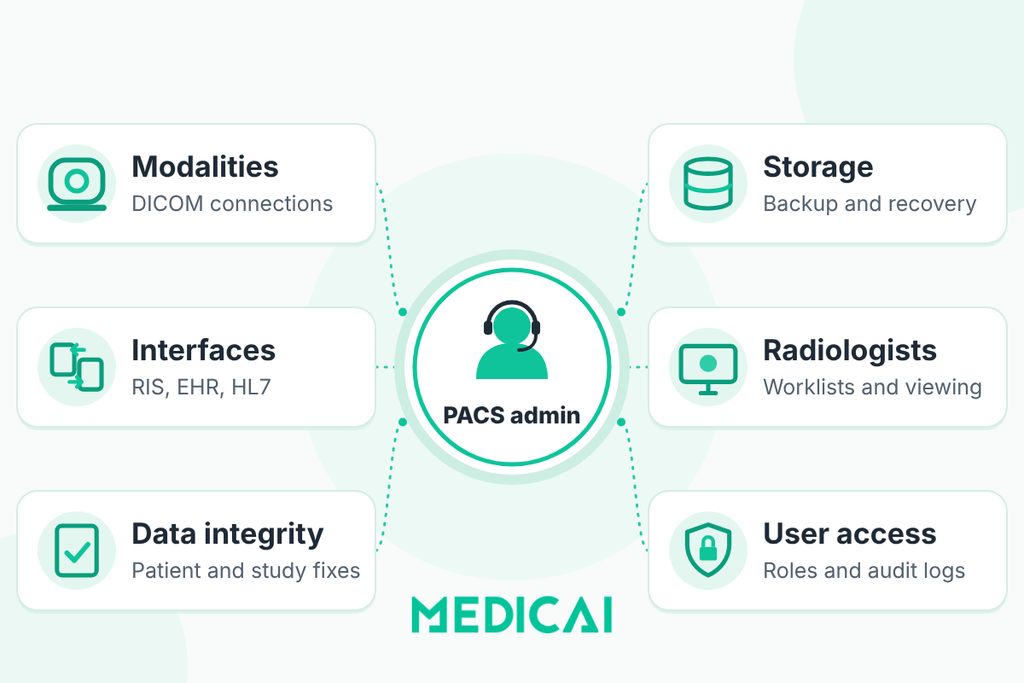
The exact mix depends on the size of the organization and whether the PACS runs on-premise or in the cloud, but most PACS administrator job descriptions include these areas:
| Area | Typical tasks |
|---|---|
| Modality and system connections | Connecting new scanners and systems to the PACS, setting up DICOM connections (AE titles, IP addresses, ports), and configuring routing rules |
| Worklists and interfaces | Keeping the modality worklist working, and maintaining HL7 interfaces between the PACS, the RIS, and the EHR so orders and reports flow correctly |
| Data integrity | Fixing studies with wrong patient details, merging and splitting studies, and reconciling exams that arrive without a matching order |
| Users and access | Creating accounts, managing roles and permissions, and supporting radiologists, technologists, and referring clinicians |
| Storage, backup, and recovery | Monitoring storage capacity, checking backups, and maintaining disaster recovery and downtime procedures |
| Upgrades and vendors | Planning upgrades, testing new releases, and working with PACS vendors on support issues |
| Workflow and viewing | Configuring hanging protocols, worklists, and viewer settings for radiologists |
| Projects | Taking part in system replacements, cloud moves, and PACS migration projects |
| Training and support | Training staff on the PACS and acting as the first line of support for imaging issues |
| Security and compliance | Reviewing access logs, supporting audits, and working with IT security on patching and access control |
In practice, a large share of the job is troubleshooting: an image that did not arrive, a viewer that will not load, an interface message that failed. Knowing how the pieces connect, from the scanner through the PACS to the report, is what makes those problems quick to solve. Our guides to PACS server configuration and RIS vs PACS cover those connections in more detail.
The role also changes with the type of PACS. With an on-premise system, the administrator often looks after servers, storage, and backups as well. With a cloud PACS, the vendor runs the infrastructure, and the administrator’s time shifts toward workflow, integrations, users, and data quality. See cloud vs on-premise PACS for how the two models differ.
Skills a PACS administrator needs
ABII says imaging informatics professionals must be able to “communicate clearly with highly technical network personnel” while also “understanding the diagnostic process of the radiologist,” and its certification is designed to verify “technical, clinical and business skills.” In practice, that breaks down into three groups.
Technical skills:
- DICOM: how images, AE titles, and services such as storage, query, and retrieve work. See what DICOM is.
- HL7 and interfaces: how orders, results, and patient updates move between the EHR, RIS, and PACS. Our reference on HL7 message types is written for PACS administrators.
- Networking basics: IP addressing, ports, firewalls, and bandwidth, because many imaging problems are network problems.
- Servers, storage, and databases: especially for on-premise systems, along with basic SQL for searching and fixing records.
- Security: user access, audit logs, and the privacy rules that apply to patient data.
Clinical and workflow knowledge:
- How each imaging modality works and what its studies look like.
- How radiologists read, compare prior studies, and report.
- Medical terminology and anatomy at a working level.
People and project skills:
- Clear communication with radiologists, technologists, IT teams, and vendors.
- Calm troubleshooting under pressure, because imaging downtime affects patient care.
- Project management for upgrades, migrations, and new sites.
- Documentation and training.
Education and background
There is no single required degree. People usually come to the role from one of two directions:
- From radiology: radiologic technologists who move into PACS support, bringing clinical knowledge and learning the IT side on the job.
- From IT: systems or network administrators who join a health system and learn imaging workflow and clinical terms.
For comparison, the US Bureau of Labor Statistics says the typical entry-level education for network and computer systems administrators, the closest occupation it tracks, is a bachelor’s degree in computer or information science or a related field, though some employers accept an associate degree or a postsecondary certificate. Many PACS job postings require either a technologist background or an IT degree, along with healthcare experience.
PACS administrator certification
Certification is not legally required, but many employers list it as preferred, and it is a common way to demonstrate knowledge when entering the field.
CIIP (Certified Imaging Informatics Professional)
The CIIP is the main certification for PACS administrators in the US. It is awarded by the American Board of Imaging Informatics (ABII), founded in 2007 through a joint effort of the Society for Imaging Informatics in Medicine (SIIM) and the American Registry of Radiologic Technologists (ARRT).
| Item | Details |
|---|---|
| Awarded by | American Board of Imaging Informatics (ABII) |
| Eligibility | A seven-point system across experience, formal education, and credentials or continuing education; ABII publishes the point chart on its Qualification Requirements page |
| Exam | 170 questions covering 10 knowledge domains, with up to 170 minutes to answer, at Pearson VUE test centers |
| Exam fee | $500; $250 to retake, with up to three attempts in 12 months |
| Annual renewal | $70, due December 31 |
| Continuing education | 24 credits every two years |
| Every 10 years | Complete one of four options: practice, education, research, or examination |
Figures are from ABII’s website as of October 2026; check ABII before you apply, as fees and rules can change.
SIIM offers preparation resources for the CIIP, and ABII lists educational resources on its website.
PARCA certifications
The PACS Administrators Registry and Certification Association (PARCA) has offered a set of PACS-specific credentials, known by the abbreviations CPAS, CPSA, CPIA, and CPSM, covering PACS administration, system analysis, interfaces, and system management. Older job postings and resumes still mention them. However, PARCA’s website currently says it is “not accepting new registrations and not offering exams,” so the CIIP is the practical option for most people today.
Vendor training
PACS vendors train administrators on their own products, and that training is often part of a new job. It is valuable, but it is product-specific; a vendor-neutral credential, such as the CIIP, demonstrates broader knowledge.
How to train for the role
- Learn the standards: DICOM and HL7 are the foundations, and both offer free introductory materials from their standards bodies and professional societies.
- Join SIIM: its courses, webinars, and annual meeting are aimed at imaging informatics professionals.
- Get hands-on: if you work in radiology or hospital IT, ask to shadow the PACS team, help with a modality installation, or take on first-line PACS support.
- Prepare for the CIIP once you meet the eligibility points, using ABII’s test content outline to guide your study.
PACS administrator salary
There is no government salary series specifically for PACS administrators, so the figures below come from a salary survey site and the closest occupation tracked by the US Bureau of Labor Statistics.
| Source | What it measures | Figure |
|---|---|---|
| PayScale (updated December 11, 2025) | Average base salary for PACS administrators in the US | $95,000 |
| PayScale | Range from the 10th to the 90th percentile | $65,000 to $137,000 |
| US Bureau of Labor Statistics (May 2025) | Median annual wage for network and computer systems administrators, the closest occupation it tracks | $99,130 |
Treat these as a guide rather than a precise benchmark. The PayScale figures are based on a small sample of 17 salary profiles, and pay varies widely by region, employer size, and seniority. Check current job postings in your area for a local picture.
Salary is also different from what the role costs an employer. Benefits, taxes, and overhead add to base pay, which is why cost models for running an on-premise PACS budget for PACS administration separately; see what PACS administration costs an employer.
Career path
A common progression looks like this:
- Entry: PACS support or junior PACS analyst, often after time as a radiologic technologist or in hospital IT support.
- PACS administrator: responsible for the day-to-day operation of the PACS, interfaces, and users.
- Senior administrator or imaging informatics analyst: leading upgrades, integrations, and migrations across sites.
- Leadership: imaging informatics manager, enterprise imaging lead, or director, responsible for strategy, budgets, and vendor selection.
The skills also transfer to vendor roles, such as implementation specialist or clinical applications specialist, and to broader health IT and interoperability work.
How to become a PACS administrator
- Build a foundation in either radiology or IT. Radiologic technologists bring clinical workflow knowledge; IT professionals bring systems and networking skills.
- Learn the imaging standards: DICOM for images and HL7 for orders and reports.
- Get close to a PACS. Volunteer for PACS-related tasks, help with modality installations, or take a PACS support role.
- Learn the clinical side, including modalities, radiology workflow, and terminology, or the IT side, whichever is new to you.
- Earn the CIIP once you meet ABII’s eligibility points.
- Apply for PACS analyst or administrator roles, highlighting both your clinical and your technical experience.
Frequently asked questions
What is a PACS administrator?
A PACS administrator manages the picture archiving and communication system that stores, routes, and displays medical images. The role covers system connections, interfaces with the RIS and EHR, data integrity, user access, storage, upgrades, and support for radiology staff.
How do I become a certified PACS administrator?
The main certification is the Certified Imaging Informatics Professional (CIIP) from the American Board of Imaging Informatics. You qualify through a seven-point system based on experience, education, and credentials, then pass a 170-question exam. The exam fee is $500.
What does a PACS administrator make?
PayScale reports an average base salary of $95,000 for PACS administrators in the US, with most falling between $65,000 and $137,000, based on a small sample. The Bureau of Labor Statistics reports a median of $99,130 for network and computer systems administrators, the closest occupation it tracks.
Is being a PACS administrator hard?
It is demanding because it combines clinical and technical work and because problems affect patient care, often under time pressure. People who enjoy troubleshooting and working with both clinicians and IT teams usually find it rewarding.
Do you need to be a radiologic technologist to become a PACS administrator?
No. Many PACS administrators started as technologists, but many others came from IT. Employers look for a mix of clinical workflow knowledge and technical skills, regardless of which direction you come from.
Is PARCA certification still available?
PARCA’s website currently states that it is not accepting new registrations and is not offering exams. The CIIP from ABII is the main certification available today.
How does cloud PACS change the PACS administrator role?
With a cloud PACS, the vendor runs servers, storage, and backups, so the administrator spends less time on infrastructure and more on workflow, integrations, user access, and data quality.
Sources


Related Articles

Lets get in touch!
Learn more about how Medicai can help you strengthen your practice and improve your patients’ experience. Ready to start your Journey?
Book A Free Demo