Teleradiology Benefits: 7 Reasons Hospitals and Imaging Centres Adopt It in 2026

Teleradiology — the electronic transmission of radiological images from the originating site to a qualified radiologist at a remote location for diagnostic interpretation — has moved from experimental capability to standard infrastructure across US hospitals and imaging centers. The American College of Radiology estimates that the majority of US hospitals now use teleradiology for at least some portion of their imaging interpretation workflow, particularly for overnight and weekend coverage where in-house radiologist availability is constrained.
The benefits driving this adoption fall into seven specific categories: 24/7 imaging interpretation availability, access to subspecialty expertise, faster diagnostic turnaround, lower operational cost compared to in-house overnight coverage, structured access to second opinions, improved patient care outcomes through faster diagnosis, and operational efficiency gains through better radiologist workload distribution. This guide covers each in technical and operational detail, alongside the underlying cloud PACS infrastructure that enables each benefit.

7 Super Teleradiology Benefits
Teleradiology has changed how medical imaging is delivered across hospital networks, imaging centers, and remote care settings. It enables faster turnaround, broader access to specialist interpretation, and more efficient use of radiologist capacity.
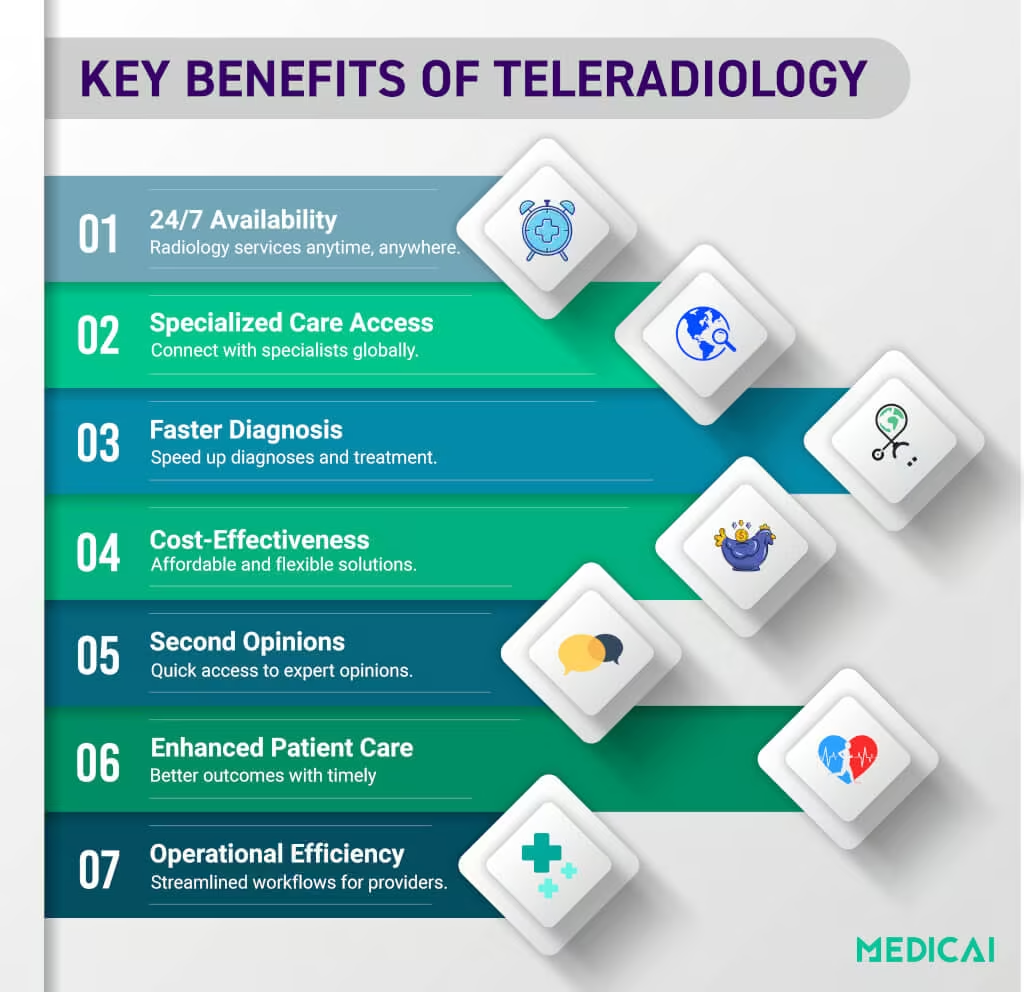
24/7 Availability
Imaging emergencies occur outside standard radiologist working hours — overnight, on weekends, and on public holidays. In-house radiologist coverage during these windows is expensive and increasingly difficult to staff, given the ACR-documented radiologist shortage.
They just invade when desired. And radiologists may not always be available. However, teleradiology ensures you receive radiology services anytime.
Teleradiology provides interpretation coverage for these periods through a remote radiologist panel that operates on its own schedule, independent of the originating site’s local working hours. It is especially beneficial for smaller or rural healthcare facilities. Clinics that don’t have on-site radiologists during off-hours can still offer uninterrupted care. They can send images taken at night to on-call teleradiologists and get the report by morning.
On the other hand, large hospitals can use teleradiology as a backup for overburdened teams.
Access To Specialized Care
Finding a specialized radiologist in many rural or underserved areas is challenging. Patients often drive far just to get the urgent care they need.
The clinical consequence is that patients in areas without local subspecialist coverage receive interpretation by general radiologists for cases in which subspecialist expertise materially affects diagnostic accuracy and treatment planning — particularly in neuroradiology, pediatric imaging, and musculoskeletal radiology.
Teleradiology restructures specialist access by separating the geographic location of the patient from the geographic location of the interpreting subspecialist.
With teleradiology, doctors at smaller clinics can easily send a patient’s scan to a specialized radiologist in a big city. The results can be returned in just a few hours, allowing patients to get the necessary care.
Another considerable benefit of teleradiology is that it has broken global barriers. Hospitals in one country can collaborate with experts in another country and gain world-class diagnostic insights.
Medicai links healthcare providers with a network of radiologists, ensuring patients can get top-notch teleradiology care whenever needed.
Faster Diagnosis and Treatment
When a patient presents to the emergency department with suspected stroke symptoms outside standard radiologist hours, the time-to-interpretation determines the patient’s eligibility for thrombolytic therapy and the probable neurological outcome. Without overnight in-house radiologist coverage, the diagnostic interpretation that determines whether thrombolysis is appropriate is delayed by the time it takes to reach an on-call radiologist.
Teleradiology eliminates this delay by routing the head CT directly to a radiologist on the teleradiology panel within the interpretation window required by the stroke protocol. Doctors can upload medical imaging directly to a platform where a teleradiologist is ready to review it, rather than waiting for the radiologist, with the help of AI-assisted teleradiology.
The radiologist interprets the study and delivers the structured report through HL7 ORU integration to the ordering physician’s EHR, enabling the treatment decision within the time window that protocol requires.
Not only emergencies but also everyday delays, such as waiting for files to transfer, tracking down specialists, etc., are no longer significant issues with teleradiology. It ensures patients get answers faster and move forward with a treatment plan sooner.
Medicai’s platform is built for speed. It provides seamless data sharing and prioritizes urgent cases, helping providers and radiologists to work efficiently.
Cost-Effectiveness
Healthcare can be expensive.
Smaller clinics and hospitals often struggle to balance their budgets to hire a full-time in-house radiologist. However, teleradiology significantly reduces their burden by offering a flexible, affordable solution.
Now, a small clinic can use teleradiology to get expert interpretations instead of hiring a full-time radiologist. They can access radiology services on demand, paying only for what they need.
Teleradiology also saves money on infrastructure. Traditional teleradiology needs physical storage for imaging studies, which can be costly. However, with cloud-based platforms like Medicai, their costs disappear.
These platforms offer cost-effective solutions with scalable service and storage, saving clinicians money without sacrificing quality.
Access To Second Opinions
A second opinion can make a huge difference when a diagnosis is complex or uncertain. Teleradiology connects healthcare providers to subspecialists who can review challenging cases to provide additional insights.
Radiologists, physicians, and specialists can collaborate through teleradiology platforms to review the studies together. Their efficient teamwork results in a holistic approach to patient care.
In short, teleradiology enhanced collaboration, teamwork, accuracy, and confidence in the treatment plan.
Enhanced Patient Care
Teleradiology doesn’t just make healthcare faster; it makes it better.
Quick and accurate diagnoses help patients. Early detection lets doctors intervene before conditions worsen, improving recovery rates. For those with chronic conditions, regular access to imaging can keep their care on track and effective.
Teleradiology also offers patients convenience.
They don’t need to travel far to larger hospitals for advanced imaging or wait days for results.
Patients can stay at home and still receive expert care, knowing their doctor has access to top-tier radiologists. This reduces anxiety and boosts peace of mind during stressful diagnoses.
Operational Efficiency
Running a hospital or clinic is no small task. Teleradiology makes it much easier by streamlining workflows and balancing workloads.
Radiologists can work remotely and review cases from multiple facilities. This reduces burnout and ensures that every study receives the attention it deserves.
Besides, automation takes the workflows a step ahead. AI-powered tools integrated into teleradiology platforms can prioritize urgent cases, generate preliminary findings, and help radiologists focus on complex diagnoses.
Thus, teleradiology provides faster turnaround times and more accurate reports for patients.
AI-driven platforms like Medicai can immensely enhance healthcare workflows with advanced technologies and seamless data sharing. We guarantee you will work smarter, not harder, to stay ahead of your healthcare team.
Supporting Technologies Enhancing Teleradiology Benefits
Teleradiology wouldn’t be the transformative tool it is today without the powerful technologies driving it. Let’s explore how technological innovations enable teleradiology.

Cloud-Based Platforms
Cloud-based PACS platforms provide DICOM-compliant storage and retrieval infrastructure accessible from any geographic location through standard HTTPS connections. The architectural difference from legacy on-premise PACS is that the archive itself sits on enterprise cloud infrastructure (typically Microsoft Azure or Amazon Web Services) rather than on a server in the originating practice’s IT environment, eliminating the local hardware investment and the IT staffing required to maintain it.
Scalability
Cloud storage scales with the practice’s actual archive growth without requiring hardware procurement cycles. A practice generating 300 studies per month, adding 360 GB of DICOM data annually, scales its cloud storage subscription as the archive grows, without the storage capacity ceilings that constrain on-premise PACS deployments.
Security and compliance
Cloud PACS platforms designed for healthcare deployment apply AES-256 encryption at rest, TLS 1.2 or higher in transit, role-based access controls, and complete audit logging of access events. HIPAA compliance is contractual through a signed Business Associate Agreement. ISO 27001-certified cloud infrastructure provides the operational security baseline that on-premise practices struggle to match with their own IT resources.
Cloud-based PACS platforms provide a secure DICOM archive accessible from any location, with role-based access controls determining which users can retrieve which studies. The infrastructure consolidates imaging storage across multiple originating sites while making studies available to authorized users regardless of geographic location.
AI Integration
AI tools integrate into teleradiology workflows through three primary architectures. Triage AI operating before radiologist review: incoming studies are processed by AI within seconds of acquisition, with studies showing features suggestive of critical findings (stroke, pulmonary embolism, intracranial hemorrhage, pneumothorax) moved to the top of the radiologist’s worklist. CAD AI operating during radiologist review: overlays appear on the DICOM viewer alongside the original images, flagging potential findings for the radiologist’s verification. Reporting AI operating after radiologist review: AI-assisted dictation, structured template population, and AI-drafted impression sections reduce the documentation overhead per study. See the AI in radiology guide for the comprehensive treatment of these capabilities and the FDA-cleared products available in each category.
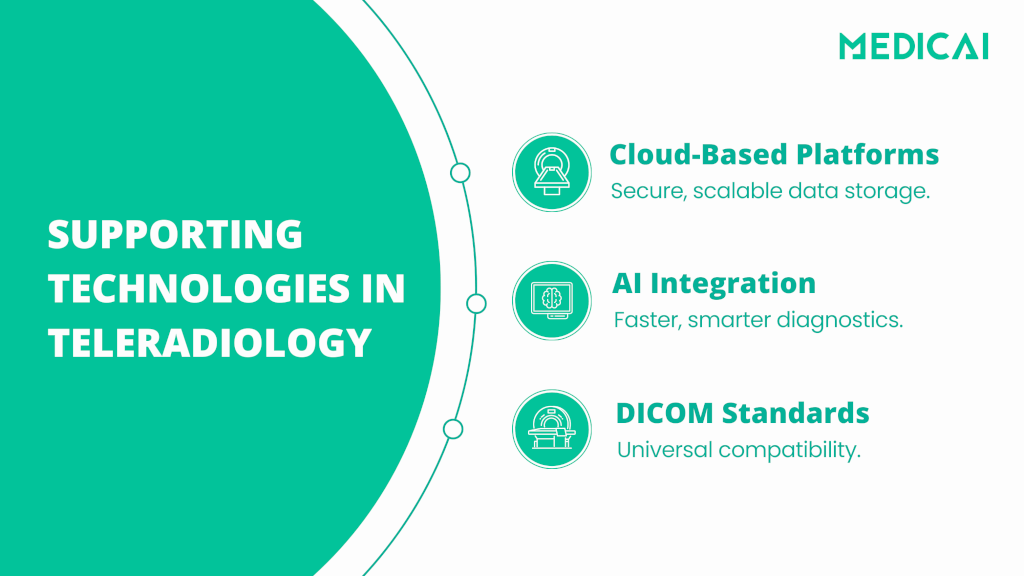
DICOM Standards
DICOM (Digital Imaging and Communications in Medicine) is the international standard for the exchange of medical imaging data. Three properties make DICOM essential to teleradiology operations. Cross-vendor consistency: DICOM-compliant CT, MRI, X-ray, and ultrasound scanners produce studies in a standardized format that any DICOM-compliant viewer can display, eliminating the modality-vendor lock-in that would otherwise constrain teleradiology deployment. Metadata preservation: the DICOM header contains acquisition parameters, spatial coordinates, and patient identification that enable downstream processing including AI analysis, multiplanar reconstruction, and longitudinal comparison. Interoperability with PACS and RIS: DICOM-defined network protocols (C-STORE, C-FIND, C-MOVE) and DICOMweb HTTP services (WADO-RS, QIDO-RS, STOW-RS) provide standard interfaces for study transmission and retrieval across the teleradiology infrastructure.

Teleradiology Challenges
Several challenges you may face with teleradiology services that you can address quickly.
Connectivity Issues
Reliable internet is vital for teleradiology. However, many facilities, especially in rural locations, need more bandwidth. So, large imaging files like MRIs can delay uploads and diagnoses.
However, data compression, cloud caching, and emerging 5G networks can help maintain efficient workflows.
Image Quality
Radiologists need high-resolution images to make accurate diagnoses. However, file compression can risk image quality.
Facilities can use lossless compression, which preserves diagnostic integrity while optimizing files. Moreover, DICOM standards provide consistent formatting across systems.
Data Security
Medical imaging files are often attractive targets for breaches. Encryption, multi-factor authentication, and compliance with HIPAA and GDPR can safeguard patient data during storage and sharing.
Frequently Asked Questions About Teleradiology Benefits
What are the main benefits of teleradiology?
Teleradiology delivers seven primary benefits to hospitals and imaging centers. Twenty-four-hour imaging interpretation coverage without requiring in-house overnight radiologist staffing. Access to subspecialty expertise (neuroradiology, pediatric imaging, musculoskeletal radiology) regardless of the originating site’s geographic location. Faster diagnostic turnaround for time-sensitive imaging — particularly stroke, pulmonary embolism, and major trauma. Lower operational cost than full-time in-house radiologist coverage for practices below approximately 4,000 studies per month. Structured access to second opinions for complex or uncertain cases. Better patient outcomes through reduced time-to-diagnosis on time-sensitive conditions. Operational efficiency gains through distributed reading panels, with corresponding reductions in radiologist burnout from on-call obligations.
How does teleradiology save money compared to in-house radiology?
Teleradiology eliminates the fixed cost of full-time in-house radiologist staffing, replacing it with per-study or per-shift pricing that scales with the practice’s actual imaging volume. A small clinic hiring a full-time radiologist faces an annual loaded cost of approximately $400,000 to $650,000 — covering salary, benefits, malpractice insurance, and licensing. A typical teleradiology service charging $15 to $45 per study produces an annual cost of $36,000 to $108,000 for a clinic generating 200 studies per month. For practices with fewer than approximately 4,000 studies per month, teleradiology is the economically viable model — see the cloud PACS total cost of ownership framework for the full financial comparison, including infrastructure and IT staffing costs.
Is teleradiology faster than traditional radiology?
For after-hours imaging, teleradiology is substantially faster because the alternative is waiting for an on-call radiologist to be reached, travel to the reading workstation, and begin interpretation. Teleradiology panels operate continuously — the radiologist is already at the reading workstation when the study arrives. For stroke imaging, AI-assisted teleradiology has reduced door-to-treatment time by an average of 26 minutes in multi-center deployment studies. For routine business-hours imaging, teleradiology turnaround time is comparable to in-house interpretation, typically operating in the 30-minute to 4-hour range depending on study complexity and panel staffing.
What technology does teleradiology require?
Teleradiology requires four technical components. A DICOM Gateway at the originating site that transmits studies from imaging modalities to the central archive over a standard HTTPS connection. A cloud PACS or vendor-neutral archive that stores DICOM studies in a structured format accessible to authorized users from any location. A zero-footprint browser-based DICOM viewer that allows the remote radiologist to read studies without installing thick-client software on a specific workstation. An HL7 ORU integration to the ordering physician’s EHR for structured report delivery. Cloud-native platforms, including Medicai, provide all four components as a single integrated subscription, eliminating the on-premise server and VPN configuration required by legacy teleradiology architectures.
Is teleradiology HIPAA compliant?
HIPAA compliance is a baseline requirement for any teleradiology platform used with US patient data. The required compliance elements are a signed HIPAA Business Associate Agreement from the teleradiology platform vendor, AES-256 encryption of all DICOM data at rest in the cloud archive, TLS 1.2 or higher encryption for data in transit between the originating site and the cloud, role-based access controls restricting study access to authorized radiologists, and complete audit logging of all study access events with timestamps and user identity. Teleradiology services that route patient data across state lines must also comply with state medical practice and radiologist licensure requirements in the patient’s state, not just the radiologist’s state.
What are the limitations of teleradiology?
Three operational limitations apply to the adoption of teleradiology. Internet connectivity dependency: large DICOM studies require reliable bandwidth at the originating site for timely transmission to the cloud archive. Image quality and display calibration: the diagnostic monitor at the remote radiologist’s location must meet diagnostic display standards, which is the radiologist’s professional responsibility, but is harder to enforce in distributed reading panels. Regulatory complexity in multi-state operations: the teleradiology service must verify radiologist licensure in each state where patients are imaged, and must comply with state-specific telemedicine practice standards. None of these limitations preclude teleradiology adoption — they require operational management rather than infrastructure investment.
Final Words
Teleradiology has produced measurable improvements in access to care, diagnostic turnaround time, and radiologist workforce utilization across the practice settings where it has been adopted. It bridges the gap in expertise and geography, ensuring efficient and accurate radiology services for everyone.
Medicai teleradiology provides the cloud PACS infrastructure that enables the teleradiology workflows described in this guide — DICOM Gateway acquisition, secure archive on Microsoft Azure with AES-256 encryption, a zero-footprint browser-based DICOM viewer for remote radiologists, and HL7 ORU integration to the ordering physician’s EHR — packaged as a single subscription with a contractual HIPAA Business Associate Agreement.


Related Articles
Lets get in touch!
Learn more about how Medicai can help you strengthen your practice and improve your patients’ experience. Ready to start your Journey?
Book A Free Demo