HIPAA-Compliant Medical Image Sharing: Rules, Safeguards, and Common Failures

Medical image sharing is HIPAA-compliant when it satisfies the Privacy Rule’s limits on disclosure, the Security Rule’s technical and administrative safeguards, and the Breach Notification Rule’s reporting obligations. Imaging studies fall under HIPAA because DICOM headers carry patient identifiers, including name, medical record number, birth date, and facility, alongside the diagnostic pixel data.
A shared study is Protected Health Information in the same way a chart note is. Compliance depends on how sharing is implemented rather than on the clinical justification for it: sending a scan for a legitimate second opinion over unencrypted email is still a violation.
This guide on HIPAA-Compliant Medical Image Sharing covers what each HIPAA rule requires for imaging specifically, the safeguards that satisfy them, the common sharing methods that fail, and how de-identification works when studies are shared for research or teaching.

What makes medical image sharing HIPAA-compliant
HIPAA does not certify products or approve vendors. There is no such thing as a HIPAA-certified image sharing platform, and any vendor claiming certification is describing something that does not exist. Compliance is a property of the covered entity’s implementation, assessed against the rules rather than granted by an authority.
Four conditions have to hold for a sharing workflow to be compliant.
The disclosure must be permitted under the Privacy Rule, either for treatment, payment, or healthcare operations, or with patient authorization. Treatment disclosures, including referrals and second opinions, generally do not require separate authorization.
Transmission and storage must be protected by Security Rule safeguards covering encryption, access control, audit logging, and integrity verification.
Any vendor with access to the images must have a Business Associate Agreement executed before receiving PHI, not after.
The minimum necessary standard must be observed for non-treatment disclosures. It does not apply to treatment disclosures, which is why a consulting radiologist can receive a complete study rather than a cropped subset.
Why Medical Imaging Matters in Personal Injury Litigation
Radiology scans provide objective insights into a client’s condition and often serve as stronger evidence than verbal testimony. For attorneys, understanding the role of imaging in evidence gathering while ensuring HIPAA compliance is essential.
Injury claims rely on evidence, and diagnostic images effectively convey an injury’s existence, location, and severity. They confirm injuries like broken bones or herniated discs and help establish causation by linking the injury to the incident, whether it’s a car crash, workplace accident, or fall.
Diagnostic Imaging Types Commonly Used
Personal injury attorneys regularly work with several types of diagnostic imaging, each offering unique advantages depending on the nature of the injury:
- MRI (Magnetic Resonance Imaging) – MRIs are used for soft tissue injuries and provide high-resolution views of muscles and nerves.
- CT (Computed Tomography) Scans – CT scans detect internal bleeding and fractures, providing detailed images for trauma cases.
- X-rays – Useful for identifying bone fractures, dislocations, or foreign objects.
- Ultrasound and PET Scans – They are less common in litigation, but can be critical in cases involving vascular damage or internal organ dysfunction.
Understanding image types helps attorneys craft solid medical arguments and choose appropriate expert witnesses.
How Imaging Strengthens Claims for Damages
Beyond proving the injury occurred, medical imaging is essential for calculating the extent of physical and financial harm. Judges and juries are more likely to award fair compensation when presented with clear, undeniable visual evidence of:
- The severity of injury
- The need for surgical intervention or long-term care
- Permanent disability or loss of function
- Future medical costs
Combined with expert testimony, radiology images can transform subjective claims into strong, scientifically backed cases, increasing clients’ chances of justice and fair compensation.
Is Medical Imaging Protected Under HIPAA?
Yes, medical imaging files containing identifiable patient data are Protected Health Information (PHI) under HIPAA and must be handled with strict privacy safeguards.
Personal injury attorneys may see medical records as printed reports or physician notes, but radiology images are equally protected due to the sensitive data they contain. Understanding HIPAA’s treatment of these digital assets is essential for legal professionals handling medical evidence.
What Is PHI and Why Does It Apply to Images
Under HIPAA’s Privacy Rule, Protected Health Information (PHI) is any identifiable information in a medical record created, used, or disclosed during health care. It includes written records, digital images, audio, and video files.
Medical images like MRIs, CT scans, and X-rays are considered PHI if they contain identifiable patient details, such as a name or medical record number. Even seemingly anonymous images may be linked to identifiable data, necessitating HIPAA compliance.
Identifiable Metadata in DICOM Files
Most medical imaging is stored in DICOM (Digital Imaging and Communications in Medicine) format—a specialized standard supporting the image and associated metadata. That metadata often includes:
- Patient name
- Date of birth
- Medical record number
- Scan date and time
- Referring physician
- Facility location
Even if an image looks neutral, its embedded metadata can link it to a specific person. Attorneys often receive this metadata automatically when digital files come from healthcare providers via CD, USB, or shared drives.
Not reviewing, sanitizing, or encrypting these files before sharing can result in unintentional HIPAA violations.
Legal Risks of Mishandling Medical Images
Personal injury attorneys must secure Protected Health Information (PHI) to comply with HIPAA. If they fail to safeguard PHI, they can be classified as business associates and face civil penalties for unauthorized access or disclosure.
Thus, HIPAA compliance applies not only to healthcare providers but also to legal professionals handling PHI.
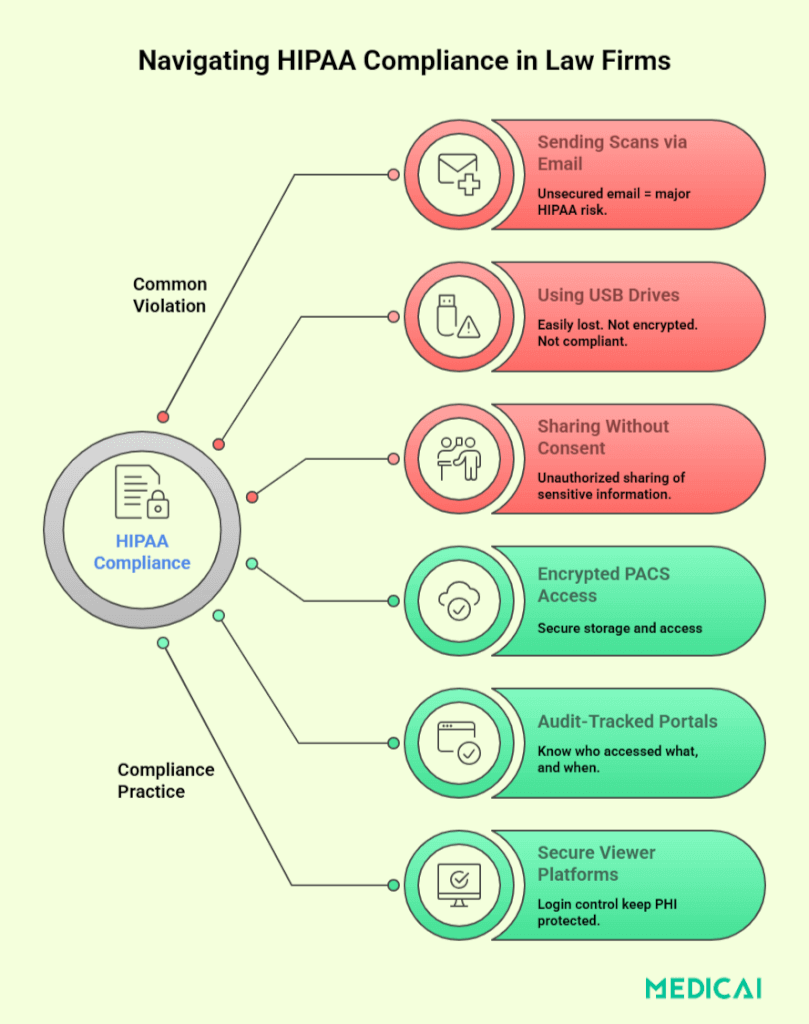
Some common attorney missteps include:
- Sharing image files via unsecured email
- Failing to de-identify files when sharing with opposing counsel
- Losing physical media like CDs or flash drives
- Using unencrypted storage or cloud platforms
Improperly handling PHI in legal proceedings can result in fines, reputational harm, and the jeopardization of crucial medical evidence. It can also lead to client litigation for privacy breaches.
Attorneys must handle medical imaging with the same care as any confidential case file and ensure their image-sharing workflows comply with HIPAA’s safeguards.
HIPAA Overview: What Personal Injury Attorneys Need to Know
Understanding HIPAA, especially Title II and its privacy requirements, is crucial for ensuring that the handling of health information remains legal.
Title II of HIPAA
The Health Insurance Portability and Accountability Act (HIPAA), enacted in 1996, enhances healthcare portability and promotes electronic health records. Title II: Administrative Simplification is crucial for attorneys working with Protected Health Information (PHI).
It sets Privacy and Security Rules, creating national standards for handling sensitive health data, including DICOM images. It also requires unique patient identifiers and standardized electronic healthcare transactions, affecting how attorneys manage imaging records.
Disregarding Title II regulations can lead to HIPAA violations for personal injury lawyers, even when gathering evidence.
The Privacy and Security Rules
The Privacy Rule regulates access to PHI, requiring entities, including attorneys, to obtain patient authorization for access. It also limits data disclosure to what is “reasonably necessary” for its intended purpose.
The Security Rule applies to electronic PHI (ePHI) and sets standards for:
- Access control – Only authorized users can access data
- Encryption – PHI must be protected during transmission and storage
- Audit controls – Systems must log access and activities
- Risk assessments – Entities must regularly evaluate their data security systems
When attorneys handle imaging files stored on CDs, flash drives, or cloud platforms, these rules are highly relevant. Even reviewing an unencrypted MRI on a shared office computer could constitute a breach if security protocols aren’t followed.
Addressable does not mean optional
The Security Rule labels each specification either required or addressable, and the distinction is the most commonly misread part of HIPAA.
Addressable means the covered entity must implement the specification if reasonable and appropriate for its environment, or document why it is not and implement an equivalent alternative. It does not mean the specification can be ignored.
Encryption is addressable rather than required, which is why some vendors and articles claim encryption is optional under HIPAA. In practice, for imaging transmitted across networks, there is essentially no defensible documented alternative, and OCR settlements have repeatedly treated unencrypted PHI transmission as a violation.
| Specification | Status | Implementation for imaging |
|---|---|---|
| Access control | Required | Unique user IDs, role-based permissions per study, automatic logoff, emergency access procedure |
| Audit controls | Required | Immutable logs of every view, download, and share, retained and reviewable |
| Authentication | Required | Identity verification, with MFA as the practical standard for external sharing |
| Integrity controls | Addressable | Checksums or equivalent verifying studies are not altered in transit or storage |
| Transmission security | Addressable | TLS 1.2 or higher in transit, AES-256 at rest, end-to-end encryption where available |
What Makes a Medical Image Sharing Method HIPAA-Compliant?
HIPAA outlines specific technical, administrative, and procedural safeguards when Protected Health Information (PHI), including imaging, is transmitted or stored digitally.
Encryption Standards and Access Controls
Encryption is crucial for HIPAA compliance regarding electronic PHI (ePHI). Image-sharing platforms must implement strong end-to-end encryption for both stored data (at rest) and data being transmitted (in transit) to protect against unauthorized access.
But encryption alone isn’t enough. Systems must also implement access controls that limit who can view or download imaging files. That means:
- Password-protected logins (enforced by Password Managers)
- Multi-factor authentication (MFA) for any user accessing imaging files, which has become a baseline expectation for MFA compliance under HIPAA’s Security Rule and related US frameworks
- Role-based access
- Session timeouts and lockouts for idle users
These safeguards prevent unauthorized parties from gaining access and help maintain a verifiable chain of custody for sensitive medical images.
Business Associate Agreements (BAAs)
When personal injury attorneys use third-party services like cloud PACS or document retrieval companies for medical imaging, HIPAA requires a Business Associate Agreement (BAA). It ensures the vendor protects PHI according to HIPAA standards.
A BAA must:
- Define how PHI will be used, stored, or shared
- Establish responsibility in the event of a breach
- Require that the vendor implement appropriate security measures
Not securing a BAA with vendors handling medical images risks non-compliance and penalties for attorneys. A secure platform alone doesn’t ensure HIPAA compliance; it must be contractually outlined.
Audit Trails and Logging Requirements
A core principle of HIPAA is accountability. Any system used to share or store medical images must have audit capabilities—digital logs that record:
- Who accessed which file and when
- What actions did they take (viewed, downloaded, deleted)
- IP addresses or device identifiers
Audit trails are vital during breach investigations or when questioning an image’s chain of custody in court. Without verifiable logs, proving proper handling of PHI and preventing unauthorized access becomes challenging for attorneys.
Platforms lacking detailed activity logs or allowing untracked file downloads do not meet HIPAA expectations.
Secure Authorization and Consent Management
Before medical images are obtained or shared, HIPAA requires proper patient authorization, especially when use is for legal purposes rather than direct care. A compliant image-sharing process must include:
- Tools to collect signed HIPAA authorization forms
- Verification steps to confirm the identity of the requestor
- Restrictions on how long and how widely the data can be accessed
Attorneys must ensure that any PHI they receive is legally authorized and that image-sharing platforms respect the consent’s scope and duration. Sharing without consent, even if well-intentioned, may be deemed a breach.
Platforms should ideally have features for uploading, storing, or verifying consent documents to simplify compliance.
Legal Consequences of HIPAA Violations
Mishandling medical images or other Protected Health Information (PHI) can result in steep fines, reputational harm, and lost client trust. Attorneys must understand the risks to build safer, more compliant practices.
Four-Tier Penalty Structure
The U.S. Department of Health and Human Services (HHS) enforces HIPAA through a tiered system based on culpability and corrective action:
| Tier | Level of Culpability | Minimum Penalty per Violation | Maximum Penalty per Violation | Annual Penalty Limit |
| Tier 1 | Lack of Knowledge (Reasonable Efforts) | $141 | $71,162 | $2,134,831 |
| Tier 2 | Reasonable Cause (Lack of Oversight) | $1,424 | $71,162 | $2,134,831 |
| Tier 3 | Willful Neglect – Corrected within 30 days | $14,232 | $71,162 | $2,134,831 |
| Tier 4 | Willful Neglect – Not Corrected within 30 days | $71,162 | $1,500,000+ | $2,134,831 |
The Breach Notification Rule and the encryption safe harbor
Unauthorized acquisition, access, use, or disclosure of unsecured PHI is presumed to be a breach unless a four-factor risk assessment demonstrates low probability of compromise. The factors are the nature and extent of the PHI involved, who received or accessed it, whether it was actually acquired or viewed, and the extent to which the risk has been mitigated.
Breaches affecting 500 or more individuals require notification to affected individuals, to HHS, and to prominent media in the affected state, within 60 days. Smaller breaches are logged and reported to HHS annually.
Properly encrypted PHI falls under the safe harbor. If encryption meets HHS specifications and the key was not compromised, a lost or improperly accessed study is not a reportable breach. This is the strongest practical argument for encrypting imaging at rest and in transit: it converts a reportable incident into a non-event.
Best Practices for Attorneys Handling Medical Images
Handling medical imaging in litigation involves a secure, compliant workflow. From record requests to court presentations, best practices help attorneys protect PHI and improve case outcomes.
Requesting Records the Right Way (HIPAA Forms, Timeline)
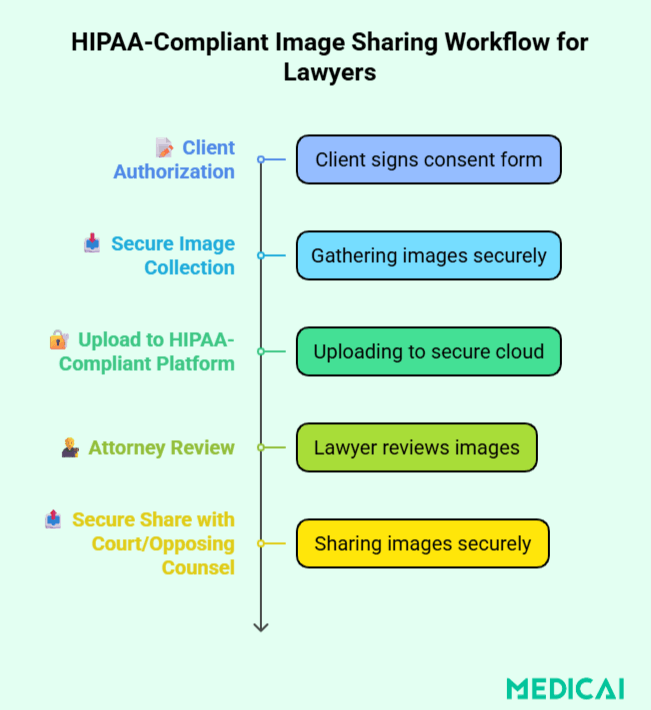
- Start with a valid HIPAA authorization form signed by the client.
- Specify the imaging type (e.g., MRI, CT), date range, and request both image files and reports.
- Opt for secure digital delivery, and avoid vague requests that cause delays or incomplete disclosures.
Maintaining a Chain of Custody
- Track who accessed each image, when, and how.
- Log transfers, store files securely, and avoid altering filenames or file contents.
This protects the image’s evidentiary integrity and supports admissibility in court.
Partnering with Medical Experts and Vendors
Trusted partners help attorneys manage files efficiently and legally.
- Work with radiologists who can interpret scans and testify when needed.
- Use HIPAA-compliant vendors for secure image storage, expert collaboration, and formatting.
Staff Training and Internal Policy Setup
Practical training reduces risk and ensures consistent, secure workflows across the firm.
- Train legal staff on HIPAA protocols annually.
- Set internal guidelines for image handling, appoint a compliance lead, and audit regularly.
HIPAA-Compliant Technologies for Imaging Sharing
Outdated CDs and unsecured emails no longer cut it. Today’s personal injury attorneys need modern, HIPAA-compliant tools to access, share, and store medical images securely
Secure Cloud PACS (Picture Archiving and Communication Systems)
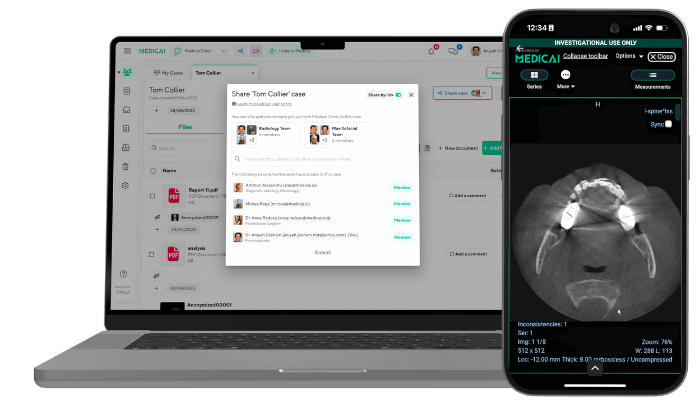
Cloud-based PACS platforms like Medicai allow legal teams to securely store, access, and share imaging, without physical media. Key features include:
- Encrypted storage and remote access
- Role-based permissions for controlled access
- Audit logging for full traceability
These systems streamline collaboration with off-site experts and reduce the risk of data breaches.
DICOM Viewers with HIPAA Features
DICOM viewers allow attorneys and experts to view scans securely, without downloading or compromising patient data. Their design for legal use offers:
- Authentication and access controls
- Data encryption
- De-identification tools
- Built-in activity logs
Encrypted File Sharing Portals
Secure portals are safer than email for sending images to courts or opposing counsel and help maintain compliance during discovery. They offer:
- End-to-end encryption
- Password-protected, time-limited links
- Detailed access logs
Integration with Legal Case Management Tools
Integrated systems save time and reduce compliance risks across the firm. HIPAA-compliant imaging tools can integrate with legal case systems to:
- Simplify access to imaging within case files
- Enable secure internal communication
- Reduce data handling errors
Sharing methods that violate HIPAA
Unencrypted email. No transmission security, no access control once delivered, no audit trail. Sending studies or links to unsecured locations by ordinary email fails the Security Rule regardless of clinical intent.
Consumer file-sharing services. Dropbox, Google Drive, and WeTransfer do not execute BAAs on consumer tiers. Some business and enterprise tiers will, but only under specific configurations, and the BAA must be executed before use rather than inferred from a subscription.
Unsecured USB drives and CDs. Portable media without encryption is a recurring source of reportable breaches. Loss of an unencrypted drive holding imaging is presumptively a breach. Loss of a properly encrypted one falls under the safe harbor.
Consumer messaging apps. SMS and consumer messengers lack access control, audit logging, and BAAs, and studies persist on recipient devices outside any administrative control.
Personal cloud accounts. Staff uploading studies to personal accounts places PHI entirely outside organizational control, with no BAA and no logging.
Giving a patient their own imaging on disc is a permitted access disclosure and is not a violation. The failure mode there is operational rather than regulatory: discs are lost, damaged, and frequently unreadable at the receiving facility, and the workflow produces no record of onward sharing.
De-identification for research and teaching
Sharing imaging for research, education, or publication generally requires de-identification, and HIPAA recognizes two methods.
Safe Harbor requires removal of 18 specified identifier categories. In DICOM, these concentrate in the header: patient name, medical record number, all date elements more precise than year, geographic subdivisions smaller than state, telephone numbers, and device serial numbers. Dates are the most frequently missed, since study dates, birth dates, and acquisition timestamps appear across multiple tags.
Expert Determination uses a qualified statistician to certify that re-identification risk is very small, applying and documenting accepted statistical principles. This method permits retention of data Safe Harbor would strip, including full dates, which matters for longitudinal imaging.
Two imaging-specific risks survive header scrubbing. Burned-in annotation places identifiers directly in pixel data, where metadata removal does not reach, requiring pixel-level redaction. And 3D reconstruction from head or face imaging can produce recognizable facial renderings, which is why defacing algorithms are standard practice for neuroimaging datasets.
Frequently asked questions
Is medical image sharing HIPAA compliant?
It can be, depending on implementation. HIPAA requires that the disclosure be permitted under the Privacy Rule, that Security Rule safeguards including encryption, access control, and audit logging are in place, and that any vendor handling the images has an executed Business Associate Agreement. Sharing over unencrypted email or consumer file-sharing services is not compliant regardless of clinical purpose.
Is email HIPAA compliant for sending medical images?
Standard email is not. It provides no transmission encryption by default, no access control once delivered, and no audit trail. Some encrypted email services execute BAAs and can be used compliantly, but ordinary email between organizations does not meet Security Rule requirements for transmitting imaging.
Does HIPAA require encryption for medical images?
Encryption is an addressable specification rather than a required one, meaning a covered entity must implement it if reasonable and appropriate, or document why not and use an equivalent alternative. For imaging crossing networks, there is rarely a defensible alternative. Encryption also triggers the breach safe harbor: properly encrypted PHI that is lost or accessed is not a reportable breach.
What is a BAA and when is one needed?
A Business Associate Agreement is a contract between a covered entity and any vendor that creates, receives, maintains, or transmits PHI on its behalf. Cloud imaging platforms, teleradiology providers, and archive vendors all require one. It must be executed before any PHI is transmitted.
Can I share medical images with a doctor at another hospital?
Yes. Disclosures for treatment, including referrals and second opinions, are permitted under the Privacy Rule without separate patient authorization. The transmission still has to meet Security Rule safeguards, so a permitted disclosure does not make an unencrypted method acceptable.
How do I de-identify DICOM images?
Under Safe Harbor, remove the 18 identifier categories from the DICOM header, including patient name, medical record number, all dates more precise than year, and geographic detail below state level. Header removal alone is insufficient when identifiers are burned into pixel data, which requires redaction, or when head imaging permits facial reconstruction, which requires defacing.
What happens if medical images are shared improperly?
Improper disclosure is presumed to be a breach unless a four-factor risk assessment shows low probability of compromise. Breaches affecting 500 or more individuals require notification to individuals, HHS, and media within 60 days. Civil penalties are tiered by culpability, with annual caps per violation category.
Are cloud platforms HIPAA compliant?
No platform is HIPAA-certified, because no such certification exists. A cloud platform can support compliant sharing when it provides the required safeguards and executes a BAA, but compliance remains the covered entity’s responsibility and depends on configuration, access management, and workforce practice.
Conclusion
Medical imaging is a powerful asset in personal injury cases, but only when handled securely and responsibly. By understanding HIPAA’s requirements and using compliant technologies, attorneys can protect client privacy while strengthening their legal strategy.
Platforms like Medicai help legal teams streamline access to imaging, maintain compliance, and collaborate with experts in a secure environment.


Related Articles


Lets get in touch!
Learn more about how Medicai can help you strengthen your practice and improve your patients’ experience. Ready to start your Journey?
Book A Free Demo