What the ACR-SIIM AI Practice Parameter Asks of Your Imaging Infrastructure

In 2026, the American College of Radiology and the Society for Imaging Informatics in Medicine approved the first ACR practice parameter dedicated to imaging AI. It sets out how a radiology practice should govern, select, test, and monitor the AI tools it uses. It also links to a recognition path: facilities that implement AI in line with the parameter can earn the ACR Recognized Center for Healthcare-AI (ARCH-AI) designation, which the ACR describes as a precursor to a formal AI accreditation program.
Most coverage of the parameter focuses on governance committees and radiologist responsibilities, and those matter. But much of what the parameter expects depends on systems: routing studies to the right AI tool, recording which model version produced which result, logging how radiologists responded, and continuing to work when an AI tool goes down. A practice cannot document what its infrastructure cannot record. This guide translates the parameter’s expectations into infrastructure terms and gives you the questions to ask any imaging platform vendor.
The parameter in brief
The ACR-SIIM Practice Parameter for Imaging Artificial Intelligence is an educational guidance document, not a legal standard of care. It applies to everyone who deploys, interprets, supports, or acts on AI output in imaging, from radiologists and technologists to medical physicists, informatics and IT teams, data scientists, and administrators.
Its scope covers FDA-regulated imaging AI, including detection, worklist triage, diagnosis, and quantification tools, as well as non-FDA-regulated AI, such as generative AI and large language models. It excludes AI used for image acquisition or reconstruction, 3D printing, and AI built exclusively for business processes such as billing and scheduling.
The parameter is organized around four practice responsibilities:
- Governance: an interdisciplinary AI governance group, led by at least one diagnostic imaging physician, that oversees the selection, testing, deployment, monitoring, and retirement of AI tools and records its decisions.
- Selection: a defined process for choosing AI tools, including a documented plan for using an adult-only tool in a practice that also treats children.
- Local acceptance testing: checking a tool’s performance on the practice’s own data, from a variety of scanners and protocols, against targets agreed in advance.
- Monitoring: continuous tracking of accuracy, calibration, drift, and subgroup performance, with a named authority who can take a tool offline.
You can read the full parameter on the ACR practice parameters page.
Why infrastructure decides whether you can meet it
The parameter gives imaging informatics and IT teams a specific job: ensuring images reach an AI tool correctly and securely, and that results return correctly to PACS, the reporting system, or the medical record. That sounds routine, but published AI trials show how often the plumbing is where things break: two large mammography studies excluded participants because of data errors on a cloud server and failed PACS transfers, as we cover in how to evaluate radiology AI evidence. In routine practice, a failed or partial transfer means the AI never sees the full study, and unless the platform detects it, nobody may notice.
The infrastructure checklist
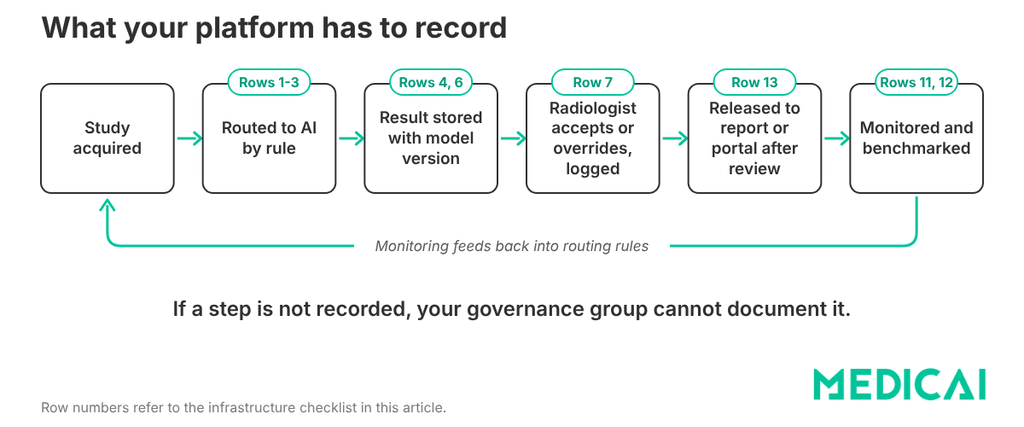
The table below maps the parameter’s expectations to what your imaging platform needs to do, and the question to ask a vendor. It is written to evaluate any platform.
| # | What the parameter expects | What your platform should do | Question to ask your vendor |
|---|---|---|---|
| 1 | Documented routing rules for each AI tool | Route studies to AI tools by rule (modality, body part, protocol) and keep the rules documented and reviewable | Can we define, view, and export the routing rule for every AI tool? |
| 2 | Standards-based AI workflows | Support relevant IHE AI profiles, such as AI Workflow for Imaging and AI Results, with conformance statements | Which IHE AI profiles do you support, and can we see your conformance statement? |
| 3 | Images reach the AI correctly and securely | Reliable, encrypted DICOM or DICOMweb transfer, with detection of failed or incomplete studies | How do you detect and alert on incomplete or failed transfers? |
| 4 | Results return correctly to the patient’s record | Store AI results with the study (for example DICOM structured reports or overlays) and in the reporting workflow | Where are AI results stored, and in what format? |
| 5 | Users know when AI has run, and why it did not | Show whether a study is processing, processed, or rejected, with the rejection reason, and notify the reader | Will our radiologists see when an AI tool ran, failed, or rejected a study? |
| 6 | An up-to-date inventory with model versions | Record the AI model name and version with every result, and keep a change history | Is the model version captured with each result, and are we notified before updates? |
| 7 | Logging of acceptances, rejections, and overrides | Capture how radiologists responded to each AI output in a standard, exportable form | Can we report on how often radiologists accept or override each tool? |
| 8 | Auditable logs of data the AI accesses | Log every AI access to patient data, reviewable on request | Can we audit which studies each AI tool accessed and when? |
| 9 | Encryption, restricted access, and MFA | Encrypt data in transit and at rest, restrict AI access to approved users and endpoints, support MFA | How is AI access authenticated and restricted? |
| 10 | A plan for reverting to non-AI work during outages | Keep reading, worklists, and reporting working when an AI tool is unavailable | What happens to our reading workflow if an AI tool goes down? |
| 11 | Local acceptance testing before full rollout | Route a subset of studies to an AI tool in a test mode, using de-identified local data from varied scanners | Can we test a tool on our own data before turning it on for everyone? |
| 12 | Continuous monitoring and registry benchmarking | Support drift and subgroup reporting, and a data path to registries such as the ACR Assess-AI registry | Can your platform support our participation in Assess-AI? |
| 13 | AI output reviewed before it is stored or shared | Hold AI output from permanent storage and patient portals until a qualified radiologist incorporates it | Can we prevent AI results from reaching the record or portal before review? |
Download: the one-page ACR-SIIM Infrastructure Readiness Checklist (PDF), with a Yes / Partial / No column for each vendor question.
Three rows that are easy to underestimate
Model versions (row 6). AI tools update, sometimes frequently. The parameter expects practices to retrain users after each version change and to track performance over time. That is only possible if every result carries the version that produced it. Without it, you can’t trace a performance drop to an update.
Override logging (row 7). The parameter asks practices to log acceptances, rejections, and overrides in a standardized way to support peer learning and quality improvement. In practice, this data reveals a tool radiologists quietly stopped trusting. If the viewer and reporting tools do not capture it, it is lost.
Release controls (row 13). The parameter does not recommend communicating or permanently storing AI output unless a qualified radiologist incorporates it into the standard reporting workflow, and it flags the risk of unreviewed AI results reaching patient portals. That is as much an infrastructure setting as a policy. For how the same principle applies when AI reorders the reading queue, see governance for AI that decides who waits.
What infrastructure cannot do for you
No platform makes a practice compliant with the parameter. The governance group, the impartiality rules that keep vendors out of decisions about their own products, the training of qualified end-users, and the authority to take a tool offline are people and process decisions. Infrastructure can make those decisions recordable and enforceable: it can route them by the rules you set, log what happened, and keep working when something fails. When you assess a vendor, look for a platform that gives your governance group evidence, not one that promises to replace it.
Preparing for recognition and accreditation
The ACR launched ARCH-AI in June 2024 as the first national AI quality assurance program for radiology facilities. Its criteria cover an interdisciplinary governance group; an inventory of AI tools with documentation; security and compliance measures; tool review and selection; documented use cases and training; performance monitoring; and contribution to the Assess-AI registry. The ACR said insights from ARCH-AI will inform a formal AI accreditation program, which a 2025 JACR article anticipated would be approved in spring 2027. Recognition already extends beyond the US, with University Hospital of Bern named the first international ARCH-AI site.
For practices considering ARCH-AI now, or accreditation later, the infrastructure checklist above is a practical starting point: most of the documentation the program asks for has to come from systems that capture it automatically. If you are planning how studies move between sites, archives, and AI tools, our guide to enterprise imaging architecture covers routing through DICOMweb.
Where Medicai fits
Medicai provides cloud imaging infrastructure for practices and health systems. Today, the platform supports several of the infrastructure foundations above:
- Routing to AI tools (row 1, in part): the platform stores and routes imaging studies and connects them to the AI tools a practice chooses. See AI-powered workflows, and read our guide to AI in radiology.
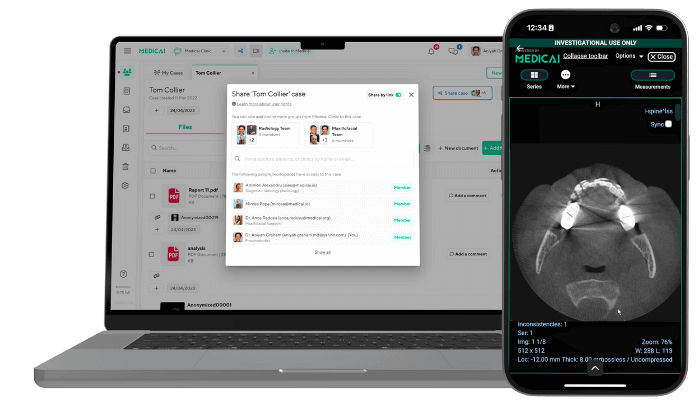
- Secure image transfer and integration (row 3): the Medicai DICOM Gateway connects local PACS and modalities to the cloud, and the Medicai Imaging API integrates imaging with EHRs and other systems, with HL7 and FHIR support. For how these connections work, see PACS integration and workflow and what DICOMweb is.
- Results with the study (row 4): AI results appear alongside the images in the viewer, so radiologists review them as part of their normal read.
- Access logging (row 8, in part): the platform uses audit logging and role-based access control to protect imaging data.
- Encryption (row 9): data is encrypted in transit and at rest, and the DICOM Gateway uses encryption and authentication to secure medical image transfers.
- Restricted access (row 9, in part): granular access control lists let practices manage exactly who can see each study.
- Security framework (row 9, in part): Medicai holds ISO 27001 and ISO 9001 certifications, and the platform is built to support HIPAA and GDPR requirements. Medicai runs on Microsoft Azure infrastructure certified to SOC 2 and HITRUST. For the regulatory background, see HIPAA vs GDPR and HIPAA-compliant medical image sharing.
- Resilience (row 10, in part): a dedicated backup and disaster recovery product, with incremental backups, snapshots, and replication across multiple locations, and a public status page for platform availability. For how backup fits into PACS planning, see cloud vs on-premise PACS.
- AI integration: the cloud platform supports deploying AI tools that analyze X-ray, MRI, and CT images within the imaging workflow.
Frequently asked questions
It is the first ACR practice parameter dedicated to imaging artificial intelligence, developed with the Society for Imaging Informatics in Medicine and approved in 2026. It sets out the infrastructure, personnel, processes, and governance a practice needs to select, test, deploy, and monitor AI safely. It is educational guidance, not a legal standard of care.
ARCH-AI, the ACR Recognized Center for Healthcare-AI, is a voluntary recognition program launched in June 2024 for radiology facilities that follow best practices for AI governance, selection, testing, and monitoring. Facilities that implement AI in line with the practice parameter can earn the designation, and the ACR describes it as a precursor to a formal AI accreditation program.
No. ACR practice parameters are educational tools and are not intended to set a legal standard of care. They do, however, define what the radiology community considers good practice, and they form the basis for ACR recognition and, in future, accreditation programs.
No. The parameter expects practices to test AI tools on their own data before full deployment, because performance can vary with scanner manufacturer, protocol, image quality, and patient population. FDA clearance defines a tool’s intended use; local testing shows whether it performs as expected in your setting.
Assess-AI is the ACR’s AI quality registry for medical imaging. It supports monitoring after deployment by measuring how closely AI outputs agree with findings derived from radiology reports, and lets facilities compare their results with other sites using AI for the same task.
Sources
- American College of Radiology and Society for Imaging Informatics in Medicine. ACR-SIIM Practice Parameter for Imaging Artificial Intelligence. Adopted 2026 (Resolution 13).
- American College of Radiology. ARCH-AI: ACR Recognized Center for Healthcare-AI.
- American College of Radiology. ACR Launches First Medical Practice Artificial Intelligence QA Program. Press release, June 26, 2024. [Add the acr.org press release URL.]
- The Road Map for ACR Practice Accreditation for Radiology Artificial Intelligence. J Am Coll Radiol. 2025. [Add the DOI.]
- AuntMinnie. ACR, SIIM approve AI practice parameter, launch Assess-AI registry. 2026. [Add the article URL.]
- Chang YW, et al. AI-STREAM preliminary analysis. Nat Commun. 2025;16:2248.
- Elias-Cabot E, et al. AITIC trial. Nat Med. 2026;32:1296-1305.


Related Articles
Lets get in touch!
Learn more about how Medicai can help you strengthen your practice and improve your patients’ experience. Ready to start your Journey?
Book A Free Demo