Telehealth vs Telemedicine: Key Differences, Examples, and Billing

Telehealth is the broad term. It covers any health service delivered at a distance, clinical or not: patient education, provider training, administration, and public health. Telemedicine is the clinical part of telehealth: remote diagnosis, treatment, and follow-up by a licensed clinician. All telemedicine is telehealth, but not all telehealth is telemedicine.
The Health Resources and Services Administration (HRSA) defines telehealth as “the use of electronic information and telecommunication technologies to support long-distance clinical health care, patient and professional health-related education, health administration, and public health” (HRSA). The American Academy of Family Physicians (AAFP) describes telemedicine as “the practice of medicine using telecommunications technologies to deliver all kinds of medical, diagnostic, and treatment-related services,” and telehealth as a broader set of services that includes care from nurses, pharmacists, and social workers (AAFP).
In everyday use, many people treat the words as synonyms. The difference matters when you buy technology, set up workflows, or bill for services. It matters most in radiology, where reading images remotely is clinical care but storing and sharing them is not.
Telehealth vs telemedicine at a glance
| Dimension | Telehealth | Telemedicine |
|---|---|---|
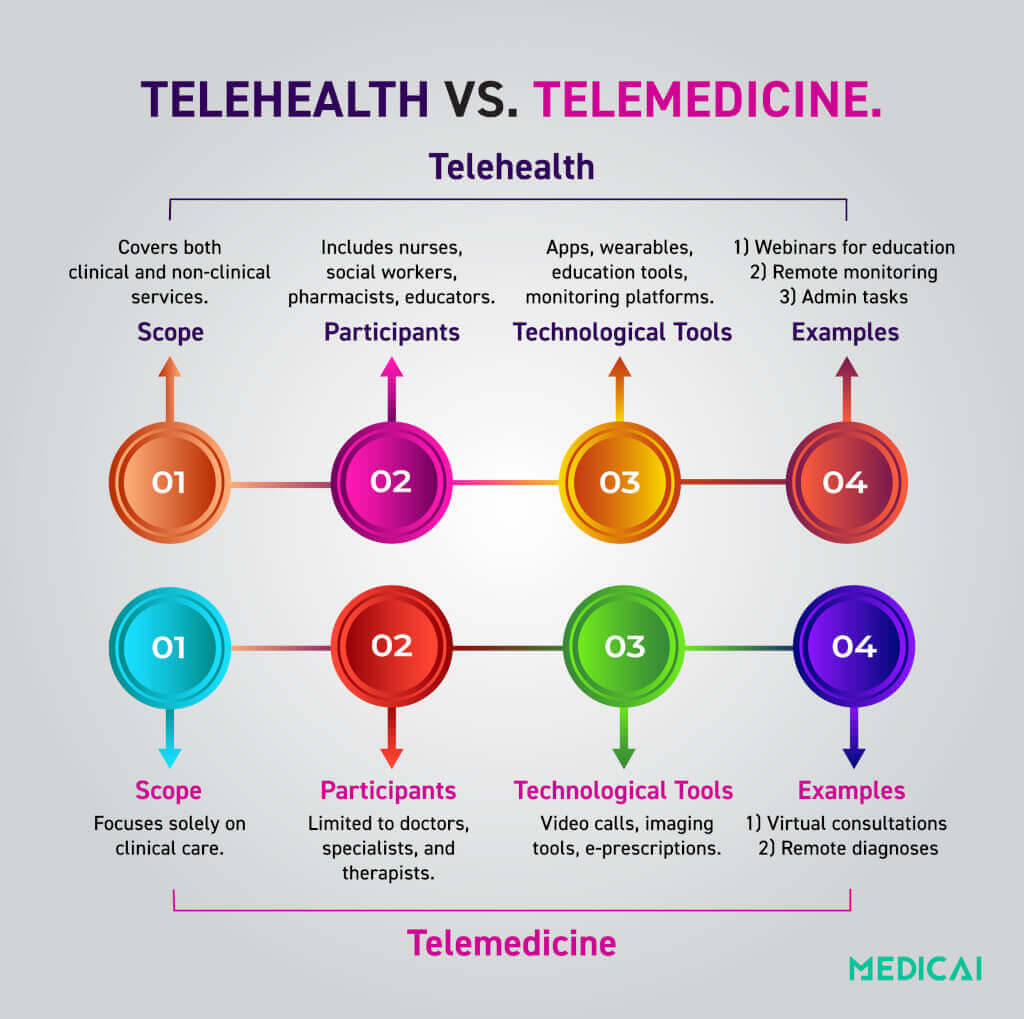
| Scope | All remote health services: clinical care, education, training, administration, public health | Clinical care only: diagnosis, treatment, prescriptions, consults, follow-up |
| Technology | Mobile apps, wearables, patient portals, remote monitoring, cloud imaging, learning platforms | Video visits, secure messaging, e-prescribing, diagnostic image viewers |
| Who takes part | The whole care team: physicians, nurses, pharmacists, social workers, educators, administrators | Licensed clinicians and their patients |
| Examples | Remote patient monitoring, diabetes education classes, clinician training, image sharing between sites | Virtual primary care visit, telepsychiatry, remote specialist consult, teleradiology reads |
| Rules that apply | HIPAA for any protected health information; payer coverage rules for the specific service | State licensure where the patient is located, HIPAA, and payer billing rules for clinical services |
What is telehealth?
Telehealth is the umbrella term for all health-related services delivered via telecommunications technology. Some of it is clinical, and much of it is not.
Examples of telehealth that are not telemedicine:
- A nurse-led diabetes education class held over video
- Blood pressure readings sent from a home cuff to a care team dashboard
- Continuing education webinars for clinicians
- A health system’s remote staff meetings and care coordination huddles
- Medical images shared securely between hospitals so the next team can view them
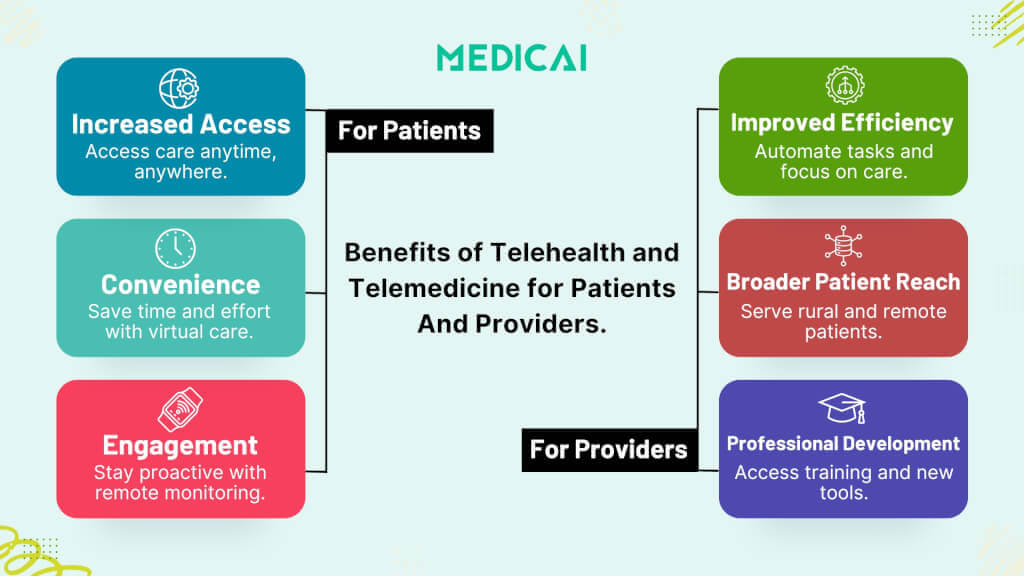
For patients, telehealth mostly means access: fewer trips, easier follow-up, and information between visits. For organizations, it means the platforms that enable remote care. If you are comparing those platforms, see the features to look for in a telehealth platform.
What is telemedicine?
Telemedicine is remote clinical care: a licensed clinician evaluates, diagnoses, treats, or monitors a patient without being in the same room. It is a subset of telehealth.
Examples of telemedicine:
- A video visit with a primary care physician for a new rash
- A telepsychiatry follow-up appointment
- An e-consult in which a cardiologist reviews a patient’s ECG for the referring doctor
- A radiologist reading a CT scan from another city and signing the report
For clinicians, telemedicine extends reach to patients who live far away or cannot travel, and lets specialists support sites that do not have them on staff.
Types of telehealth
Telehealth is usually grouped into four delivery modes. Each can support clinical (telemedicine) or non-clinical services.
- Live video (synchronous). Real-time visits between a patient and clinician, or between two clinicians.
- Store-and-forward (asynchronous). Images, recordings, or test results are sent for review later. Dermatology photos and many imaging consults work this way.
- Remote patient monitoring. Devices such as blood pressure cuffs, glucose meters, or pulse oximeters send readings to the care team.
- Mobile health. Apps and messages that support self-management, reminders, and education.
Most practices combine the first two. For a deeper comparison, see synchronous and asynchronous telehealth.
Do the terms matter for billing?
Payers rarely use “telemedicine” as a billing category. What matters is whether a specific service is covered when delivered remotely.
Medicare. Medicare pays for a defined list of “Medicare telehealth services” that would otherwise be furnished in person, such as office visits and psychotherapy. CMS updates that list each calendar year (CMS, Telehealth). The pandemic-era flexibilities have been extended: through December 31, 2027, beneficiaries can receive Medicare telehealth services anywhere in the United States, including at home (CMS Telehealth FAQ, updated 2/26/2026).
Teleradiology is different. CMS treats teleradiology as a remote service, not a Medicare telehealth service, because image interpretation is not ordinarily performed face-to-face. It is not eligible for the telehealth flexibilities, and teleradiologists must enroll the actual location where they read, including a home address (CMS, Understanding Telehealth and Teleradiology Enrollment).
Medicaid and commercial plans. Coverage, eligible services, and documentation rules vary by state and by plan. Check each payer’s current policy.
Non-clinical telehealth. Education platforms, image archives, portals, and other infrastructure are generally not billed as clinical services. They are operating costs that support the billed services.
What the distinction means for radiology
Radiology shows the difference between the two terms more clearly than any other specialty, because the clinical act and the technology behind it are easy to separate.
Teleradiology is telemedicine
When a licensed radiologist interprets a CT, MRI, or X-ray from another location and signs a diagnostic report, that is remote clinical care. In other words, it is telemedicine. CMS describes teleradiology as “the electronic transmission of radiological images… from one location to a radiologist at a remote location for interpretation and reporting” (CMS). As covered above, Medicare still bills it as a diagnostic service, not as a Medicare telehealth service.
The same licensure principle applies as for other telemedicine: the radiologist generally needs a license in the state where the patient was imaged. For the full workflow, see how teleradiology works. If you are choosing an outsourced reading partner, compare teleradiology reading services. For a specialty example, see pediatric teleradiology.
The infrastructure is telehealth
The systems that move and store images are telehealth: cloud PACS, vendor-neutral archives, zero-footprint viewers, patient imaging portals, and image exchange between facilities. They make the remote read possible but are not themselves clinical services. Orders and reports typically move between the EHR and the imaging system via HL7 messages, while studies move via DICOM.
What imaging centers should check
When you evaluate remote reading infrastructure, look for:
- Secure transfer and storage. Encryption in transit and at rest is standard good practice. HIPAA itself does not specify an algorithm: under the current Security Rule, encryption is an addressable specification determined by your risk analysis (HHS).
- A business associate agreement (BAA) from every vendor that handles images or reports.
- Diagnostic-quality viewing in the browser, so radiologists can read from any approved location without installing software.
- Access controls and audit logs for every study opened.
- Interoperability with your RIS and EHR (HL7, FHIR) and with outside facilities (DICOM, DICOMweb).
- Image sharing for referring physicians and patients. See medical image sharing platforms for an evaluation framework.
Medicai’s teleradiology software connects multiple sites to a single reading environment, includes a HIPAA BAA as a standard contract term, and runs on ISO 27001-certified Microsoft Azure infrastructure with access audit logging. Medicai also supports secure medical image sharing between facilities, clinicians, and patients.
Telehealth vs telemedicine vs telecare
Telecare is the third term people often mix in. It refers to technology that helps people, often older adults or people with disabilities, live safely and independently at home. It is usually non-clinical.
| Telehealth | Telemedicine | Telecare | |
|---|---|---|---|
| What it is | All remote health services, clinical and non-clinical (HRSA) | Remote clinical care by a licensed clinician (AAFP) | Remote support for safety and independent living |
| Typical services | Education, monitoring, training, administration, and clinical care | Diagnosis, treatment plans, prescriptions, specialist consults | Fall alerts, medication reminders, emergency call buttons, caregiver alerts |
| Who delivers it | The whole care team, plus educators and administrators | Physicians, nurse practitioners, therapists, and other licensed clinicians | Home care services, alarm monitoring centers, caregivers |
| Radiology example | Cloud PACS, image sharing, patient imaging portals | A radiologist’s remote read and signed report | Not typical |
| How it is paid for | Varies by service; infrastructure is generally an operating cost | Covered by many payers for eligible services; Medicare covers listed telehealth services | Often private pay or social care programs; varies by location |
| Example | A diabetes education webinar | A video visit with a psychiatrist | A wearable fall-detection pendant |
Challenges to plan for
Licensure across state lines
Telemedicine is generally regulated by the state where the patient is located, so a clinician who sees patients in several states usually needs a license in each state. The Interstate Medical Licensure Compact offers an expedited licensing path for eligible physicians. Its site lists 44 member states plus 2 US territories (snapshot as of September 9, 2026). Check current membership before relying on it.
Privacy and security
Any telehealth service that handles protected health information falls under HIPAA, whether it is a video visit or an image archive. HHS publishes guidance on HIPAA and telehealth. In practice, that means BAAs with vendors, access controls, audit logs, and encryption decided through a documented risk analysis.
Access and connectivity
Remote care only works if patients have a suitable device, a reliable internet connection, and the confidence to use them. Offer audio or asynchronous options where clinically appropriate, and keep in-person care available for patients who need it.
Frequently asked questions
Telehealth is any health service delivered at a distance, including education, monitoring, training, and administration. Telemedicine is the clinical part of telehealth: remote diagnosis, treatment, and follow-up by a licensed clinician. All telemedicine is telehealth, but not all telehealth is telemedicine.
Not exactly. People often use the terms interchangeably, but telehealth is broader. A video visit with a doctor is both telehealth and telemedicine. A diabetes education class or a remote staff training session is telehealth but not telemedicine.
The four common types are live video (synchronous), store-and-forward (asynchronous), remote patient monitoring, and mobile health. Each can support clinical services, which are telemedicine, or non-clinical services such as education.
Yes. Medicare telehealth flexibilities have been extended, so through December 31, 2027, beneficiaries can receive Medicare telehealth services anywhere in the United States, including at home. Medicaid and commercial coverage vary by state and plan.
Teleradiology is telemedicine because a licensed radiologist interprets images remotely and signs a diagnostic report. The cloud PACS, viewers, and image sharing tools behind it are telehealth infrastructure. Medicare treats teleradiology as a remote diagnostic service, not as a Medicare telehealth service.
Not strictly, but it needs secure image transfer, storage, and a diagnostic-quality viewer that remote radiologists can reach. A cloud PACS with a browser-based viewer is a common way to meet those needs across multiple sites.
Telehealth is the whole system of remote care; telemedicine is the clinical care delivered through it. In imaging-heavy specialties, both depend on getting the right study to the right clinician quickly and securely. Medicai’s telemedicine platform for imaging-heavy specialties combines cloud image storage, a built-in DICOM viewer, and secure sharing for live and store-and-forward consults.


Related Articles


Lets get in touch!
Learn more about how Medicai can help you strengthen your practice and improve your patients’ experience. Ready to start your Journey?
Book A Free Demo